Kawaihau Orchestra and Glee Club in SF. 1905.

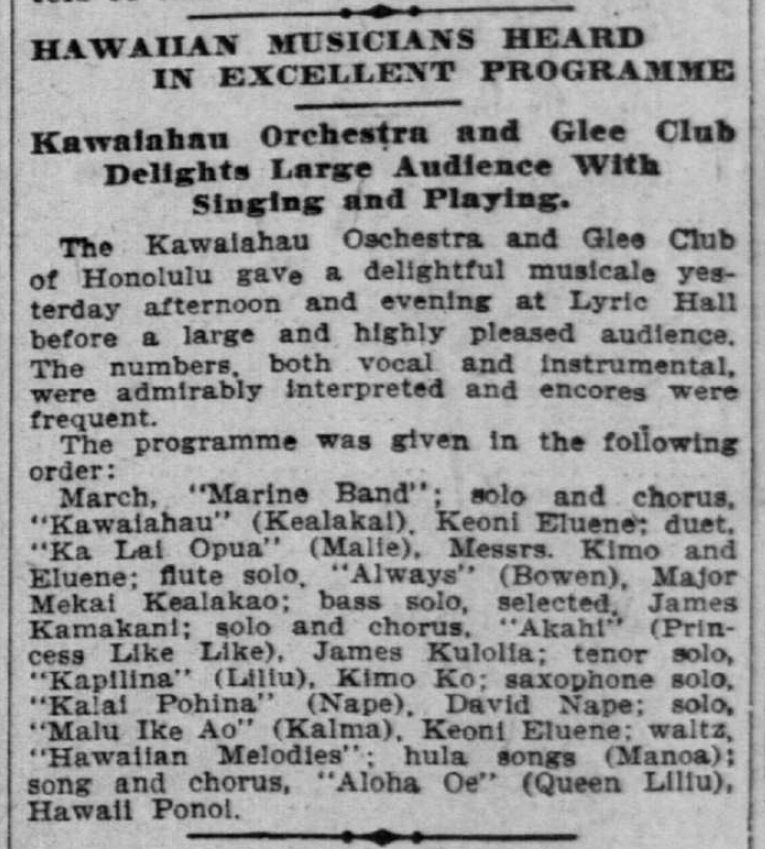
HAWAIIAN MUSICIANS HEARD IN EXCELLENT PROGRAMME

Kawaiahau Orchestra and Glee Club Delights Large Audience With Singing and Playing.

The Kawaiahau Orchestra and Glee Club of Honolulu gave a delightful musicale yesterday afternoon and eveing at Lyric Hall before a large and highly pleased audience. The numbers, both vocal and instrumental, were admirably interpreted and encores were frequent.

The programme was given in the following order:

March, “Marine Band”; solo and chorus, “Kawaiahau” (Kealakai), Keoni Eluene; duet, “Ka Lai Opua” (Malie), Messrs. Kimo and Eluene; flute and solo, “Always” (Bowen), Major Mekia Kealakao [Kealakai]; bass solo, selected, James Kamakani; solo and chorus, “Akahi” (Princess Like Like [Likelike]), James Kulolia; tenor solo, “Kapilina” (Liliu), Kimo Ko; saxophone solo, “Kalai Pohina” (Nape), David Nape; solo, “Malu Ike Ao” (Kalima), Keoni Eluene; waltz, “Hawaiian Melodies” ; hula songs (Manoa); song and chorus, “Aloha Oe” (Queen Liliu), Hawaii Ponoi.

[Because of its location, The San Francisco Call had much Hawaii coverage.]

(San Francisco Call, 10/7/1905, p. 16)

HAWAIIAN MUSICIANS HEARD IN EXCELLENT PROGRAMME

The San Francisco Call, Volume XCVIII, Number 129, Page 16. October 7, 1905.

Commission carrying the anti-annexation petitions, 1897.

THE APPEARANCES OF THE REPRESENTATIVES ARE FINE.

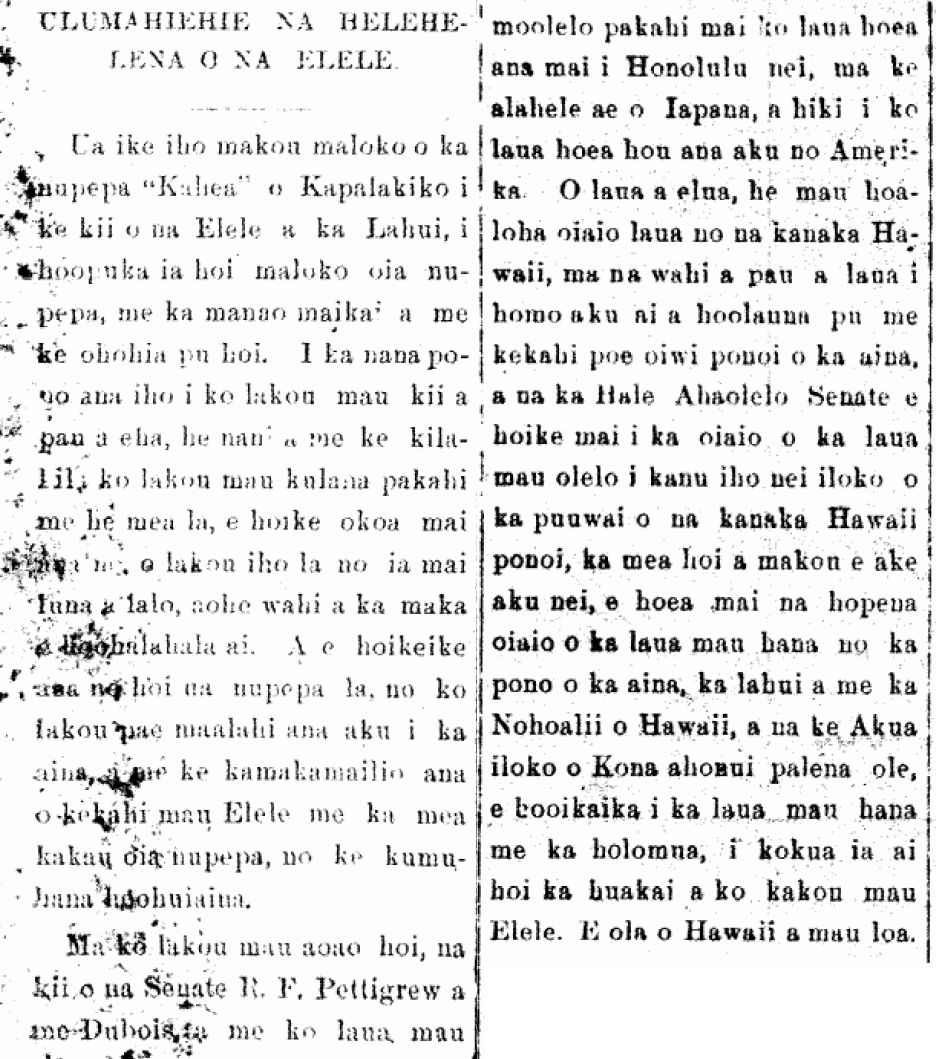
We have just seen in the newspaper the “Call” of San Francisco, portraits of the Representatives of the Lahui which were published in that newspaper, with appreciation and delight. Looking closely at all four of their portraits, they each appear fine and dignified, as if those are truly them from top to bottom; there is nothing for the eye to criticize. Also, that newspaper reports of their safe arrival, as well as a conversation of some of the Representatives with a reporter of the newspaper about annexation.

On their sides are portraits of Senators R. F. Pettigrew and Dubois, and both of their stories, from their arrival in Honolulu on the way to Japan, all the way to their return to America. Both of them are true friends to the Hawaiian, wherever they went and came in contact with our native people, but it will be the Senate that will confirm the truth of the words they planted in the hearts of the true Hawaiian people; we hope that the true outcome of their efforts for the good of the land, the people, and the Monarchy arises, and may God in His endless patience bolster their endeavors and progress, so that the journey of our Representatives is helped along. Let Hawaii live forever.

[See the issue of the San Francisco Call (11/28/1897, pp. 1 & 2) referred to in this article here.]

(Aloha Aina, 12/11/1897, p. 2)

ULUMAHIEHIE NA HELEHELENA O NA ELELE.

Ke Aloha Aina, Buke III, Helu 50, Aoao 2. Dekemaba 11, 1897.

Excerpts of “Strangling Hands…” appearing in the Hawaiian-Language Newspaper. 1897.

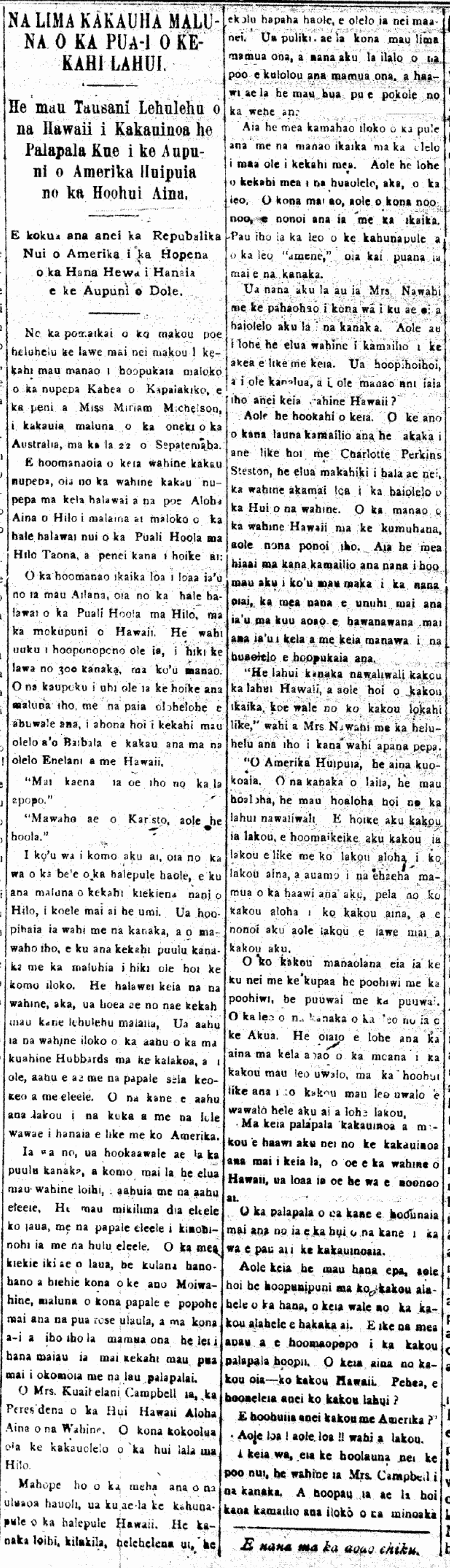
NA LIMA KAKAUHA MALUNA O KA PUA-I O KEKAHI LAHUI.

[This article is taken from the famed “Strangling Hands upon a Nation’s Throat” article by Miriam Michelson, which appears in the San Francisco Call, 9/30/1897, pp. 1–3. The introductory paragraphs go:]

For the benefit of our readers, we are taking some ideas printed in the newspaper San Francisco Call, written by the pen of Miss Miriam Michelson, on the deck of the ship, Australia, on the 22nd of September.

Remember that this woman newspaper reporter was the woman reporter present at the meeting of the Patriotic League of Hilo held at the meeting house of the Salvation Army in Hilo Town, and this is what she reported: . . .

(Aloha Aina, 10/16/1897, pp. 6 & 7.)

NA LIMA KAKAUHA MALUNA O KA PUA-I O KEKAHI LAHUI.

Ke Aloha Aina, Buke III, Helu 42, Aoao 6. Okatoba 16, 1897.

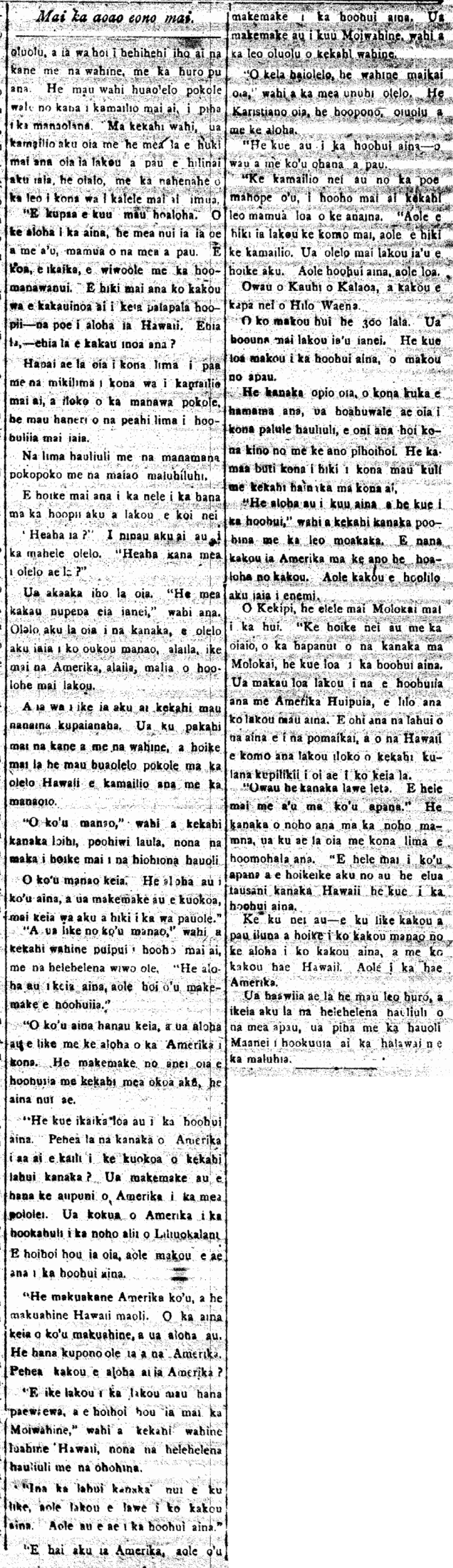
Mai ka aoao eono mai.

Ke Aloha Aina, Buke III, Helu 42, Aoao 7. Okatoba 16, 1897.

Strangling Hands upon a Nation’s Throat. 1897.

STRANGLING HANDS UPON A NATION’S THROAT.

[This is the famous article by Miriam Michelson who went to Hilo and wrote of an anti-annexation petition drive held there.]

(San Francisco Call, 9/30/1897, pp. 1–3.)

http://chroniclingamerica.loc.gov/lccn/sn85066387/1897-09-30/ed-1/seq-1/

http://chroniclingamerica.loc.gov/lccn/sn85066387/1897-09-30/ed-1/seq-2/

http://chroniclingamerica.loc.gov/lccn/sn85066387/1897-09-30/ed-1/seq-3/

More on Hawaiians and the lowering of the flag, 1898.

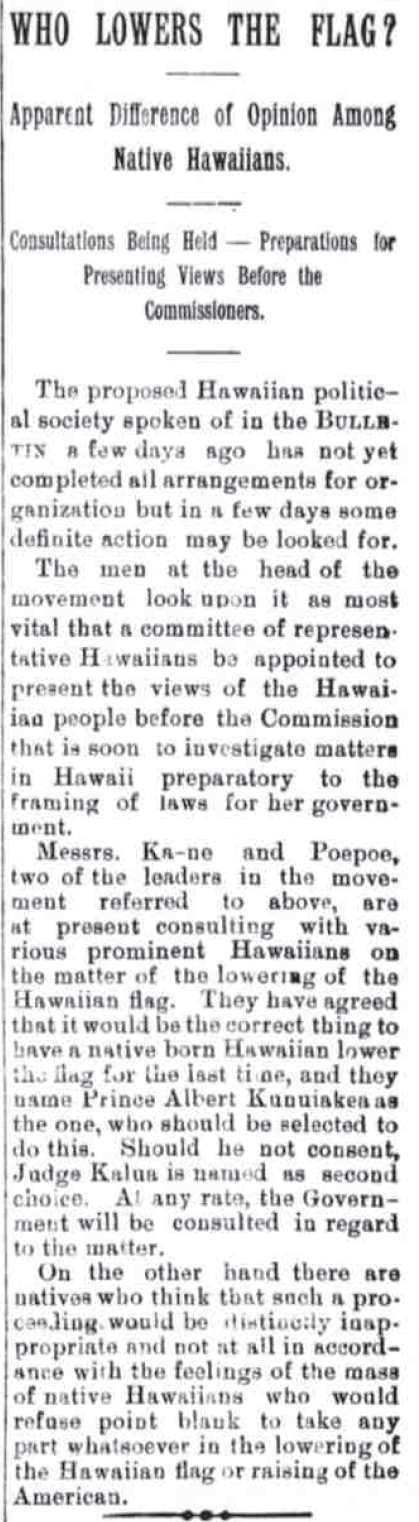
WHO LOWERS THE FLAG?

Apparent Difference of Opinion Among Native Hawaiians.

Consultations Being Held—Preparations for Presenting Views Before the Commissioners.

The proposed Hawaiian political society spoken of in the Bulletin a few days ago has not yet completed all arrangements for organization but in a few days some definite action may be looked for.

The men at the head of the movement look upon it as most vital that a committee of representative Hawaiians be appointed to present the views of the Hawaiian people before the Commission that is soon to investigate matters in Hawaii preparatory to the framing of laws for her government.

Messrs. Ka-ne and Poepoe, two of the leaders in the movement referred to above, are at present consulting with various prominent Hawaiians on the matter of the lowering of the Hawaiian flag. They have agreed that it would be the correct thing to have a native born Hawaiian lower the flag for the last time, and they name Prince Albert Kunuiakea as the one, who should be selected to do this. Should he not consent, Judge Kalua is named as second choice. At any rate, the Government will be consulted in regard to the matter.

On the other hand there are natives who think that such a proceeding would be distinctly inappropriate and not at all in accordance with the feelings of the mass of native Hawaiians who would refuse point blank to take any part whatsoever in the lowering of the Hawaiian flag or raising of the American.

[This is one of the articles in the English newspapers of the day, on the subject of having a Hawaiian be the one to lower the flag.]

(Evening Bulletin, 8/5/1898, p. 1)

WHO LOWERS THE FLAG?

Evening Bulletin, Volume V, Number 982, Page 1. August 5, 1898.

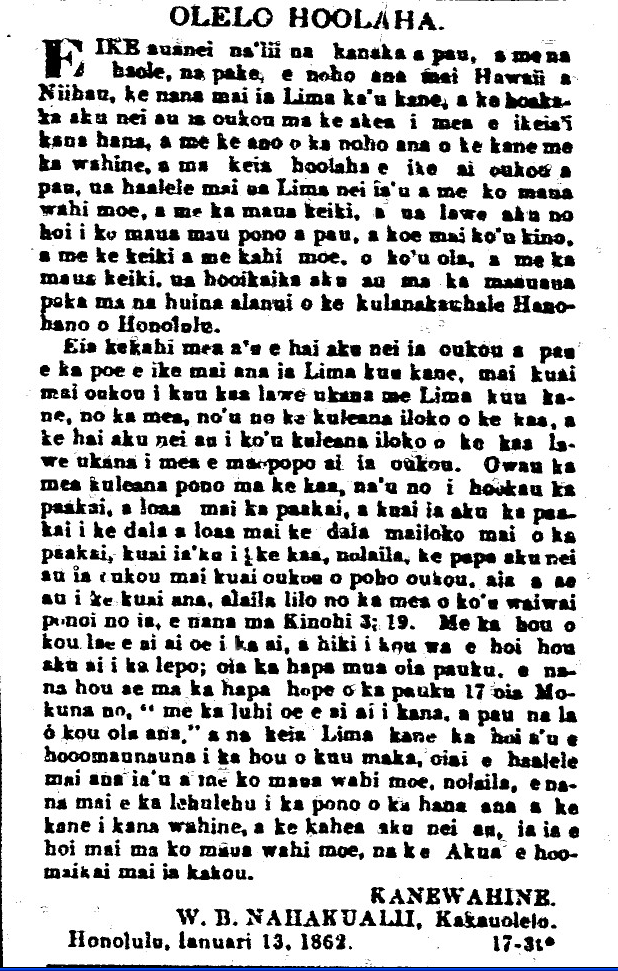
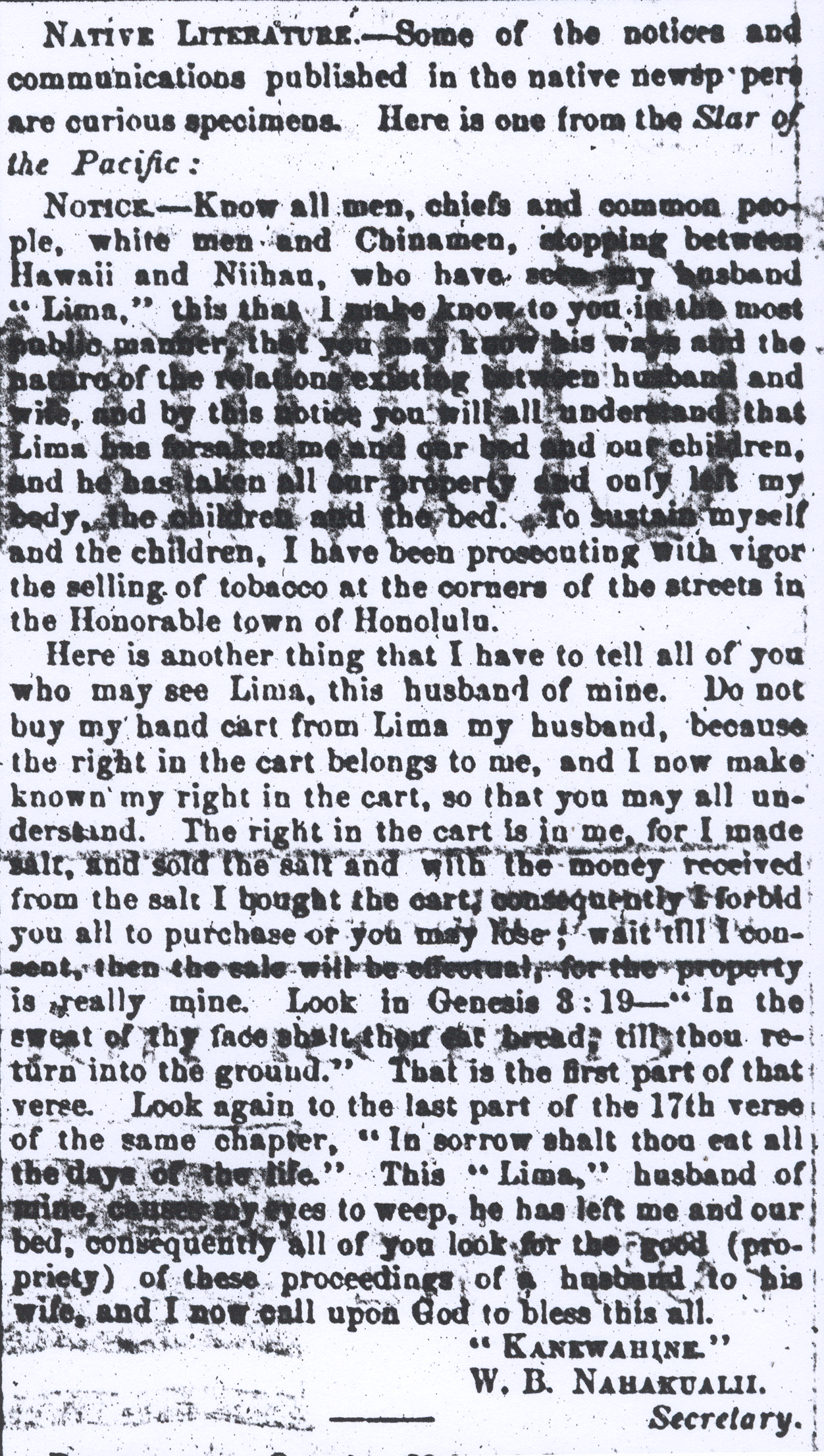
Mockery? by the Pacific Commercial Advertiser over personal ads in the Hawaiian-Language Newspapers, 1862.

NATIVE LITERATURE—Some of the notices and communications published in the native newspapers are curious specimens. Here is one from the Star of the Pacific [Ka Hoku o ka Pakipika]:

NOTICE.—Know all men, chiefs, and common people, white men and Chinamen, stopping between Hawaii and Niihau [residing from Hawaii to Niihau], who have seen my husband “Lima,” this that I make know to you in the most public manner that you may know his ways and the nature of the relations existing between husband and wife, and by this notice you will all understand that Lima has forsaken me and our bed and our children, and he has taken all our property and only left my body, the children and the bed. To sustain myself and the children, I have been prosecuting with vigor the selling of tobacco at the corners of the streets in the Honorable town of Honolulu.

Here is another thing that I have to tell all of you who may see Lima, this husband of mine. Do not buy my hand cart from Lima my husband, because the right in the cart belongs to me, and I now make know my right in the cart, so that you may all understand. The right in the cart is in me, for I made salt, and sold the salt and with the money received from the salt I bought the cart, consequently I forbid you all to purchase or you may lose [or it will be your loss]; wait till i consent, then the sale will be effectual [only should I consent will the sale be effectual], for the property is really mine. Look in Genesis 3:19—”In the sweat of thy face shalt thou eat bread; till thou return into the ground.” That is the first part of that verse. Look again to the last part of the 17th verse of the same chapter, “In sorrow shalt thou eat all the days of the [thy] life.” This “Lima,” husband of mine, causes my eyes to weep [It is because of this Lima that I waste the sweat of my face], he has left me and our bed, consequently all of you look for the good (propriety) of these proceedings of a husband to his wife [so all of you, look at the treatment by this man of his wife], and i now call upon God to bless this all [and I call out to him to return to our bed, and may God bless us all].

“Kanewahine.”

W. B. Nahakualii,

Secretary.

[The bracketed inserts are what I felt might be closer interpretations of the original…]

(Pacific Commercial Advertiser, 2/23/1862, p. ?)

Native Literature.

The Pacific Commercial Advertiser, ????. January 23, 1862.
One more article from Garden Island, 1912.

[Found under the Hawaiian-Language column: “Lei Mokihana”]

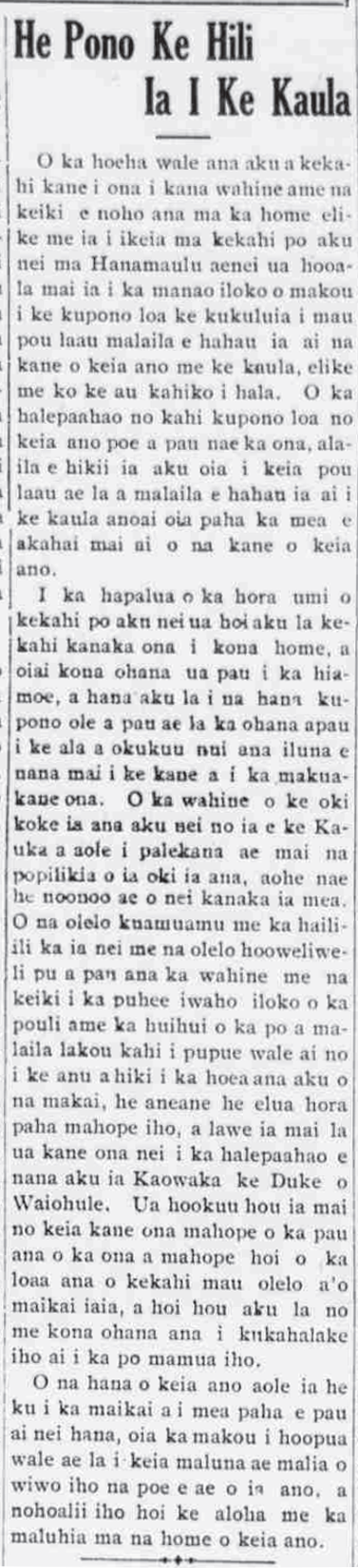
They Should Be Flogged.

The abuse of a drunk man of his wife and children at home, like what was seen a few nights ago in Hanamaulu, made us think that there should be wooden posts set up there to whip his kind, just like it was done in the olden days. Jail is where all these kinds of drunks should be, and they should be tied to a wooden pole and there be whipped and that perhaps will make this sort of man become docile.

At half after ten one night past, a drunken man returned home, and as his family lay fast asleep, he did all sorts of improper acts and woke the whole family up and they sat up watching their husband and father. The wife had been just operated on by a doctor and was not recovered yet from the surgery [?], but this man thought nothing of this. All he had was curse and swear words along with threats to his wife and children who fled outside in the dark and freezing night, and there they crouched in the cold until the police arrived maybe some two hours later, and the drunk man was taken away to the jail to see Kaowaka, the Duke of Waiohule [?] This drunk was set free after he was sober and received a good talking to, then he returned home to his family who he ranted and raved at the night before.

This kind of thing is just not right, and so to perhaps put an end to this type of behavior, this is why we wrote the above, so that those like him will hopefully feel fear, and love and peace will then reign in these homes.

(Garden Island, 1/30/1912, p. 2)

He Pono Ke Hili Ia I Ke Kaula

The Garden Island, Volume 9, Number 5, Page 2. January 30, 1912.

Garden Island newspaper online at Chronicling America! 2012.

One more awesome thing I wanted to note about Garden Island—You can look at old issues online from anywhere connected to the internet (from 5/2/1911 to 12/26/1922), thanks to Chronicling America. And not just that, but Maui News (2/17/1900 to 12/27/1918) and Hilo Tribune (1/2/1902 to 6/26/1906) as well!

For a current and complete list of all they have available at this moment (because they are always adding new pages), click here!

Hawaiian-Language column in the Garden Island! 1912.

[Found under the column entitled: “LEI MOKIHANA”]

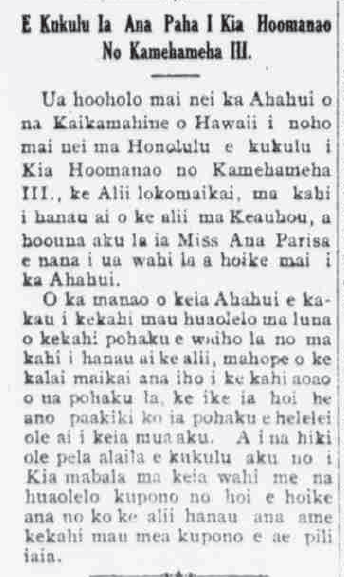
A Monument to Kamehameha III Might be Built.

The Association, The Daughters of Hawaii which just met in Honolulu decided to build a Monument to Kamehameha III, the kindhearted Alii, where he was born in Keauhou, and Miss Ana Paris will be sent there to to survey the site and to report to the Association.

The idea of this Association is to inscribe some words upon a rock that is located where the chief was born, after one side of the rock was shaved nicely away, and knowing that the rock was solid and would not wear away in the future. And if this is not possible, then they will put up a marble monument at this place with proper words telling of the birth of the alii and some other fitting things about him.

[Here is one of the articles under the Hawaiian-Language column of the Garden Island newspaper, called: “Lei Mokihana”. It was edited by J. M. Kaneakua  and A. G. Kaulukou. (And in following issues, also by H. W. Waiau.)]

(Garden Island, 1/30/1912, p. 2)

E Kukulu Ia Ana Paha I Kia Hoomanao No Kamehameha III.

The Garden Island, Volume 9, Number 5, Page 2. January 30, 1912.