800,000 more word-searchable pages added to Chronicling America, 2013.

Chronicling America Update: 800,000 added pages, including newspapers from North Dakota and Indiana

March 20, 2013

On March 18, the Library of Congress updated the Chronicling America Web site to add more than 800,000 newspaper pages, published from 1836 to 1922 in the U.S. In addition to the 25 states and the District of Columbia already represented on the site, this update adds newspapers from Indiana and North Dakota as well as additional French and Spanish newspapers from Arizona, Louisiana, New Mexico, and Texas. Other updates include improved use on iOS devices, added navigation features, and updated US Newspaper Directory information.

[Reposted from Chronicling America, Program News.]

More on the life and passing of Naomi Kekela, 1902.

MRS. NAOMI KAENAOKANE MAKA KEKELA.

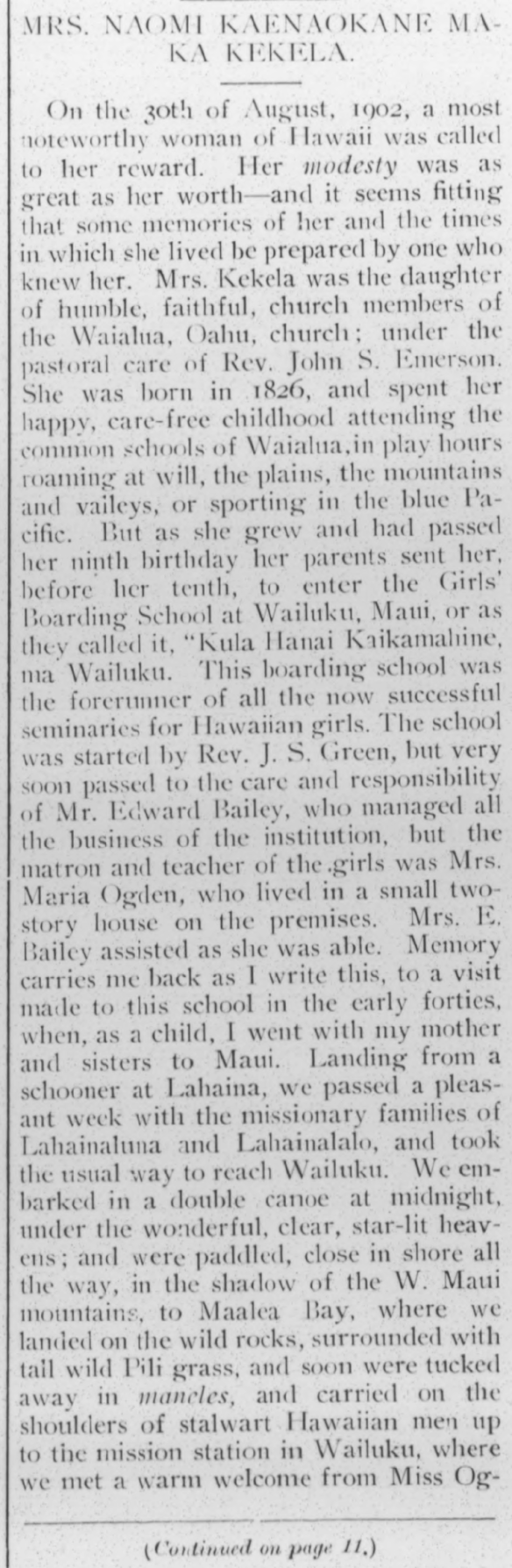
On the 30th of August, 1902, a most noteworthy woman of Hawaii was called to her reward. Her modesty was as great as her worth—and it seems fitting that some memories of her and the times in which she lived be prepared by one who knew her. Mrs. Kekela was the daughter of humble, faithful, church members of the Waialua, Oahu church; under the pastoral care of Rev. John S. Emerson. She was born in 1826, and spent her happy, care-free childhood attending the common schools of Waialua, in play hours roaming at will, the plains, the mountains and valleys, or sporting in the blue Pacific. But as she grew and had passed her ninth birthday her parents sent her, before her tenth, to enter the Girls’ Boarding School at Wailuku, Maui, or as they called it, “Kula Hanai Kaikamahine, ma Wailuku.[“] This boarding school was the forerunner of all the now successful seminaries for Hawaiian girls. The school was started by Rev. J. S. Green, but very soon passed to the care and responsibility of Mr. Edward Bailey, who managed all the business of the institution, but the matron and teacher of the girls was Mrs. Maria Ogden, who lived in a small two-story house on the premises. Mrs. E. Bailey assisted as she was able. Memory carries me back as I write this, to a visit made to this school in the early forties, when, as a child, I went with my mother and sisters to Maui. Landing from a schooner at Lahaina, we passed a pleasant week with the missionary families of Lahainaluna and Lahainalalo, and took the usual way to reach Wailuku. We embarked in a double canoe at midnight, under the wonderful, clear, star-lit heavens; and were paddled, close in shore all the way, in the shadow of W. Maui mountains, to Maalea Bay, where we landed on the wild rocks, surrounded with tall Pili grass, and soon were tucked away in maneles, and carried on the shoulders of stalwart Hawaiian men up to the mission station in Wailuku, where we met a warm welcome from Miss Og-

(Continued on page 11.)

(Friend, 10/1902, p. 6)
MRS. NAOMI KAENAOKANE MAKA KEKELA.

The Friend, Volume LX, Number X, Page 6. October 1902.

den and her school. Most vividly returns to me the memory of the long adobe thatched buildings, the dormitories, the school and dining-rooms, and the sight of that supper table to which we sat down. The company at the small square table of Miss Ogden, in the centre of the room, looking down on the long low tables of the girls, which were completely garlanded from end to end with wreaths or leis, of the fragrant Four-o-Clocks blossoms of many hues, which they cultivated in their own little flower-beds. All the girls stood by their places until they had sweetly sung together one verse, their “Grace before meat,” when they seated themselves all together, on the low backless benches, and attacked their bowls of poi and relishes in the usual way of the land, with their fingers. Always dipping their fingers before and after eating in bowls of clean water, which stood handy to all, on the table. Naomi was one of the girls amid that crowd, and she always retained a memory of “that visit of Mrs. Chamberlain and her little girls,” as her husband and children testify. After the meal the leis were heaped on the heads and shoulders of their guests. To this school-home in June, 1847, came a young student of Lahainaluna Seminary, Mr. James Hunnewell Kekela, (who had been a protege of the gentleman whose name he bore) and was also a native of Waialua. He had just graduated, and here, in the school-home of Naomi, at Wailuku, a beautiful wedding ceremony was observed. The minister who tied the nuptial knot was Rev. T. Dwight Hunt, who was then the missionary of the Hawaiian church in Wailuku. Later, he commenced preaching to foreigners in Honolulu, and was called from there to inaugurate a church in San Francisco in 1849, which is now one of the flourishing churches of that city. The young couple at once returned to Waialua, where Rev. J. S. Emerson had formed a separate church organization at Kahuku, Oahu, and very soon Mr. Kekela was ordained and placed over that church, this same being the very first church upon the islands to be placed under the care of a Hawaiian pastor.

(Continued on page 13.)

(Friend, 10/1902, p. 11)
den and her school.

The Friend, Volume LX, Number X, Page 11. October 1902.

They remained in Kahuku until 1853. Here their first little daughter was born and died in a few months of the first epidemic of measles,—and here was born the second daughter daughter, Maria Ogden Kekela, whose life and death are so well known to the H. M. C. Soc. When the Mission to the Caroline Islands was sent out in 1852, Rev. J. Kekela accompanied Rev. E. W. Clark as a delegate, and soon after his return to Oahu again, came the personal call to himself and Naomi to go as Foreign Missionaries. The story of the arrival of the Marquesas chief Matunui, with his Hawaiian son-in-law, in Honolulu with an appeal for the Gospel to be again sent from Hawaii to that savage cannibal people sounds like romance, and a most tremendous wave of religious and missionary enthusiasm spread all over the isalnds. The writer of this article, (when she had returned in 1854 from the United States from a course of education), received from her mother all the particulars of that wonderful time, of the public meetings, of the impression made by Matunui, of the choice of Rev. and Mrs. James Kekela to go as missionaries, of the great trial to the faith and love of Mrs. Naomi Kekela, in that it seemed that they should leave little Maria behind, of the final triumph of faith, when dear Mother Ogden had said, “I will adopt her as my own child,” their departure and many other facts.

Of Mrs. Kekela’s life at the Marquesas there is not time now to write much. It can be more fully dwelt on in future years when her husband’s heroic race is finished. But she never desired or asked to return to her native land for a visit, not even to see her beloved child! On one trip of the Morning Star, Miss Maria O. Kekela (after she had completed her course at Oahu College) was sent down to see her mother. Many children were born to them in the Marquesas—of whom Susan (who was also adopted by Miss Ogden and lived with her until Miss O’s death); James, who died a young man at Waialua; Samuel, adopted son of Rev. and Mrs. Kauwealoha, their associates, who had no children, who was educated by the H. M. C. Soc. at the farm school at Makawao, and who returned to his parents; and Rachel, educated at Mauna Olu Seminary under Miss Helen Carpenter, are best known here.

In 1899 it was deemed best by the officers of the Hawaiian Board that Rev. and Mrs. Kekela return to their native land, bringing their two youngest daughters and a number of grandchildren, to be educated in Hawaii. At the annual meeting of the Woman’s Board of Mission’s in June, 1899, it was the writer’s privilege to introduce with warm welcome, this beloved missionary mother to the large assembly; and we all listened to her words of greeting and mention of her life service with great delight, as translated to us by Rev. O. H. Gulick. Ten children in all were born to the Kekela family, seven of whom are now living. Nineteen grand-children are living, and thirteen great-grand-children. Mr. and Mrs. Kekela spent the first year after their return from the Marquesas in Kau, Hawaii, where Mrs. Maria O. Martin’s children were settled in happy and comfortable circumstances. Then they came to Oahu, to the home of their daughter Susan, a widow, at Waianae. Here Mrs. Kekela was called to her Heavenly Home very suddenly with heart trouble from which she had long suffered. The funeral was observed at Waianae, Sabbath P. M. August 31st. It was a matter of much regret that from the fact of death occurring so suddenly and so near the Sab-

(Friend, 10/1902, p. 13)
They remained in Kahuku...

The Friend, Volume LX, Number X, Page 13. October 1902.

bath no foreign pastor could attend the funeral, but the two native pastors, Rev. Messrs. Kaaia and Kekehuna [Kekahuna] made the services most appropriate and memorable.

Martha A. Chamberlain.

(Friend, 10/1902, p. 14)
bath no foreign pastor...

The Friend, Volume LX, Number X, Page 14. October 1902.

More on Kaiulani buttons, 1899.

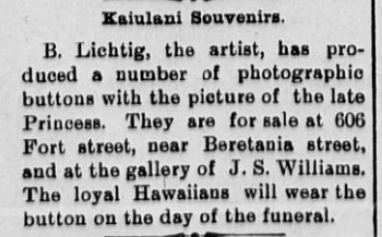
Kaiulani Souvenirs.

B. Lichtig, the artist, has produced a number of photographic buttons with the picture of the late Princess. They are fro sale at 606 Fort street, near Beretania street, and at the gallery of J. S. Williams. The loyal Hawaiians will wear the button on the day of the funeral.

[How is that for advertising? “The loyal Hawaiians will wear the buttons…”]

(Independent, 3/7/1899, p. 3)

Kaiulani Souvenirs.

The Independent, Volume VIII, Number 1142, Page 3. March 7, 1899.

Mahalo to MAB for pointing to this article on the Kaheleiki trial, 1863.

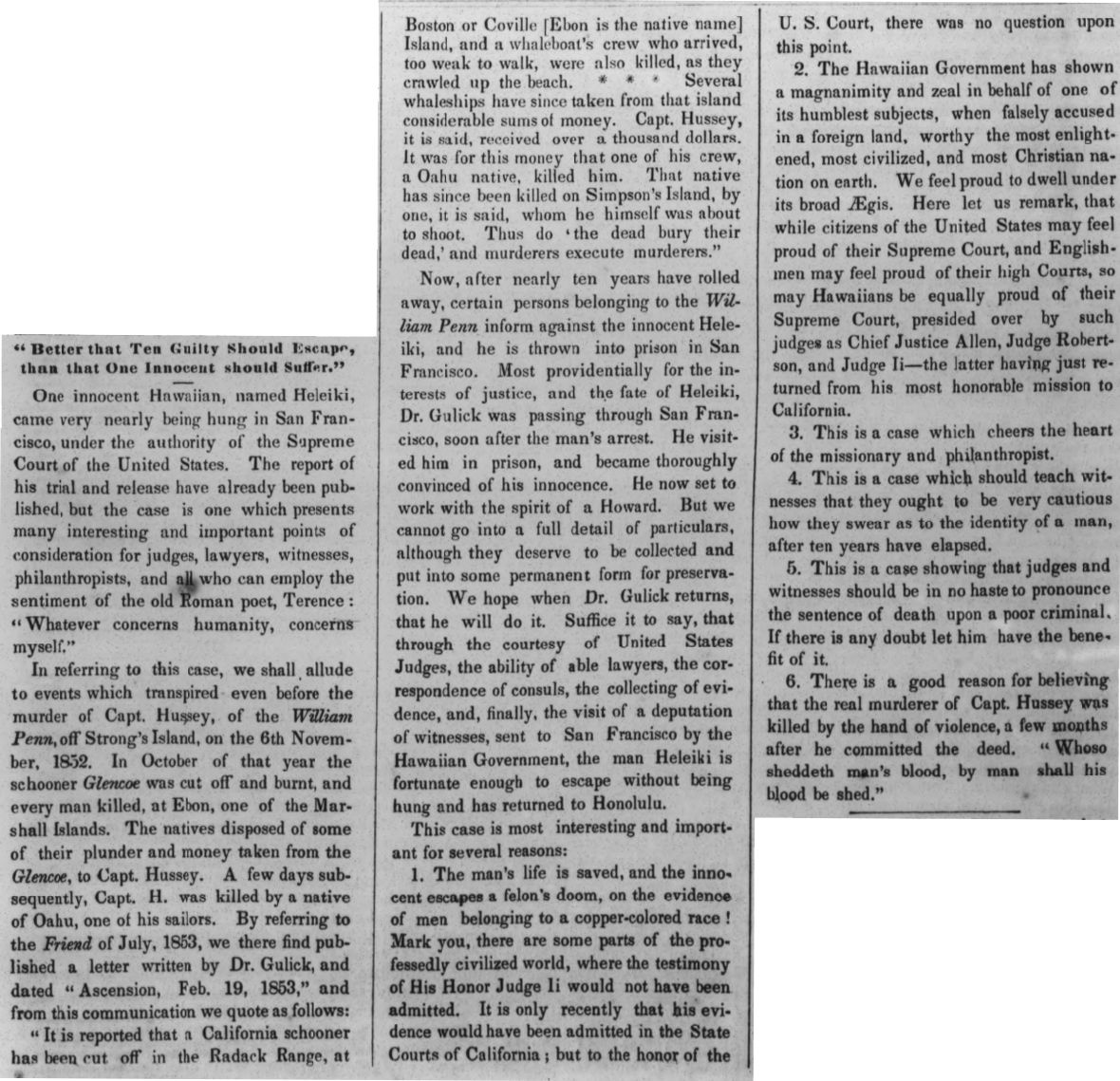
“Better that Ten Guilty Should Escape, than that One Innocent should Suffer.”

One innocent Hawaiian, named Heleiki, came very nearly being hung in San Francisco, under the authority of the Supreme Court of the United States. The report of his trial and release have already been published, but the case is one which presents many interesting and important points of consideration for judges, lawyers, witnesses, philanthropists, and all who can employ the sentiment of the old Roman poet, Terence: “Whatever concerns humanity, concerns myself.”

In referring to this case, we shall allude to events which transpired even before the murder of Capt. Hussey, of the William Penn, off Strong’s Island, on the 6th of November, 1852. In October of that year the schooner Glencoe was cut off and burnt, and every man killed, at Ebon, one of the Marshall Islands. The natives disposed of some of their plunder and money taken from the Glencoe, to Capt. Hussey. A few days subsequently, Capt. H. was killed by a native of Oahu, one of his sailors. By referring to the Friend of July, 1853, we there find published a letter written by Dr. Gulick, and dated “Ascension, Feb. 19, 1853,” and from this communication we quote as follows:

“It is reported that a California schooner has been cut off in the Radack Range, at Boston or Coville (Ebon is the native name) Island, and a whaleboat’s crew who arrived, too weak to walk, were also killed, as they crawled up the beach. * * * Several whaleships have since taken from that island considerable sums of money. Capt. Hussey, it is said, received over a thousand dollars. It was for this money that one of his crew, a Oahu native, killed him. That native has since been killed on Simpson’s Island, by one, it is said, whom he himself was about to shoot. Thus do ‘the dead bury their dead,’ and murderers execute murderers.”

Now, after nearly ten years have rolled away, certain persons belonging to the William Penn inform against the innocent Heleiki, and he is thrown into prison in San Francisco. Most providentially for the interests of justice, and the fate of Heleiki, Dr. Gulick was passing through San Francisco, soon after the man’s arrest. He visited him in prison, and became throughly convinced of his innocence. He now set to work with the spirit of a Howard. But we cannot go into a full detail of particulars, although they deserve to be collected and put into some permanent form for preservation. We hope when Dr. Gulick returns, that he will do it. Suffice it to say, that through the courtesy of United States Judges, the ability of able lawyers, the correspondence of consuls, the collecting of evidence, and, finally, the visit of a deputation of witnesses, sent to San Francisco by the Hawaiian Government, the man Heleiki is fortunate enough to escape without being hung and has returned to Honolulu.

This case is most interesting and important for several reasons:

1. The man’s life is saved, and the innocent escapes a felon’s doom, on the evidence of men belonging to a copper-colored race! Mark you, there are some parts of the professedly civilized world, where the testimony of His Honor Judge Ii would not have been admitted. It is only recently that his evidence would have been admitted in the State Courts of California; but to the honor of the U. S. Court, there was no question upon this point.

2. The Hawaiian Government has shown a magnanimity and zeal in behalf of one of its humblest subjects, when falsely accused in a foreign land, worthy the most enlightened, most civilized, and most Christian nation on earth. We feel proud to dwell under its broad Ægis. Here let us remark, that while citizens of the United States may feel proud of their Supreme Court, and Englishmen may feel proud of their high Courts, so may Hawaiians be equally proud of their Supreme Court, presided over by such judges as Chief Justice Allen, Judge Roberson, and Judge Ii—the latter having just returned from his most honorable mission to California.

3. This is a case which cheers the heart of the missionary and philanthropist.

4. This is a case which should teach witnesses that they ought to be very cautious how they swear as to the identity of a man, after ten years have elapsed.

[See earlier article: Government officials to go to California to defend a Hawaiian citizen. 1863.]

(Friend, 5/1/1863, p. 33)

"Better that Ten Guilty Should Escape, than that One Innocent should Suffer."

The Friend, New Series, Volume 12, Number 5, Page 33. May 1, 1863.

A newspaper called, “Lunalilo” 1873.

[Found under: “DOMESTIC NEWS”]

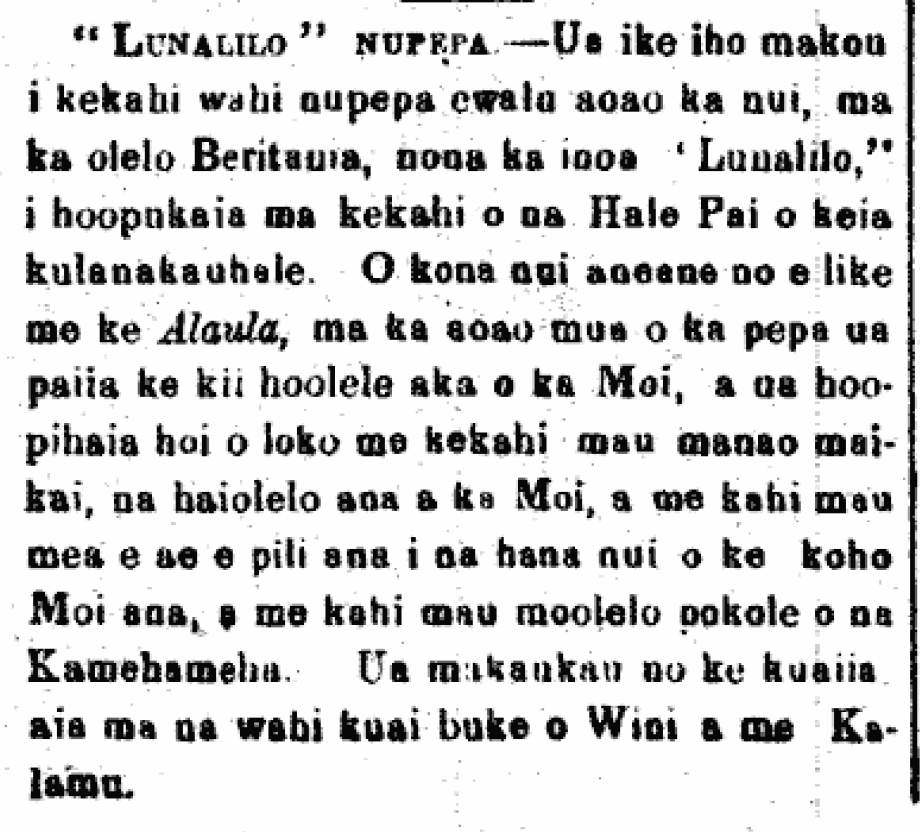
“Lunalilo” Newspaper.—We have seen a newspaper of eight sides, in the English language, with the name, “Lunalilo,” which was printed at one of the Printing Houses of this town. Its size is about the size of the Alaula, and on the first page of the paper is printed with a silhouette [kii hoolele aka] of the King, and the inside is filled with good ideas, the speeches of the King, and some other things pertaining to the election of the King, as well as some short stories about the various Kamehameha. It is ready for sale at the bookstores of Whitney [Wini] and Kalamu [Thrum].

[This is documented in the great four-volume Hawaiian bibliography by David Forbes, “Hawaiian National Bibliography, 1780-1900”]

(Au Okoa, 1/30/1873, p. 3)

"Lunalilo" nupepa.

Ke Au Okoa, Buke VIII, Helu 42, Aoao 3. Ianuari 30, 1873.

Tourists… 1906.

[Found under: “TOWN TALK”]

One of my Southern California friends here with the party of editors had a very amusing experience with a native waiter in a restaurant into which she had dropped for lunch. She saw the brown son of the islands coming and she nerved herself for the ordeal. She consulted her souvenir program and running over the list of translated words she finally found and said “Pa-Hay-Oe.”

“Maikai no” replied the man with a smile.

The young lady then attempted to find the native words for “Ham and Eggs” or something to that effect—but alas they were not there. She hesitates, looked frantically around in search of some haole, and finally she though of sign language and commenced to make all sorts of passes in the air. The native stood near her her and kept shaking his head, all the time with a questioning look in his eye.

Finally the young lady said in despair, “Oh, you block head, why don’t you talk English?”

“I was about to say madam,” came the reply, “that if you would say in English what you are endeavoring to convey by means of the sign language, I would be most delighted to fill even your humblest desire.”

Then the young lady was angry. She stamped out of the restaurant and all one needs to do to court sudden death is to make a few passes like “Ham and Eggs” in the air in her presence.

(Hawaiian Star, 9/22/1906, p. 7)

One of my Southern California friends...

The Hawaiian Star, Volume XIV, Number 4524, Page 7. September 22, 1906.

James Pauahi Alohikea and the alalaua, 1917.

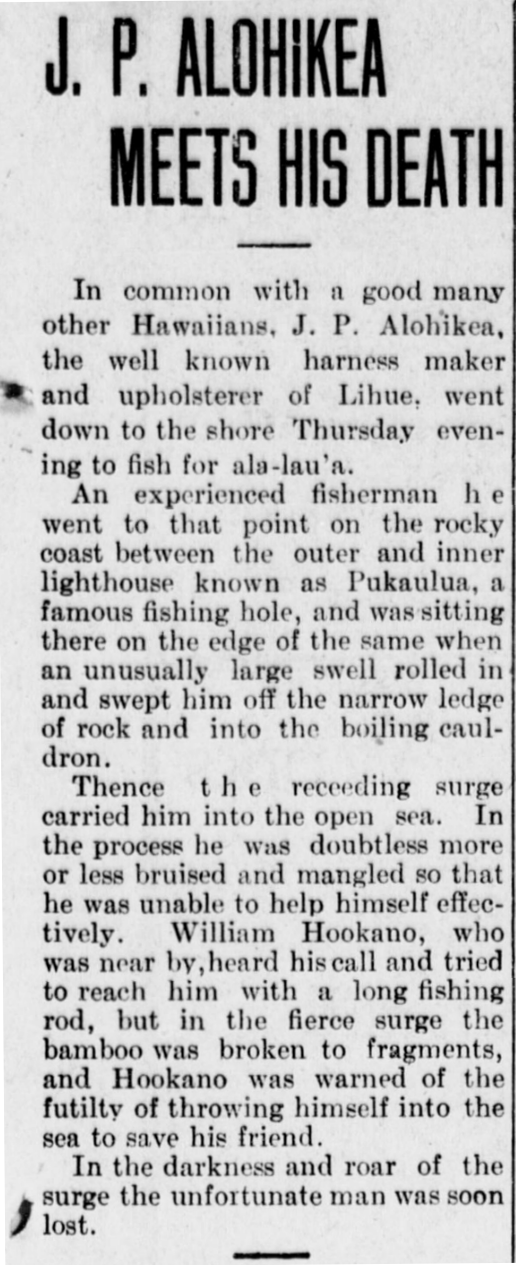
J. P. ALOHIKEA MEETS HIS DEATH

In common with a good many other Hawaiians, J. P. Alohikea, the well known harness maker and upholsterer of Lihue, went down to the shore Thursday evening to fish for ala-lau’a.

An experienced fisherman he went to that point on the rocky coast between the outer and inner lighthouse known as Pukaulua, a famous fishing hole, and was sitting there on the edge of the same when an unusually large swell rolled in and swept him off the narrow ledge of rock and into the boiling cauldron.

Thence the receeding surge carried him into the open sea. In the process he was doubtless more or less bruised and mangled so that he was unable to help himself effectively. William Hookano, who was near by, heard his call and tried to reach him with a long fishing rod, but in the fierce surge the bamboo was broken to fragments, and Hookano was warned of the futility of throwing himself into the sea to save his friend.

In the darkness and roar of the surge the unfortunate man was soon lost.

(Garden Island, 9/11/1917, p. 1)

J. P. ALOHIKEA MEETS HIS DEATH

The Garden Island, Volume 13, Number 37, Page 1. September 11, 1917.

More on the alalaua, 1917.

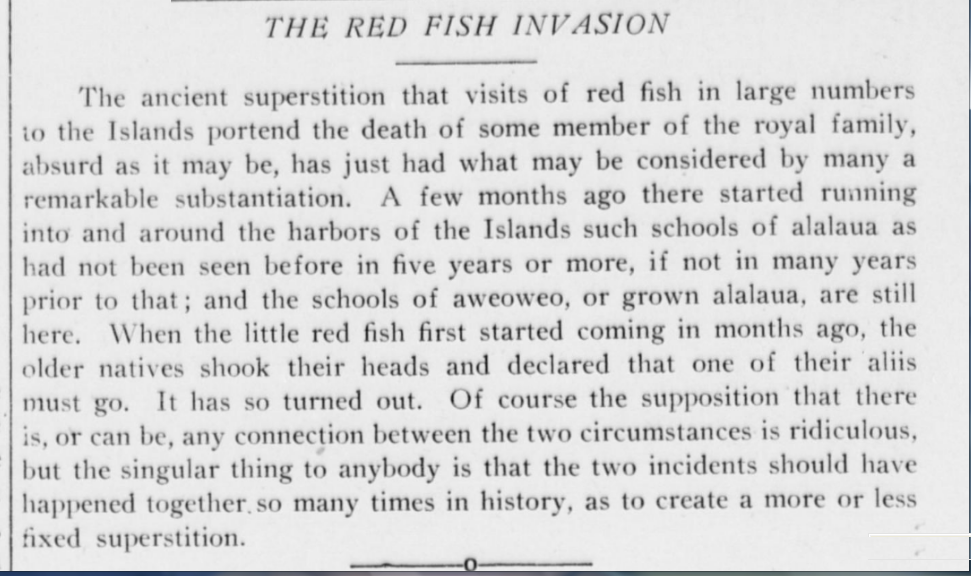
THE RED FISH INVASION

The ancient superstition that visits of red fish in large numbers to the Islands portend the death of some member of the royal family, absurd as it may be, has just had what may be considered by many a remarkable substantiation. A few months ago there started running into and around the harbors of the Islands such schools of alalaua as had not been seen before in five years or more, if not in many years prior to that; and the schools of aweoweo, or grown alalaua, are still here. When the little red fish first started coming in months ago, the older natives shook their heads and declared that one of their aliis must go. It has so turned out. Of course the supposition that there is, or can be, any connection between the two circumstances is ridiculous, but the singular thing to anybody is that the two incidents should have happened together so many times in history, as to create a more or less fixed superstition.

(Maui News, 11/16/1917, p. 4)

THE RED FISH INVASION

The Maui News, Eighteenth Year, Number 923, Page 4. November 16, 1917.

More on the Boston, in English, 1893.

The U. S. S. Boston Lands Sailors and Marines.

(From Daily, January 17.)

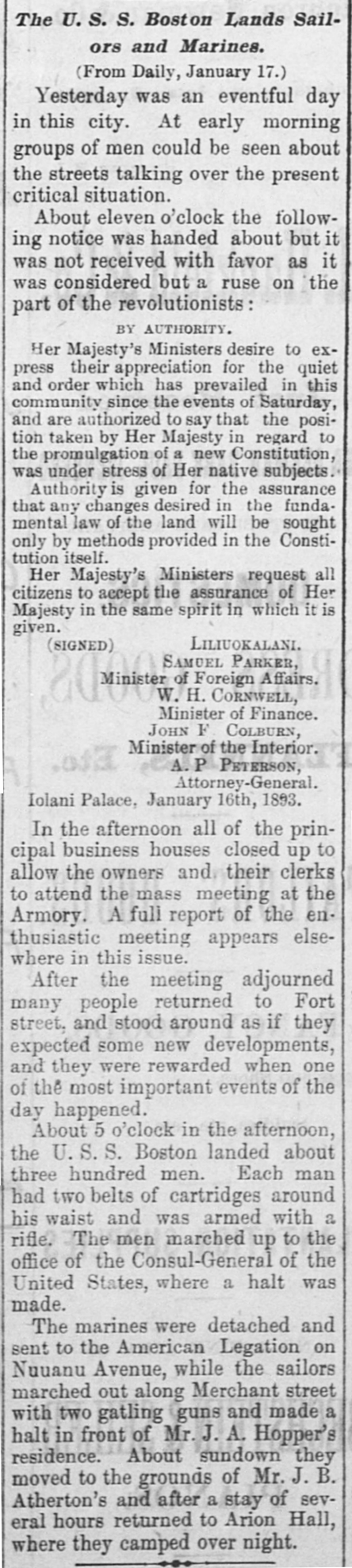
Yesterday was an eventful day in this city. At early morning groups of men could be seen about the streets talking over the present critical situation.

About eleven o’clock the following notice was handed about but it was not received with favor as it was considered but a ruse on the part of the revolutionists:

BY AUTHORITY.

Her Majesty’s Ministers desire to express their appreciation for the quiet and order which has prevailed in this community since the events of Saturday, and are authorized to say that the position taken by Her Majesty in regard to the promulgation of a new Constitution, was under stress of Her native subjects.

Authority is given for the assurance that any changes desired in the fundamental law of the land will be sought only by methods provided in the Constitution itself.

Her Majesty’s Ministers request all citizens to accept the assurances of Her Majesty in the same spirit in which it is given.

(SIGNED) Liliuokalani.

Samuel Parker,
Minister of Foreign Affairs.

W. H. Cornwell,
Minister of Finance.

John F. Colburn,
Minister of the Interior.

A. P. Peterson,
Attorney-General.

Iolani Palace, January 16, 1893.

In the afternoon all of the principal business houses closed up to allow the owners and their clerks to attend the mass meeting at the Armory. A full report of the enthusiastic meeting appears elsewhere in this issue.

After the meeting adjourned many people returned to Fort street, and stood around as if they expected some new developments, and they were rewarded when one of the most important events of the day happened.

About 5 o’clock in the afternoon, the U. S. S. Boston landed about three hundred men. Each man had two belts of cartridges around his waist and was armed with a rifle. The men marched up to the office of the Consul-General of the United States, where a halt was made.

The marines were detached and sent to the American Legation on Nuuanu Avenue, while the sailors marched out along Merchant street with two gatling guns and made a halt in front of Mr. J. A. Hopper’s residence. About sundown they moved to the grounds of Mr. J. B. Atherton’s and after a stay of several hours returned to Arion Hall, where they camped over night.

[The “Daily” here mention at the top refers to the Daily Pacific Commercial Advertiser.]

(Hawaiian Gazette, 1/24/1893, p. 6)

The U. S. S. Boston Lands Sailors and Marines.

Hawaiian Gazette, Volume XXVIII, Number 4, Page 6. January 24, 1893.

More on the Boston, in English, 1893.

Of What Are They Afraid?

Editor Bulletin:—

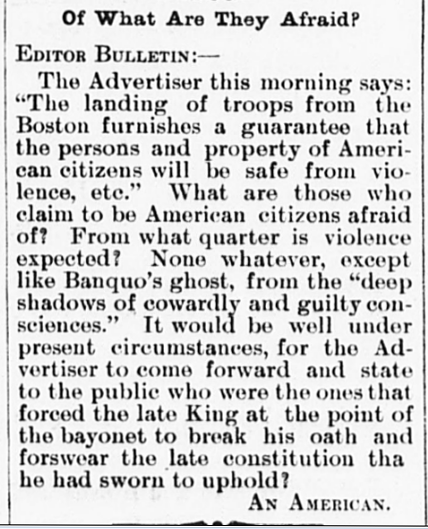
The Advertiser this morning says: “The landing of troops from the Boston furnishes a guarantee that the persons and property of American citizens will be safe from violence, etc.” What are those who claim to be American citizens afraid of? From what quarter is violence expected? None whatever, except like Banquo’s ghost, from the “deep shadows of cowardly and guilty consciences.” It would be well under present circumstances, for the Advertiser to come forward and state to the public who were the ones that forced the late King at the point of the bayonet to break his oath and forswear the late constitution tha he had sworn to uphold?

An American.

(Daily Bulletin, 1/17/1893, p. 3)

Of What Are They Afraid?

The Daily Bulletin, Volume 5, Number 626, Page 3. January 17, 1893.