Emalia Kaihumua abused, 1906.

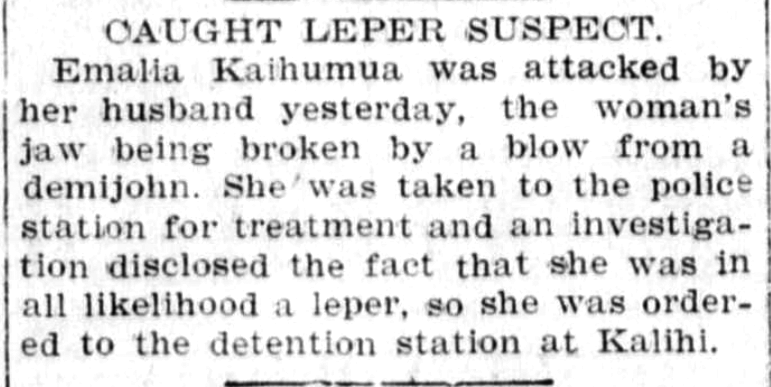
CAUGHT LEPER SUSPECT.

Emalia Kaihumua was attacked by her husband yesterday, the woman’s jaw being broken by a blow from a demijohn. She was taken to the police station for treatment and an investigation disclosed the fact that she was in all likelihood a leper, so she was ordered to the detention station at Kalihi.

(Hawaiian Star, 1/29/1906, p. 8)

CAUGHT LEPER SUSPECT.

The Hawaiian Star, Volume XIII, Number 4322, Page 8. January 29, 1906.

Sweet Emalia out and about, 1901.

[Found under: “LOCAL ‘HAWKSHAWS’ OWN UP IDENTITY … Sweet Emalia Denied the Oft-Repeated Impeachment]

“Sweet Emalia” was brought before the bar of justice to answer to the charge of being drunk. The fair defendant denied the soft impeachment, meanwhile shedding a copious flow of tears. Emalia was given a reprimand and discharged.

[Yes, Emalia Kaihumua made it out from the insane asylum!]

(Honolulu Republican, 6/2/1901, p. 1)

"Sweet Emalia" was brought...

The Honolulu Republican, Volume II, Number 305, Page 1. June 2, 1901.

More on the Hawaiian National Hymn, 1874.

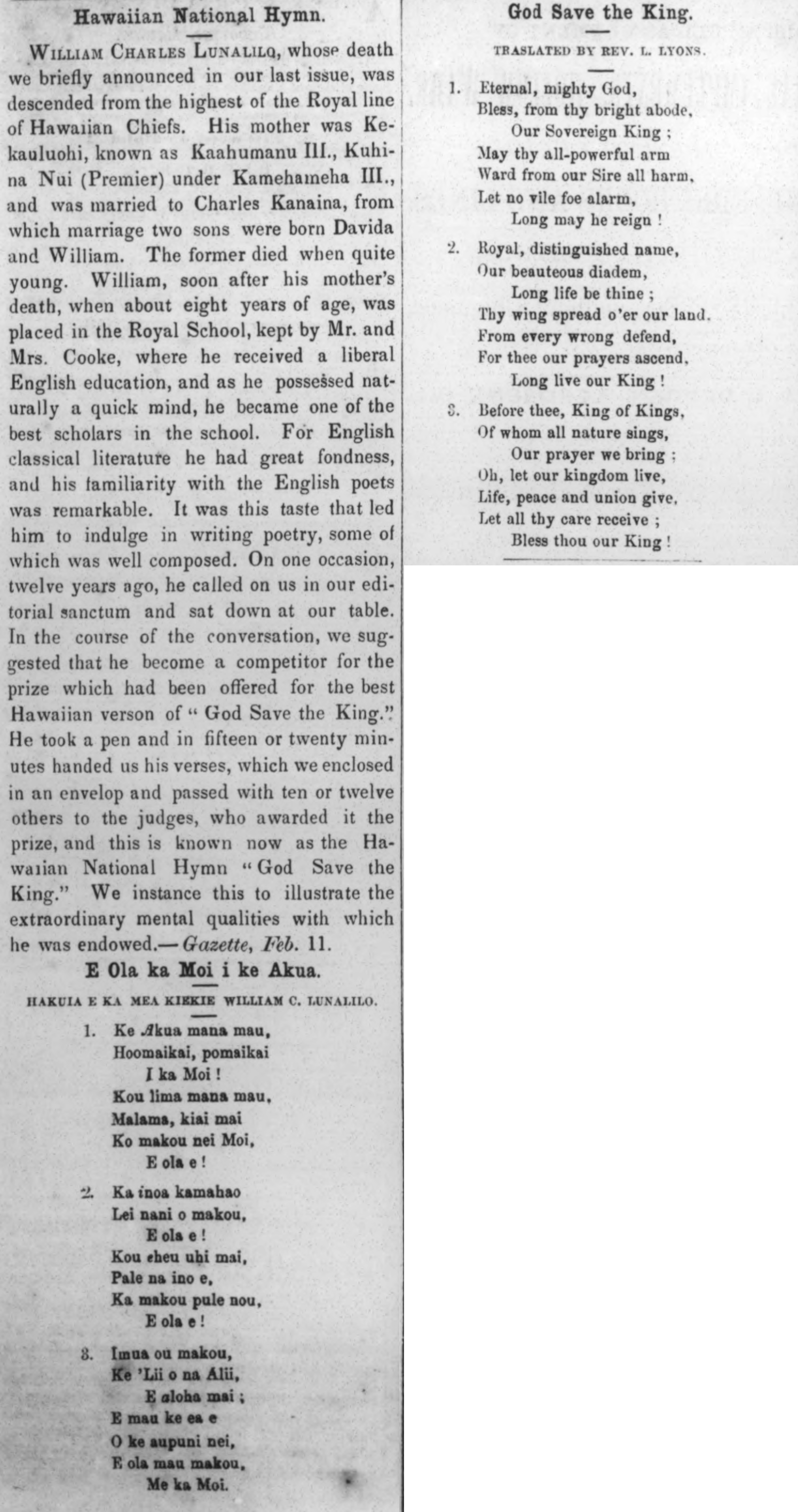
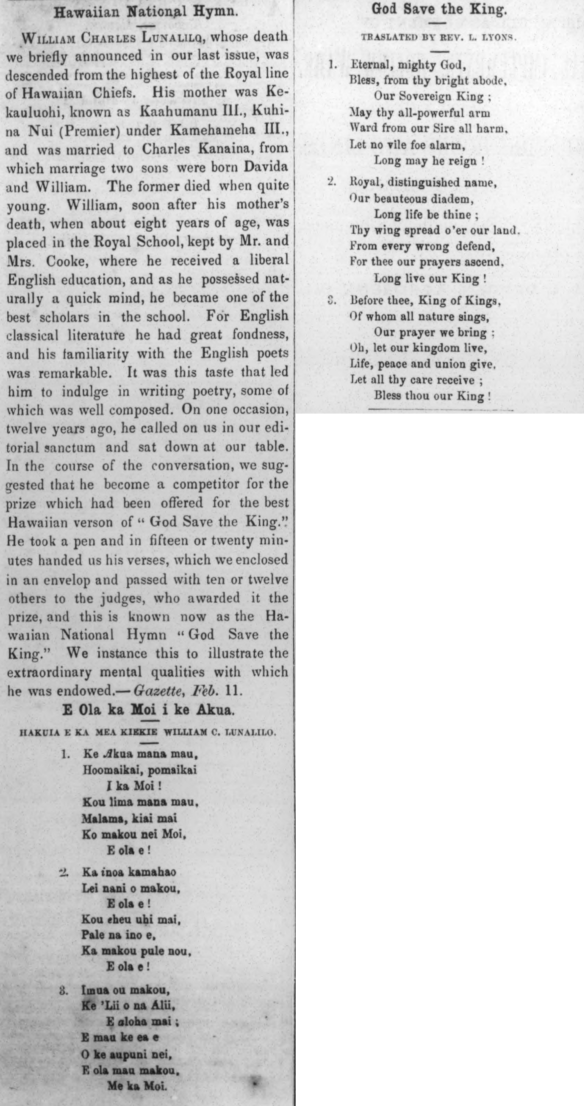
Hawaiian National Hymn.

William Charles Lunalilo, whose death we briefly announced in our last issue, was descended from the highest of the Royal line of Hawaiian Chiefs. His mother was Kekauluohi, known as Kaahumanu III., Kuhina Nui (Premier) under Kamehameha III., and was married to Charles Kanaina, from which marriage two sons were born Davida and William. The former died when quite young. William, soon after his mother’s death, when about eight years of age, was placed in the Royal School, kept by Mr. and Mrs. Cooke, where he received a liberal English education, and as he possessed naturally, a quick mind, he became one of the best scholars in the school. For English classical literature he had great fondness, and his familiarity with the English poets was remarkable. It was this taste that led him to indulge in writing poetry, some of which was well composed. On one occasion, twelve years ago, he called on us in our editorial sanctum and sat down at our table. In the course of the conversation, we suggested that he become a competitor for the best prize which had been offered for the best Hawaiian version of “God Save the King.” He took a pen and in fifteen or twenty minutes handed us his verses, which we enclosed in an envelope and passed with ten or twelve others to the judges, who awarded it the prize, and this is known now as the Hawaiian National Hymn “God Save the King.” We instance this to illustrate the extraordinary mental qualities with which he was endowed.—Gazette, Feb. 11.

E Ola ka Moi i ke Akua.

HAKUIA E KA MEA KIEKIE WILLIAM C. LUNALILO.

1. Ke Akua mana mau,
Hoomaikai, pomaikai
I ka Moi!
Kou lima mana mau,
Malama, kiai mai
Ko makou nei Moi,
E ola e!

2. Ka inoa kamahao
Lei nani o makou,
E ola e!
Kou eheu uhi mai,
Pale na ino e,
Ka makou pule nou,
E ola e!

3. Imua ou makou,
Ke ‘Lii o na Alii,
E aloha mai;
E mau ke ea e
O ke aupuni nei,
E ola mau makou,
Me ka Moi.

God Save the King.

TRANSLATED BY REV. L. LYONS.

1. Eternal, mighty God,
Bless, from thy bright abode,
Our Sovereign King;
May thy all-powerful arm
Ward from our Sire all harm,
Let no vile foe alarm,
Long may he reign!

2. Royal, distinguished name,
Our beauteous diadem,
Long life be thine;
Thy wing spread o’er our land.
From every wrong defend,
For thee our prayers ascend,
Long live our King!

3. Before thee, King of Kings,
Of whom all nature sings,
Our prayer we bring;
Oh, let our kingdom live,
Life, peace and union give,
Let all thy care receive;
Bless thou our King!

(Friend, 3/2/1874, p. 24)
Hawaiian National Hymn.

The Friend, New Series, Volume 23, Number 3, Page 24. March 2, 1874.

Oamaru, New Zealand graves searchable online, 2013.

Cemetery database makes family searches easier

A new Oamaru cemeteries database has the potential to provide insight into the past, a supporter of the initiative says.

The database is available through the Waitaki District Council website and allows users to search for people buried in the Oamaru Old and Lawn Cemeteries by surname and/or first name, and shows information such as the age of the deceased and what block and plot they are buried in.

North Otago Museum archives curator Eva Garbutt says tracing family history is becoming a popular pastime, with more people than ever wanting to unearth their roots.

“In the past year the demand for putting our cemetery database online has increased as more and more people are getting into doing their family history.

“Now people will be able to search for their ancestors buried in the Oamaru cemeteries thanks to the wonderful

efforts of our volunteers, who have spent many hours putting the information from the original burial registers into a digital and searchable format.”

Waitaki District councillor and historian Helen Stead is a huge supporter of the database and says she is delighted it is up and running.

“I think it places us in the research and genealogical world, because people can look at the database that relates to Oamaru from anywhere in the world.”

Mrs Stead also believes the database could unlock dozens of stories about Oamaru’s past that have been lost with time.

[For the entire article from The Timaru Herald, click the link below:

Cemetery database makes family searches easier]

More on the death of Keanu, 1902.

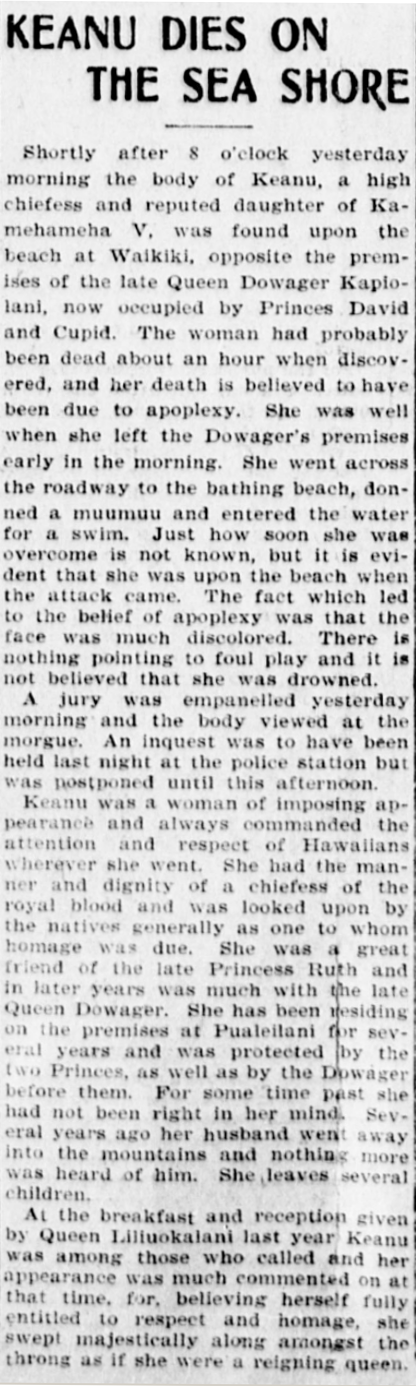
KEANU DIES ON THE SEA SHORE

Shortly after 8 o’clock yesterday morning the body of Keanu, a high chiefess and reputed daughter of Kamehameha V, was found upon the beach at Waikiki, opposite the premises of the late Queen Dowager Kapiolani, now occupied by Princes David and Cupid. The woman had probably been dead about an hour when discovered, and her death is believed to have been due to apoplexy. She was well when she left the Dowager’s premises early in the morning. She wen across the roadway to the bathing beach, donned a muumuu and entered the water for a swim. Just how soon she was overcome is not known, but it is evident that she was upon the beach when the attack came. The fact which led to the belief of apoplexy was that the face was much discolored. There is nothing pointing to foul play and it is not believed that she was drowned.

A jury was empanelled yesterday morning and the body viewed at the morgue. An inquest was to have been held last night at the police station but was postponed until this afternoon.

Keanu was a woman of imposing appearance and always commanded the attention and respect of Hawaiians wherever she went. She had the manner and dignity of a chiefess of the royal blood and was looked upon by the natives generally as one to whom homage was due. She was a great friend of the late Princess Ruth and in later years was much with the late Queen Dowager. She has been residing on the premises at Pualeilani for several years and was protected by the two Princes, as well as by the Dowager before them. For some time past she had not been right in her mind. Several years ago her husband went away into the mountains and nothing more was heard of him. She leaves several children.

At the breakfast and reception given by Queen Liliuokalani last year Keanu was among those who called and her appearance was much commented on at that time, for, believing herself fully entitled to respect and homage, she swept majestically along amongst the throng as if she were a reigning queen.

(Hawaiian Gazette, 7/1/1902, p. 4)

KEANU DIES ON SEA SHORE

Hawaiian Gazette, Volume XXXVII, Number 50, Page 4. July 1, 1902.

Ninipo Hoonipo Song in Australia, 1927.

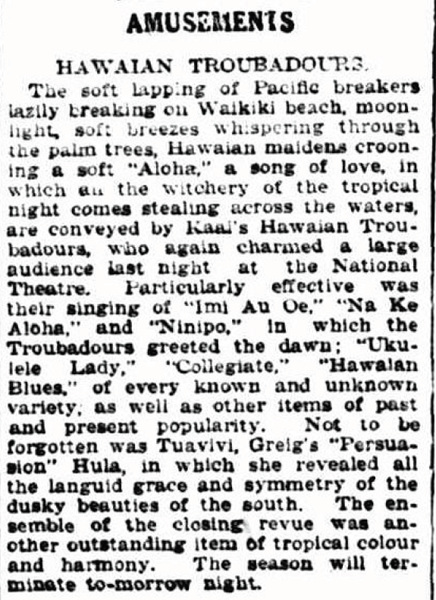
AMUSEMENTS

THE HAWAIIAN TROUBADOURS. The soft lapping of Pacific breakers lazily breaking on Waikiki beach, moon light, soft breezes whispering through the palm trees, Hawaian maidens crooning a soft “Aloha,” a song of love, in which all the witchery of the tropical night comes stealing across the waters, are conveyed by Kaai’s Hawaian Troubadours, who again charmed a large audience last night at the National Theatre. Particularly effective was their singing of “Imi Au Oe,”¹ “Na Ke Aloha,” and “Ninipo,” In which the Troubadours greeted the dawn; “Ukulele Lady,” “Collegiate,” “Hawaian Blues.” of every known and unknown variety; as well as other items of past and present popularity. Not to be forgotten was Tuavivi, Greig’s “Persuasion” Hula, in which she revealed all the languid grace and symmetry of the dusky beauties of the south. The ensemble of the closing revue was another outstanding item of tropical colour and harmony. The season will terminate to-morrow night.

[Earlier, i posted Liliuokalani’s “Ninipo Hoonipo Song”, and strangely enough, i ran across this reference to it being sung all the way in Australia in 1928!]

¹”Imi Au Ia Oe”

(Examiner, 4/22/1927, p. 6)

AMUSEMENTS.

The Examiner, Volume LXXXV, Number 95, Page 6. April 22, 1927.

“Kaai’s Hawaiians” on TROVE, 1928.

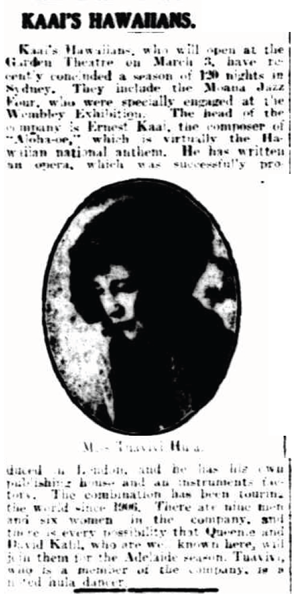
KAAI’S HAWAIIANS.

Kaaiʻs Hawaiians, who will open at the Garden Theatre on March 3, have recently concluded a season of 120 nights in Sydney. They include the Moana Jazz Four, who were specially engaged at the Wembley Exhibition. The head of the company is Ernest Kaai, the composer of   “Aloha oe,” which is virtally the Hawaiiian national anthem. He has written and opera, which was successfully pro…

Miss Tuavivi Greig

…duced in London, and he has his own publishing house and an intsruments factory. The combination has been touring the world since 1906. There are nine men   and six women in the company, and there is every possibility that Queenie and   David Kaili, who are we know here, will join them for the Adelaide season. Tuavivi,   who is a member of the company, is a noted hula dancer.

[This comes from an Adelaide, South Australia newspaper, found on the National Library of Australia webside, TROVE. It seems unclear newspaper images is not something limited to Hawaii nei. However, at least the text on that site is correctable.]

(Advertiser, 2/23/1923, p. 11)

KAAI'S HAWAIIANS.

The Advertiser, Volume LXX, Number 21645, Page 11. February 23, 1928.

The Kings of Hawaii, 1876.

This is from an issue of “The Friend,” which includes a short biography in English of the ruling monarchs of Hawaii nei, written by S. C. Damon. As for this page of illustrations, they say:

The illustrations accompanying this number of the Friend we could wish were better executed. The plate was made in New York, from the best photographs we could procure in Honolulu. The original of Kamehameha 1st was executed in 1817 by a Russian artist, who accompanied Kotzebue in his voyage, and may be seen by referring to the third volume of his voyage. The original of Kamehameha 2d was executed in England in 1824, in the style of the dress of George 4th’s reign. We think those of Kamehameha 3d, 4th and 5th are very good, but not quite so good those of Lunalilo or His Majesty Kalakaua.

[For the biographies, find them here: The Friend, February 1, 1876.

Although it is clunky to maneuver, most of this series of news letters is available from the Mission Houses Museum here: The Friend.]

(Friend, 2/1/1876, pp. 9–13)

[Monarchs]

The Friend, New Series, Volume 25, Number 2, Page unnumbered. February 1, 1876.

Response to hula commentary, 1891.

THE HULA AND THE “P. C. ADVERTISER.”

Another example of the “P. C. Advertiser’s” moral attitude appears int the announcement, that a hula given by the Hon. J. A. Cummins at his resident at Waimanalo was a glorious affair.—We have no doubt, that the display was exceptionally fine, since the ex-Premier has a well earned reputation as a connoiseur in that line, and is said to use the collection of females, formerly of boat house fame, second to none in the country.—Still there is something about the hula, that has so far excluded it from the programs of church festivals and school exercises.—It has never been recommended to lure the mind to thoughts of higher and better things or to produce rigid uprightness of morals.

The hula is a graceful and rhythmic representation of certain actions of the human animal. There is no doubt, that from the earliest ages the physiology of reproduction has been the most intrinsically interesting known to man. After the question of food and personal safety, it is the most important consideration in the lives of man, savage and civilized. The Hindoos and Budhists covered their temples and public buildings with indecent pictures, which in some instances took the form of a cross. This was imported to Rome together with the worship of Isis. So every spire on a Christian Church represents a resurrection of the flesh. But civilized society has decided for good reason to cover Isis with a vail and put Osiris in a straight-jacket. It is only those, who believe in the infallibility and prerogatives derived from gold—as some of our friends—who may wish to go back to the first principles and have the hula taught as an accomplishment in our public schools, so that it might prove more attractive in catching a husband and certainly in domesticating him when caught, than the art of piano playing or embroidery. There are great posibilities in the hula! But at present it is prohibited by the law, and we are sorry to see the law violated by those who ought to know better.

(Leo o ka Lahui, 5/14/1891, p. 4)

THE HULA AND THE "P. C. ADVERTISER."

Ka Leo o ka Lahui, Buke II, Helu 193, Aoao 4. Mei 14, 1891.