20 million dollars worth of land for sale? 1892.

[Found under: “NU HOU KULOKO.”]

All those people who are looking to purchase Land for themselves should go and talk with Keoni Samoa, because his wife, Nakaiewalu, has a number of ahupuaa, which is valued up to 20 million dollars. This is what he is announcing, and you can choose your pick when you talk with this person to whom belongs this great wealth.

(Leo o ka Lahui, 12/15/1892, p. 3)

LOKL_12_15_1892_3

Ka Leo o ka Lahui, Buke II, Helu 604, Aoao 3. Dekemaba 15, 1892.

Ship passenger list, 1893.

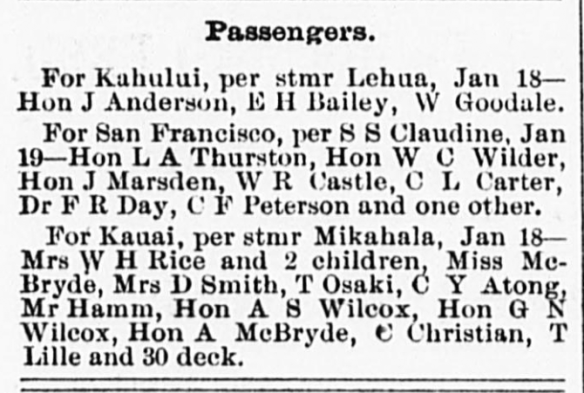
Passengers.

For Kahului, per stmr Lehua, Jan 18—Hon J Anderson, E H Bailey,W Goodale.

For San Francisco, per S S Claudine, Jan 19—Hon L A Thurston, Hon W C Wilder, Hon J Marsden, W R Castle, C L Carter, Dr F R Day, C F Peterson and one other.

For Kauai, per stmr Mikahala, Jan 18—Mrs W H Rice and 2 children, Miss McBryde, Mrs D Smith, T Osaki, C Y Atong, Mr Hamm, Hon A S Wilcox, Hon G N Wilcox, Hon A McBryde, C Christian, T Lille and 30 deck.

(Daily Bulletin, 1/19/1893, p. 3)

DailyBulletin_1_19_1893_3

The Daily Bulletin, Volume  V, Number 628, Page 3. January 19, 1893.

One more from the Deshas, 1944.

Our Day

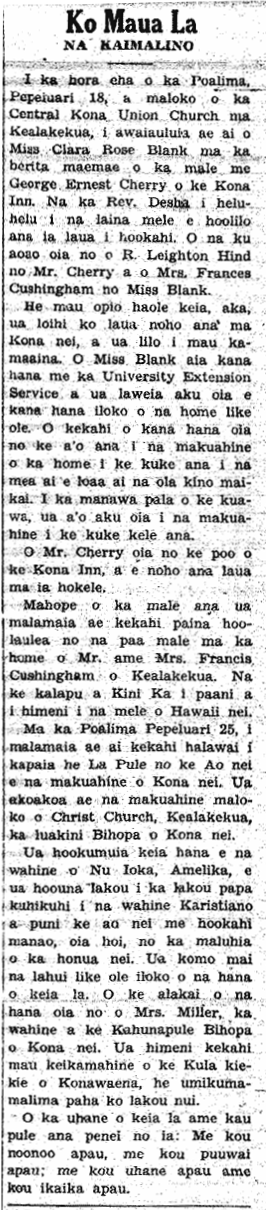
THE CALM SEAS OF KONA

At four o’clock on Friday, February 18, and in the Central Kona Union Church, Miss Clara Rose Blank was joined in holy covenant of matrimony with George Ernest Cherry of Kona Inn. Rev. Desha read the lines of the mele which made the two of them into one. The attendants [ku aoao] were R. Leighton Hind for Mr. Cherry and Mrs. Frances Cushingham for Miss Blank.

These are haole youths, but they lived here in Kona for a long time, and have become kamaaina. Miss blank is working for the University Extension Service, and her work takes her into the different homes. One of her duties is to teach housewives how to cook nutritious foods. When guava is ripe, she taught the mothers how to make jelly.

Mr. Cherry is the head of Kona Inn, and they will live at the hotel.

 After the wedding a celebratory party was held for the married couple at the home of Mr. and Mrs. Francis Cushingham of Kealakekua. The club of Kini Ka played and sang the songs of Hawaii nei.

On Friday, February 25, a meeting was held called a Day of Prayer for the World by the mothers of Kona. The mothers gathered in Christ Church, Kealakekua, the Episcopal church of Kona nei.

This endeavor was begun by the women of New York, America, and they sent their program to Christian women all over the world who have the same thought, that is peace on earth. All the various ethnicities participated in the activities of the day. The leader of this exercise was Mrs. Miller the wife of the Episcopal pastor of Kona. Some girls of Kona Waena High School sang; there were perhaps eleven of them.

The spirit of the day and the prayer went like this: With all of your though, with all your heart, with all your soul, and with all your strength.

(Hoku o Hawaii, 3/8/1944, p. 2)

Ko Maua La

Ka Hoku o Hawaii, Volume XXXVIII, Number 46, Aoao 2. Maraki 8, 1944.

Even more from the Deshas, 1944.

Our Day

THE CALM SEAS OF KONA

These past days, the Rev. Desha went to Hilo for a conference of pastors held there. He went with Rev. Paul Morimoto and Rev. and Mrs. James Upchurch. Rev. Desha said that this was one of the finest Conferences.

Rev. Desha planned to go to Honolulu once the Conference in Hilo was over for the birthday of his Aunty, Mrs. Bella [Isabella] Desha, and those who know her as Mother Desha. But he gave up this idea to go when he hear that his cousin, Alika Desha, left this life, the youngest son of Mother Desha. How regretful for these young Hawaiians.

Alika [Alexander] Desha was born in Honolulu, and he was forty-nine years old. He was educated at the government schools of Honolulu and Hilo. He married Emma Ukauka of Honolulu and from this union they had five children. For over twenty-five years he worked for the store of P. C. Beamer, his brother-in-law, in Hilo.

The family from Honolulu who came for the funeral was Mother Desha [Isabella Desha], mother of the deceased; Mrs. Ida Becker, sister; David Desha, older brother, Mr. and Mrs. John R. Desha, cousins; and the children, Capt. Adolph Desha, Alec Jr. and Vivian. The funeral was held in the afternoon of Thursday, January 13, 1944. The first funeral congregation was held Elmore Funeral Home for the family and friends. Rev. Moses Moku and Rev. Desha performed the service. The final funeral congregation was held at the Masonic Hall under the direction of the Masons, and there were many friends who came.

The celebration of the birthday of Mother Desha was not neglected, but the children and grandchildren of the one whose day it was gathered in the morning of the Sabbath and honored her with a very nice party. She is eighty years old.

(Hoku o Hawaii, 1/26/1944, p. 1)

Ko Maua La

Ka Hoku o Hawaii, Volume XXXVIII, Number 40, Aoao 1. Ianuari 26, 1944.

And more from the Deshas, 1944.

Our Day

THE CALM SEAS OF KONA

Kealakekua, Friday, May 12, 1944—This is the birthday of our firstborn, Stephen Luluhiwalani Desha, III. Today he is twenty-two years old. This afternoon the Rev. Desha will go down to Milolii because he will hold prayer there this Sunday. He is going to Milolii at once because he wants to go fishing. He wants some fish to take to Honolulu. The kamaaina sends you off, O malihini, with a bundle for your hand.

I will not get to Milolii this week, and our Aunty, Mrs. Annie Au of Napoopoo and her grandchild, will go down with Rev. Desha. She will stay with Mrs. Sarah Kalua, the teacher of Milolii, and Rev. Desha will stay at the home of his friends, Mr.and Mrs. Eugene Kaupiko.

 Saturday, May 13, 1944—By way of telephone from Honolulu, I heard the sad news of Mrs. Kaulani Woodward, that she left this world of life. Aloha ino no. Mrs. Woodward was the actual Aunty Judge R. Desha of Honolulu, Mrs. Eliza Desha Brown of Hilo and the Rev. Desha of Kona, and she was the actual younger sister of their mother, Mary Kaakopua Desha. Mrs. Kaulani Woodward was born in Napoopoo, Kona, and she was raised there until she was grown up. She married David Bent, and had two sons by this marriage, David Kaonohi Bent and Henry Kuuhaealoha Bent. Mrs. Pearl Nye and Samuel Kekumano are children of her brother, Samuel L. Kekumano who passed on earlier. She was married again to the Rev. Joseph Woodward perhaps twenty years ago or more. The first resided in Kohala, during the time when Rev. Woodward was assigned as Kahu for the Kalahikiola Church. They moved to Waimea when Woodward became Kahu for Imiola Church. They moved once more to Napoopoo when Rev. Woodward was called to be the Kahu for Kahikolu Church. There they lived until Woodward retired. They then returned to Honolulu this past year. From what I heard, the funeral will be held on Monday, May 15. The kamaaina of our beloved land are going little by little.

[This is a nice genealogy centered around Kaulani Woodward. Genealogy can be found anywhere!]

(Hoku o Hawaii, 5/24/1944, p. 1)

Ko Maua La

Ka Hoku o Hawaii, Volume XXXIX, Number 5, Aoao 1. Mei 24, 1944.

More from the Deshas, 1944.

Our Day

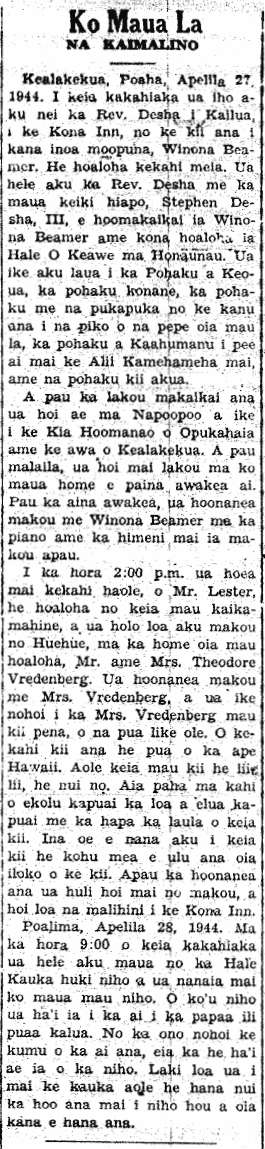
THE CALM SEAS OF KONA

Kealakekua, Thursday, April 27, 1944. This morning the Rev. Desha went down to Kailua, to the Kona Inn, to fetch his namesake grandchild, Winona Beamer. She had a friend with her. The Rev. Desha went with our first child, Stephen Desha III, to take Winona Beamer and her friend to Hale o Keawe at Honaunau. They saw the Stone of Keoua [Pohaku a Keoua], the stone konane board, the stone with holes to bury the umbilical cord of babies of those days, the stone that Kaahumanu used to hide from Kamehameha with, and the stone god figures.

After their tour was over they returned to Napoopoo and saw the Monument to Opukahaia and the bay of Kealakekua. And after that was done, they came back to our home to eat lunch. After lunch, we had an enjoyable time with Winona Beamer with the piano and all of us singing.

At 2:00 p. m., a haole arrived, Mr. Lester, a friend of these girls, and we all went to Huehue, to the home of those friends, Mr. and Mrs. Theodore Vredenberg [Vredenburg]. We spent a pleasant time with Mrs. Vredenberg and saw her drawings of all sorts of flowers. One of her pictures was of the flower of the Hawaiian ape. These drawings were not small, they were big indeed. The length of this drawing is around three feet while the width is about two feet and a half. If you look at this drawing, it looks as if it is growing in the picture. After enjoying our time, we turned back and the visitors returned to the Kona Inn.

Friday, April 28, 1944. At 9:00 this morning, the two of us went to the Dentist [Hale Kauka huki niho] and had a checkup. My tooth was chipped from eating the charred skin from a kalua pig. I ate it because it was tasty, and alas my tooth became chipped. I was so lucky, the doctor said it was not a big thing to insert a new tooth, and that is what he will do.

[This was a fun account, perhaps mostly because I know the awesome daughter of Theodore and Beatrice Vredenburg!]

(Hoku o Hawaii, 5/10/1944, p. 1)

Ko Maua La

Ka Hoku o Hawaii, Volume XXXIX, Number 3, Aoao 1. Mei 10, 1944.

More from Kona and the Deshas, 1943.

Our Day

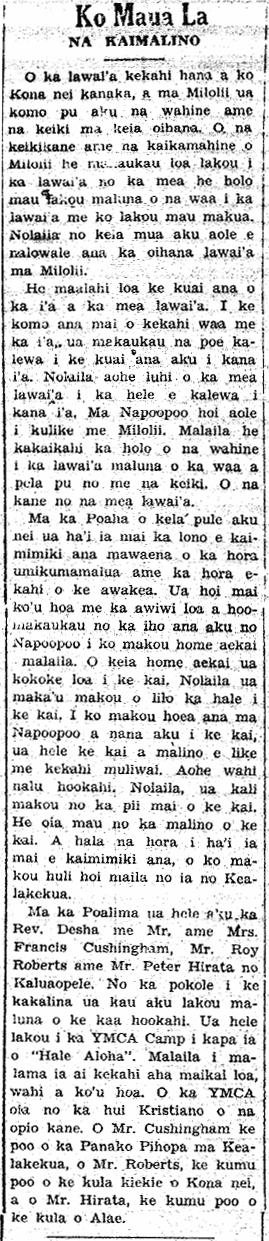
The Calm Seas of Kona

Fishing is an occupation carried out by Kona men, and in Milolii the women and children take part in this endeavor. The boys and girls of Milolii are totally capable at fishing because they always go out on the canoes to go fishing with their parents. Therefore, in the future, fishing will not disappear from Milolii.

It is a truly simple thing to sell the fish of the fishermen. When a canoe comes in with fish, the peddlers are ready to buy the fish. So the fisherman doesn’t have to bother with selling his fish. In Napoopoo, it is not like Milolii. There, there are a few women who go fishing on canoes and so too of the children. Men are the ones who go fishing.

On last week Thursday, the news was told that there would be a tsunami [kai mimiki] between eleven o’clock and one o’clock in the afternoon. My companion rushed home and made ready to go down to Napoopoo, to our home by the sea there. This beach home was very near the ocean. So we were afraid the house would be lost to the sea. When we arrived at Napoopoo and looked at the ocean, the water was calm like an estuary. There was not a single wave. Therefore, we waited for the water to rise. The water remained calm. And the time it was said that there would be a tsunami passed, and we turned back for Kealakekua.

On Friday, the Rev. Desha along with Mr. and Mrs. Francis Cushingham, Mr. Roy Roberts, and Mr. Peter Hirata went to the Crater. Because of the gasoline shortage, they all went on one car. They went to the YMCA Camp called “Hale Aloha.” There a fine meeting was held, according to my companion. The YMCA is the Christian association of young men. Mr. Cushingham is the head of the Bishop Bank [Panako Pihopa] at Kealakekua; Mr. Roberts is the principal of the high school of Kona, and Mr. Hirata is the principal of Alae School.

(Hoku o Hawaii, 11/17/1943, p. 1)

Ko Maua La

Ka Hoku o Hawaii, Volume XXXVIII, Number 30, Aoao 1. Novemaba 17, 1943.

Journal of Evelyn Desha and Stephen Desha Jr., 1943.

Our Day

THE CALM SEAS OF KONA

The person who helps me in all sorts of chores at home is Nellie Kakutani. She is a pleasant girl and lively at work.

And these days what we are doing is cooking guava jelly [puhi kele kuawa]. The guava here in Kona is very ripe. There are two types of jelly we are making. One jelly is dark red, and the other is yellowish. The difference comes with the heat at which you cook it. If you want dark red, you cook with on medium heat. So you cook it for a long time. And should you want yellowish jelly, then you cook it on high heat. And you cook it for a short time.

There is a butter shortage, so this is advice to the women of the home; if you haven’t cooked your jelly, you should start these days, right.

On Thursday, the ninth of November, there was a meeting of the members of the Board of Supervisors [Papa Lunakiai] and some other members of the County of Hawaii and some citizens of Kona nei, at the meeting house of Central Kona Union Church that is under the care of Rev. Stephen Desha of Kealakekua. They discussed the Appropriations [Bila Haawina] of the County of Hawaii pertaining to matters here in Kona. They decided to set aside funds for schools, hospitals, and roads. This was one of the few times where the members of the Board of Supervisors met with the citizens of Kona to talk about the well-being of this district. Praise goes to the members of the Board of Supervisors and the other members of Hawaii County.

—–

There are many visitors here in Kona these days. Here with us these days are Mr. and Mrs. Paul Mahi, the daughter-in-law of our elder sister, Mrs. May Haae. This is the first time that Mrs. Mahi has come to Hawaii and to here in Kona. With them came their baby son, Mosely. We took them around sight seeing.

The other day we took the two of them to Kailua and Keauhou. Yesterday we took them to Napoopoo, to our home by the sea. Mr. Mahi is adept at spearfishing, and he caught some fish. My companion caught the sweet-eyed kole. The fish were fried and eaten for lunch. We went to seethe monument to Opukahaia at the cove of Kealakekua.

Today they went to see some of their friends here in Kona.

The women of Kona held a prayer meeting called “The Church Wide Day of Prayer.” This assembly was held at the Episcopal Church, Christ Church, of Kealakekua. The Japanese, Chinese, Hawaiians and Haole participated. After the meeting, a celebration was held, and everyone joined in at the U. S. O. Hall.

[This is a series that seems to continue after another called “Ko’u La” written by Evelyn Desha. I believe that “Ko Maua La: Na Kaimalino” is also written by her about her daily life with Stephen Langhern Desha, Jr.]

(Hoku o Hawaii, 12/4/1943, p. 1)

Ko Maua La

Ka Hoku o Hawaii, Volume XXXVIII, Number 32, Aoao 1. Dekemaba 4, 1943.

Ice and Ice Cream in Hawaii, 1869.

[Found under: “NOTES OF THE WEEK.”]

Ice and Ice Cream at all Hours.—If anyone doubts that ice can be manufactured here, he has simply to step into Mr. Bartow’s auction room, where will be found an apparatus so simple that a child can make from one to two quarts of ice (or from two to four pounds) in about half an hour. Yesterday, on the first trial, with the thermometer at about 80°, solid ice was formed, which served to make for the spectators some refreshing drink. This apparatus is a new invention, for which Mr. B. is agent, and the machines are supplied at one hundred dollars each. They are so simple and handy that they recommend themselves, and are always ready to serve the wants of those using them. From eleven to twelve o’clock to-day, Mr. B. will again demonstrate to the skeptical how easy it is to make ice when you know how. In New Orleans, ice is now regularly manufactured, by the aid of a steam engine, and supplied to customers at less than one cent a pound, while the imported article costs four cents. If its manufacture is so successful there, why may it not be introduced here on a smaller scale?

(Pacific Commercial Advertiser, 7/17/1869, p. 3)

Ice and Ice Cream at all Hours.

The Pacific Commercial Advertiser, Volume XIV, Number 3, Page 3. July 17, 1869.

Clarence E. Edwords comes to Hawaii, 1896.

A Literary Visitor.

Dr. Clarence E. Edwords, managing editor and owner of the Journal of Kansas City, Missouri, is representing a syndicate of United States newspapers, including the New York Herals, Boston Globe, Philadelphia Times, and St. Louis Globe Democrat. He has taken numerous trips for these papers, his most extended one being four years in Yucatan. This doctor is a writer of some note being the author of several books, his best being “The Camp-fires of a Naturalist,” giving the history of his trips and his studies of Natural History. He was sent by the United States Ethnological Bureau among the Indians and as a result he is is considered the best authority on Indian mysticism and religion in the United States. He intends making an exhaustive study of our native legends with special reference to the old mysticism and religions and contemplates a book on the results of his investigations which will be in the pleasing form of a novel rather than a bureau report. In addition to his more heavy literary work, Dr. Edwords has also published a volume of poems, entitled “Fallen Leaves.” He is also an amateur photographer and illustrates his letters and books with his own pictures. The doctor will remain on the islands several weeks, making the Hawaiian hotel his headquarters.

(Evening Bulletin, 5/13/1896, p. 7)

A Literary Visitor.

Evening Bulletin, Volume I, Number 303, Page 7. May 13, 1896.