Lucy Kahaina Keohohinaokalani Kekoa turns 50 years old, 1919.

JUBILEE CELEBRATION.

MRS. ANE KEALOHA K. NAMAKELUA.¹

To Solomon Hanohano, Esq., Aloha oe:—Please let me introduce before you and your workers of the press.

Last Sunday, January 5, 1919, Mrs. Lucy Kahaina Keohohinaokalani Kekoa made 50 years old; she is a native mother and kamaaina to the dark cliffs of Koolaupoko, and there she was born from the loins of Mrs. Lilia Kamaka Kailiponi and C. Apela Kailiponi on the 5th of January, 1869, and she is a mother who is well known to Honolulu’s people, and she has many family and friends on the islands. Continue reading

Kilipaki and lauhala hats in Honolulu, 1903.

LAUHALA HATS SCARCE WHEN GILBERTESE LEAVE HONOLULU

Art of Hat Making is Falling Into Decadence Among the Hawaiians and Was Chief Industry Among the South Sea Islanders.

GILBERT ISLANDERS’ SETTLEMENT.

GILBERT ISLANDERS AT HOME.

With the departure of the Gilbert Islanders for their South Sea home in the British S. S. Isleworth, the art of native hat making is likely to fall into decadence. Strange as it may seem the majority of the native hats sold in Honolulu for many years past have been made by the Lewalewas who in turn were taught the art by the Hawaiians. Form the Island of Hawaii come the more expensive native hats, and the departure of the Gilbert Islanders will undoubtedly give an impetus to the art in Kona and Kohala.

In and around Honolulu there are but few Hawaiians who have the deft art at their fingers ends, and except among the older generations of natives, little about hat making is known. As with hat weaving, so with the making of mats. An old native woman at Waikiki is one of the few who can repair mats, and another in Manoa valley still manufactures mats, large and small. The present generation of Hawaiians has not added hat and mat weaving to its accomplishments.

A couple of years ago the Gilbert Islanders has a village on the naval reservation on the Waikiki side of the harbor channel. Camera fiends and brush artists found the village a picturesque attraction, where nearly all the women villagers manufactured the cheaper grade of hats which were sold here for $1 and $1.50.

The Honoluluans will miss the Gilbert Islanders from the streets on which they appeared barefooted and generally with about half a dozen of the cheap hats in their hands, going from one store to another in quest of a purchaser for the lot. When a tourist arrives in Honolulu about the first thing he or she does is to seek a curio store and invest in a native hat, and after adorning it with a flaring striped pugaree “do” the sights of the city. The hats have always an attraction for the newcomer. But few of the malihinis or even kamaainas have ever seen them made. Continue reading

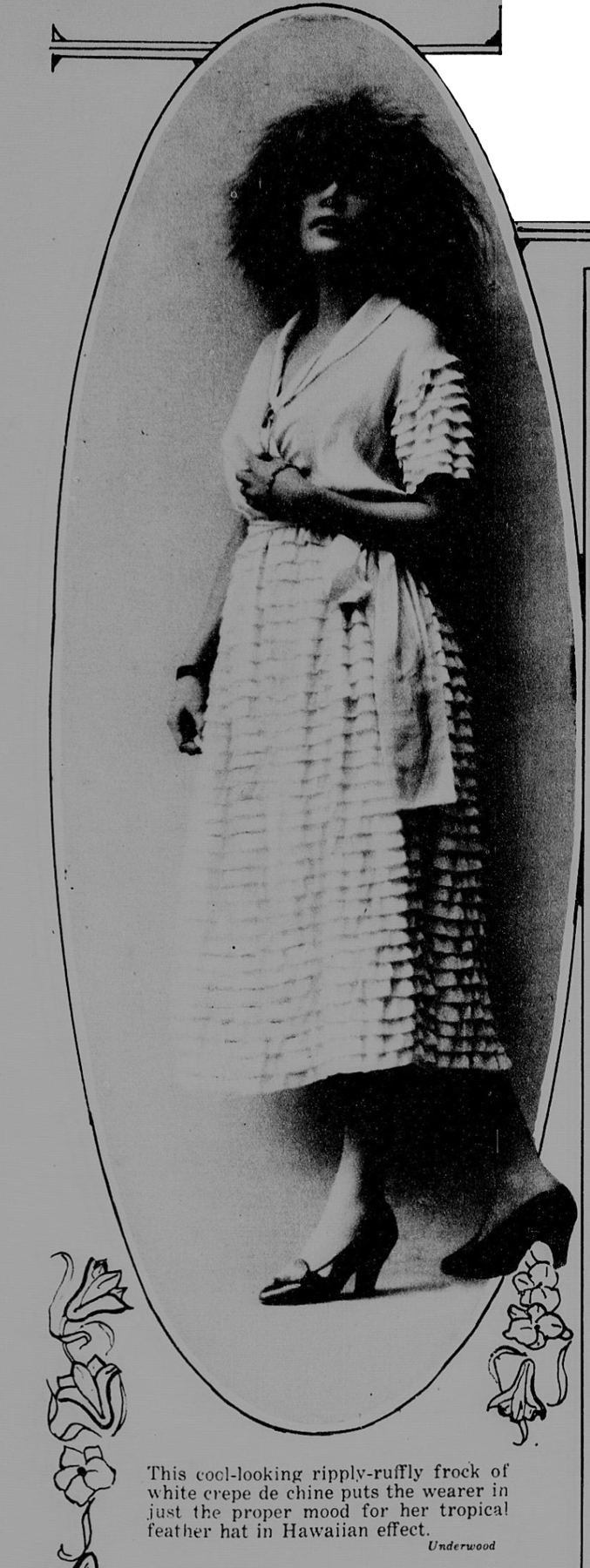
Hawaiian-based? fashion in New York, 1921.

[Found under: “Maison Fashion Offers These Eight Appealing Suggestions For Miss Manhattan’s Everyday Wardrobe For the Coming Spring and Summer”]

This cool-looking ripply-ruffly frock of white crepe de chine puts the wearer in just the proper mood for her tropical feather hat in Hawaiian effect.

Underwood

(New York Tribune, 3/13/1921, pt. 6, p. 12)

This cool-looking...

New York Tribune, Volume LXXX, Number 27,146, Part 6, Page 12. March 13, 1921.

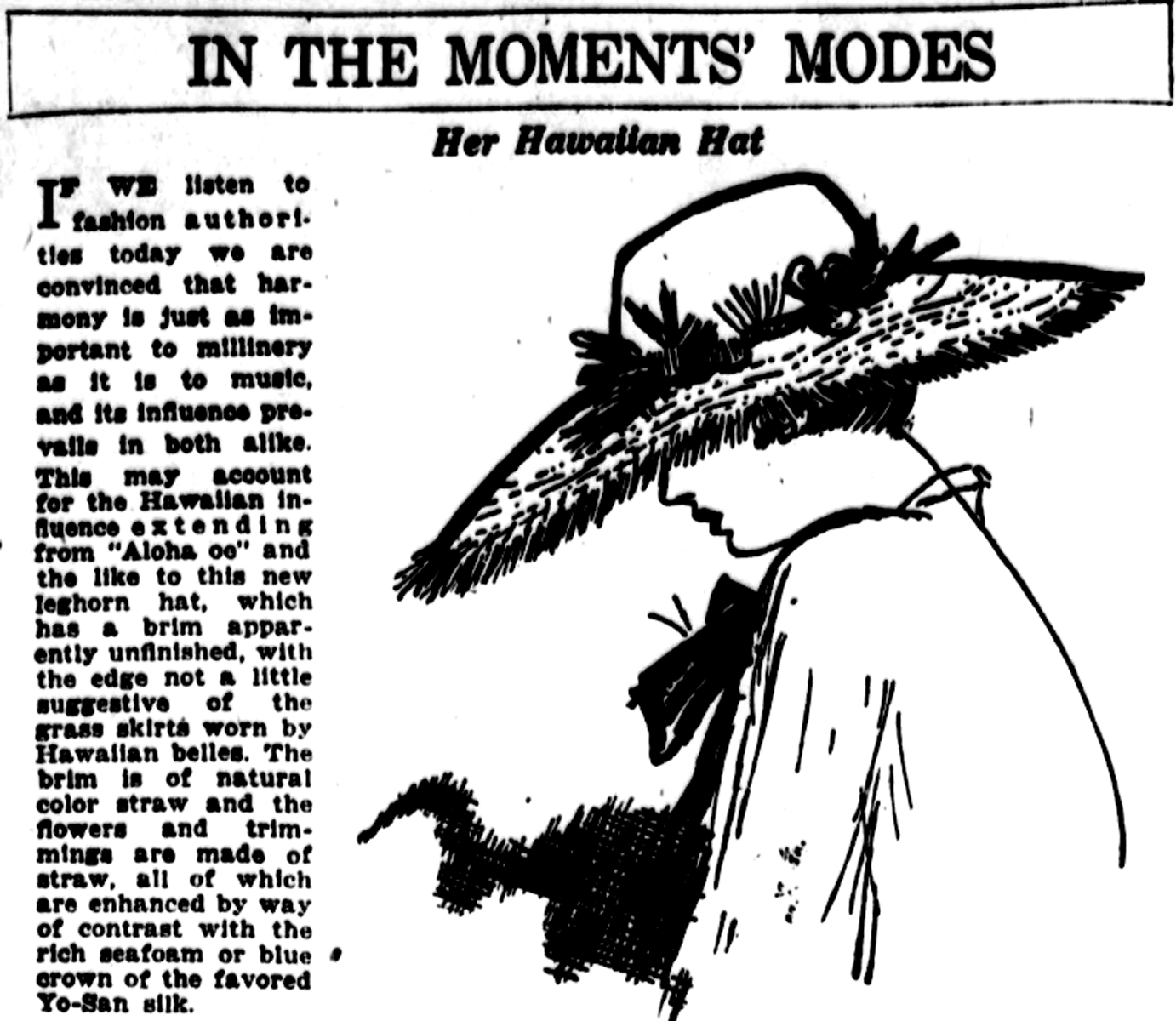
Hawaiian influence in music and fashion, 1917.

IN THE MOMENTS’ MODES

Her Hawaiian Hat

IF WE listen to fashion authorities today we are convinced that harmony is just important to millinery as it is to music, and its influence prevails in both alike. This may account for the Hawaiian influence extending from “Aloha oe” and the like to this new leghorn hat, which has a brim apparently unfinished, with the edge not a little suggestive of the grass skirts worn by Hawaiian belles. The brim is of natural color straw and the flowers and trimmings are made of straw, all of which are enhanced by way of contrast with the rich seafoam or blue crown of the favored Yo-San silk.

(Evening Ledger, 4/5/1917, p. 12)

IN THE MOMENTS' MODES

Evening Ledger, Volume III, Number 174, Page 12. April 5, 1917.

Ku kilakila o Kamehameha, Kuu home hoonaauao… rang out in Long Beach, 1926.

THERE WAS GREAT DELIGHT IN THE SINGING OF MISS LOUISE POHINA

A newspaper from Long Beach, California described how the recent singing of Miss Louise Pohina became something that the haole who showed up to hear her were greatly delighted in, joining in with those who went to offer their thanks and congratulations to her, the singers, and the skilled dancers.

There was a concert given in this city by the Ebell Club, with Miss Pohina singing some numbers and Lillian Edwards of Pasadena playing the piano; at the concert, the audience kept clapping for each song performed by Miss Pohina, and one of those songs was Kamehameha Waltz. Continue reading

The death of Prince Albert Kunuiakea, 1903.

PRINCE ALBERT KUNUIAKEA’S BODY BORNE IN STATE TO THE CAPITOL

Kamehameha III.  Prince Albert.  Queen Kalama.

PRINCE ALBERT AS AN INFANT.

From a picture hanging on the walls of the home of the late Prince Albert Kunuiakea. Made about 1853.

The Program of the Ceremonies Today.

In the old throne room of the Capitol Building, where royalty once held sway, the remains of Prince Albert Kunuiakea were laid in state yesterday afternoon. At 6 o’clock to the accompaniment of muffled drums and the solemn tread of soldiery the casket containing the body of the last heir presumptive of the Kamehamehas was brought from his late residence in Palama to the old royal estate where the Prince as a boy had been raised in the family of Kamehameha III. The procession from the residence was headed by a drum corps followed by four companies of the First Regiment of the National Guard of Hawaii. Behind the troops came the hearse bearing the royal casket, flanked by young Hawaiian chiefs bearing large and small feather kahilis. These were novel in the startling array of beautiful colored feathers and in the adaptation of ancient funeral customs. Behind the hearse came the mourners, the chiefs and chiefesses according to rank as recognized among the Hawaiians. When the military filed into the Capitol grounds they divided on each side of the driveway allowing the hearse to pass between serried lines of soldiers standing at present arms. Col. Soper and Capt. Hawes of the Governor’s staff, in full uniform, met the remains at the front entrance of the Capitol.

The casket was carried into the throne room and deposited upon a bier overspread with a beautiful pall of heavy black velvet faced with yellow silk. At the head was a magnificent feather kahili of black and yellow and candelabra authorized by the Roman Catholic church. Four huge kahilis, the tabu marks of the royal presence, designated the sacred enclosure and within this, six chiefs, three on each side of the bier, were placed upon watch, waving small kahilis in unison over the casket. From the old throne of the Kalakauas the crown flag of Hawaii was suspended and over the entrances the Hawaiian colors were draped. A beautiful array of palms upon the dais, together with the picturesque old throne room chairs, formed a pleasing picture. When the beautiful crystal candelabra were illuminated the scene beneath was spectacular.

The main staircase from the hallway was lined with palms. The waving of the kahilis, and the chanting of the genealogy of the Prince were continued through the night and will be a part of the weird ceremony until the casket is borne from the palace.

The committee on decorations was as follows: Mrs. Carrie Robinson, Mrs. Helen Holt, Mrs. Mary Beckley, Mrs. Ena, Mrs. A. P. Taylor, Mrs. Emmeline Magoon, Mrs. Alice Hutchinson, Miss Hilda Burgess, Miss May Low, Harry Davison, J. McGuire.

From 11 a. m. to 1 p. m. today the body will lie in state in the old throne room of the Capitol. From 1 to 1:20 p. m. the Roman Catholic service will be said, Pro Vicar Libert officiating. A detail of the National Guard was assigned as a guard of honor yesterday afternoon and will remain under arms until the procession moves this afternoon.

The order of procession today appears elsewhere in a By Authority notice.

[Might anyone know where this portrait is today?]

(Pacific Commercial Advertiser, 3/15/1903, p. 1)

PRINCE ALBERT KUNUIAKEA'S BODY BORNE IN STATE TO THE CAPITOL

Sunday Advertiser, Volume I, Number 11, Page 1. March 15, 1903.

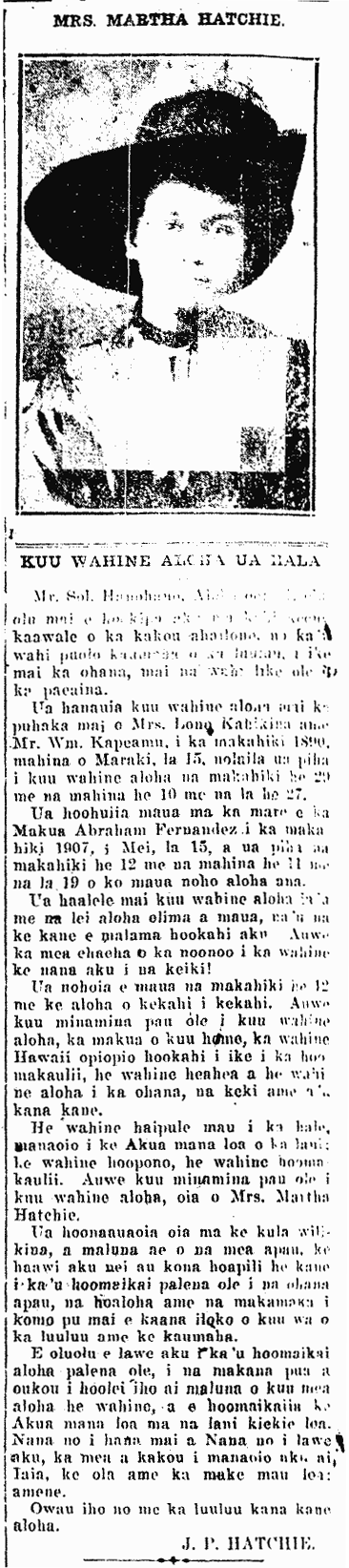
Martha Hatchie passes on, 1920.

MRS. MARTHA HATCHIE.

MY BELOVED WIFE HAS PASSED ON

Mr. Sol. Hanohano, Aloha oe: please welcome in some empty room in our messenger for this sad parcel that is placed above so that the family sees in all parts of this archipelago.

My beloved wife was born from the loins of Mrs. Lono Kahikina and Mr. William Kapeamu, in the year 1890, in the month of March, on the 15th day, therefore, my wife was 29 years and 10 months and 27 days old.

We were joined in marriage by the Father Abraham Fernandez in the year 1907, on May 15th, and we lived in aloha for 12 full years, 11 months, and 19 days.

My beloved wife left me and our five beloved lei for me, her husband to singly care for. Auwe, how painful to think of my wife when looking at the children!

We lived together for 12 years with love for each other. Auwe, my endless regret for my loving wife, the adult of our home, the one young Hawaiian woman who knew thrift; she was a welcoming woman, and a woman who loved her family, the children, and me, her husband.

My wife was always devout in the home, she had faith in the almighty God of the heavens, she was a respectable woman, and she was thrifty. Auwe, my endless sorrow for my beloved wife, Mrs. Martha Hatchie.

She was educated at the school of the nuns [?? St. Andrew’s Priory]; and above all, I, her companion, her husband, give my boundless thanks to all the family, companions, and friends who came and shared in our time of grief and sadness.

Please take my endless appreciation for the gifts of flowers that you strew upon my beloved, my wife, and blessed be the almighty god in the highest heavens. It is He who giveth and He who taketh away, the one in whom we trust; of Him is eternal life and death; amen.

Me, in sadness, her loving husband.

J. P. HATCHIE.

(Kuokoa, 1/23/1920, p. 2)

MRS. MARTHA HATCHIE.

Ka Nupepa Kuokoa, Buke LVIII, Helu 4, Aoao 2. Ianuari 23, 1920.

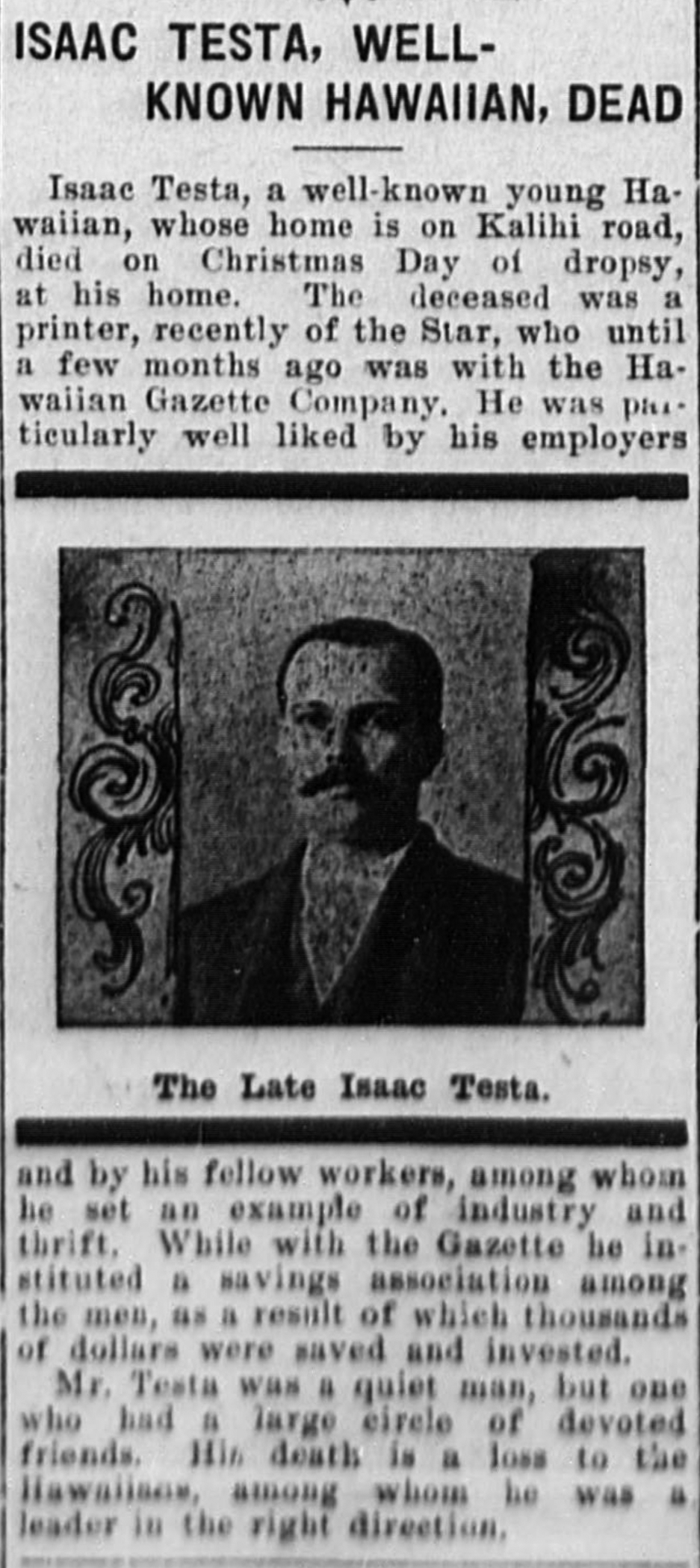
Isaac Testa dies, 1909.

ISAAC TESTA, WELL-KNOWN HAWAIIAN, DEAD

Isaac Testa, a well-known young Hawaiian, whose home is on Kalihi road, died on Christmas Day of dropsy, at his home. The deceased was a printer, recently of the Star, who until a few months ago was with the Hawaiian Gazette Company. He was particularly well liked by his employers…

The Late Isaac Testa.

…and by his fellow workers, among whom he set an example of industry and thrift. While with the Gazette he instituted a savings association among the men, as a result of which thousands of dollars were saved and invested.

Mr. Testa was a quiet man, but one who had a large circle of devoted friends. His death is a loss to the Hawaiians, among whom he was a leader in the right direction.

[It seems that this is the son of the sister of Hoke (Francisco Jose Testa).]

(Hawaiian Gazette, 12/28/1909, p. 3)

ISAAC TESTA, WELL-KNOWN HAWAIIAN, DEAD

Hawaiian Gazette, Volume LII, Number 104, Page 3. December 28, 1909.

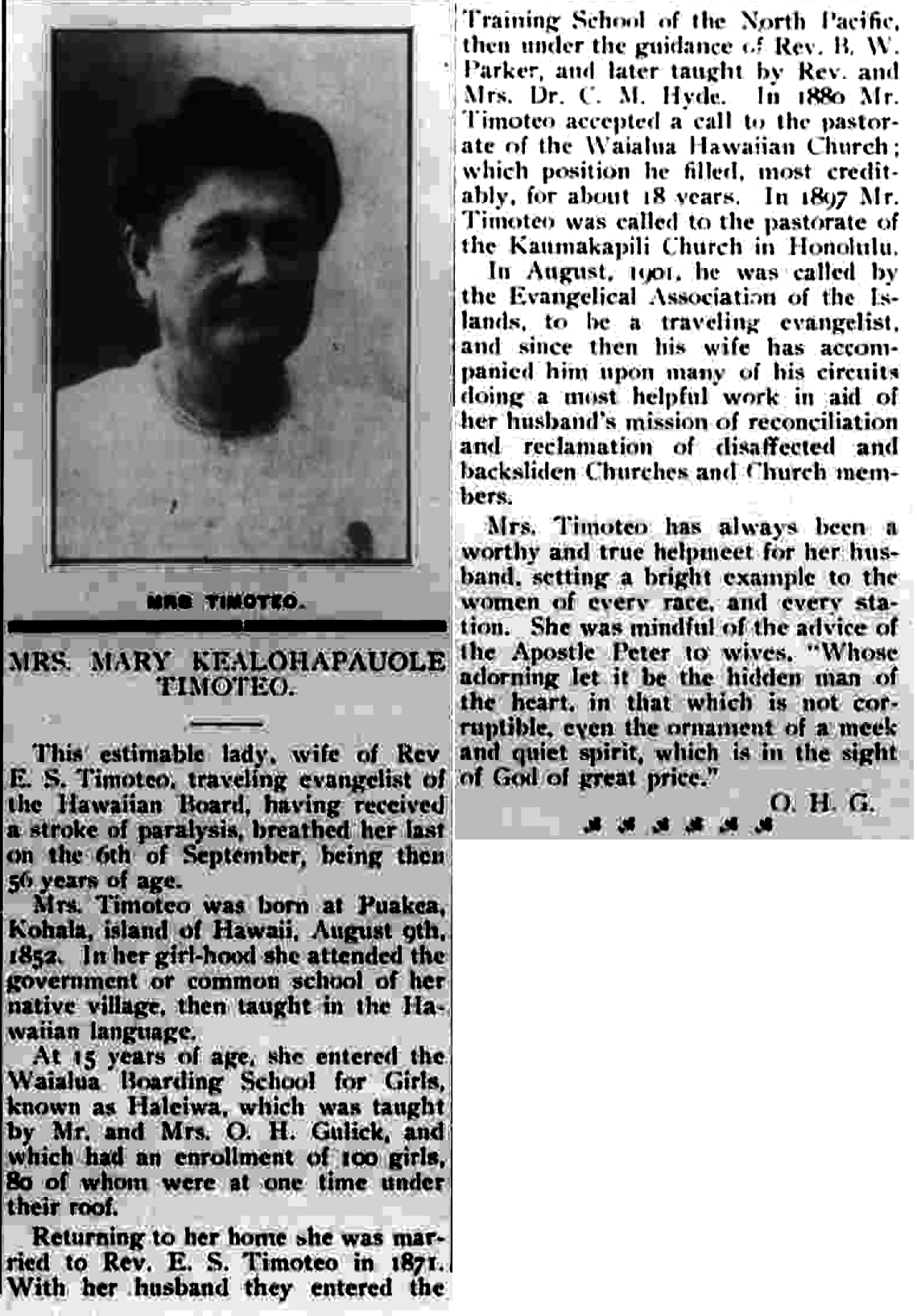
Mary Kealohapauole Timoteo passes away, 1908.

MRS. TIMOTEO.

MRS. MARY KEALOHAPAUOLE TIMOTEO.

This estimable lady, wife of Rev. E. S. Timoteo, traveling evangelist of the Hawaiian Board, having received a stroke of paralysis, breathed her last on the 6th of September, being then 56 years of age.

Mrs. Timoteo was born at Puakea, Kohala, island of Hawaii, August 9th, 1852. In her girl-hood she attended the government or common school of her native village, then taught in the Hawaiian language.

At 15 years of age, she entered the Waialua Boarding School for Girls, known as Haleiwa, which was taught by Mr. and Mrs. O. H. Gulick, and which had an enrollment of 100 girls, 80 of whom were at one time under their roof.

Returning to her home she was married to Rev. E. S. Timoteo in 1871. With her husband they entered the Training School of the North Pacific, then under the guidance of Rev. B. W. Parker, and later taught by Rev. and Mrs. Dr. C. M. Hyde. In 1880 Mr. Timoteo accepted a call to the pastorate of the Waialua Hawaiian Church [Liliuokalani Protestant Church]; which position he filled, most creditably, for about 18 years. In 1897 Mr. Timoteo was called to the pastorate of the Kaumakapili Church in Honolulu.

In August, 1901, he was called by the Evangelical Association of the Islands, to be a traveling evangelist, and since then his wife has accompanied him upon many of his circuits doing a most helpful work in aid of her husband’s mission of reconciliation and reclamation of disaffected and backsliden Churches and Church members.

Mrs. Timoteo has always been a worthy and true helpmeet for her husband, setting a bright example to the women of every race, and every station. She was mindful of the advice of the Apostle Peter to wives, “Whose adorning let it be the hidden man of the heart, in that which is not corruptible, even the ornament of a meek and quiet spirit, which is in the sight of God of great price.”

O. H. G.

[This publication, The Friend, is word-searchable, and can be found on the Mission Houses Museum website here.]

(Friend, 10/1908, p. 16)

MRS. MARY KEALOHAPAUOLE TIMOTEO.

The Friend, Volume LXV, Number 10, Page 16. October, 1908.