Pictures from the past and taking clear images of the newspapers, 1916/2012.

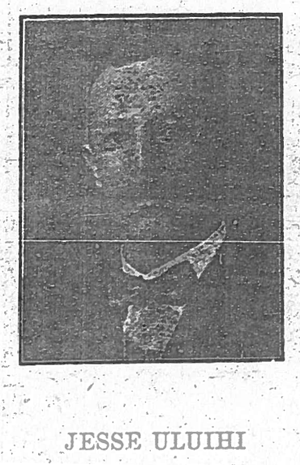
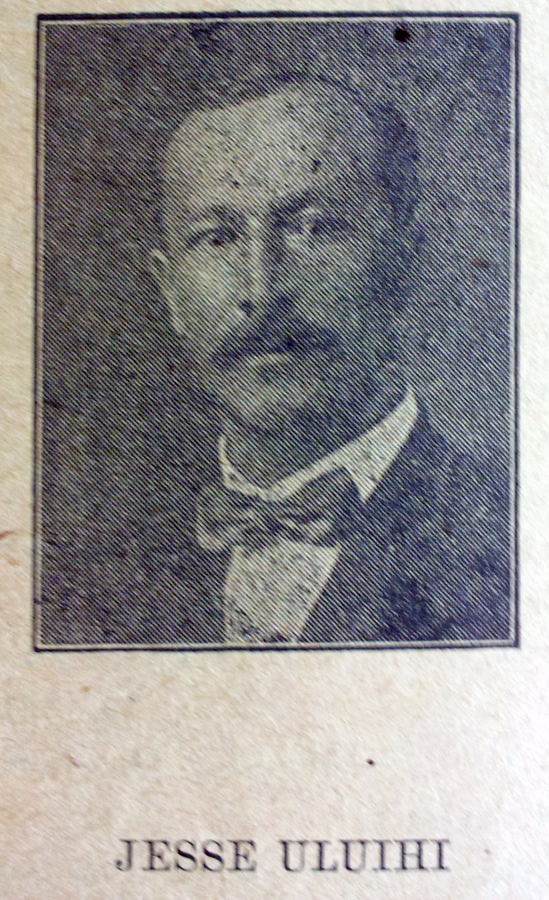
Below are three images of the Jesse Uluihi from the same issue of the newspaper. The first is what you get online, the second from the microfilm, and the third is a shot taken with an average camera (I assume that if scanned on a modern large scanner like at Hamilton Library at UHM, it would be even better).

Online image:

JESSE ULUIHI (online)

Ke Aloha Aina, Buke XXI, Helu 56, Aoao 4. Novemaba 3, 1916.

Microfilm image:

JESSE ULUIHI (microfilm)

Ke Aloha Aina, Buke XXI, Helu 56, Aoao 4. Novemaba 3, 1916.

Image from original newspaper:

JESSE ULUIHI (average camera)

Ke Aloha Aina, Buke XXI, Helu 56, Aoao 4. Novemaba 3, 1916.

Canoe Building, 1924.

The Art of Canoe Building is Being Revived in Hawaii

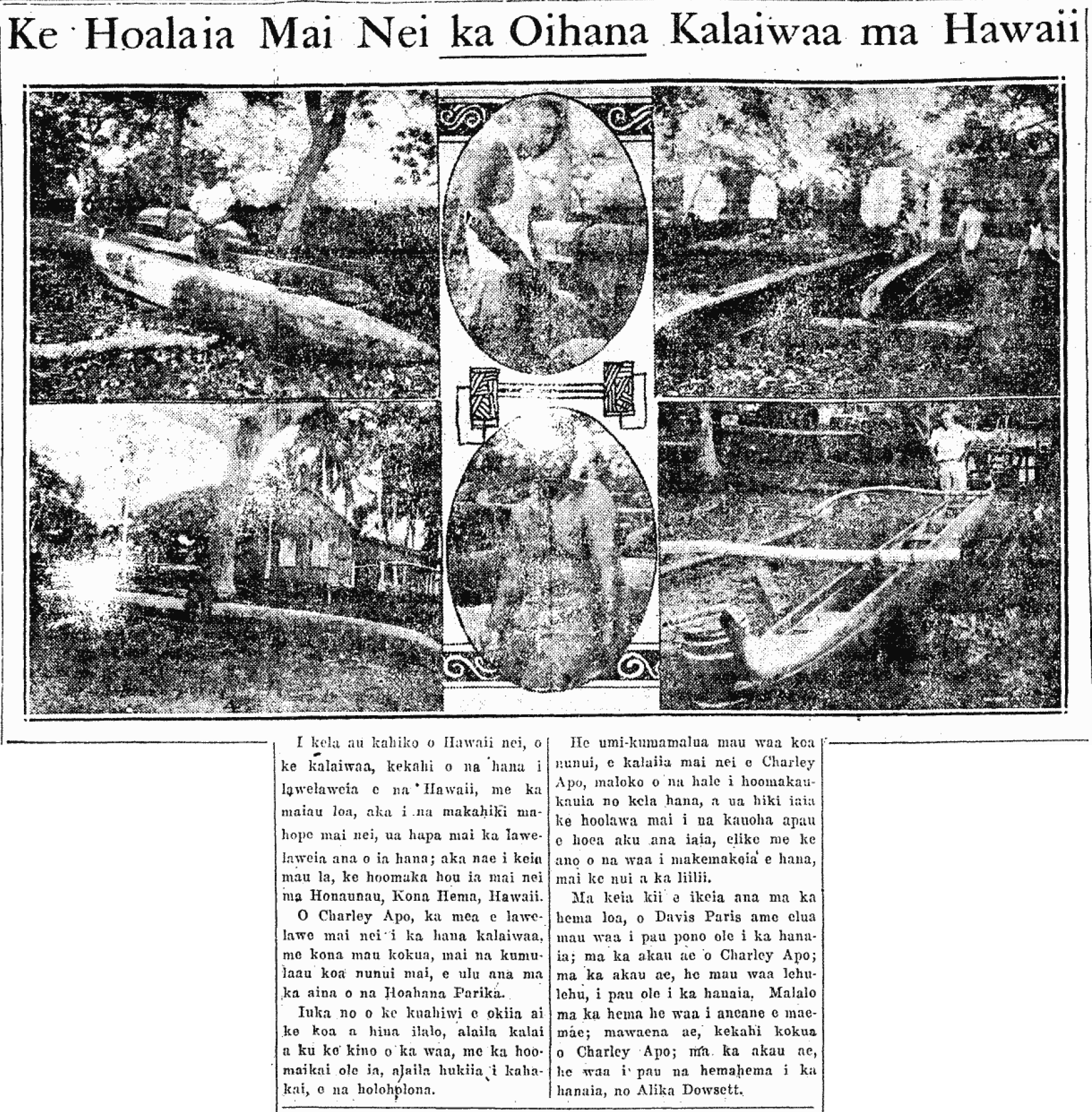
In the olden days of Hawaii nei, canoe building [kalaiwaa] was one of the occupations deftly done by Hawaiians, but during the years since, this work has gone down to but a fraction; but these days, it is being started up once again in Honaunau, South Kona, Hawaii.

Charley Apo along with his assistants are undertaking this endeavor of carving waa from large koa trees growing on the land of Paris and Company [Hoahana Parika ?].

The koa is fell in the high mountains, then it is roughly carved out into the form of a waa, and then dragged to sea by animals.

Twelve large waa are being carved by Charley Apo in a building prepared for this work, and he is able to fill all orders that he receives as per specifications wanted, from large to small.

In the picture on the far left, Davis Paris can be seen with two waa that are unfinished; to the right is Charley Apo ; to the right of that are many unfinished waa. Below on the left is a nearly finished waa; in the middle is an assistant of Charley Apo; to the right of that is a roughly completed waa for Alika Dowsett.

[I wish the newspapers were reshot clearly so not only the words are sharp and legible, but so that pictures and images are as clear as possible…]

(Kuokoa, 6/5/1924, p. 2)

Ke Hoalaia Mai Nei ka Oihana Kalaiwaa ma Hawaii

Ka Nupepa Kuokoa, Buke LXIII, Helu 23, Aoao 2. Iune 5, 1924.

Nelson P. Watson’s son dies at Kalaupapa, 1924.

AN EXPRESSION OF LOVE FOR MY DEAR CHILD MANLEY DEDRICK WASTON.

Mr. Solomon Hanohano, Editor of the Newspaper Kuokoa, Aloha oe:—Please be so kind as to insert in some vacant space of your paper, so that the family, intimates, and friends may know that my dearly beloved child, Manley Dedrick Waston has left this life.
He was ill for just a few days, when on the 28th of Friday in the month of this past May at dawn, he grew weary of this life in Kalaupapa, Molokai.
He was born in Kahana, Koolauloa, Oahu on the 27th of December 1906, therefore, he made 17 years, 4 months, and 5 days.
Within one year or so of life after he was born…

MANLEY DEDRICK WATSON

…his mother left him and his two sisters, Lillian and Emma Waston.
From the loins of mine and my wife, there were 4 children: 2 were taken away, and 2 girls are left living. So he was burdened by me without a wife for almost 14 years.
He was separated from me because of the “disease which separates families” [mai hookaawale ohana]. Alas for my grief for my dearly beloved child! My burden that I bear alone; who’d be without aloha; he is with me wherever I go.
Aloha to that blossom who began to bloom but faded soon after!
O Kalaupapa, you all will never see the youthful face of my son again, passing before your faces; I sit with grief and sadness, but I find solace in the Lord Jesus, for he is sleeping in the Lord Jesus, for I know that one day I will be with him again in this body, in that life, and we will kiss, with all of my children, and their mother, after that great terrifying day of Jehovah.
I am grateful for all those who attended his funeral and for all their assistance.
Sincerely,
Nelson P. Watson,
Colburn Street, Honolulu.

(Kuokoa, 6/5/1924, p. 6)

HE HOALOHALOHA NO KUU KEIKI MANLEY DEDRICK WASTON.
Ka Nupepa Kuokoa, Buke LXIII, Helu 23, Aoao 6. Iune 5, 1924.

More on E. K. Rose, Prince Lei Lani, 1924.

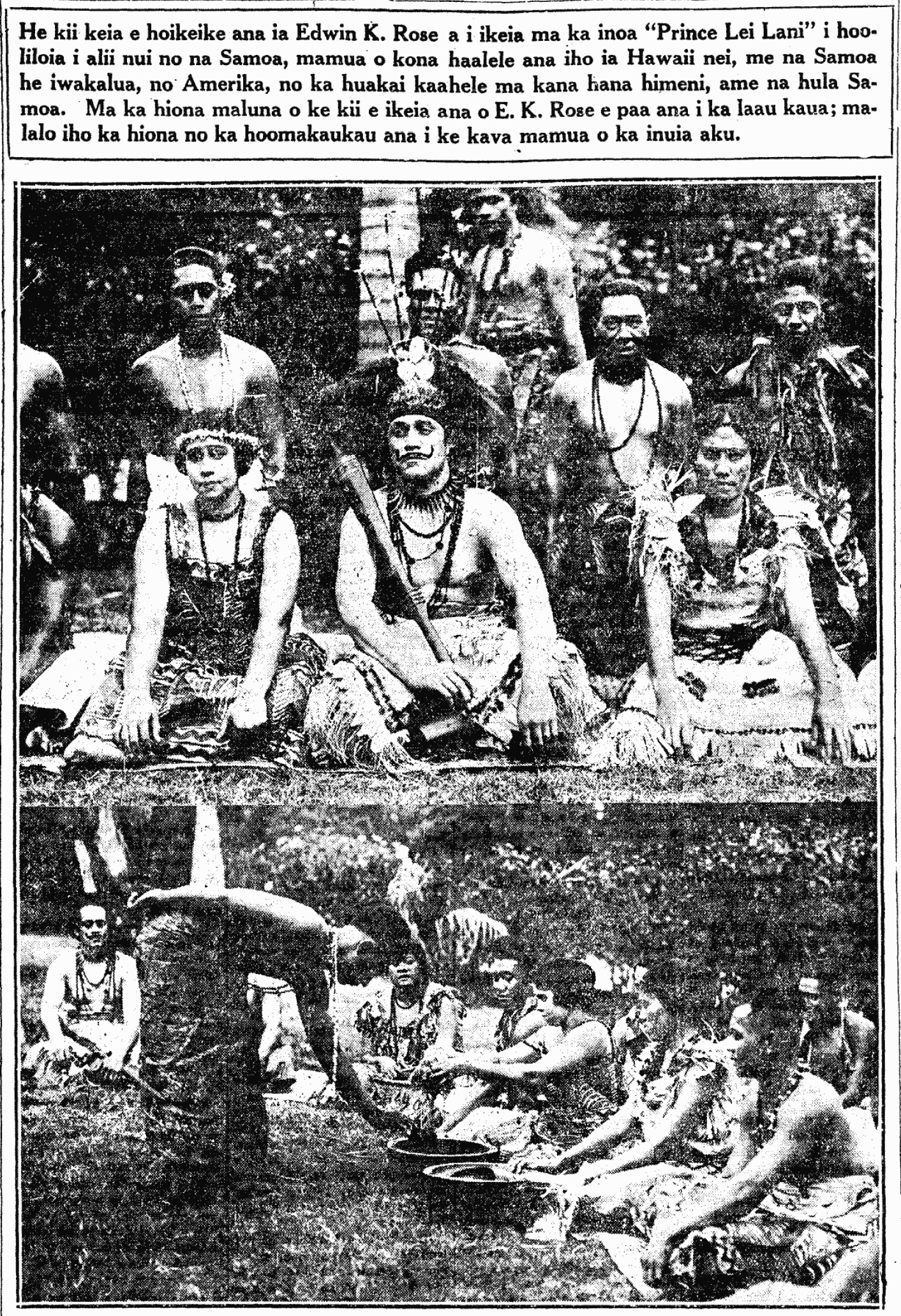
This is a picture showing Edwin K. Rose known by the name “Prince Lei Lani,” who was made a high chief of the Samoans, before he left Hawaii nei with twenty Samoans for America on a singing and Samoan dancing tour. In the scene on the top picture seen is E. K. Rose holding a war club; and below is a scene showing the preparation of kava before it being drunk.

(Kuokoa, 7/24/1924, p. 2)

He kii keia e hoikeike ana ia Edwin K. Rose...

Ka Nupepa Kuokoa, Buke LXIII, Helu 30, Aoao 2. Iulai 24, 1924.

Voice from the past, 1924.

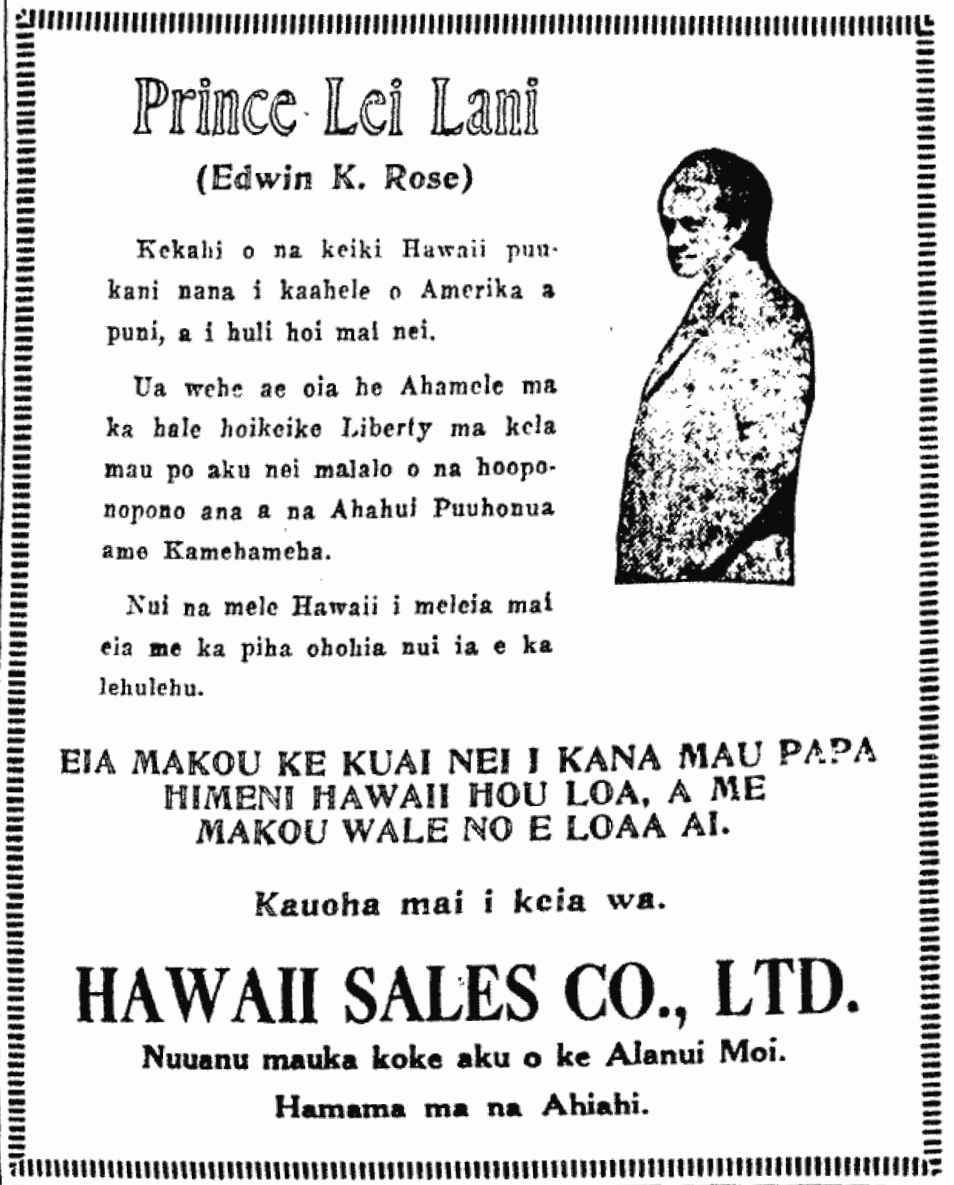
Prince Lei Lani

(Edwin K. Rose)

One of the Hawaiian singers who is touring all over America, and returned home.

He held a Concert at the Liberty Theater the other night organized by the Hawaiian Protective Association [Ahahui Puuhonua] and the Royal Order of Kamehameha [Ahahui Kamehameha].

There were many Hawaiian songs sung by him which were highly acclaimed by the crowd.

WE ARE SELLING HIS BRAND NEW HAWAIIAN RECORDS, AND WE ARE THE ONLY ONES WHO HAVE THEM.

Put in your orders now.

HAWAII SALES CO., LTD.

Nuuanu mauka near King Street.

Open in the Evenings.

(Kuokoa, 4/10/1926, p. 6)

Prince Lei Lani

Ka Nupepa Kuokoa, Buke LXIII, Helu 15, Aoao 6. Aperila 10, 1924.

Play of Pele and Lohiau at Hawaii Theater, 1925.

Tableau of the Hawaiian Dramatic Club

The Tableau of Pele and Lohiau shown in the Hawaii Theater [Halekeaka Hawaii] last Friday by the Hawaiian Dramatic Club. The play will be shown at Los Angeles, on the journey of the Royal Order of Kamehameha [Ahahui Kamehameha] for the city day coming up in June.

(Kuokoa, 4/23/1925, p. 5)

Tabalo a ka Haw'n Dramatic Club

Ka Nupepa Kuokoa, Buke LXIV, Helu 17, Aoao 5. Aperila 23, 1925.

Description of Yedo, capital of Japan, 1860.

Yedo.

This is the capital of the nation of Japan; it is a grand city. It is built by the sea, by a great and fine harbor; but large ships cannot approach it.

The land surrounding that city is beautiful, and is well farmed, and there are many shade trees and fruit trees. Inland of the city of Yedo, there is a tall mountain from 12,000 to 16,000 feet, almost like Mauna Kea; it is topped by snow and a caldera like Mauna Loa. It is a sacred mountain for the people there, they go there to worship and to repent for their sins.

In the city of Yedo, there are five forts which are equipped with cannons; there are a great number o people, and houses are crowded together, but the houses are not nice, they are dilapidated. They are not painted, and not improved.

Shops are small, not like here in Honolulu. Some houses however, of the distinguished people, are nice, and they are surrounded by fine trees. The streets of the city are wide, and straight, and clean as well. The houses of the alii there are restricted, men and women cannot enter; only when given permission can they enter. They are surrounded by great and tall walls. The length of this city is twenty miles, and the width is twelve miles. The population is not clear; it is said that the number of people in that city is almost three million.

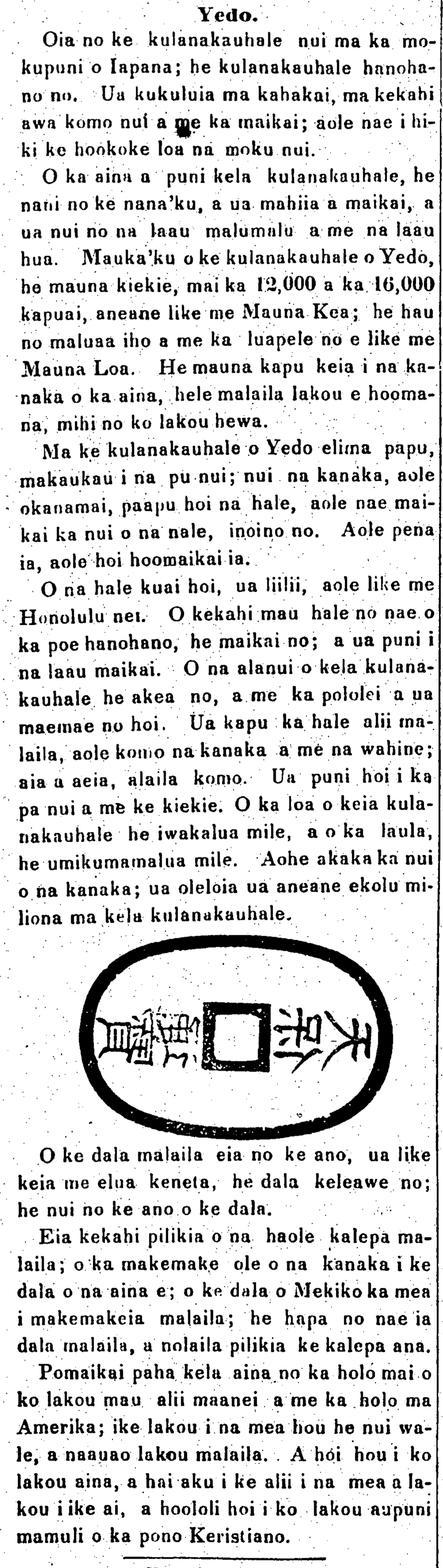
The currency there is like this; this is similar two cents, and it is a copper coin; there are a many variety of currency.

Here is a problem that the haole traders have there: the fact that people there don’t want foreign money; Mexican currency is what is wanted, and so trading is problematic.

Perhaps this land would benefit by their chiefs coming here and to America; they would see many new things and get educated. And they’d return to their land and tell the alii what they saw, and then reform their land following the tenants of Christianity.

[This is just a few years after Japan was forced to end its sakoku policy by the United States and Perry (1854).

The image of the coin is a mirror image.]

(Hae Hawaii, 3/21/1860, p. 202)

Yedo.

Ka Hae Hawaii, Buke 4, Helu 51, Aoao 202. Maraki 21, 1860.

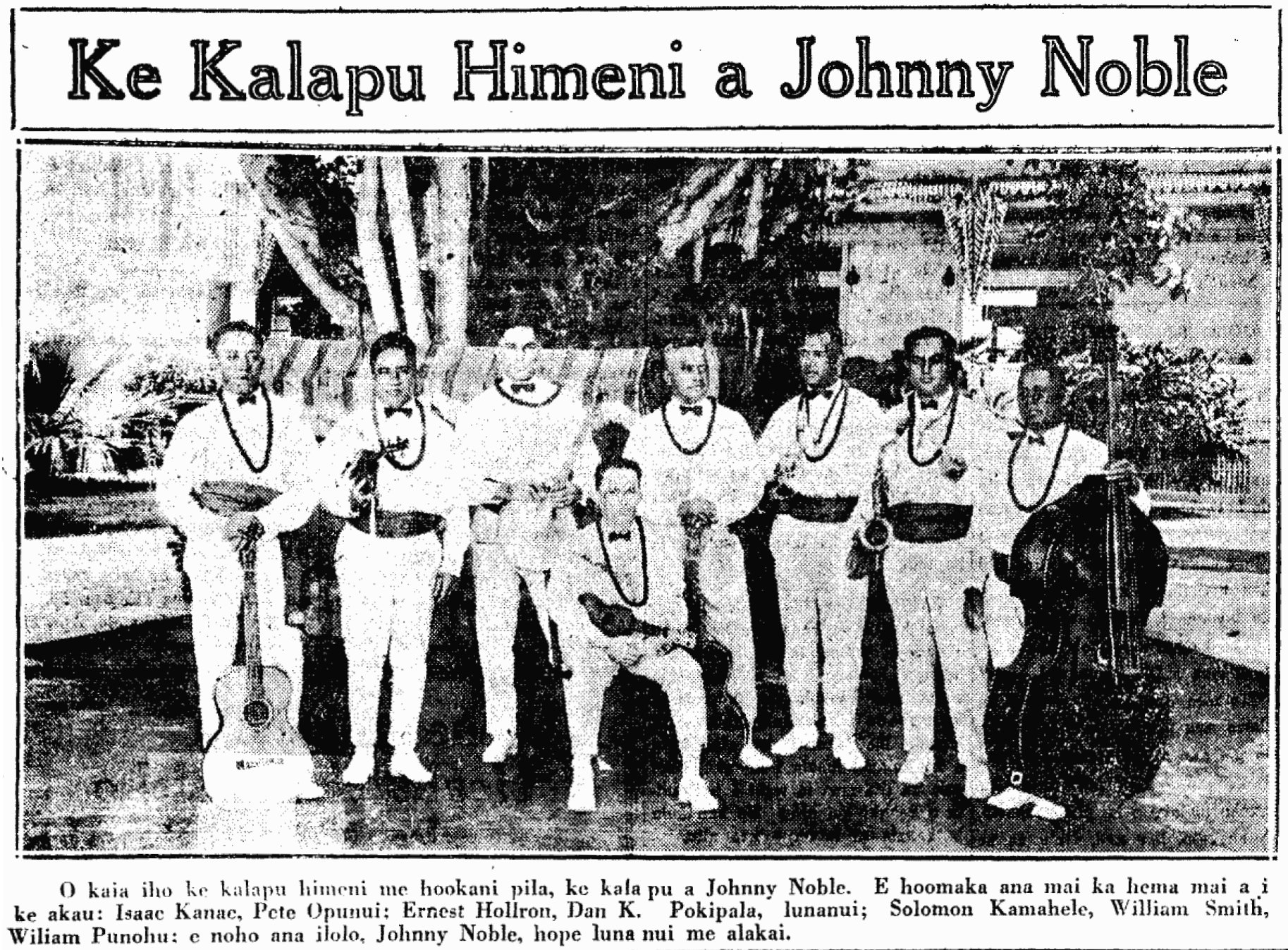
Johnny Noble’s band, 1925.

Johnny Noble’s Singing Group

This is the singing group and band, the club of Johnny Noble. Starting from the left to right, Isaac Kanae, Pete Opunui, Ernest Hollron, Dan K. Pokipala (manager), Solomon Kamahele, William Smith, William Punohu, and seated is Johnny Noble (second in charge and leader of the band).

[If this image looks familiar to you and you were following the Hoolaupai page on Facebook, i am reposting past articles i previously put up there, so that they can be easily searched here at http://nupepa-hawaii.com. I try to categorize it under “repost” when i remember…]

(Kuokoa, 4/23/1925, p. 5)

Ke Kalapu Himeni a Johnny Noble

Ka Nupepa Kuokoa, Buke LXIV, Helu 17, Aoao 5. Aperila 23, 1925.

Use of tradition for propaganda, 1896.

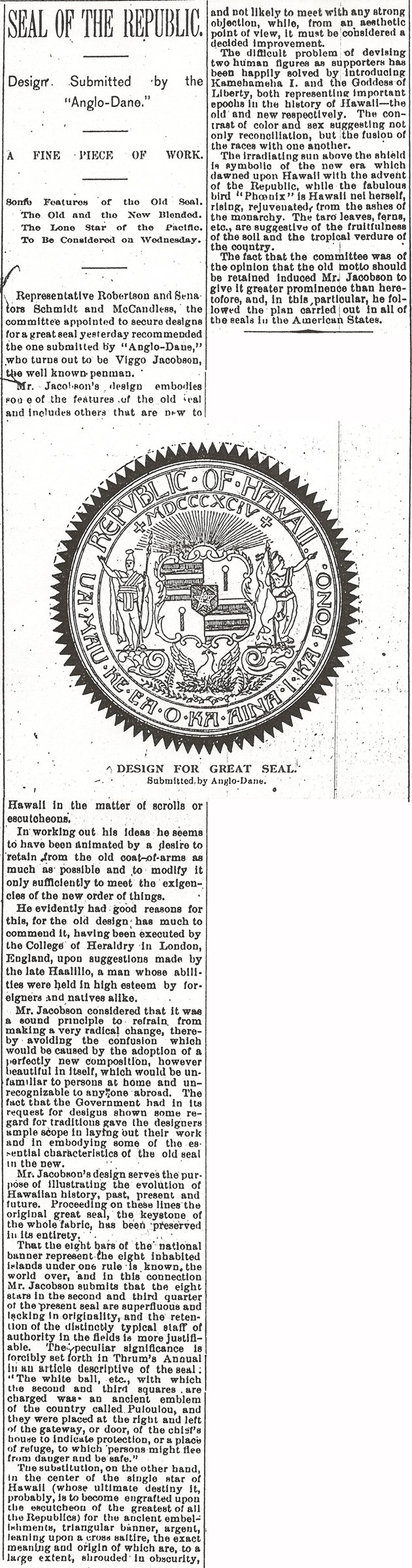
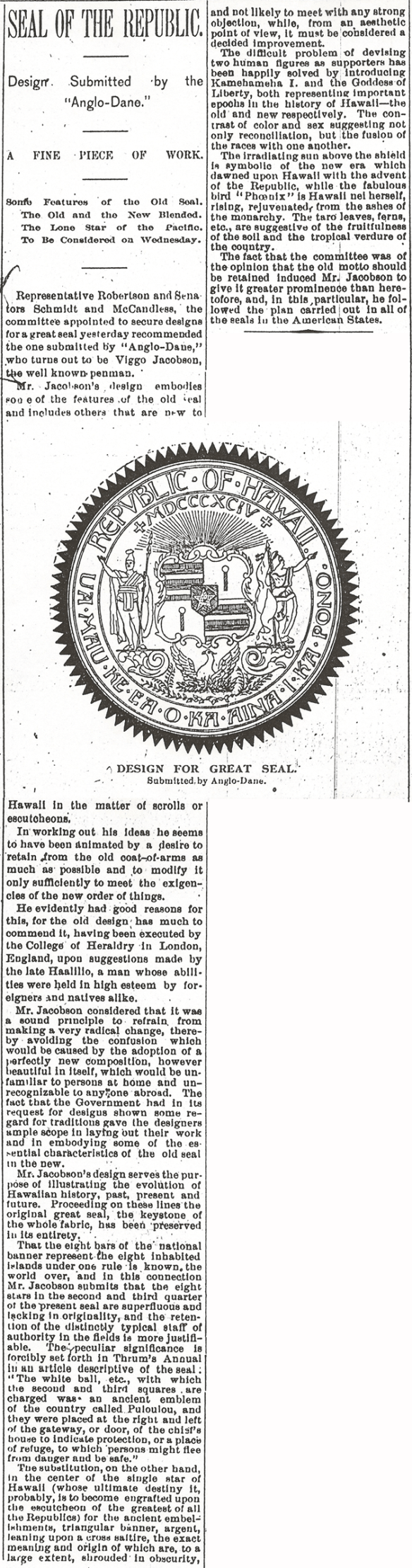
SEAL OF THE REPUBLIC.

Design Submitted by the “Anglo-Dane.”

A FINE PIECE OF WORK.

Some Features of the Old Seal. The Old and the New Blended. The Lone Star of the Pacific. To be Considered on Wednesday.

Representative Robertson and Senators Schmidt and McCandless, the committee appointed to secure designs for a great seal yesterday recommended the one submitted by “Anglo-Dane,” who turns out to be Viggo Jacobson, the well known penman.

Mr. Jacobson’s design embodies some of the features of the old seal and includes others that are new to Hawaii in the matter of scrolls or escutcheons.

In working out his ideas he seems to have been animated by a desire to retain from the old coat-of-arms as much as possible and to modify it only sufficiently to meet the exigencies of the new order of things.

He evidently had good reasons for this, for the old design has much to commend it, having been executed by the College of Heraldry in London, England, upon suggestions made by the late Haalilio, a man whose abilities were held in high esteem by foreigners and natives alike.

Mr. Jacobson considered that it was a sound principle to refrain from making a very radical change, thereby avoiding the confusion which would be caused by the adoption of a perfectly new composition, however beautiful in itself, which would be unfamiliar to persons at home and unrecognizable to anyone abroad. The fact that the Government had in its request for designs shown some regard for traditions gave the designers ample scope in laying out their work and in embodying some of the essential characteristics of the old seal in the new.

Mr. Jacobson’s design serves the purpose of illustrating the evolution of Hawaiian history, past, present and future. Proceeding on these lines the original great seal, the keystone of the whole fabric, has been preserved in its entirety.

That the eight bars of the national banner represent the eight inhabited islands under one rule is known, the world over, and in this connection Mr. Jacobson submits that the eight stars in the second and third quarter of the present seal are superfluous and lacking in originality, and the retention of the distinctly typical staff of authority in the fields is more justifiable. The peculiar significance is forcibly set forth in Thrum’s Annual in an article descriptive of the seal: “The white ball, etc., with which the second and third squares are charged was an ancient emblem of the country called Puloulou, and they were placed at the right and left of the gateway, or door, of the chief’s house to indicate protection, or a place of refuge, to which persons might flee from danger and be safe.”

The substitution, on the other hand, in the center of the single star of Hawaii (whose ultimate destiny it, probably, is to become engrafted upon the escutcheon of the greatest of all the Republics) for the ancient embellishments, triangular banner, argent, leaning upon a cross saltire, the exact meaning and origin of which are, to a large extent, shrouded in obscurity, and not likely to meet with any strong objection, while, from an aesthetic point of view, it must be considered a decided improvement.

The difficult problem of devising two human figures as supporters has been happily solved by introducing Kamehameha I. and the Goddess of Liberty, both representing important epochs in the history of Hawaii—the old and new respectively. The contrast of color and sex suggesting not only reconciliation, but the fusion of the races with one another.

The irradiating sun above the shield is symbolic of the new era which dawned upon Hawaii with the advent of the Republic, while the fabulous bird “Phœnix” is Hawaii nei herself, rising, rejuvenated, from the ashes of the monarchy. The taro leaves, ferns, etc., are suggestive of the fruitfulness of the soil and the tropical verdure of the country.

The fact that the committee was of the opinion that the old motto should be retained induced Mr. Jacobson to give it greater prominence than theretofore, and, in this particular, he followed the plan carried out in all of the seals in the American States.

(Pacific Commercial Advertiser, 2/25/1896, p. 1)
SEAL OF THE REPUBLIC.

The Pacific Commercial Advertiser, Volume XXIII, Number 4234, Page 1. February 25, 1896.