More on the “King of the Cannibal Islands,” 1873.

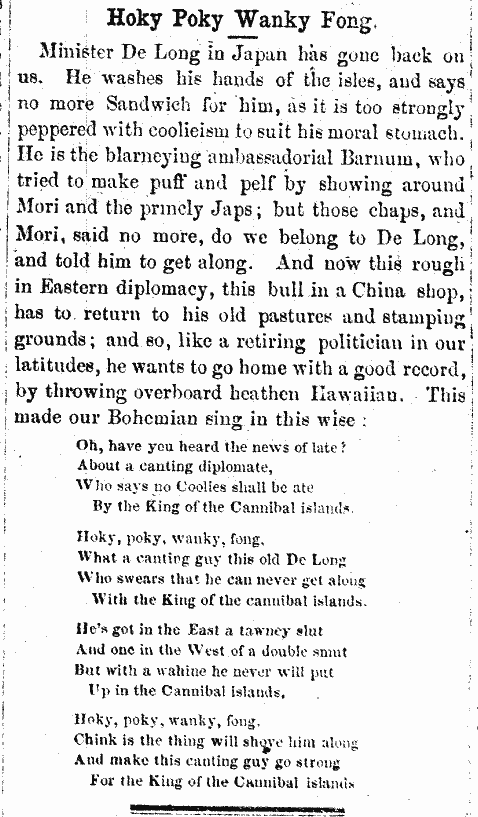
Hoky Poky Wanky Fong.

Minister De Long in Japan has gone back on us. He washes his hands of the isles, and says no more Sandwich for him, as it is too strongly peppered with coolieism to suit his moral stomach. He is the blarneying ambassadorial Barnum, who tried to make a puff and pelf by showing around Mori and the princly Japs; but those chaps, and Mori said no more, do we belong to De Long, and told him to get along. And now this rough in Eastern diplomacy, this bull in a China shop, has to return to his old pastures and stamping grounds; and so, like a retiring politician in our latitudes, he wants to go home with a good record, by throwing overboard heathen Hawaiian. This made our Bohemian sing in this wise:

Oh, have you heard the news of late?
About a canting diplomate,
Who says no Coolies shall be ate
By the King of the Cannibal islands.

Hoky, poky, wanky, fong,
What a canting guy this old De Long
Who swears that he can never get along
With the King of the cannibal islands.

He’s got in the East a tawney slut
And one in the West of a double smut
But with a wahine he never will put
Up in the Cannibal islands.

Hoky, poky, wanky, fong,
Chink is the thing will shove him along
And make this canting guy go strong
For the King of the Cannibal islands.

(Nuhou, 4/15/1873, p. 3)

Hoky Poky Wanky Fong.

Nuhou, Volume I, Number 15, Aoao 3. Aperila 15, 1873.

Wailuku memorial for Queen Liliuokalani, 1917.

[Found under: “QUEEN’S DEATH WIDELY MOURNED AROUND ISLANDS”]

WAILUKU, Maui, Nov. 23.—Most interesting services were held on Sunday in memory of Queen Liliuokalani. At the Church of the Good Shepherd at the usual hour of service, Rev. J. Charles Villiers preached a most interesting sermon, speaking of the good life of the queen and what she had done for her people and for Hawaii. There was a large and most appreciative audience.

At the Kaahumanu church there was also an unusually large audience, many coming from Waikapu, and the Japanese church in Wailuku, in honor of the queen. Revs. L. B. Kaumeheiwa and Rowland B. Dodge spoke upon the queen’s life and how much it meant that after the changes that had come in the government here the queen should have done so much to welcome and assist all the people of Hawaii irrespective of nationality.

References to the queen were also made in the Kahului Union chuch and the Makawao Union church by the pastors, though no special memorial services were held.

On Sunday evening at the Wailuku Union church, Rev. W. B. Coale of Lahaina, preached a strong sermon upon  “The Divine Silence.” He was listened to by a most appreciative audience.

(Honolulu Star-Bulletin, 11/24/1917, p. 37)

WAILUKU...

Honolulu Star-Bulletin, Volume XXV, Number 7993, Page 37. November 24, 1917.

Report of deaths in Japan, 1900.

By the Hongkong Maru.

Word was received by the Hongkong Maru from the Orient that Rev. David Keaweamahi, who left here about twelve years ago for Japan to undergo treatment for leprosy, died in Tokyo on the 29th of July last of consumption. No signs of the disease was visible on his face. He was buried that same evening, a large concourse of friends following his remains to the grave

W. H. Cummings died on July 15th at the Kusatsu springs and was buried there.

(Independent, 8/14/1900, p. 3)

By the Hongkong Maru.

The Independent, Volume XI, Number 1584, Page 3. August 14, 1900.

Sumo in Hawaii, 1914.

BRAWNY MEN OF JAPAN HERE TO SHOW THEIR ART

Big Troupe of Wrestles Arrives on Tenyo Maru—Matches Begin Saturday

Headed by Tachiyama, mightiest wrestler of all Japan, a troupe of 54 of the greatest mat artists of Dai Nippon arrived this morning on the T. K. K. liner Tenyo Maru. They have come to Honolulu for a series of performances, beginning on Saturday night at Athletic park.

Tremendous big fellows, mighty of girth and of limb, are these  Japanese wrestlers, and as they lined the deck of the Tenyo Maru this morning they attracted the immediate attention of the thousands of Japanese and others who had assembled at the dock. The picturesque dress of the Nipponese wrestler—silken over-kimono, a sort of under-garment falling below the knees, girdle, and above all the peculiar headdress—make the athletes conspicuous anywhere, and they are still more conspicuous because of their size, far greater than that of the ordinary Japanese.

The wrestlers will be in Hawaii for several weeks. The arrangements for the series of matches at Athletic park are nearly complete. The matches start at 7 o’clock on Saturday night, and a number of local Japanese athletes are anxious to match skill and brawn against the famed champions from the empire.

This morning and informal committee of Japanese went out to the Tenyo Maru to receive the wrestlers. Arthur K. Ozawa, who has been somewhat in charge of the advance arrangements here, and several Japanese newspapermen met the steamer off port. At the dock to receive their comrades were W. Uchiumi and K. Yamanishi, who arrived here on May 22 as advance agents for the troupe. Uchimi is a retired wrestler and will probably act as referee at some of the matches.

The wrestlers will be matched somewhat according to weight and previous records. Tachiyama is billed to appear every night. He has been the undisputed champion of Japan since he won the title in a series of desperate matches with contenders for the crown left by Hitachiyama, an old veteran who was declared to be the greatest of all Japan’s champions.

Tachiyama has amassed a fortune estimated at half a million dollars during his career. He is a big, good-natured man, standing about six feet three inches and weighing in the neighborhood of 315 pounds. He is said to be quick in spite of his enormous size. Many of these wrestlers seem to be mountains of flesh, which is an advantage at the Japanese style of wrestling in short, furious bouts much like two bulls locking horns.

Spectators at Athletic park recently have noticed a high skeleton tower of wood being erected in deep center field and wondered what the structure was for. This is put up to observe and old custom in Japanese wrestling circles. Early in the morning on the day when matches are to take place, a gong is beaten for a half hour to an hour by a herald who announces the matches.

Champion Wrestler of All Japan Here With Comrades

Tachiyama (“Mountain of Swords”), who is the premier mat artist of Japan, will appear nightly at the local matches.

(Honolulu Star-Bulletin, 7/9/1914, p. 9)
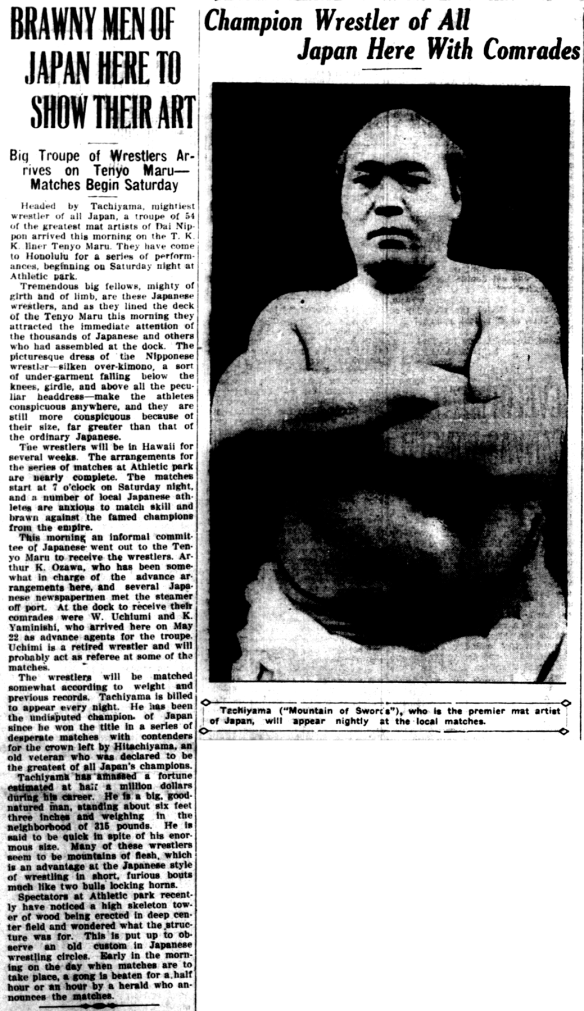
BRAWNY MEN OF JAPAN HERE TO SHOW THEIR ART

Honolulu Star-Bulletin, Volume XXII, Number 6940, Page 9. July 9, 1914.

One of the biggest early influences on Hawaiian music in Japan starts here, 1909.

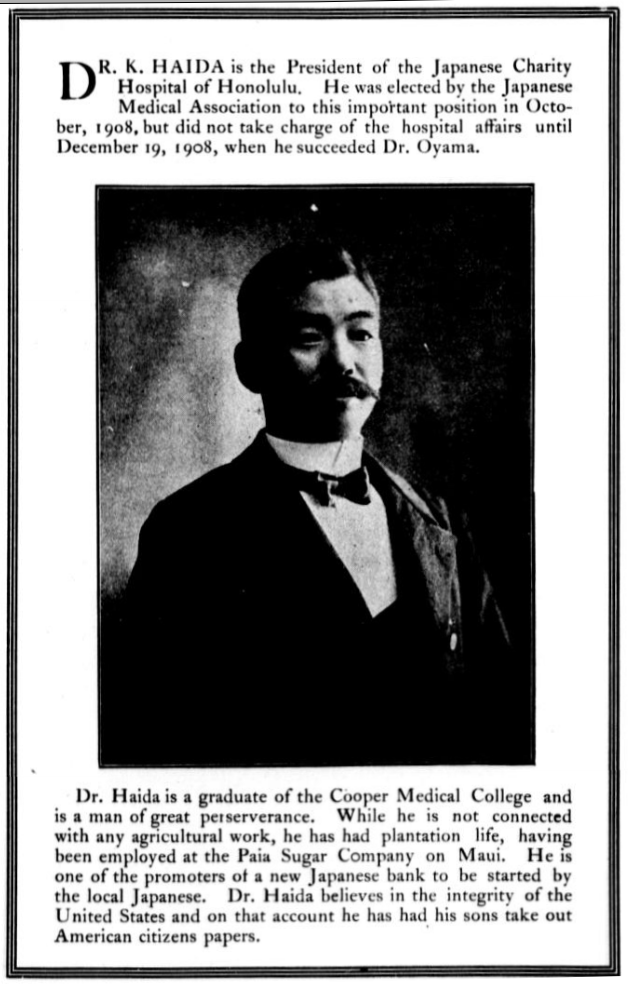
DR. K. HAIDA [Katsugorō Haida] is the President of the Japanese Charity Hospital of Honolulu. He was elected by the Japanese Medical Association to this important position in October, 1908, but did not take charge of the hospital affairs until December 19, 1908, when he succeeded Dr. Oyama.

Dr. Haida is a graduate of the Cooper Medical College and is a man of great perseverance. While he is not connected with any agricultural work, he has had plantation life, having been employed at the Paia Sugar Company on Maui. He is one of the promoters of a new Japanese bank to be started by the local Japanese. Dr. Haida believes in the integrity of the United States and on that account he has had his sons take out American citizen papers.

[See also this article on Yukihiko Haida returning to Hawaii in 1933 from Japan to study Hawaiian music.

And also see this article put up by the Nihon Ukulele Association on Yukihiko (Harry) Haida.]

(Evening Bulletin, 3/25/1909, p. 44)

DR. K. HAIDA...

Evening Bulletin Industrial Edition, 1909, p. 44.

Kohala Hula Club and Emma Moniz, 1936.

HAWAIIAN TABLEAU TO BE PRESENTED HERE

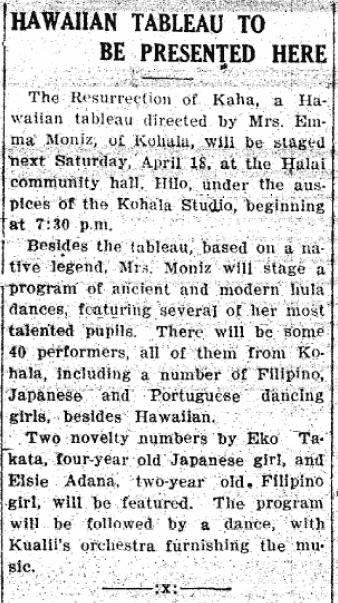
The Resurrection of Kaha, a Hawaiian tableau directed by Mrs. Emma Moniz, of Kohala, will be staged next Saturday, April 18, at the Halai community Hall, Hilo, under the auspices of the Kohala Studio, beginning at 7:30 p. m.

Besides the tableau, based on a native legend, Mrs. Moniz will stage a program of ancient and modern hula dances featuring several of her most talented pupils. There will be some 40 performers, all of them from Kohala, including a number of Filipino, Japanese and Portuguese dancing girls, besides Hawaiian.

Two novelty number by Eko [? Eiko] Takata, four-year old Japanese girl, and Elsie Adana, two-year old Filipino girl, will be featured. The program will be followed by a dance, with Kualii’s orchestra furnishing the music.

(Hoku o Hawaii, 4/15/1936, p. 1)

HAWAIIAN TABLEAU TO BE PRESENTED HERE

Ka Hoku o Hawaii, Volume XXII, Number 39, Aoao 1. April 15, 1936.

Bonin Islands and Hawaiians abroad, 1830 / 2014.

ADVENTURERS IN HAWAII WENT TO SETTLE BONIN ISLANDS IN 1830

Historical Work Soon to Be Published Will Contain Letters From Honolulans

New and interesting facts concerning the conditions and history of the Hawaiian Islands during the first few decades of last century are promised in a history of the Bonin Islands which will be published in October by Constable London.

One feature is the tale of how the British consul in Honolulu in 1830 sent out a band of colonists to settle the Bonin Islands an attempt at colonizing the tiny archipelago for the British Empire which was destined to failure, for the islands now belong to Japan.

The book is by Rev. L. B. Cholmondeley, honorary chaplain of the British embassy at Tokio, who was for many years in charge of the mission at the Bonin group, and has since made frequent visits there. Continue reading

Papaikou School graduates, 1919.

This is a picture of the students who graduated from the school of Papaikou, Hawaii. The total number of children are eleven, but the astonishing thing is that there are no Hawaiian children amongst this crowd. From the children who graduated, eight of them are Japanese, five boys and three girls. Where are the Hawaiian children, the hope of this race to be looked to in the future? These children are prepared to enter Hilo High School in this new school year.

(Kuokoa, 8/15/1919, p. 1)

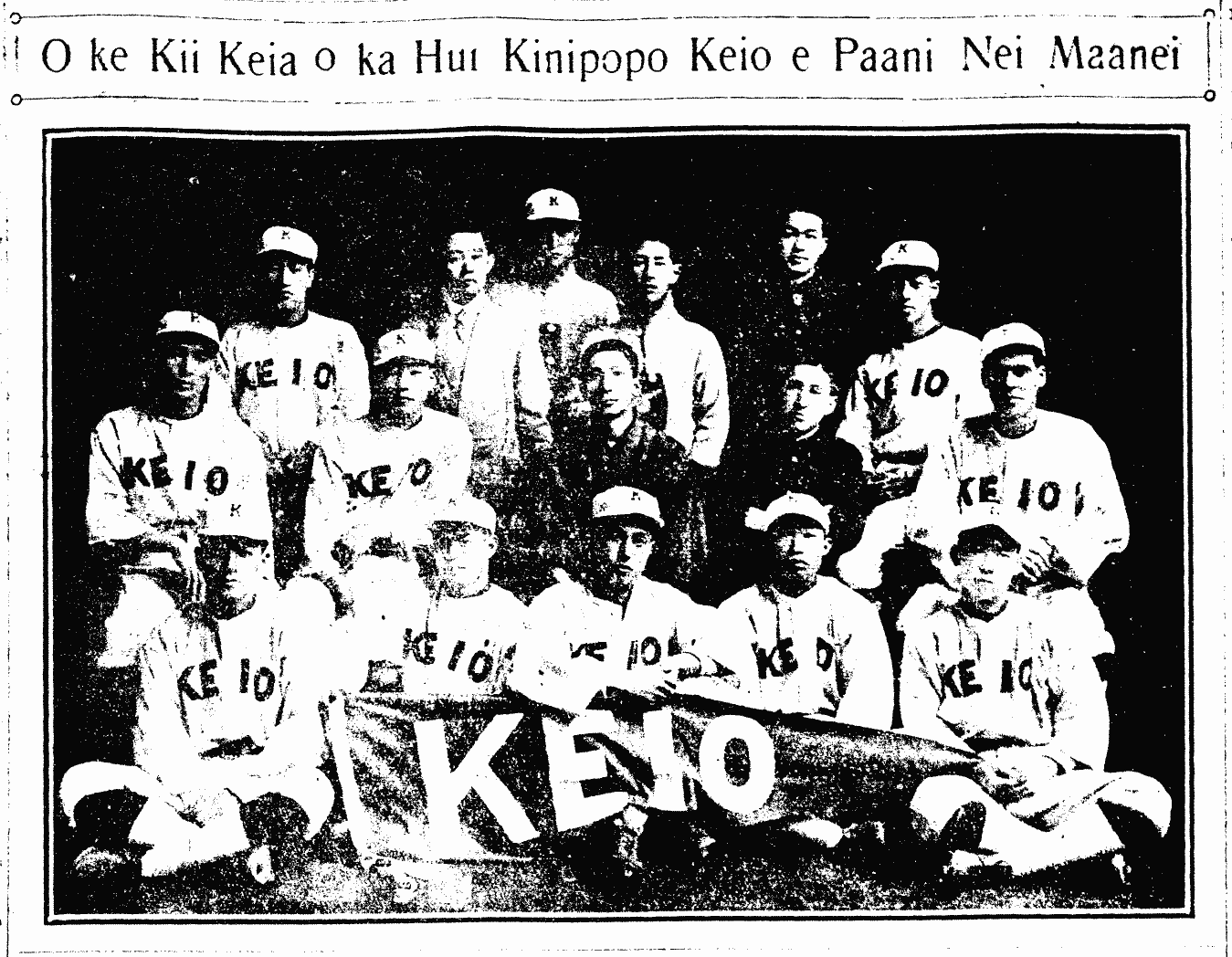
He kii keia no na haumana...

Ka Nupepa Kuokoa, Buke LVII, Helu 33, Aoao 1. Augate 15, 1919.

Seizaburō Shimizu, 1908.

After finding out what the given name of the Consul General from Japan was in 1895, it was easier to find other information about him, like this picture from the Chicago Daily News. It seems he served as Japanese Consul in Chicago a few years after leaving Hawaii.

Seizaburo Shimizu, Chicago Daily News negatives collection, DN-0006102. Courtesy of Chicago History Museum, found on “American Memory from the Library of Congress.”

This can be found here: http://memory.loc.gov/cgi-bin/query/D?cdn:1:./temp/~ammem_yyAd::