Hawaiians at Harvard, 1908 / 2014.

A Letter From Lands Afar

Cambridge, Mass.,
Nov. 4, 1908.

My beloved father;

For a long time now I have not received a letter from you, and I assume you are in the midst of political battles. I am very interested in the results of the election over there, and I hope very much that you were elected. Please, papa, tell me what became of the elections there. There was not much of great import in the elections here being that it was known in advance that Taft would come out as the new President of America. Taft was elected victoriously, and he was far ahead of his fellow candidates, and maybe you all have heard before the arrival of this letter of mine.

The parade of the Republicans on this past Friday before election day was one of the grandest seen here in the town of Boston. Thousands of students from the colleges joined in this parade, and students from our school, Harvard were out first leading the parade, and I was one among the students marching in this parade beyond compare. We were dressed in crimson caps of the college of Harvard with the school uniform, and each student held a candle in his hand, and the old town of Boston glowed red in its light. The candle-light parade was 11 miles long. We marched on the streets of town, and when we arrived before the Governor, we removed our crimson caps and gave our greetings to the Governor. This was a great parade indeed, and everything went well. It was a Republican Governor that was elected yesterday. Continue reading

Hawaiian Language Imprints, Judd, Bell, and Murdoch, 1978.

This is a nice bibliography of Hawaiian-language material written between 1822 and 1899 compiled by Bernice Judd, Janet E. Bell, and Clare G. Murdoch in 1978. What is nice about this is that it lists where known copies at the time were located. Unfortunately, this online copy is not easily searchable like the 1869 Bibliography of the Hawaiian Islands in the last post. If you do a search, you will only be pointed to the word in the typescript, but if you want to know where it appears on the image of the original, you will only be pointed to the page where it appears. There is supposed to be another copy on Project Gutenberg, but the file seems to be corrupt. On Project Gutenberg, you would be able to do a word search against the image of the original with it highlighting the word or phrase searched for.

Hawaiian Language Imprints, 1822-1899.

Hawaiian Language Imprints, 1822-1899.

Hawaiian Language classes on Maui, 1941.

TEACHES MAUI HAWAIIAN CLASS

J. P. COCKETT

 J. P. Cockett, county treasurer of Maui, is successfully conducting a class for the study of the Hawaiian language at Wailuku, which has a total enrollment of 33.

The class is now in an advanced stage and the students are making very satisfactory progress according to Mr. Cockett.

The membership consists of the following: Frank Suzuki, Hawley Seiler, Mr. and Mrs. J. T. Correa, D. A. Correa, Mary D. Ah Sam, Mr. and Mrs. G. Furukawa, Mrs. H. Stibbard, Thomas Furukawa, Violet Chong, Ululani Collins, Elaine Matsumoto, C. Lindsay, Mrs. Abbie Baldwin, Misses Ah Lum and Mum Kyau Hew, B. Evelyn Miswander, M. Jane Gray, Miss Mildred Dean, Jack Marnie, K. Kawahara, G. Shimanuki, R. R. Omori, Mr. and Mrs. Ted Chung, Sylvester Correa, Alfred C. Franco, William A. Adams, Bella R. Martin, A. W. Langa and M. L. Carmichael.

(Star of Hawaii, April 30, 1941, p. 4)

TEACHES MAUI HAWAIIAN CLASS

The Star of Hawaii, Volume XXXVI, Number 1, Page 4. April 30, 1941.

Hawaiian-language versus English historical documents, 2014 and beyond.

When researching anything relating to Hawaii nei, it goes without saying that it is imperative that we look at the Hawaiian-language documents left by the people of old. However, it is important to look at all the other documents available to us written in other languages as well.

The three different articles covering the 100th birthday celebration of Kauikeaouli recently posted is a simple case in point. Each of the three supply information not provided by the other two. Continue reading

Latest news about the heir to the throne, Princess Kaiulani, 1891.

[Found under: “NU HOU HAWAII.”]

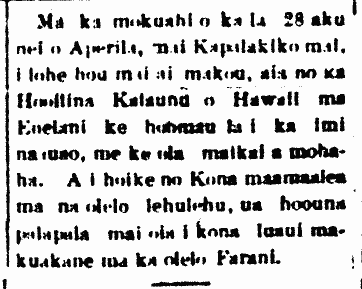
On the steamship of this past 28th of April from San Francisco, we have heard once again, the Heir to the Throne of Hawaii is in England where she is continuing her studies in good and robust health. And as an example of Her competence in many languages, she sent her father a letter in French.

[In those days, much of the news from afar came by way of steamship.]

(Kuokoa, 5/2/1891, p. 3)

Ma ka mokuahi o ka la 28...

Ka Nupepa Kuokoa, Buke XXX, Helu 18, Aoao 3. Mei 2, 1891.

Let Hawaiian Language be not something just remembered in February, 1920 / 2014.

THE HAWAIIAN LANGUAGE

O Mr. Editor of the Kuokoa Newspaper, Much Aloha to you:—Please allow me a column, for the title placed above.

When I read on page 8, column 2, about the Hawaiian language, I was ecstatic about what was published by the Kuokoa Newspaper on the topic of Mr. Coelho pertaining to the Hawaiian language.

This is seen on the streets, at pleasant gatherings, at meetings, and at the homes; these are just Hawaiians that I am talking about; they just speak English.

Hear me, O My flesh and blood, My beloved people: you are known as a Hawaiian and a lahui by your language; should you lose your mother tongue, you will end up like the Negroes and the Indians; they’ve no lahui and no language.

Pio ka oe ahi,
Pau ka oe hana;
I ikeia mai no oe,
I ka wa moni o ko eke;
Nele ae kahi mea poepoe,
Pau ka pilina ma ka aoao.

You light is extinguished,
Your work has come to an end;
You are acknowledged,
When there is money in your purse;
When the round objects are gone,
You have no place by her side.

Therefore, this writer is calling out to you: do not squander your gold and silver—your mother tongue. Your language is how it is known that you are an educated and superior people, like the great nations of the world. Look at Britain, France, Italy, Germany, Japan and America. Every nation learns their own language; why? For glory, for knowledge; it is known that one is British by the language he knows. The writer of the Psalms says: “That glory may dwell in our land.” How is our nation to have glory?

By abandoning our mother tongue and speaking the language of the malihini, are we knowledgeable, skilled and prepared in that language?

Are you not the foremost, O Tiny Hawaii, by way of the mother tongue of Opukahaia who travelled to America to explain the troubled existence of his lahui, and asked with tears streaming down to send missionary parents for Hawaii nei?

Did he go to America speaking English? No; he went with his own mother tongue. And when the missionaries arrived here in Hawaii, it is through the Hawaiian language that you received education, knowledge, honor, peace, justness, prosperity, righteousness, faith, and aloha.

What nation to the north or south latitudes of the equator is in peace like that of Hawaii? None, there is not a one; it is just Hawaii!

Therefore, this writer calls out: Don’t abandon your mother tongue so that glory may always dwell in Hawaii nei. We must build Hawaiian schools, and teach Hawaiian curriculum. Not just one eye, or one hand and foot. [? Aole i hookahi wale no maka, a i hookahi wale no lima a wawae.] When the legislature meets again the representatives and senators should make a law for teaching the Hawaiian language.

I give my thanks to the Honorable H. M. Kaniho, the first one to submit this bill in his first year there. It did not pass because some of the representatives just watched and did nothing. And I give my thanks to D. M. Kupihea who continually submits this bill.

Honolulu’s people should reelect the Hon. Kupihea so that this bill will once again be submitted; and should it be passed, then both eyes will be gotten: both Hawaiian language and English; and this writer will boast in advance that glory will indeed forever dwell in our land, for all times.

This writer is not saying that we should only teach these languages, but this responsibility is yours to teach knowledge and glory for your life. To be taken up at another time!

To the typesetting boys goes my love, and my unending aloha to the Editor.

[This is probably written in response to the article, “KA OLELO HAWAII.” written by Mrs. Kikilia P. Kealoha of Kaimuki, in Kuokoa on 6/18/1920, p. 8, which in turn was a response to an article of the same title written by W. J. Coelho in the Kuokoa on 5/21/1920, p. 2.

Although we have come a far way from 1920, there is still far to go. There are still those who seem to believe that losing Hawaiian is nothing to be alarmed about.

Z. P. K. Kawaikaumaiikamakaokaopua, is another name for the great historian Z. P. K. Kalokuokamaile (as well as Z. P. K. Lionanohokuahiwi).]

(Kuokoa, 6/18/1920, p. 3)

KA OLELO HAWAII.

Ka Nupepa Kuokoa, Buke LVII, Helu 24, Aoao 3. Iune 18, 1920.

New Hawaiian Language Textbook, 1939.

Hawaiian Language Book

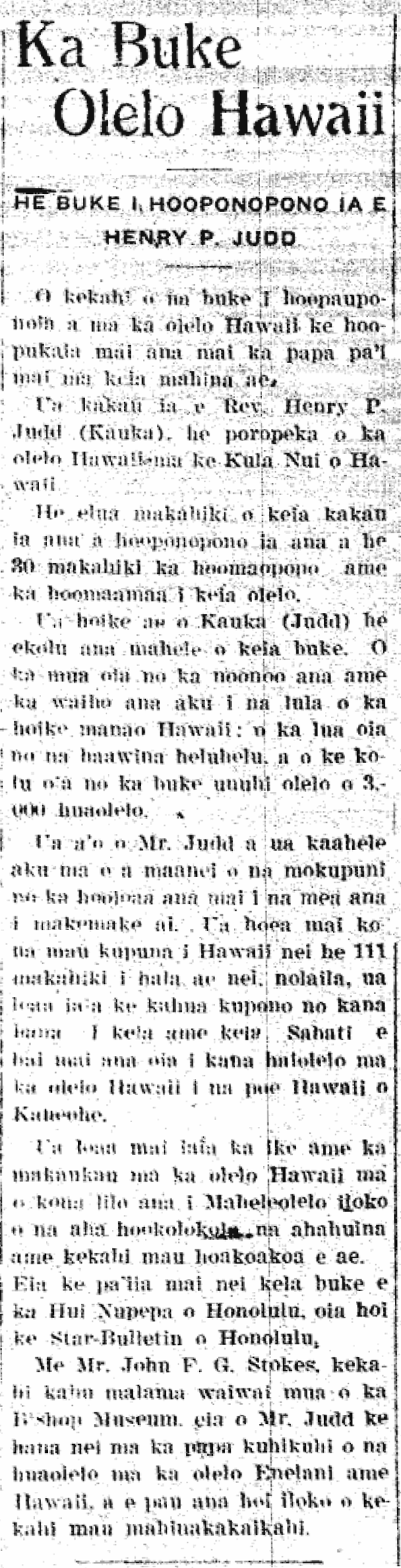
A BOOK EDITED BY HENRY P. JUDD

A book completed in the Hawaiian language is being published by the press next month.

It was written by Rev. Henry P. Judd (Kauka), a professor of the Hawaiian language at the University of Hawaii.

The writing and editing took two years, and it was 30 years of learning and practicing of the language.

Kauka (Judd) says there are three sections to this book. The first part is the studying and the giving of rules of Hawaiian expression; the second is reading lessons; and the third is the translation of 3,000 words.

Mr. Judd has taught and travelled here and there in the islands obtaining what he was after. His kupuna came to Hawaii nei 111 years ago, and therefore, he has the appropriate place for his work. Every Sunday, he gives his sermons in Hawaiian to Hawaiians in Kaneohe.

He gained his knowledge and proficiency in the Hawaiian language through his becoming a translator [Maheleolelo] in the courts, the [Evangelical] Conferences, and other gatherings.

This book is being published by the Newspaper Company of Honolulu, that is the Star-Bulletin of Honolulu.

With Mr. John F. G. Stokes, one of the first trustees of the Bishop Museum, Mr. Judd is now in the process of making a word list in English and Hawaiian, which will be completed in a few months.

[This is referring to the book: Judd, Henry P. The Hawaiian language. Honolulu: Honolulu Star-Bulletin, Ltd., 1939.]

(Hoku o Hawaii, 7/26/1939, p. 1)

Ka Buke Olelo Hawaii

Ka Hoku o Hawaii, Volume XXXIV, Number 13, Aoao 1. Iulai 26, 1939.

Why bother learning the Hawaiian Language—a response, 2013.

Hawaiian Language Benefits All

…For all of the rare-in-the-world success that Hawaiian language revitalization has achieved in four decades, only a fraction of it has been paid for by public funds. For every dollar that’s ever been spent on teacher salaries, school rooms or curriculum, 10 times that has been expended from the pockets or personal schedules of people who dedicated their lives to making sure Hawaiian wasn’t erased by the sweep and force of English dominance. The kupuna who gave all of their golden years to learners and the teachers who create lessons from scratch are the tip of the iceberg. Unlike other places where government support of indigenous efforts is now the norm, most of the investment in Hawaiian language and culture always has been a people’s project. Hawaiian is the foundation of Hawai’i’s unique identity and knowledge base, not a useless adornment to a place with nice geography. That mind-set loses everything that makes these Islands so special. Money spent on keeping Hawai’i connected to its past and present isn’t hush money to assuage and entertain the natives, it’s an investment in Hawai’i’s continuity.

[Click here for the rest of this response to Bob Jones’ article (MidWeek 4/24/2013) which we put up in the previous post, written by Puakea Nogelmeier in the current issue of MidWeek.

What do you all think?]

Why bother learning the Hawaiian Language? 2013.

Are Hilo Projects Money Well-spent?

Somebody surely will ask: Why are we spending $28 million in state money for the College of Hawaiian Language building at UH Hilo?

Why put all that public money into Hawaiian language when we need funds for command of the English language and delving into American political history and contemporary culture issues?

[Click here to read the rest of this piece of work penned by Bob Jones which appeared the other week in the MidWeek!]

Tourists… 1906.

[Found under: “TOWN TALK”]

One of my Southern California friends here with the party of editors had a very amusing experience with a native waiter in a restaurant into which she had dropped for lunch. She saw the brown son of the islands coming and she nerved herself for the ordeal. She consulted her souvenir program and running over the list of translated words she finally found and said “Pa-Hay-Oe.”

“Maikai no” replied the man with a smile.

The young lady then attempted to find the native words for “Ham and Eggs” or something to that effect—but alas they were not there. She hesitates, looked frantically around in search of some haole, and finally she though of sign language and commenced to make all sorts of passes in the air. The native stood near her her and kept shaking his head, all the time with a questioning look in his eye.

Finally the young lady said in despair, “Oh, you block head, why don’t you talk English?”

“I was about to say madam,” came the reply, “that if you would say in English what you are endeavoring to convey by means of the sign language, I would be most delighted to fill even your humblest desire.”

Then the young lady was angry. She stamped out of the restaurant and all one needs to do to court sudden death is to make a few passes like “Ham and Eggs” in the air in her presence.

(Hawaiian Star, 9/22/1906, p. 7)

One of my Southern California friends...

The Hawaiian Star, Volume XIV, Number 4524, Page 7. September 22, 1906.