May Day in Hilo town, 1942.

Our Lei Day

According to what we understand and hear pertaining to the celebration of Lei Day, that being this Friday, the show put on will be great.

There will be two hula groups that will hula on that day, that being the hula troupe [Hui Lokelani] of Mrs. Rose Kuamoo and the Hui Huapala led by Albert Nahale-a. Other than these groups will be the Police Glee Club led by William K. Kahimoku (Kualii), and also the children of Mr. and Mrs. Joseph Kalima, and also perhaps some duets and some solos.

Last year, this show was held in the evening, beginning at 6:00, but this year, it can’t be put on in the late evening, but instead will be held at 3:00  p. m. This is times of blackout in this land, and we are not to turn on lights outside.

This show and hula will be held at Kalakaua Square, and we are lucky to have the military band join in and commemorate this day. There is nothing to be said about our County Band, for they have not dropped out of the activities of the day.

The activities of the day will begin with a concert put on by the military band at port here in Hilo, at 2:30 p. m. until 3:00 p. m., and the County band until 3:30 p. m. and followed by the other parts.

Here below is the program of events of that afternoon

MAY DAY IS LEI DAY
IN HAWAII
Directed by the Hawaiian Civic Club of Hilo
Friday, May 1, 1942,
at the Hour of 3:30 P. M.
KALAKAUA PARK

Part I, Old Hawaiian Hula

1. “Ka La o Mei He La Lei Ia Ma Hawaii” [May Day is Lei Day in Hawaii] Police Glee Club, Lokelani, and Huapala.

2. “Oli” by Mary Ahiena

3. Old Hawaiian Hula, by the Hui Lokelani.

a. Olapa — Niihau, Pua Hau o Maleka

b. Puili — Malualua

c. Iliili — Kona Hema

d. Uliuli — Moku Kia Kahi, Alekoki

4. Combined Old Hawaiian Hula, by the Hui Huapala

a. Puili & Uliuli — Nani Wale Na Hala

5. “Pua Mohala” by the Hilo Police Glee Club

Part II, Hawaiian Hula of Modern Times

1. “Kuikahi” by Huapala

2. A Hula for President Roosevelt, Lokelani

3. “Ua Hoomaka lakou i Kekahi Mea,” Frank Kahili

4. Holoholo Kaa, Huapala

5. “Loke Honesakala,” Ernest Hanaike and his Guitar

6. Nani Hilo, Lokelani

7. “Mele Maka Lalau” by Baby Kaieie

9. “Wiliwili Wai,” William Kualii

8. Aloha Ia No O Maui, Lokelani

10. Kona Hema, Huapala

11. My Sweet Sweetie, Three Children of Kalaima

12. Oahu, Lokelani

13. Ke Kali Nei Au, duet by Miss Kuaana Nathaniel and Joseph Kalima

14. Maikai Wale No Kauai, Lokelani

15. “TAHUAHUAI,” Abraham Laeha

16. Sasa & Somemore o Samoa, Huapala

17. THE CONCLUSION

a. Hilo March — Lokelani

b. “I Lei Nou” — Police Glee Club

c. Leahi, Hanohano Hanalei — Huapala

18. ALOHA OE

19. STARS SPANGLED BANNER

(Hoku o Hawaii, 4/29/1942, p. 2)

Ka La Lei O Kakou

Ka Hoku o Hawaii, Volume 37, Number 1, Page 2. Apelila 29, 1942.

More on the life and passing of Naomi Kekela, 1902.

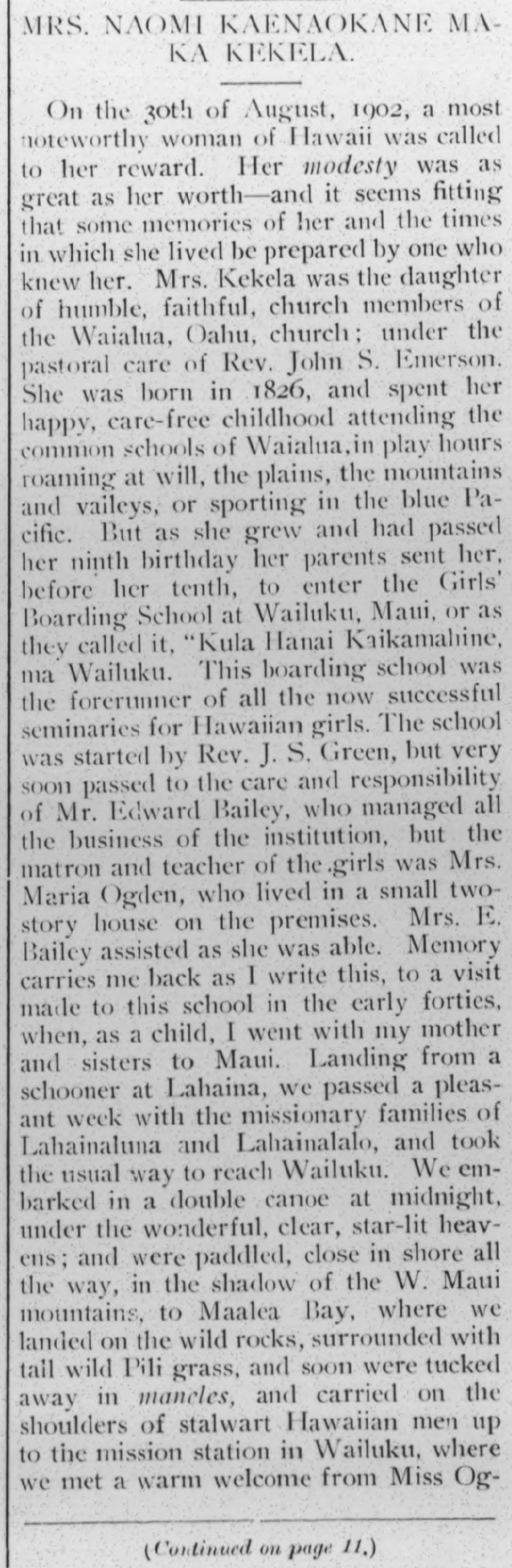
MRS. NAOMI KAENAOKANE MAKA KEKELA.

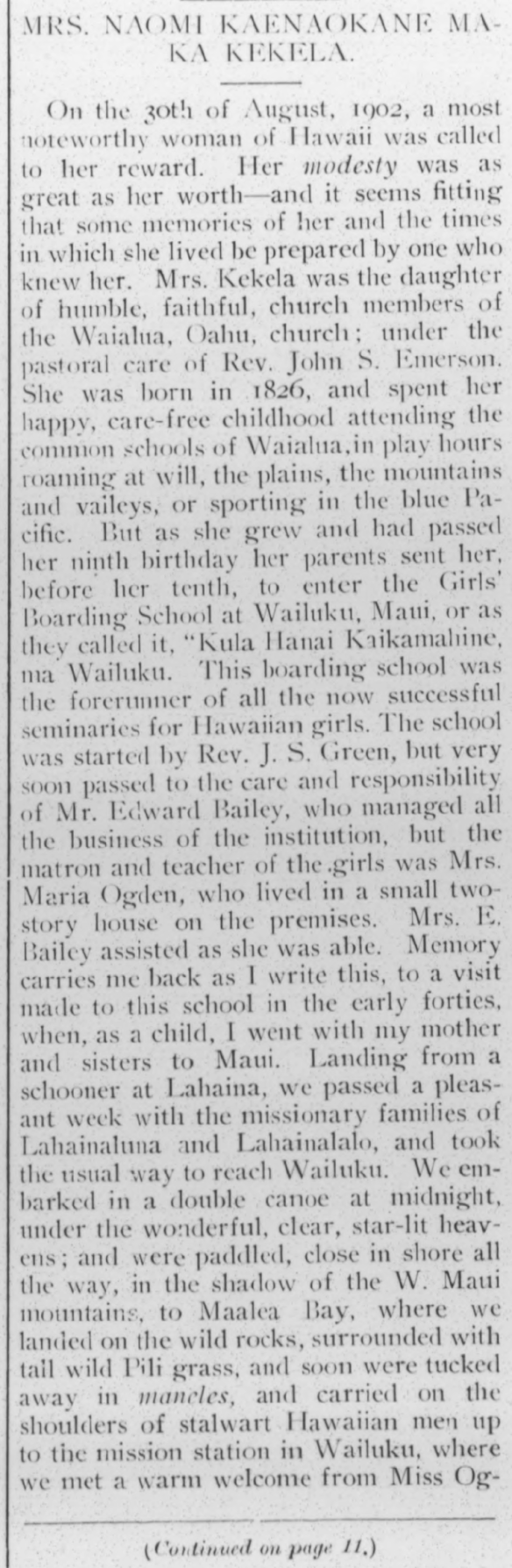
On the 30th of August, 1902, a most noteworthy woman of Hawaii was called to her reward. Her modesty was as great as her worth—and it seems fitting that some memories of her and the times in which she lived be prepared by one who knew her. Mrs. Kekela was the daughter of humble, faithful, church members of the Waialua, Oahu church; under the pastoral care of Rev. John S. Emerson. She was born in 1826, and spent her happy, care-free childhood attending the common schools of Waialua, in play hours roaming at will, the plains, the mountains and valleys, or sporting in the blue Pacific. But as she grew and had passed her ninth birthday her parents sent her, before her tenth, to enter the Girls’ Boarding School at Wailuku, Maui, or as they called it, “Kula Hanai Kaikamahine, ma Wailuku.[“] This boarding school was the forerunner of all the now successful seminaries for Hawaiian girls. The school was started by Rev. J. S. Green, but very soon passed to the care and responsibility of Mr. Edward Bailey, who managed all the business of the institution, but the matron and teacher of the girls was Mrs. Maria Ogden, who lived in a small two-story house on the premises. Mrs. E. Bailey assisted as she was able. Memory carries me back as I write this, to a visit made to this school in the early forties, when, as a child, I went with my mother and sisters to Maui. Landing from a schooner at Lahaina, we passed a pleasant week with the missionary families of Lahainaluna and Lahainalalo, and took the usual way to reach Wailuku. We embarked in a double canoe at midnight, under the wonderful, clear, star-lit heavens; and were paddled, close in shore all the way, in the shadow of W. Maui mountains, to Maalea Bay, where we landed on the wild rocks, surrounded with tall Pili grass, and soon were tucked away in maneles, and carried on the shoulders of stalwart Hawaiian men up to the mission station in Wailuku, where we met a warm welcome from Miss Og-

(Continued on page 11.)

(Friend, 10/1902, p. 6)
MRS. NAOMI KAENAOKANE MAKA KEKELA.

The Friend, Volume LX, Number X, Page 6. October 1902.

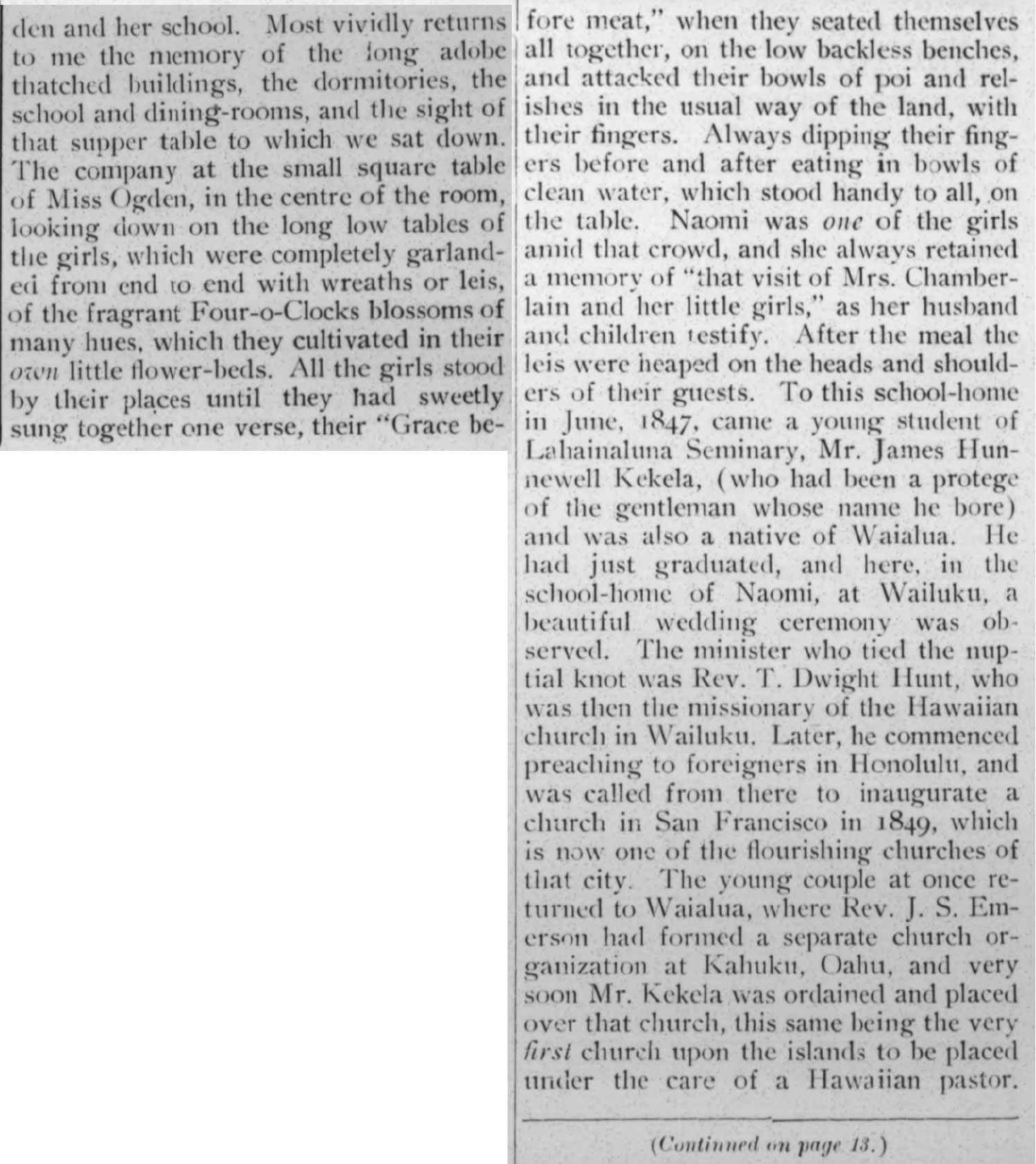
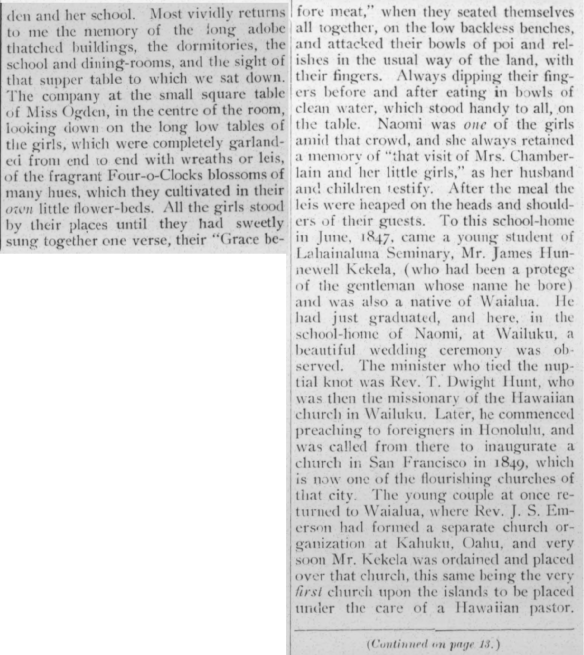
den and her school. Most vividly returns to me the memory of the long adobe thatched buildings, the dormitories, the school and dining-rooms, and the sight of that supper table to which we sat down. The company at the small square table of Miss Ogden, in the centre of the room, looking down on the long low tables of the girls, which were completely garlanded from end to end with wreaths or leis, of the fragrant Four-o-Clocks blossoms of many hues, which they cultivated in their own little flower-beds. All the girls stood by their places until they had sweetly sung together one verse, their “Grace before meat,” when they seated themselves all together, on the low backless benches, and attacked their bowls of poi and relishes in the usual way of the land, with their fingers. Always dipping their fingers before and after eating in bowls of clean water, which stood handy to all, on the table. Naomi was one of the girls amid that crowd, and she always retained a memory of “that visit of Mrs. Chamberlain and her little girls,” as her husband and children testify. After the meal the leis were heaped on the heads and shoulders of their guests. To this school-home in June, 1847, came a young student of Lahainaluna Seminary, Mr. James Hunnewell Kekela, (who had been a protege of the gentleman whose name he bore) and was also a native of Waialua. He had just graduated, and here, in the school-home of Naomi, at Wailuku, a beautiful wedding ceremony was observed. The minister who tied the nuptial knot was Rev. T. Dwight Hunt, who was then the missionary of the Hawaiian church in Wailuku. Later, he commenced preaching to foreigners in Honolulu, and was called from there to inaugurate a church in San Francisco in 1849, which is now one of the flourishing churches of that city. The young couple at once returned to Waialua, where Rev. J. S. Emerson had formed a separate church organization at Kahuku, Oahu, and very soon Mr. Kekela was ordained and placed over that church, this same being the very first church upon the islands to be placed under the care of a Hawaiian pastor.

(Continued on page 13.)

(Friend, 10/1902, p. 11)
den and her school.

The Friend, Volume LX, Number X, Page 11. October 1902.

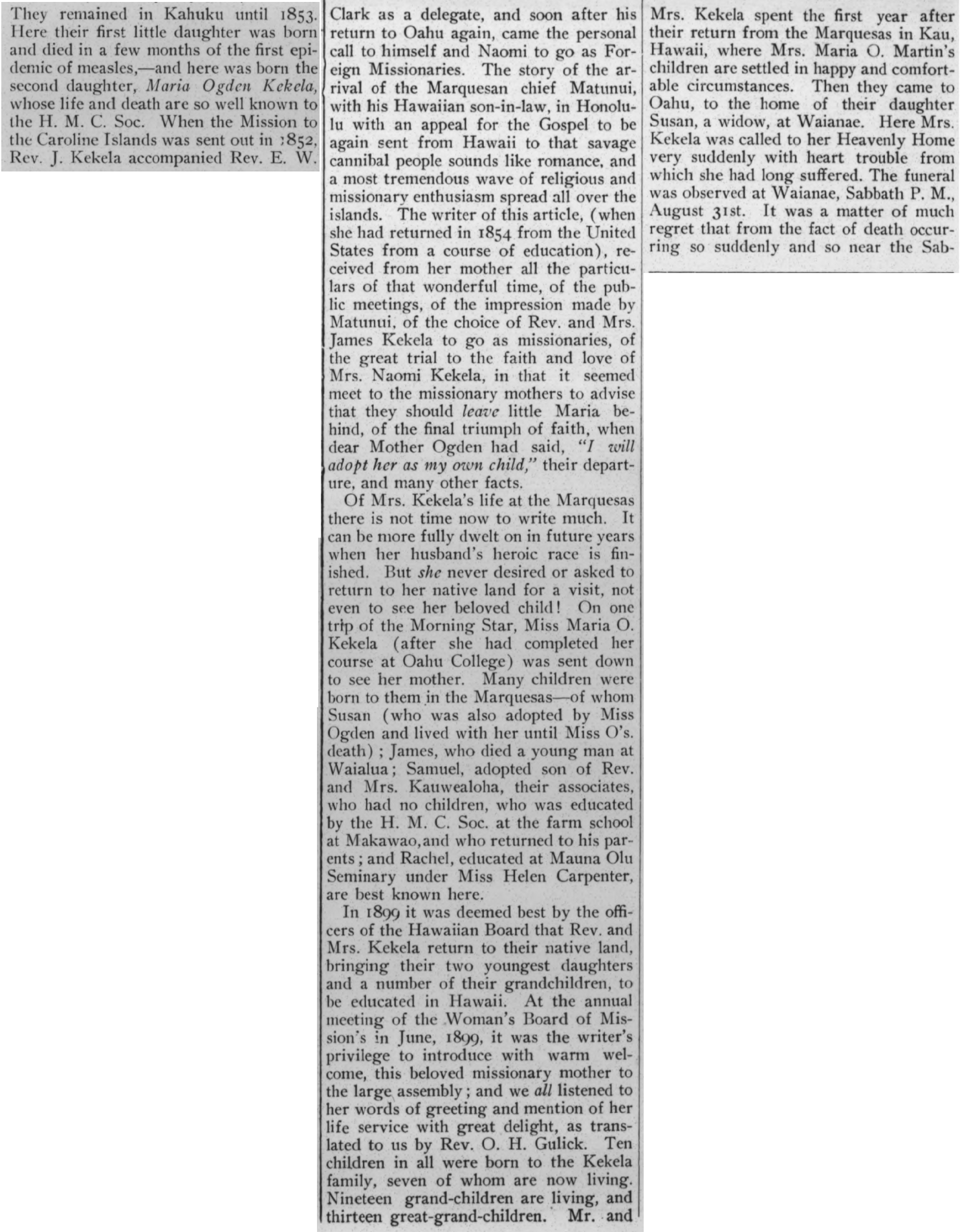
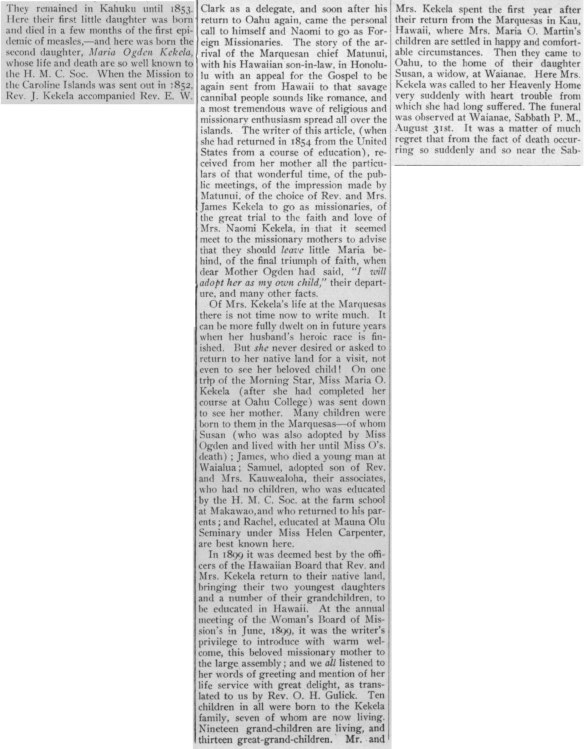
They remained in Kahuku until 1853. Here their first little daughter was born and died in a few months of the first epidemic of measles,—and here was born the second daughter daughter, Maria Ogden Kekela, whose life and death are so well known to the H. M. C. Soc. When the Mission to the Caroline Islands was sent out in 1852, Rev. J. Kekela accompanied Rev. E. W. Clark as a delegate, and soon after his return to Oahu again, came the personal call to himself and Naomi to go as Foreign Missionaries. The story of the arrival of the Marquesas chief Matunui, with his Hawaiian son-in-law, in Honolulu with an appeal for the Gospel to be again sent from Hawaii to that savage cannibal people sounds like romance, and a most tremendous wave of religious and missionary enthusiasm spread all over the isalnds. The writer of this article, (when she had returned in 1854 from the United States from a course of education), received from her mother all the particulars of that wonderful time, of the public meetings, of the impression made by Matunui, of the choice of Rev. and Mrs. James Kekela to go as missionaries, of the great trial to the faith and love of Mrs. Naomi Kekela, in that it seemed that they should leave little Maria behind, of the final triumph of faith, when dear Mother Ogden had said, “I will adopt her as my own child,” their departure and many other facts.

Of Mrs. Kekela’s life at the Marquesas there is not time now to write much. It can be more fully dwelt on in future years when her husband’s heroic race is finished. But she never desired or asked to return to her native land for a visit, not even to see her beloved child! On one trip of the Morning Star, Miss Maria O. Kekela (after she had completed her course at Oahu College) was sent down to see her mother. Many children were born to them in the Marquesas—of whom Susan (who was also adopted by Miss Ogden and lived with her until Miss O’s death); James, who died a young man at Waialua; Samuel, adopted son of Rev. and Mrs. Kauwealoha, their associates, who had no children, who was educated by the H. M. C. Soc. at the farm school at Makawao, and who returned to his parents; and Rachel, educated at Mauna Olu Seminary under Miss Helen Carpenter, are best known here.

In 1899 it was deemed best by the officers of the Hawaiian Board that Rev. and Mrs. Kekela return to their native land, bringing their two youngest daughters and a number of grandchildren, to be educated in Hawaii. At the annual meeting of the Woman’s Board of Mission’s in June, 1899, it was the writer’s privilege to introduce with warm welcome, this beloved missionary mother to the large assembly; and we all listened to her words of greeting and mention of her life service with great delight, as translated to us by Rev. O. H. Gulick. Ten children in all were born to the Kekela family, seven of whom are now living. Nineteen grand-children are living, and thirteen great-grand-children. Mr. and Mrs. Kekela spent the first year after their return from the Marquesas in Kau, Hawaii, where Mrs. Maria O. Martin’s children were settled in happy and comfortable circumstances. Then they came to Oahu, to the home of their daughter Susan, a widow, at Waianae. Here Mrs. Kekela was called to her Heavenly Home very suddenly with heart trouble from which she had long suffered. The funeral was observed at Waianae, Sabbath P. M. August 31st. It was a matter of much regret that from the fact of death occurring so suddenly and so near the Sab-

(Friend, 10/1902, p. 13)
They remained in Kahuku...

The Friend, Volume LX, Number X, Page 13. October 1902.

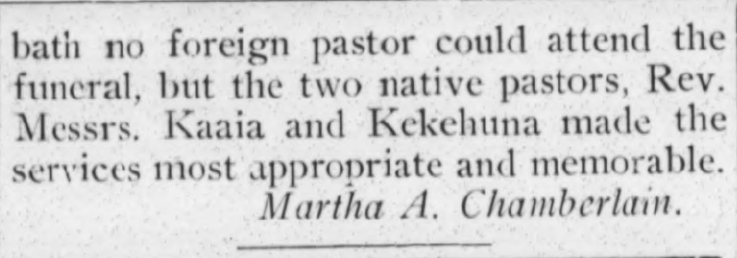
bath no foreign pastor could attend the funeral, but the two native pastors, Rev. Messrs. Kaaia and Kekehuna [Kekahuna] made the services most appropriate and memorable.

Martha A. Chamberlain.

(Friend, 10/1902, p. 14)
bath no foreign pastor...

The Friend, Volume LX, Number X, Page 14. October 1902.

Paper Lei and Hawaiian foods popular in New York. 1912.

PAPER LEI ARE MUCH SOUGHT AFTER IN NEW YORK.

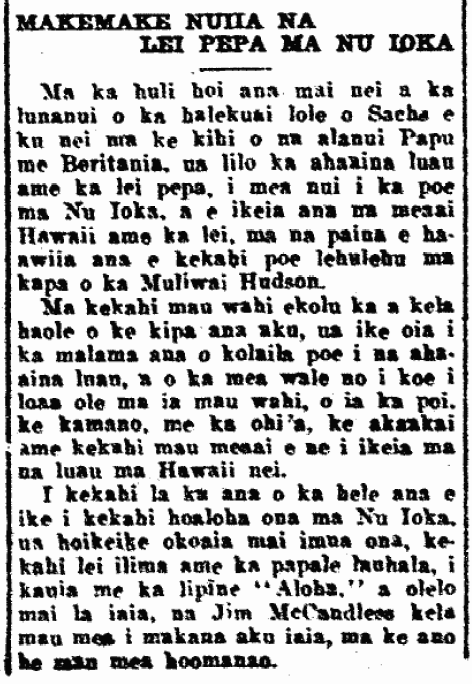
At the return of the head manager of the clothiers, Sachs, which stands at the corner of Fort and King Streets; [he said,] “Luau and paper lei have become popular with New Yorkers, and Hawaiian foods and lei are seen at parties given by many people on the banks of the Hudson River.

Supposedly at three places that haole went to visit, he saw people holding luau parties, and the only thing missing at those places was poi, salmon, tomatoes, onions and some other foods seen at luau in Hawaii nei.

One day when he went to go see one of his friends in New York, shown before him was an ilima lei and a lauhala hat upon which was a ribbon which read “Aloha,” and he said that they were a gift from Jim McCandless, as a memento.

(Kuokoa, 8/9/1912, p. 6)

MAKEMAKE NUIIA NA LEI PEPA MA NU IOKA

Ka Nupepa Kuokoa, Buke XLVIII, Helu 32, Aoao 6. Augate 9, 1912.

Marriage announcement outside of the Vital Statistics Column, 1912.

BOUND WITH THE THREE-STRAND CORD OF TRUE LOVE

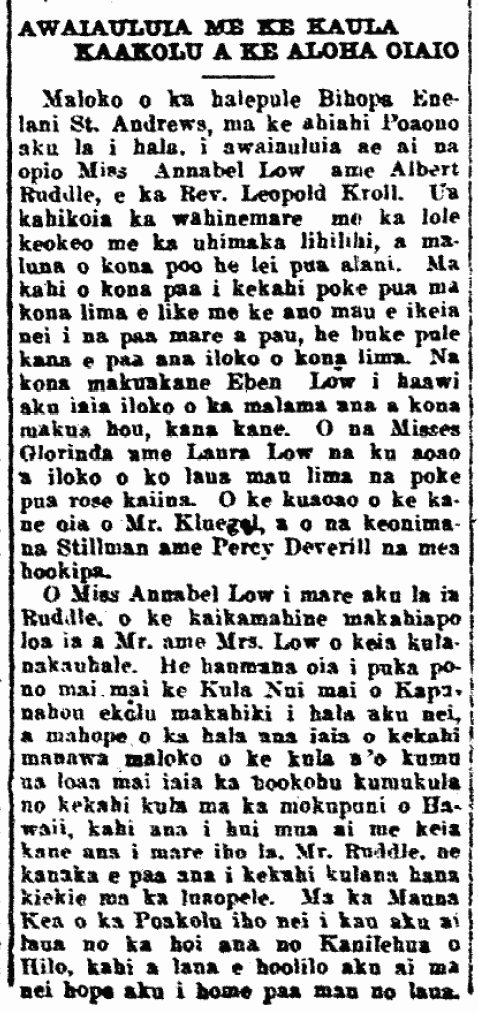
Within the Anglican Church of St. Andrew’s, on this past Saturday evening, the youths, Miss Annabel Low and Albert Ruddle were joined together by the Rev. Leopold Kroll. The bride was donned with a white dress and a sheer veil, and atop her head was a lei of orange blossoms. She held a bouquet of flowers in her hand as seen in all marriage ceremonies, and she held a book of prayers in her hand. It was her father, Eben Low, who gave her into the care of her new parent, her husband. Misses Glorinda and Laura Low were the bride’s maids, and they held in their hands, bouquets of lavender roses. The best man was Mr. Kinegal, and the gentlemen in charge of hospitality were Stillman and Percy Deverill.

Miss Annabel Low who married Ruddle is the eldest daughter of Mr. and Mrs. Low of this town. She was a student who graduated from the College of Kapunahou [Punahou] three years ago, and after some time in the teachers’ school, she was appointed as a teacher at a school on Hawaii Island, where she first met this man whom she wed, Mr. Ruddle, who is employed in a high position at the volcano. They will be returning to the Kanilehua of Hilo on Wednesday’s Mauna Kea where they will make their permanent home from here forth.

(Kuokoa, 7/12/1912, p. 6)

AWAIAULUIA ME KE KAULA KAAKOLU A KE ALOHA OIAIO

Ka Nupepa Kuokoa, Buke XLVIII, Helu 28, Aoao 6. Iulai 12, 1912.

And more yet from Lei Day in Hilo, 1928.

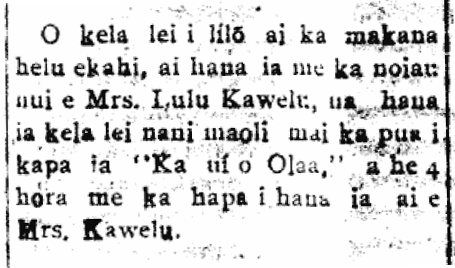
The lei that took first prize and made with great skill by Mrs. Lulu Kawelu—that truly beautiful lei was made from the flowers called “Ka ui o Olaa”¹ [Olaa Beauty], and it was made in 4 hours and a half by Mrs. Kawelu.

¹This plant is also known as “Nani o Olaa”.

(Hoku o Hawaii, 5/8/1928, p. 2)

O kela lei i lilo ai ka makana helu ekahi...

Ka Hoku o Hawaii, Buke XXI, Helu 48, Aoao 2. Mei 8, 1928.

More Lei Day in Hilo, 1928.

DAY TO CELEBRATE LEI IN HILO

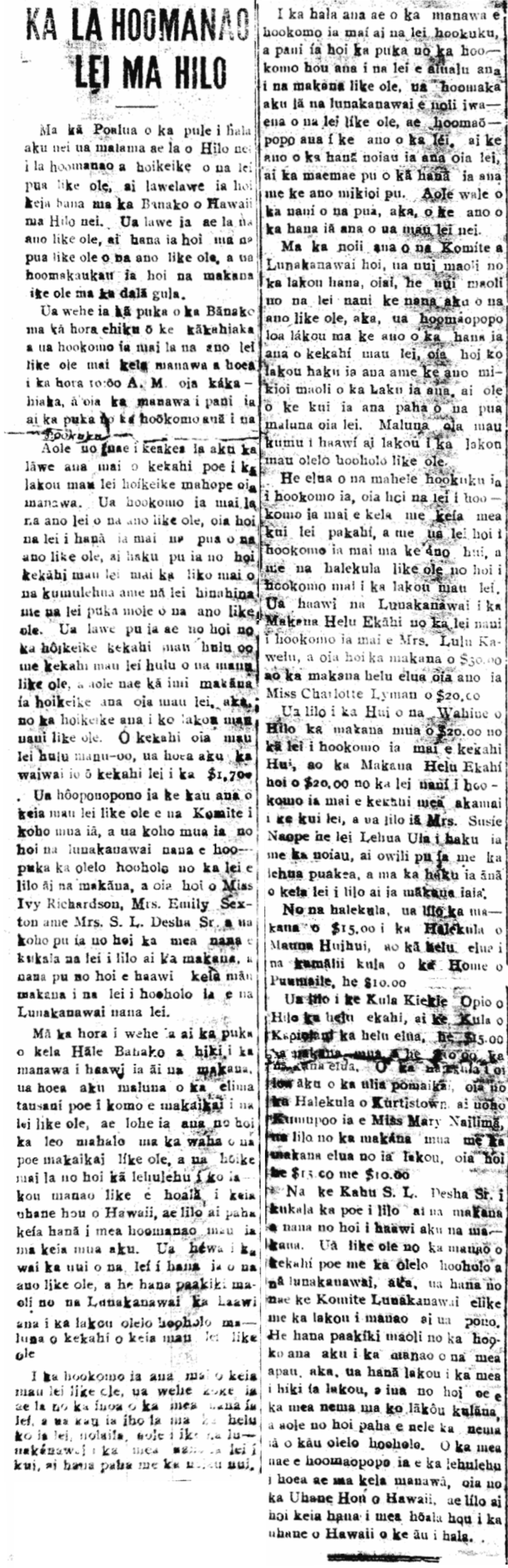
On Tuesday last week, Hilo held a celebration and display of flower lei of all sorts, and this was done at the Bank of Hawaii in Hilo. All types of lei were brought down and they were made will all kinds of flowers of all types, and prizes of all kinds were prepared of gold coins [dala gula].

The doors of the Bank were opened at seven in the morning, and lei of all types were brought in from then on until 10:00 A. M. of that morning, and then the doors were closed to bring in the judges.

However the bringing in of lei to put on display by others after that was not barred. Entered were all types of lei of all sorts; for instance, lei made of various flowers, and some lei were woven with the buds of the lehua, and lei hinahina, and lei pukamole of all sorts. Also brought for display were some oo bird feathers, and feather lei of various birds, but they were not there for judging, they were just there to show the many beautiful kinds. Some of those lei of oo bird feathers are valued at $1,700 for one.

The placing of the various lei were organized by the Committee chosen earlier, and also chosen before were the judges who would decide which lei won the prizes, and they were Miss Ivy Richardson, Mrs. Emily Sexton, and Mrs. S. L. Desha, Sr. Also selected was the one who would announce the winning lei and he would also hand out the prizes decided upon by the lei judges.

From the time when the Bank was opened until the time when the awards were given, there was approximately five-thousand visitors who entered to look at the many lei, and voices of appreciation were heard from the mouths of many attendees, and the crowd expressed their joint feelings to rouse this new Hawaiian spirit, and that this event will be commemorated always from now on. There were countless [hewa i ka wai] lei that were crafted of all sorts, and it was truly a difficult task for the Judges to give their decision on some of these lei.

When the many lei were brought in, the name of the maker was immediately announced, and a number was given to the lei, so therefore the judges did not know who strung the lei, or crafted them with great skill.

When the period for the competition lei to be entered was over and the doors were closed to the entry of lei competing for the various prizes, the judges began to examine each lei, paying attention to make up of the lei, and how it was crafted, and how cleanly it was made and how neat they were as well. [They were judged] not on just how pretty the flowers were, but on how the lei were made.

In the examination by the Judging Committee, their job was tremendous, being that there were just so many beautiful-looking lei of all sorts, but some were distinguished by how they were made, in that they were woven with true craftsmanship, or by how the flowers were sewn into the lei. By those qualities did they hand down each of their judgements.

There were two competition divisions that were entered, those being lei entered by individual lei makers, and lei entered by a group, and many different schools entered their lei. The Judges awarded the First Place Prize to the beautiful lei entered by Mrs. Lulu Kawelu, and that was a prize of $30.00 and the second place prize went to Miss Charlotte Lyman, $20.00.

To the Women’s Association of Hilo went the first prize of $20.00, for the lei entered by a group; and the First Place Prize of $20.00 for the beautiful lei entered by a skilled maker of lei—to Mrs. Susie Naope with a lei of Red Lehua skillfully woven  and wound with white lehua, and by weaving this lei, that prize went to her.

As for the schools, the prize of $15.00 went to the Mauna Huihui School, and the second place to the school children of Puumaile Home, a prize of $10.00.

To Hilo Junior High School went the first place, and to Kapiolani School the second place; $15.00 was the first prize and $10.00 was the second prize. The school that was the luckiest was the Kurtistown School, whose principal is Miss Mary Nailima—to them went the first prize and second prize, $15.00 and $10.00.

Kahu S. L. Desha, Sr. announced the winners of the prizes and it was he who presented the prizes. Some people had all sorts of ideas regarding the decisions of the judges, but the Judging Committee did as they thought was right. It is difficult indeed to please everyone, but they did what they could, and should you, O Fault Finders, be in their place, there mostly surely would be those faulting your decisions. The thing sensed by the crowd there at that time was the new Hawaiian spirit; and this event will become something that reawakens the spirit of Hawaii of times past.

(Hoku o Hawaii, 5/8/1928, p. 2)

KA LA HOOMANAO LEI MA HILO

Ka Hoku o Hawaii, Buke XXI, Helu 48, Aoao 2. Mei 8, 1928.

Lei Day in Honolulu, 1928.

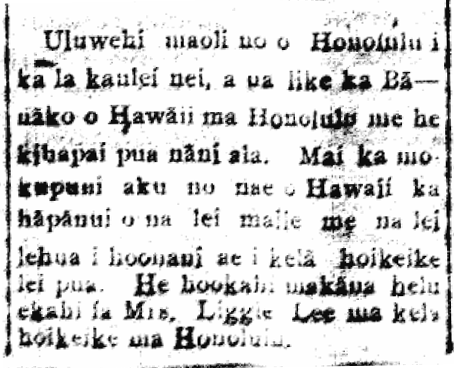
Honolulu was truly festive on this day to wear lei, and so too was the Bank of Hawaii in Honolulu, which was like a lovely flower garden. Most of the maile lei and lehua lei which decorated that display of flower lei were however from Hawaii Island. The single first prize went to Mrs. Liggie [Liggle?] Lee at that show in Honolulu.

(Hoku o Hawaii, 5/8/1928, p. 2)

Uluwehi maoli no o Honolulu...

Ka Hoku o Hawaii, Buke XXI, Helu 48, Aoao 2. Mei 8, 1928.