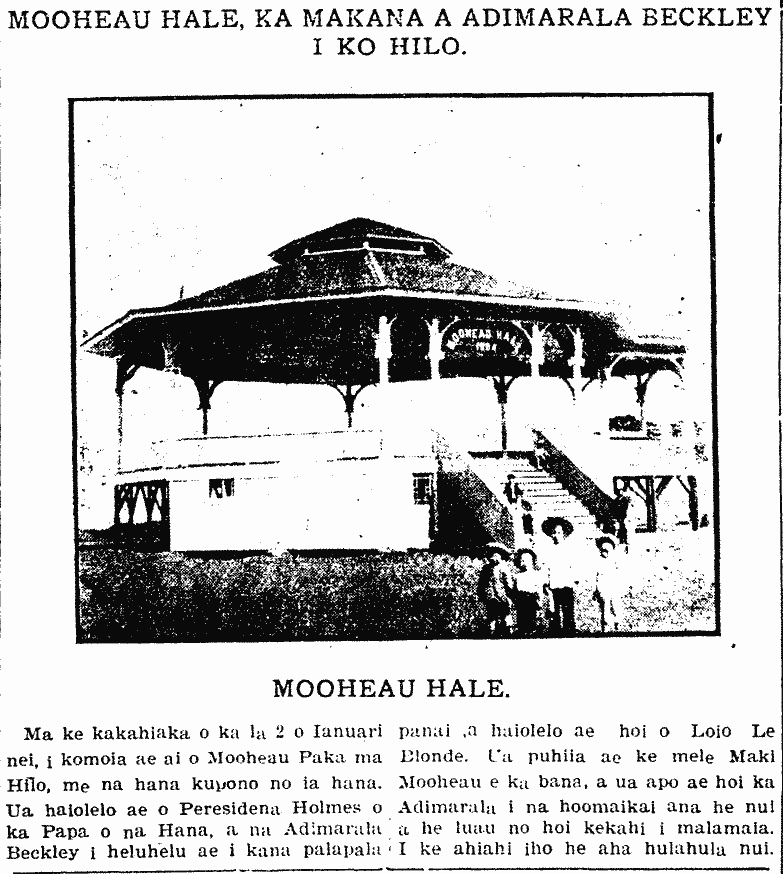
Admiral George Beckley donates Mooheau Bandstand, 1905.

MOOHEAU HALE, GIFT OF ADMIRAL BECKLEY TO HILO’S PEOPLE.

MOOHEAU HALE.

On the morning of the 2nd of January, Mooheau Park in Hilo was entered with fitting pomp. President Holmes of the Board of Trade [Papa o na Hana] gave a speech, and Admiral Beckley read his response, and then Attorney Le Blonde spoke. The song, Mooheau March was played by the band, and the Admiral received many thanks and there was held a luau. That evening, there was a great ball.

[I wonder what this march sounded like composed special for this event by Joaquim Carvalho. For more on Professor Carvalho (and if you can read Portuguese) see this page on Portuguese immigration and band music in Hawaii nei.]

(Kuokoa, 1/6/1905, p. 5)

MOOHEAU HALE, KA MAKANA A ADIMARALA BECKLEY I KO HILO.

Ka Nupepa Kuokoa, Buke XLIII, Helu 1, Aoao 5. Ianuari 6, 1905.

A mele by Liliuokalani, 1896.

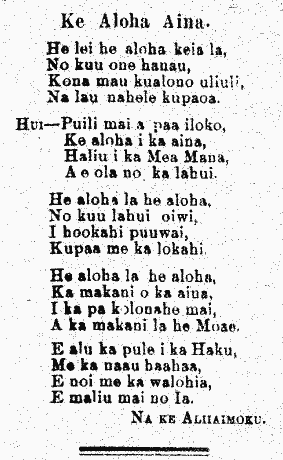
Ke Aloha Aina.

He lei he aloha keia la,
No kuu one hanau,
Kona mau kualono uliuli,
Na lau nahele kupaoa.

Hui—Puili mai a paa iloko,
Ke aloha i ka aina,
Haliu i ka Mea Mana,
A e ola no ka lahui.

He aloha la he aloha,
No kuu lahui oiwi,
I hookahi puuwai,
Kupaa me ka lokahi.

He aloha la he aloha,
Ka makani o ka aina,
I ka pa kolonahe mai,
A ka makani la he Moae.

E alu ka pule i ka Haku,
Me ka naau haahaa,
E noi me ka walohia,
E maliu mai no Ia.

Na ke Aliiaimoku.

[Patriotism.

A song of adornment, a song of love,
For my homeland,
Her verdant mountainsides,
The fragrant forest foliage.

Chorus—Embraced and held tightly within,
Love for this land,
Look towards the Almighty,
And the lahui shall live.

A song of love, a song of love,
For my native people,
Of one heart,
Steadfast in unity.

A song of love, a song of love,
The wind of the land,
Blowing gently
The wind, the Moae.

Pray as one to the Lord,
With humble hearts,
Beseech with reverence,
He shall pay heed.

By the Ruling Alii]

[Sometimes just doing a search using terms like “Liliuokalani,” “Liliu,” “Liliuonamoku,” “Liliuonalani,” “Moiwahine,” &c., will not bring up all there is to find…

It would be very useful if there perhaps was a central place where people could add their finds to various topics, like in this case, mele by Liliuokalani.]

(Makaainana, 10/5/1896, p. 1)

Ke Aloha Aina.

Ka Makaainana, Buke VI—-Ano Hou, Helu 14, Aoao 1. Okatoba 5, 1896.

Mele inoa for Keelikolani Muolaulani, 1863.

NO KEELIKOLANI, MUOLAULANI KA INOA.

1 He anana’la i ka loa o Alakai,
Ke kuhi la he koke aku o Maunahina,
He liuliu Waialeale na ke a—nui,
He anu ka ka nahele o Aipo,
O ke kupilikii aku ia hina i Maunahina—,
Hina i ka hoona rama a ke aloha,
I ka ae hakoko a ka manao,
E pilia la i ka moe he kanaka—i—a,
He kanaka ia ua helu ia ka malama,
Hana ia iho i mio kou aloha—e—a.

Na Lilipi. Continue reading

Ti ka char sow san nin fat choi? 1866.

Aloha La Konohi!

Is there anyone that knows what dialect the Chinese lines are from in the previous mele post?

Also, might there be someone that might offer an interpretation or translation for the Chinese lines?

1 La hauoli a pomaikai,
No ka lahui o Kina,
Ti ka char sow san nin fat choi
No ka makahiki hou,
Hape Nuia. Hape Nuia &co
E na makamaka nei.

2 Ke hui mai nei na kalepa
O ko Kina poe gentlemen,
Me ka lakou mau ladies no
A hauoli hoomaikai,
Ti ka kon hi. Ti ka kon hi, &co
And san nin Tat-i.

3 Na makua o keia hui
Me na keiki a lakou,
A pomaikai na mea a pau
Keia makahiki hou,
Choi tan qui sow. Choi tan qui sow
Hooili ia lakou.

4 Na ke Akua ma ka lani
Nana e hoomaikai mai
O keia hui ko Kina poe
E noho ma Hawaii nei,
Haleluia. Haleluia
No ka Haku ola mau.

5 Na Keonimana me na Lady
E aloha kakou a pau,
No ko kakou olioli,
Ka la nu Lahui o Kina,
Huro kakou! Huro kakou!!
A hauoli pu.

Chinese New Year song in Lahaina, 1866.

[Found under: “Ka Happy New Year o na Pake”]

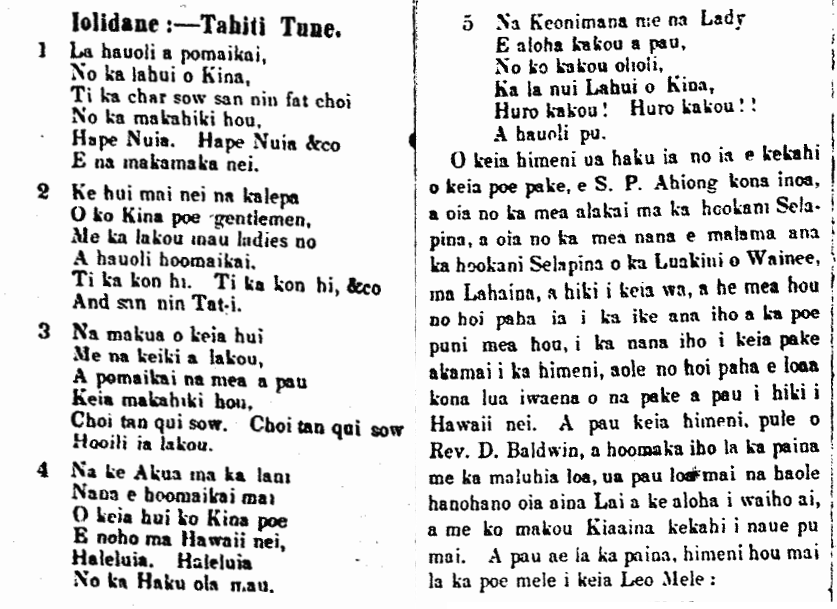
Iolidane:—Tahiti Tune.

1 La hauoli a pomaikai,
No ka lahui o Kina,
Ti ka char sow san nin fat choi
No ka makahiki hou,
Hape Nuia. Hape Nuia &co
E na makamaka nei.

2 Ke hui mai nei na kalepa
O ko Kina poe gentlemen,
Me ka lakou mau ladies no
A hauoli hoomaikai,
Ti ka kon hi. Ti ka kon hi, &co
And san nin Tat-i.

3 Na makua o keia hui
Me na keiki a lakou,
A pomaikai na mea a pau
Keia makahiki hou,
Choi tan qui sow. Choi tan qui sow
Hooili ia lakou.

4 Na ke Akua ma ka lani
Nana e hoomaikai mai
O keia hui ko Kina poe
E noho ma Hawaii nei,
Haleluia. Haleluia
No ka Haku ola mau.

5 Na Keonimana me na Lady
E aloha kakou a pau,
No ko kakou olioli,
Ka la nu Lahui o Kina,
Huro kakou! Huro kakou!!
A hauoli pu.

[Jordan [?]:—Tahiti Tune.
1 Joyous and blessed day,
For the Chinese people,
Ti ka char sow san nin fat choi
For the new year,
Happy New Year. Happy New Year &co
O Friends here.
2 The merchants have gathered
Of China’s gentlemen,
Along with their ladies
And blessed happiness
Ti ka kon hi. Ti ka kon hi, &co
And sun nin Tat-i.
3 The elders of this group
Along with their children,
Blessed is everyone
This new year,
Choi tan qui sow. Choi tan qui sow.
Onto them.
4 It is God in heaven
Who will bless them
This group of China’s people
Living in Hawaii nei,
Hallelujah, Hallelujah
For the eternal Lord.
5 The Gentlemen and Ladies
Aloha amongst all of us,
For our joy,
The holiday of the Chinese people,
Hurrah to us! Hurrah to us!!
And happiness too.]

This song was composed by one of these Chinese; S. P. Ahiong is his name, and he is the director in the playing of the Seraphim [Selapina], and he holds Seraphim concerts in the Wainee Church in Lahaina until today, and it may be something novel to see for those who are into new things; seeing this skilled Chinese singer, he probably has no match amongst all the Chinese who have come to Hawaii nei. After this song, Rev. D. Baldwin gave a prayer and the banquet started with much calm; all of the respected haole of that Calm land which aloha has put forth, along with our Governor [Paulo Nahaolelua] who came by….

[This is just a portion of a much larger article describing the new year celebration in Lahaina. There are more mele!]

(Kuokoa, 3/3/1866, p. 4)

Iolidane

Ka Nupepa Kuokoa, Buke V, Helu 9, Aoao 4. Maraki 3, 1866.

Alekoki, 1896.

KAHI WAI O ALEKOKI.

(An expression of affection by King Kalakaua.)

Aole i manaoia
Kahi wai o Alekoki
Hookohu ka ua iuka
Noho mai la i Nuuanu
Anuanu makehewa au
Ke kali ana ilaila
Kai no paha ua paa
Kou manao ia nei
Au i hoomalu ai
Hoomalu oe a malu
Ua malu keia kino
Mamuli o ko leo
Kau nui aku ka manao
Kahi wai o Kapena
Pania paa ia mai
Na manowai o uka
Ahuwale na kiowai
Na papahele o luna
Maluna ae no au
Ma na rumi liilii
Ma na keena o waho
A waho o Mamala
Hao mai nei ehuehu
Pulu au i ka huna kai
Kai he’ahe’a i ka ili
Hookahi no koa nui
Nana e alo ia ino
Inoino mai nei luna
I ka hao a ka makani
He makani ahailono
Lohe ka luna i Pelekane
Oia pouli nui
Mea ole i kuu manao
I o ia nei au
Ka piina o Maemae
E kilohi au o ka nani
Na pua i Maunaala
He ala onaona kou
Ke pili mai ia nei
Aole i billwi ia [Aole i biliwi ia]
Kahi pali o Leahi
Ku kilakila i ka lai
Lai hohola i ke pili
Pili paa o Kawaihoa
Hoa oe o ka inoino
O oe owau kekahi
Pau keia pilikia

(Leo o ka Lahui, 2/3/1896, p. 3)

KAHI WAI O ALEKOKI.

Ka Leo o ka Lahui, Buke II, Helu 1390, Aoao 3. Feberuari 3, 1896.

Short biography of Jane Loeau by her husband, S. L. Kaelemakule, 1873.

A History of Jane Loeau.

In the year 1847, Jane Loeau was boarding at the school of Mr. and Mrs. Cooke [Kuke], and she married John Robert Jasper [Keoki-pu], and he died. In the year 1855 perhaps, she married Marvin Seger [Sika] [? Martin Seger], and he died. In the year 1862, she married me. We were together for 10 years, 7 months, and 25 days in the covenant of marriage in peace and happiness. We did not leave one another, but it was the angel of heaven who has separated us, and I live with sadness and never-ending regret.

She is one of the royal descendants of Hawaii nei, born of alii “Papa.” From ancient times, her rank was of royalty, but she humbled herself, befriended and warmly welcomed newcomers, she was loving, and she was kind in actions and words, and she was a follower of the Lord. In the year 1865, she joined the church at West Hamakua, Hawaii, and this past July, the Rev. J. Bicknell [Bikanele] released our covenant at Kawaiahao Church, to Rev. H. H. Parker [Paleka] [? ua hookuu mai la o Rev. J. Bikanele i ko maua berita ma ka ekalesia o Kawaiahao, ia Rev. H. H. Paleka.]. “Blessed are those who die in the Lord.” I composed this loving chant [kanaenae] for her below:

Ke aoa lani ulu haoa o ke kapu,
Ke aoa lani o Haholua o Palena,
O ke Kihenelani nei a Kauhi—e,
Na Kauhikealani o Kama,
Oia no—a.

Ka Punua ula ku i ka moku,
I hoopunanaia iloko o ka lani,
O ka lani me he aka la i ka wai,
He akamai i ke kui lani,
Kuiia ae kani kui hono i ka moku,
Ka mai kaupoa ma ke kua,
I ku ka hene ma ka houpo,
Poaha ia hemo ka Haku,
Ma ka manawa o ka ua kapu,
O Holani nui kaipo,
Ma ka loko mai o Holani na ‘lii,
Oia no—a.

Hoopuka i Nuuanu ka ua a ka makani,
Haiki ka pili hau i Kahaukomo,
Komo i na kiowai a ke Kiowao,
Aleale i ke alo ua o Lanihuli,
Hala i ka na’ki o Konahuanui,
Nui ka ua, mahimahi nui ka makani,
Na hookoikoi a ka waahia,
He hilahila oe ke hai mai—e,
Iini ana loko,
Oia no—a.

O Hanalei ua pehu ka lani,
Pohu ka lani, loloa ka opua,
Opua lani uli ku hakakai,
Kai ka ua e—e ua i ka liko,
A ka liko awe loloa ka ua iluna,
Lele pulelo iluna o ka lau o ka laau,
Ukuhi i na pakeke wai o Neki,
Piha Hilo ke kaheka kulu a ka wai,
Wahiaia aku la Waioli e ka ua,
Naha Hanalei ke kahe nei ke one,
Oia ua e—e ua i Hanalei,
Oia no—a.

Hanalei lani kupilikii, kupilikii mau a ka lani,
Huikau ae la he hooilo, mahiki mai la ka lehua,
Ka lehua hale, ka lehua makanoe,
Ka naele i o ia e ka wai ka lepo,
O Hiku iluna o Maunahina,
Kupeke, kapekepeke iluna o Hauai’liki,
Iliki ka noe, anu ka nahele,
He nahele anu, me ua hoa’la i na lae ino o ka moe,
E poi ana a ku he ‘hu,
Moe aku ka luhi i Kauakanana—e,
E hoonana ae ana i ka moe—e,
O oni mai auanei ma ka hope,
Mahope mai—a,
Oia no—a.

(To be continued.)

S. L. Kaelemakule.

Honolulu, August 6, 1873.

[I am not sure if there is a continuation to this.

S. L. Kaelemakule doesn’t live that many years after that. He dies on March 3, 1878, at Kepahoni, Honolulu.]

(Ko Hawaii Ponoi, 8/13/1873, p. 4)

He Moolelo no Jane Loeau.

Ko Hawaii Ponoi, Buke I, Helu 9, Aoao 4. Augate 13, 1873.
Kaipoleimanu, okolehao, place names, and such, 1895 / 2014.

KAIPOLEIMANU.

This Tuesday, Captain Kalei of the Schooner Rob Roy, which is a schooner travelling between Honolulu nei and Molokai, was arrested for having an Okolehao jug containing liquor; there were a great many officers sent to the seaside to arrest the Captain of the schooner.

There was much found in a dark room: four gin jugs, two Whiskey jugs, but the majority found were bottles that were empty with no whiff of Okolehao.

One of the sailors of this ship, distanced himself with a dismal look on his face, and another scratched his head while looking pale.

When it was clear to an officer that he saw alcohol was brought into Honolulu town to be sold, and because of orders received by the officers, should there be a person or persons that were confirmed to have alcohol, they were to be taken to Jail [Halewai], that indeed is what happened as per what was ordered; and the officers and some others went along to the Jailhouse while bringing in a Demijohn [“basketry filled with a bottle”] containing some Okolehao; there was the stench of Ipoleimanu, and this made us recall these lines of mele.

He manao he aloha,
No Kaipoleimanu,
He manu ku’u hoa,
Noho mai ka nahele,
Iiwi a o uka,
Polena i kaua,
Ua ao Hanalei,
Anu au maeele,
[Ua anu hoi au
I ka ua noe anu
Na hau o Maihi
Au ana i ke kai
Na ulu o Weli
Punohu mai ana
E mapu mai ana
Ke ala o ka Hala
Hala o Mapuana
Honi ana i ka ihu
Ke ala pua rose
Hooheno i kuu poli
Naue kuu kino
Ko hiki ana mai
Haina ia ka puana
No ka ipo leimanu.]

¹Kaipoleimanu was during this time a slang for okolehao.

[I took a step back from “Hawaii’s Story,” but not too far. This mele by Queen Kapiolani for her King Kalakaua, Kaipoleimanu, is still widely sung today. But who today still knows that along with Hanalei, Maihi, Weli, and Mapuana, that Kaipoleimanu is a place on Kauai. In a Hawaii where we are so used to places called Diamond Head, Pearl City, Bowls, Sunset, Yokohama, and the like, is there value in re-membering more traditional names?

On that note, before i take some time away from these posts, i thought i would try a little survey. If you have the time, please think about the question rationally, then choose an answer or add one of your own. And as always, do feel free to leave comments in the box all the way at the bottom.]

(Oiaio, 8/23/1894, p. 3)

KAIPOLEIMANU.

Nupepa Ka Oiaio, Buke VII, Helu 25, Aoao 3. Augate 23, 1895.

A mele by Joseph Nawahi for his wife Emma Aima, 1936.

A HAWAIIAN MELE.

Some day later, we were asked at our Hoku publishing office, of the songs which were sung at the funeral of Mrs. Aima Nawahi on the last Sunday of this past year. The mele sung on that day were famous songs in “Leo Hoonani a me Hoku Ao Nani.”¹ They were not all shown and there were others, like “Mai Kuu Kaumaha Luuluu a Po,” and the young girls of Haili sang those songs with beautiful lyrics.

There were also hymns sung by some girls who were close to Aunty Aima, and they were sung with such sweetness. The mele sung by the Kaahumanu Society was this one. “Ma ko Iesu mau lima,” and some others as well.

The main reason that this question was asked, was because of the great admiration for the hymns composed by the devout in years gone by. There is someone writing down some old mele in a book to be distributed, and these hymns are wanted by this person writing down Hawaiian mele as something new for him. Another admired mele sung at the funeral of Mrs. Nawahi was that mele composed by Mr. Nawahi before their marriage. Here are the lines of that mele that are recalled partially, and recalled at that time.

Nana aku iluna
He star e alohi ana
Ua like me sweet rose
Me Fairy Puakoolau.

Hui
Aheahe mai ke kehau of the twilight
Pa mai ke ala onaona oia of my dear
Please wau e kiss i ke ala oia pua
And not Forgetting the sweet Lei Lehua

Hoi iho au e moe
Hiki ana o sweet rose
E naue ae kaua
I kuu home iuiu.

This is a mele that was sung all the time by the women of those days, and the lyrics are beautiful. There are many other lovely mele by Hawaiians that we remember, but when it is thought to sing it, we totally forget the words.

¹Leo Hoonani a me Hoku Ao Nani. Honolulu: Ka Papa Hawaii, 1902.

[This mele is printed earlier in Hoku o Hawaii on 1/3/1936 and the article itself is a reprint from 1/7/1936.]

(Hoku o Hawaii, 1/15/1936, p. 3)

HE MELE HAWAII

Ka Hoku o Hawaii, Buke XXVII, Helu 29, Aoao 3. Ianuari 15, 1936.