King Kalakaua returns from trip around the world, 1881 / 1912.

KE KAENA A KA MOI KALAKAUA

Ua kaahele au maluna o ka ilihonua me na moana,
A Inia mamao, a me Kina kaulana;
Hoea i na aekai o Aferika, a me na palena o Europa,
A halawai me ka ikaika o na aina apau,
A ia’u i ku ai ma ka aoao o na Poo Aupuni,
Ka poe mana maluna o ka lakou, me ka hiehie Alii;
Hoomaopopo iho la au i ka ukuiki, a nawaliwali o ko’u,
Me ko’u Nohoalii hookahua ia maluna o kahi puu Pele,
A ma kahi he miliona i hooko i ka keia mau Moi,
He mau tausani wale iho no malalo o ko’u mau malu;
Aka, ke upu nei loko, na’u ke Kaena hiki,
Aia he mau nani maloko o na poai o ko’u mau aekai—
I oi aku ka makamae i ka o’u mau hoa Moi,
Aohe o’u kumu hopo maloko o ko’u Aupuni,
He hiki ke hui me ko’u lahui, me ka weli ole,
Aohe makau no’u iho, me ke kiai pilipaa ole ia,
A na’u ke Kaena, he momi i hoounaia mailuna mai na’u—
Eia me A’u ke Aloha pilipaa o Ko’u Lahuikanaka.

[See an English translation for this mele.]

(Au Hou, 2/14/1912, p. 25)

KE KAENA A KA MOI KALAKAUA

Ke Au Hou, Buke 3, Helu 6, Aoao 25. Feberuari 14, 1912.

Another sweet song for Liliuokalani, 1897.

MAKALAPUA.

O Makalapua ulumahiehie,
O ka lei o Kamakaeha,
No Kamakaeha ka lei o na Liawahine,
No na wahine kihene pua.

Hui:—E lei ho–i e Liliulani e,
E lei ho–i e Liliulani e.

Haihai pua Kamani pauku pua Ki-ki,
I lei hoowehi no ka wahine,
I walea ai i ka waokele,
Iuka o Omaonahele.

Lei Kaala i ka ua a ka Naulu,
Hoolue ihola ilalo o Haleauau,
Ka ua lei kakooula i ke pili,
I pili ia e ka mauu nene me ke kupukupu.

Lei aku i na hala o Kekele,
Na hala moe ipo o Malailua,
Ua maewa wale i ke oho o ke Kawelu,
Ka lei Kamakahala a ka ua i Waahila.

[Another well known mele for Queen Liliuokalani found within the pages of the Hawaiian-Language Newspapers.]

(Aloha Aina, 1/16/1897, p. 7)

MAKALAPUA

Ke Aloha Aina, Buke III, Helu 3, Aoao 7. Ianuari 16, 1897.

More familiar mele, with English translation, 1909.

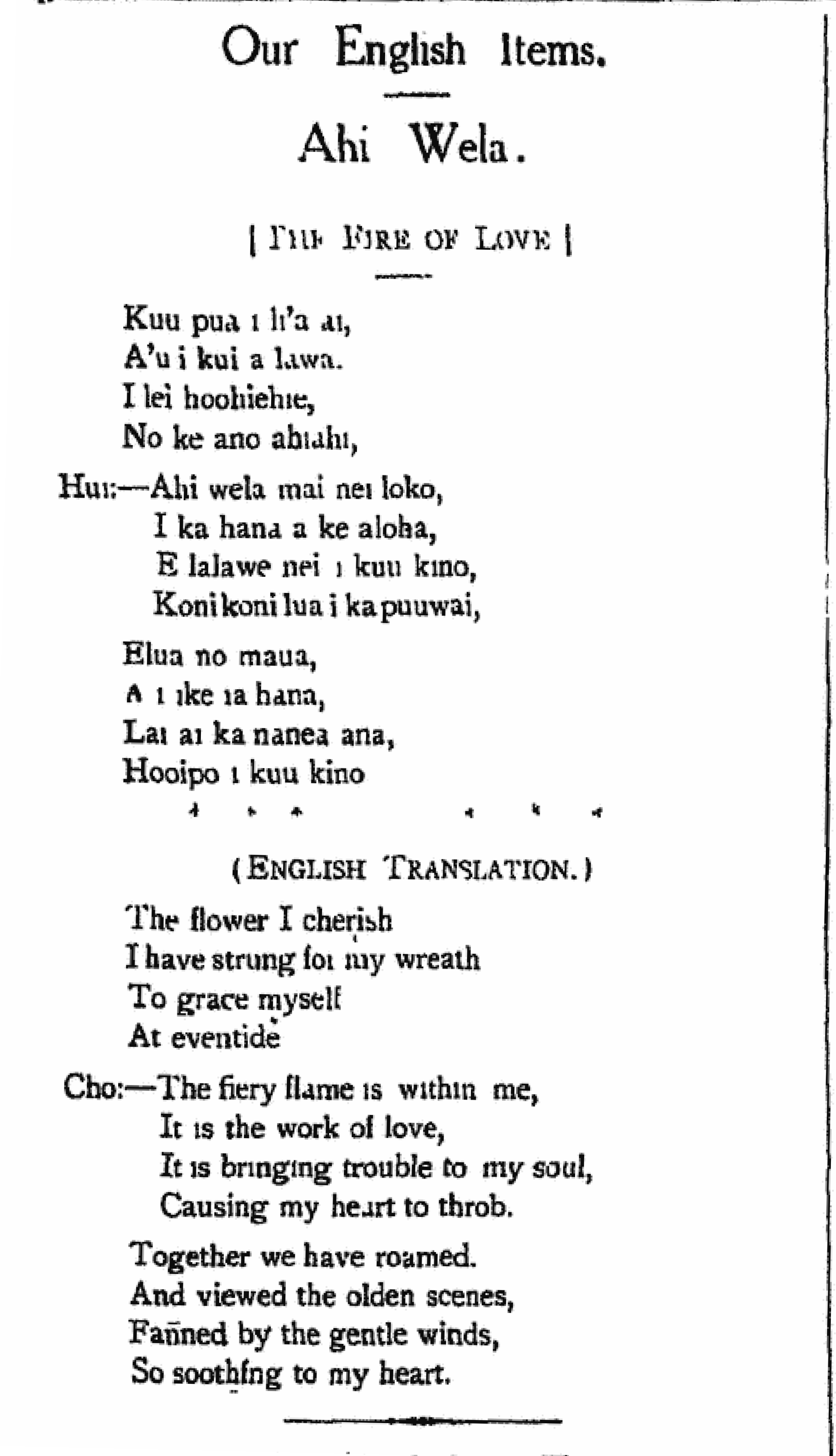
Our English Items.

Ahi Wela.

[THE FIRE OF LOVE]

Kuu pua i li’a ai,
A’u i kui a lawa,
I lei hoohiehie,
No ke ano ahiahi,

Hui:—Ahi wela mai nei loko,
I ka hana a ke aloha,
E lalawe nei i kuu kino,
Konikoni lua i ka puuwai,

Elua no maua,
A i ike ia hana,
Lai ai ka nanea ana,
Hooipo i kuu kino.

(English Translation.)

The flower I cherish
I have strung for my wreat
To grace myself
At eventide

Cho:—The fiery flame is within me,
It is the work of love,
It is bringing trouble to my soul,
Causing my heart to throb.

Together we have roamed,
And viewed the olden scenes,
Fanned by the gentle winds,
So soothing to my heart.

(Kuokoa Home Rula, 5/21/1909, p. 1)

Our English Items.

Kuokoa Home Rula, Bukke VII, helu 21, Aoao 1. Mei 21, 1909.

“Ka Ipo Lei Manu,” 1891.

KALANI KAULILUA.

He manao he aloha
Na ka ipo lei manu
Ua manu kuu hoa
Noho mai ka nahele
Iiwi o uka
Polena i ka ua
Elua maua
I ka po ua nui
Ua o Hanalei
Anu au maeele
Ua anu hoi au
I ka ua noe anu
Na hau o Maihi
Au ana i ke kai
Na ulu o Weli
Ponuhu mai ana
Mapu mai ana
Ke ala o ka Hala
Hala o Mopuena [Mapuana]
Onaona i ka ihu
Ke ala pua Loke
Hone na ka manao
Naue kuu kino
Ko hiki ana mai
Haina ia ka puana
O ka Lani Kaulilua.

[A song attributed to Queen Kapiolani for her King that travelled afar; it is still widely sung today and more commonly known by the title “Ka Ipo Lei Manu”. This is perhaps the first time it appears in the Hawaiian-Language Newspapers. It was published in the issue immediately following the issue announcing the death of King Kalakaua.]

(Leo o ka Lahui, 2/2/1891, p. 2)

KALANI KAULILUA.

Ka Leo o ka Lahui, Buke II, Helu 120, Aoao 2. Feberuari 2, 1891.

Christmas at Iolani Palace, 1920.

THE PALACE IS AGLOW WITH ELECTRIC LIGHTS.

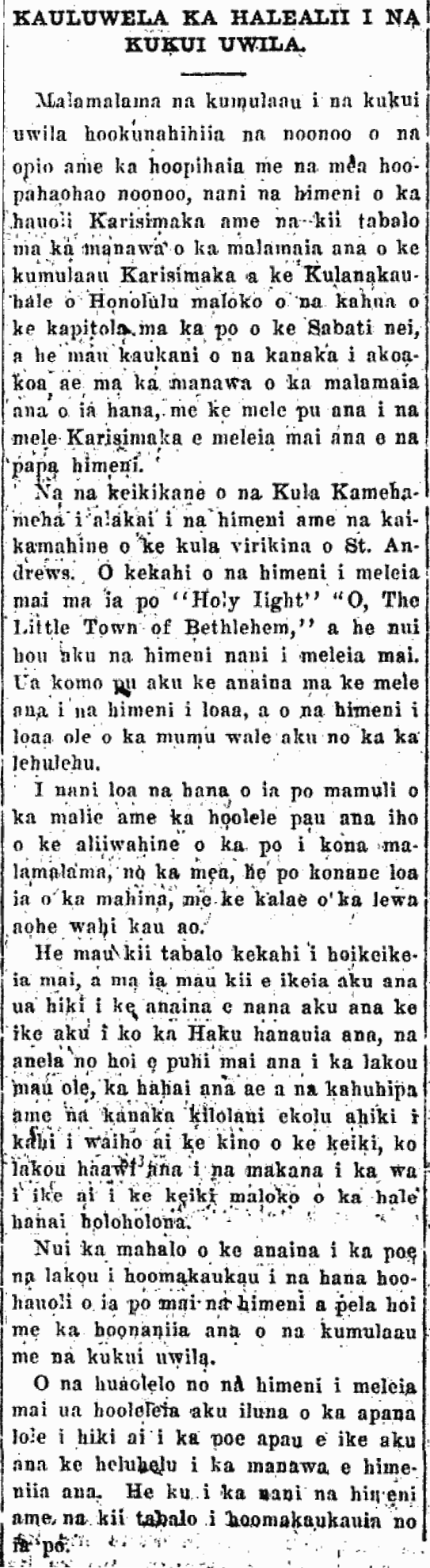
The trees were bright with electric lights and the minds of the children were amazed, filled with wonder; the singing of Christmas joy and the skits were beautiful as the Christmas tree of the City of Honolulu was lit on the grounds of the capital this past Sunday; and there were thousands of people gathered while the event was held, while they sang along to Christmas carols being sung by choral groups.

The boys of the Kamehameha Schools led the singing along with the girls of the St. Andrews Priory School. Some of the songs sung that night were “Holy Light,” “O, The Little Town of Bethlehem,” a many other beautiful songs were sung. The crowd joined in the singing of the songs they knew, and when they did not know the words, they were silent.

The activities that night were wonderful because of the peace and because the queen of the night shone down her light, being this was a bright moonlit night, with a clear sky an no clouds.

There were skits performed as well, and in these performances to be seen, the crowd could watch the birth of the Lord, the angels blowing their trumpets, the following of the shepherds and the three magi to where the child lay, and their giving of gifts when they saw the child in the manger.

The audience was very appreciative of those who put on the joyous festivities that night, from the singing and so forth to the decorating of the trees with lights.

The words of the songs sung were projected onto a section of cloth so that everyone who could see could read it while the songs were being sung. The singing and the skits that were prepared for that night were wonderful.

(Kuokoa, 12/31/1920, p. 2)

KAULUWELA KA HALEALII I NA KUKUI UWILA.

Ka Nupepa Kuokoa, Buke LVIII, Helu 53, Aoao 2. Dekemaba 31, 1920.

Christmas acrostic, 1868.

Christmas Day.

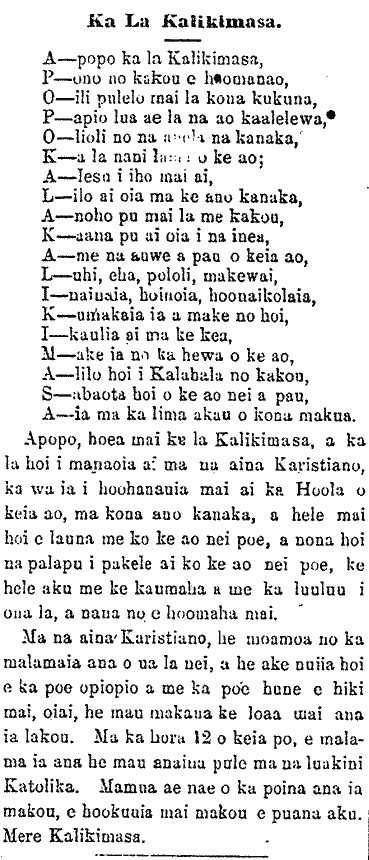
Tomorrow is Christmas,
We should remember,
Its rays rise in triumph,
The drifting clouds lie outstretched,
Joyous were the angels, the people,
The [illegible word] beautiful day of the world;
When Jesus came down,
He became as a human,
And dwelt with us,
He shared the suffering,
And the sorrows of this world,
Weary, hurt, hungry, thirsty,
Hated, abused, scorned,
Betrayed and died,
Suspended from the cross
He died for the sins of the world,
And became our Redeemer,
Sabaoth of the whole world,
At the right hand of his father.

Tomorrow, Christmas day will arrive, and it is a day to remember in Christian lands, the day that the Savior of the world was born in human form, and he walked with the people of this world, and he bore the wounds so that those of this world would be saved, should they go before him oppressed and in woe, it is he that will give them relief.

In Christian lands, the commemoration of this day is cherished, and it is a great desire of the youth and the poor to come by, for they will receive presents. At 12 o’clock at night, a service will be held at the Catholic Church. Before we forget, we leave you while saying, “Mere Kalikimasa.”

[This poem works off the phrase “APOPO KA LA KALIKIMASA” [Tomorrow is Christmas Day]. With writing also came this new form of mele, acrostic. They are found quite often throughout the many Hawaiian-Language Newspapers.]

(Au Okoa, 12/24/1868, p. 2)

Ka La Kalikimasa.

Ke Au Okoa, Buke IV, Helu 36, Aoao 2. Dekemaba 24, 1868.

Now online: Guide to Sheet Music Collection from the Hawaiian Historical Society, 2013.

Guide to Sheet Music Collection Now On Line

sheet music image

The Hawaiian Historical Society library includes a modest but growing collection of Hawaiian and hapa-haole sheet music spanning the 1860s to the 1960s. An illustrated guide to the collection can now be consulted on line thanks to the work of HHS library intern Annemarie Aweau, who compiled the guide. Ron Williams photographed the cover pages of the music to provide the illustrations. (Click here to read on…)

Remembrance, 1918.

A PARCEL OF TEARS OF LOVE.

KAOWAKAOKALANI KEAMUAMUKU.

Gone, no more, is that royal descendant of the land—Kaoakaokalani Keamuamuku (f)—a scion of Liloa, King of Hawaii, with Akahiakuleana (f); Umi a Liloa (m) joined with Kapukini (f), begot Keliiokaloa (m), joined with Makuahineopalaka (f), begot Kukailani (m), joined with Kaohukiokalani (f), begot Makakaualii (m), joined with Kaakanaoao (f), begot Pueopokii (f), joined with Kalanikaaoao (m), begot Lonoikamakahiki (m), joined with Kailuapea, Kailuakea (f), begot Hookuiniaumakaokalani (m), joined with Kahoowaha (f), begot Kainahopukahi (m), joined with Kauopuaikanuumealani (f), begot Luukia (f), joined with Kauhiaimokuakama (m), begot Ikawahi (f), joined with Ihikolopana (m), begot Kaleimakalii (f), joined with Keakealani (m), begot Keawekuikaai (m), joined with Kihawahine (f), begot Kaaloaikanoa (f), joined with Umihulumakaokalani (m), begot Palena (m), Paia (m), Luahine (m), joined with Hikuikekualono (f), begot three sons, one daughter, Kahaopulani (f), the one who raised Kamehameha I, King of the Hawaiian Archipelago, Kahaopulani (f) joined with Kioula (m), begot Kuakane (f), the one fed on the same milk as Kamehameha I. Kuakane (f) joined with Kamoeau (m), begot Akimakaokalauhue (f), joined with Kamalanaikuaheahe (m), begot Kapiimoku (f), joined with Kekahili (m), begot Kaoakaokalani Keamuanuku (f).

……..

[This is an interesting death announcement for the picture (if the newspapers were rescanned clearly, it would surely be a much better picture), for the genealogy and who appears in it, and also the mele at the end.

Note the reference to the kahu hanai of Kamehameha I here being not Naeole, but Kahaopulani.]

(Kuokoa, 10/4/1918, p. 2)

HE PUOLO WAIMAKA NA KE ALOHA.

Ka Nupepa Kuokoa, Buke LVI, Helu Helu 40, Aoao 2. Okatoba 4, 1918.

Queen Kapiolani, Mele, Maunakea, and a new site to check out, 1878/2013.

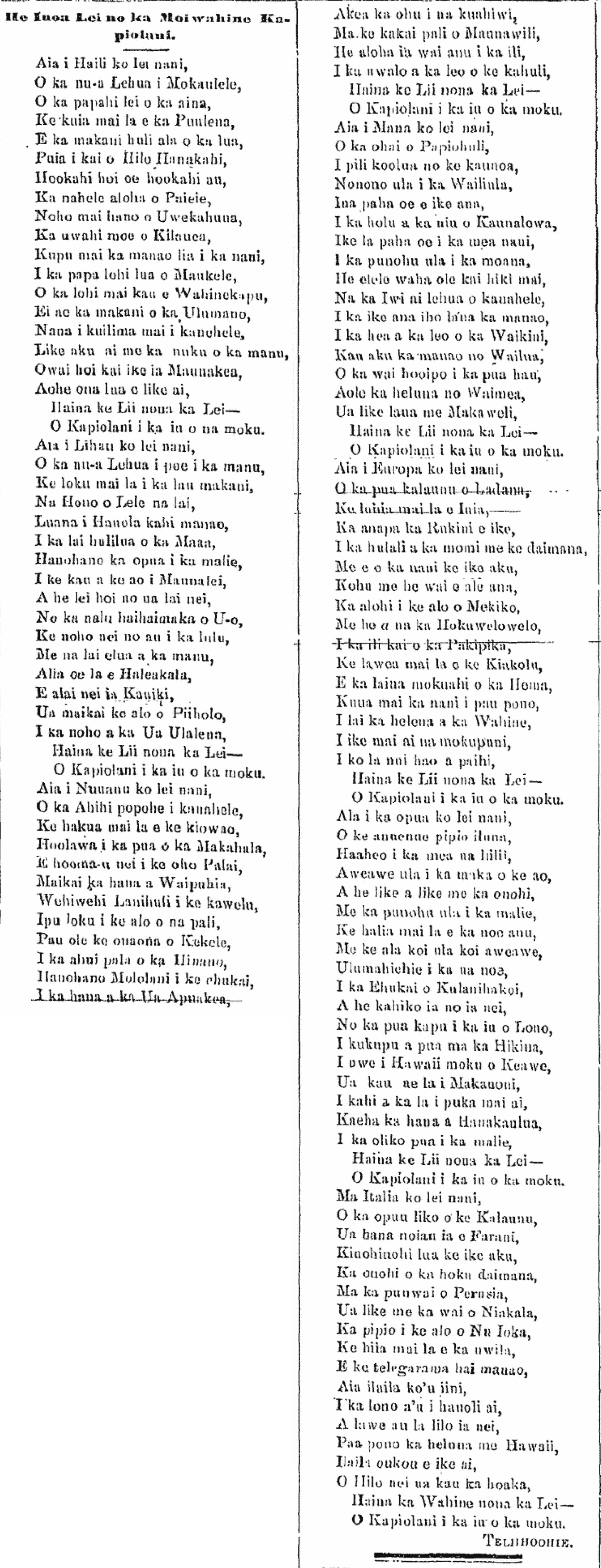
He Inoa Lei no ka Moiwahine Kapiolani.

Aia i Haili ko lei nani,
O ka nu-a Lehua i Mokaulele,
O ka papahi lei o ka aina,
Ke kuia mai la e ka Puulena,
E ka makani huli ala o ka lua,
Puia i kai o Hilo Hanakahi,
Hookahi hoi oe hookahi au,
Ka nahele aloha o Paieie,
Noho mai hano o Uwekahuna,
Ka uwahi moe o Kilauea,
Kupu mai ka manao lia i ka nani,
I ka papa lohi lua o Maukele,
O ka lohi mai kau e Wahinekapu,
Ei ae ka makani o ka Ulumano,
Nana i kuilima mai i kanehele,
Like aku ai me ka nuku o ka manu,
Owai hoi kai ike ia Maunakea,
Aohe ona lua e like ai,
Haina ke Lii nona ka Lei—
O Kapiolani i ka iu o na moku.

Aia i Lihau ko lei nani,
O ka nu-a Lehua i poe i ka manu,
Ke loku mai la i ka lau makani,
Na hono o Lele na lai,
Luana i Hauola kahi manao,
I ka lai hulilua o ka Maaa,
Hanohano ka opua i ka malie,
I ke kau a ke ao i Maunalei,
A he lei hoi no ua lai nei,
No ka nalu haihaimaka o U-o
Ke noho nei no au i ka lulu,
Me na lai elua a ka manu,
Alia oe la e Haleakala,
E alai nei ia Kauiki,
Ua maikai ke alo o Piiholo,
I ka noho a ka Ua Ulalena,
Haina ke Lii nona ka Lei—
O Kapiolani i ka iu o ka moku.

Aia i Nuuanu ko lei nani,
O ka Ahihi popohe i kanahele,
Ke hakua mai la e ke kiowao,
Hoolawa i ka pua o ka Makahala,
E hooma-u nei i ke oho Palai,
Maikai ka hana a Waipuhia,
Wehiwehi Lanihuli i ke kawelu,
Ipu loku i ke alo o na pali,
Pau ole ke onaona o Kekele,
I ka ahui pola o ka Hinano,
Hanohano Mololani i ke ehukai,
I ka hana a ka Ua Apuakea,
Akea ka ohu i na kuahiwi,
Ma ke kakai pali o Maunawili,
He aloha ia wai anu i ka ili,
I ka uwalo a ka leo o ke kahuli,
Haina ke Lii nona ka Lei—
O Kapiolani i ka iu o ka moku.

Aia i Mana ko lei nani,
O ka ohai o Papiohuli,
I pili koolua no ke kaunoa,
Nonono ula i ka Wailiula,
Ina paha oe e ike ana,
I ka holu a ka ulu o Kaunalewa,
Ike la paha oe i ka mea nani,
I ka punohu ula i ka moana,
He elele waha ole kai hiki mai,
Na ka Iwi ai lehua o kanahele,
I ka ike ana iho lana ka manao,
I ka hea a ka leo o ka Waikini,
Kau aku ka manao no Wailua,
O ka wai hooipo i ka pua hau,
Aole ka heluna no Waimea,
Ua like laua me Makaweli,
Haina ke Lii nona ka Lei—
O Kapiolani i ka iu o ka moku.

Aia i Europa ko lei nani,
O ka pua kalaunu o Ladana,
Ke luhia mai la e Inia,
Ka anapa ka Rukini e ike,
I ka hulali a ka momi me ke daimana,
Me e o ka nani ke ike aku,
Kohu me he wai e ale ana,
Ka alohi i ke alo o Mekiko,
Me he a na ka Hokuwelowelo,
I ka ili kai o ka Pakipika,
Ke lawea mai la e ke Kiakolu,
E ka laina mokuahi o ka Hema,
Kuua mai ka nai i pau pono,
I lai ka helena a ka Wahine,
I ike mai ai na mokupuni,
I ko la nui hao a paihi,
Haina ke Lii nona ka Lei—
O Kapiolani i ka iu o ka moku.

Ala i ka opua ko lei nani,
O ke anuenue pipio iluna,
Haaheo i ka mea na liilii,
Aweawe ula i ka maka o ke ao,
A he like a like me ka onohi,
Me ka punohu ula i ka malie,
Ke halia mai la e ka noe anu,
Me ke ala koi ula koi aweawe,
Ulumahiehie i ka ua noe,
I ka Ehukai o Kulanihakoi,
A he kahiko ia no ia nei,
No ka pua kapu i ka iu o Lono,
I kukupu a pua ma ka Hikina,
I uwe i Hawaii moku o Keawe,
Ua kau ae la i Makanoni,
I kahi a ka la i puka mai ai,
Kaeha ka hana a Hanakaulua,
I ka oliko pua i ka malie,
Haina ke Lii nona ka Lei—
O Kapiolani i ka iu o ka moku.

Ma Italia ko lei nani,
O ka opuu liko o ke Kalaunu,
Ua hana noiau ia e Farani,
Kinohinohi lua ke ike aku,
Ka onohi o ka hoku daimana,
Ma ka puuwai o Perusia,
Ua like me ka wai o Niakala,
Ka pipio i ke alo o Nu Ioka,
Ke hiia mai la e ka uwila,
E ke telegarama hai manao,
Aia ilaila ko’u iini,
I ka lono a’u i hauoli ai,
A lawe au la lilo ia nei,
Paa pono ka helua me Hawaii,
Ilaila oukou e ike ai,
O Hilo nei ua kau ka hoaka,
Haina ka Wahine nona ka Lei—
O Kapiolani i ka iu o ka moku.

Teliihoohie.

[I was reminded of this set of lei chants for Queen Kapiolani by a post on a relatively new site with information about Hawaii past and present. Check out the recent post on Maunakea and much more by Nanea Armstrong Wassel, right here:

http://instagram.com/naneaarmstrongwassel

This mele is also printed in the very next issue of Ko Hawaii Pae Aina, 10/12/1878, p. 4, with some variation.]

(Ko Hawaii Pae Aina, 10/5/1878, p. 4)
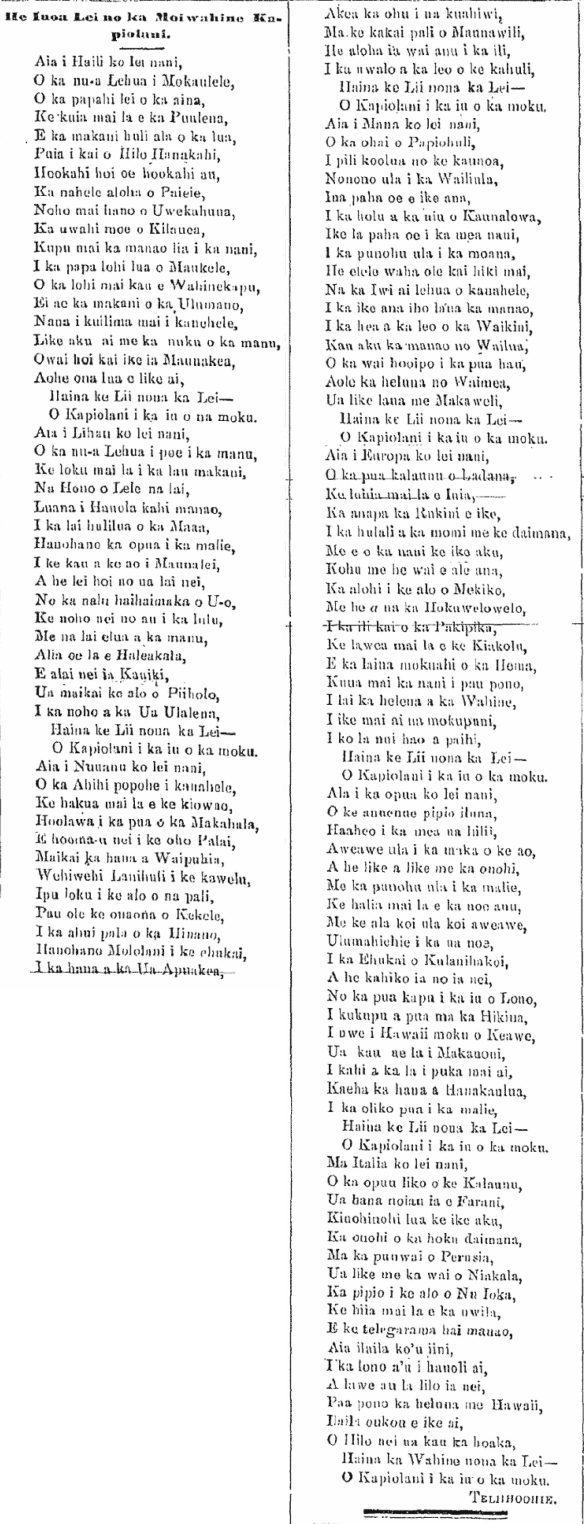
He Inoa Lei no ka Moiwahine Kapiolani.

Ko Hawaii Pae Aina, Buke I, Helu 40, Aoao 4. Okatoba 5, 1878.

Ellen Kekoahiwaikalani Prendergast’s “Kaulana na Pua”, 1896.

Look Here at This Mele

MELE ALOHA AINA AI-POHAKU
[PATRIOTIC ROCK-EATING SONG]

1. Kaulana na pua o Hawaii
Kupaa mahope o ka aina,
Hiki mai ka elele a ka lokoino
Palapala alunu me ka pakaha

2. Pane mai Hawaii-Nui o Keawe
Kokua na Hono-a-Piilani
Kakoo mai Kauai o Mano
Pau pu me ke one o Kakuhihewa

3. Aole e kau e ka pulima
Maluna o ka pepa a ka enemi
Aole makou a e minamina
I ka puu dala a ke Aupuni

4. Ua lawa makou i ka pohaku
I ka ai kamahao o ka aina
Hoohuiaina kuai hewa
I ka pono kivila o ke kanaka

5. Mahope makou o Liliulani
A kau hou la i ke Kalaunu
Haina ia mai ana ka puana
Na pua i aloha i ka aina

Composed by KEKOAHIWAIKALANI.

[This mele for obvious reasons is published many times throughout time.]

(Aloha Aina, 6/13/1896, p. 4)

MELE ALOHA AINA AI-POHAKU.

Ke Aloha Aina, Buke II, Helu 24, Aoao 4. Iune 13, 1896.