A mele by the “Solomon” of Hawaii, William J. Sheldon, 1918.

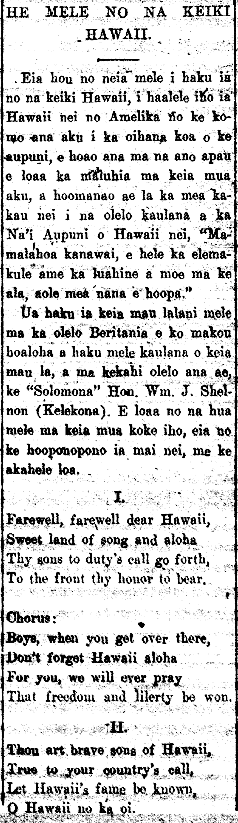
A MELE FOR THE HAWAIIAN BOYS.

Here again is this mele which was composed for the Hawaiian boys who just left Hawaii for America to join the armed forces of the nation, to try all means to obtain peace in the future, and the composer recalls the famous words of the Conqueror of the Nation of Hawaii nei, “Law of the Splintered Paddle: let the old men and the old women go and lie by the roads, no one is to disturb them.”

These lines of mele were composed in English by our friend and famous composer of songs of these days, and in other words, the “Solomon,” Hon. William J. Sheldon (Kelekona). The music will be available soon as it is now being edited with great care.

I.

Farewell, farewell dear Hawaii,
Sweet land of song and aloha
Thy sons to duty’s call go forth,
To the front thy honor to bear.

Chorus:

Boys, when you get over there,
Don’t forget Hawaii aloha
For you, we will ever pray
That freedom and liberty be won.

II.

Thou are brave sons of Hawaii,
True to your country’s call,
Let Hawaii’s fame be known,
O Hawaii no ka oi.

(Aloha Aina, 6/21/1918, p. 2)
HE MELE NO NA KEIKI HAWAII.

Ke Aloha Aina, Buke XXIII, Helu 25, Aoao 2. Iune 21, 1918.
Members of the volunteer military organization, Prince’s Own, Company C, 1886.

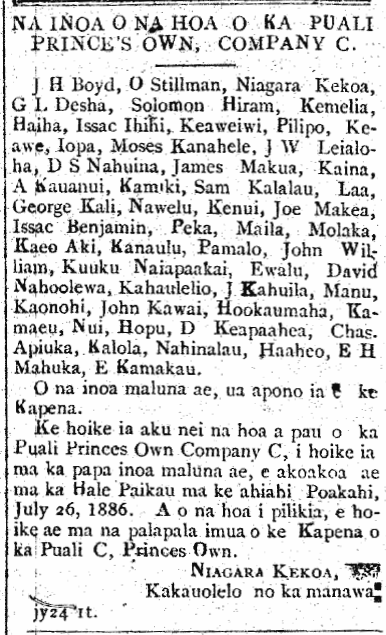
THE NAMES OF THE MEMBERS OF THE PRINCE’S OWN CORPS, COMPANY C.

J. H. Boyd, O. Stillman, Niagara Kekoa, G. I. Desha, Solomon Hiram, Kemelia, Haiha, Isaac Ihihi, Keaweiwi, Pilipo, Keawe, Iopa, Moses Kanahele, J. W. Leialoha, D. S. Nahuina, James Makua, Kaina, A. Kauanui, Kamiki, Sam Kalalau, Laa, George Kali, Nawelu, Kenui, Joe Makea, Isaac Benjamin, Peka, Maila, Molaka, Kaeo Aki, Kanaulu, Pamalo, John William, Kuuku Naiapaakai, Ewalu, David Nahoolewa, Kahaulelio, J. Kahuila, Manu, Kaonohi, John Kawai, Hookaumaha, Kamaeu, Nui, Hopu, D. Keapaahea, Charles Apiuka, Kalola, Nahinalau, Haaheo, E. H. Mahuka, E. Kamakau.

The names above are approved by the Captain.

Made known to all of the members of the Prince’s Own Corps, Company C, shown in the list above, they are to assemble at the Armory [Hale Paikau] in the evening of Monday, July 26, 1886. And for those members who have trouble, make this known in a letter addressed to the Captain of the Company C, Prince’s Own.

Niagara Kekoa,

Temporary Secretary.

(Nupepa Elele, 7/24/1886, p. 2)

NA INOA O NA HOA O KA PUALI PRINCE'S OWN, COMPANY C.

Ka Nupepa Elele, Buke VIII, Helu 4, Aoao 2. Iulai 24, 1886.

The Alii moved to Maunaala, 1865.

[Found under: “HUNAHUNA MEA HOU O HAWAII NEI.”]

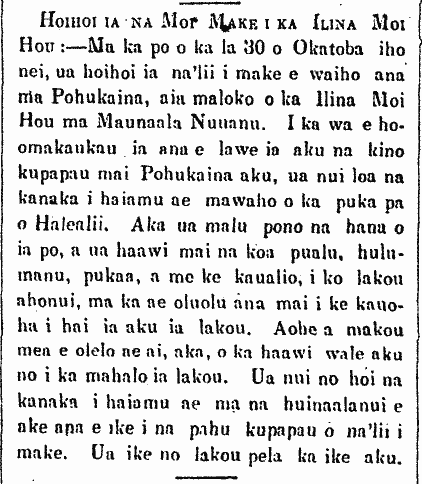
The Deceased Kings Taken to the New Royal Cemetery:—On this past 30th of October, the deceased alii who were at placed at Pohukaina were taken to the New Royal Cemetery at Maunaala, Nuuanu. When they were preparing to take the remains from Pohukaina, there were many people gathered outside the gates of the Palace grounds. But the activities that night were properly peaceful, and the volunteer [pualu], hulumanu, cannon, and calvary troops extended their patience. We have nothing to say but to give our thanks to them. There were many people gathered at the street crossings in hopes of seeing the coffins of the deceased alii. They knew that is how they would see them.

(Kuokoa, 11/4/1865, p. 2)

Hoihoi ia na Moi Make i ka Ilina Moi Hou.

Ka Nupepa Kuokoa, Buke IV, Helu 44, Aoao 2. Novemaba 4, 1865.

Who was threatening whom? 1893.

Martial law in a situation of this kind is a ridiculous and absurd proceeding and does not reflect creditably on the part of those who designed it or who still keep it enforced. The late Ministry and their adherents surrendered everything peacefully and quietly. No one wants to attempt to change the state of affairs existing as everyone is content to await the decision of the United States and abide by it. The Hawaiians are eminently a peaceable people and no one is either exiting them or endearvoring to excite them. All are confident in the justice of their cause and willing to await the result with patience. The foreigners who adhere to that side advise them so, and follow their own advice; to do nothing calculated to annoy, scare, or injure anyone or anything, and this advice is being sedulously followed.

(Daily Bulletin, 1/18/1893, p. 3)

Martial law in a situation...

The Daily Bulletin, Volume V, Number 627, Page 3. January 18, 1893.

Another Hawaiian son away at war, 1917.

A LETTER TO HIS PARENTS.

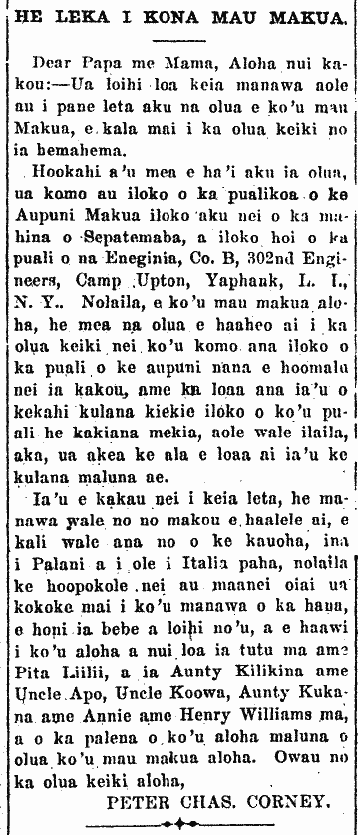
Dear Papa and Mama, much love:–It has been a very long time that I have not written back to you, my Parents. Please forgive your child for his neglect.

There is one thing I will tell you; I have joined the military of the Father Country this past September, and I am in the forces of the Engineers, Co. B, 302nd Engineers, Camp Upton, Yaphank, L. I., N. Y. Therefore, my beloved parents, this is something you should be proud of your child for, for my joining the military of the country which protects us, and for me obtaining a high rank in my division, a sergeant major; and not just that, but the path is wide open for me to advance higher.

As I compose this letter, it is time for us to move out, and I am just waiting for the orders, whether it be to France, or to Italy perhaps, so I will make it short as it is soon time for me to get into action. Give baby a long kiss for me, and give my great aloha to tutu them and Pita Liilii [Little Peter], and to Aunty Kilikina and Uncle Apo, Uncle Koowa, Aunty Kukana and Annie and Henry Williams them; and all of my aloha to you two, my loving parents. Your loving child,

PETER CHARLES CORNEY.

(Kuokoa, 12/28/1917, p. 5)

HE LEKA I KONA MAU MAKUA.

Ka Nupepa Kuokoa, Buke LV, Helu 52, Aoao 5. Dekemaba 28, 1917.

Kamehameha boys graduate, 1917.

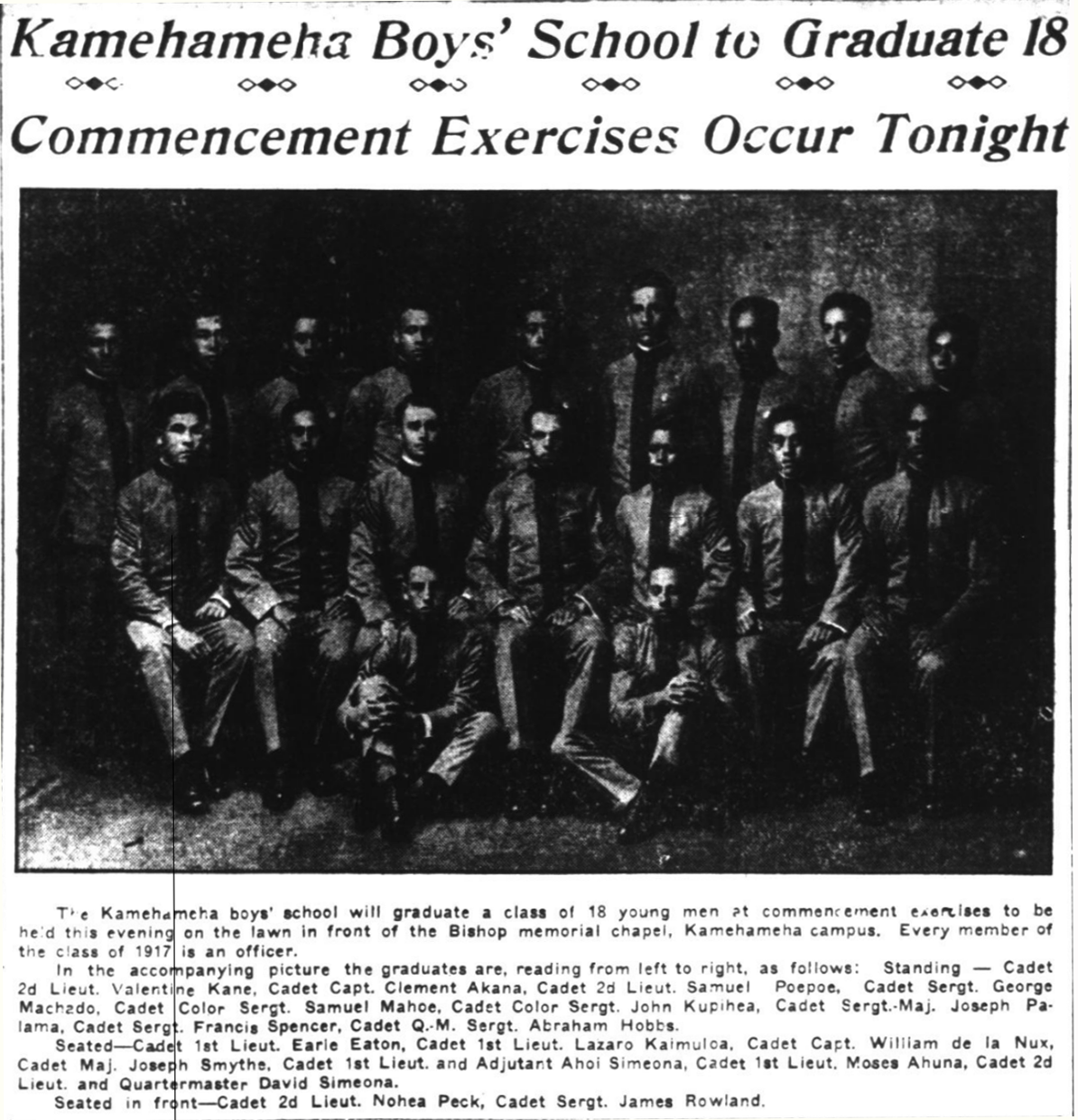
Kamehameha Boys’ School to Graduate 18 Commencement Exercises Occur Tonight

The Kamehameha boys’ school will graduate a class of 18 young men at commencement exercises to be held this evening on the lawn in front of the Bishop memorial chapel, Kamehameha campus. Every member of the class of 1917 is an officer.

In the accompanying picture the graduates are, reading from left to right, as follows: Standing—Cadet 2d Lieut. Valentine Kane, Cadet Capt. Clement Akana, Cadet 2d Lieut. Samuel Poepoe, Cadet Sergt. George Machado, Cadet Color Sergt. Samuel Mahoe, Cadet Color Sergt. John Kupihea, Cadet Sergt.-Maj. Joseph Palama, Cadet Sergt. Francis Spencer, Cadet Q. M. Sergt. Abraham Hobbs.

Seated—Cadet 1st Lieut. Earle Eaton, Cadet 1st Lieut. Lazaro Kaimuloa, Cadet Capt. William de la Nux, Cadet Maj. Joseph Smythe, Cadet 1st Lieut. and Adjutant Ahoi Simeona, Cadet 1st Lieut. Moses Ahuna, Cadet 2d Lieut. and Quartermaster David Simeona.

Seated in front—Cadet 2d Lieut. Nohea Peck, Cadet Sergt. James Rowland.

(Honolulu Star-Bulletin, 6/7/1917, p. 5)

Kamehameha Boys' School to Graduate 18...

Honolulu Star-Bulletin, Volume XXIV, Number 7847, Page 5. June 7, 1917.

Hawaiian boy in the military writes home to his mom, 1921.

A LETTER FROM A BOY TO HIS MOM.

JOHNSON KEALOHA

February 23, 1921.

To My beloved Mama:—I received your letter, and with much aloha for you and papa, I am writing this letter. I was pleased to find out that you guys received the check that I sent, that check that you sent to me and that I sent back.

Mama, I had a very happy experience here in Balboa; we had a swimming meet, competing with the swimming team of the Balboa Club. I won the 50 yard meet, and the competitor for the Balboa Club lost. Older brother Kalei was with me, he is now the captain of the Yeoman of the warship Wyoming. Kaehu won the 200 yard meet, this was a race where you swam face up. We lost the relay race [heihei paku’i], however some of us were right behind the winner. We will race once again on the 24th of this month with that same club. I believe that by the time you receive this letter, we will soon reach San Pedro in a couple of days.

I am in good health, and I hope that so too are you two and everyone as well at home. O Mama, one more thing I wanted to tell you, of which I am happy about, and that is this, I received my gold medals a few days ago, from the Mayor of New York. I will send the medals to you, when he returns to the states.

In a shooting practice amongst the Pacific and the Atlantic fleets, the Pacific won in a competition held in the sea of Panama. I will stop here, because I am returning to catch a skiff to go back on board the battleship New York, so much aloha for you and papa and all of the family.

March 15, 1921.

My dear Mama:—I am sending the two of you this dipoloma [palapala homaikai] given for crossing over the Mediterranean Sea [Kaiwaena] with a American battleship. I was going to send you this with the other things I sent you,  but I forgot because I was very rushed, so I will send you this “diploma” now, and I hope that you will get it.

Mama, I want you to frame this diploma in a big wooden frame so that it doesn’t get damaged, and I also hope that it will be something nice for the family to look at always. Both older brother Kalei and I crossed over the Mediterranean Sea. Write me if you get this diploma.

I am in good health, and so too is older brother, Kalei. I hope that there will be a swim meet between us and the club of South California this coming month; our superior is organizing a meet between the club of the warships of the Pacific and that of California.

I am stopping here and will write again to you mama. Give my aloha to papa and all the family at home. From you loving child,

JOHNSON KEALOHA.

(Kuokoa, 4/8/1921, p. 2)

HE LEKA NA KE KEIKI I KONA MAMA.

Ka Nupepa Kuokoa, Buke LIX, Helu 14, Aoao 2. Aperila 8, 1921.

James A. E. Kinney and his ohana, 1943.

At Sea

The picture above is of James A. E. Kinney, the son of K. W. Kinney of Hana, Maui, and one of the writers to Ka Hoku o Hawaii. It is believed that A. E. Kinney is at Sea with the Air Force, doing air surveillance [kilo ea]. He graduated from the air surveillance school in Grand Rapids, Michigan this past April and returned to his post at West Palm Beach, Florida, and thereafter it was decided to send him to sea.

A Hawaiian Youth

James Apollo Everett Kinney was born of the loins of Mr. K. W. [Kihapiilani William] and Mrs. Sarah Kaleo Kinney, at the McBryde Sugar Plantation in Kauai, when his father was working burning cane, and he was 32 years old. Continue reading

More Hawaiians in the military, 1917.

JOHN A. K. K. MILES

WORKING IN THE SERVICE OF AMERICA

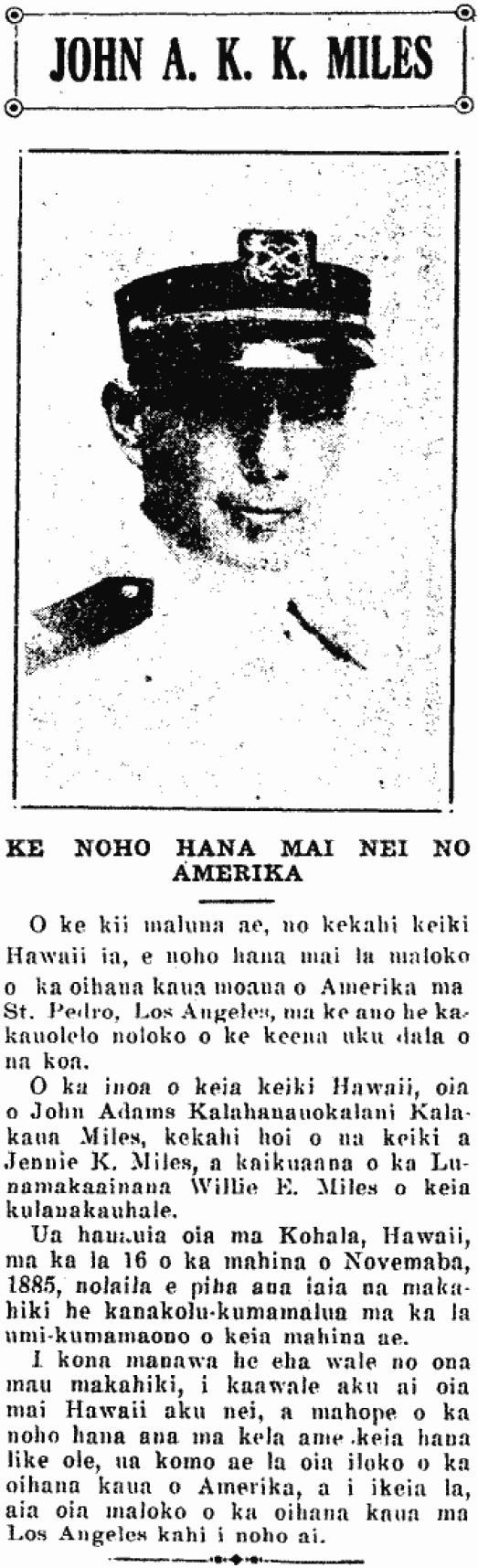
The picture above is of a Hawaiian boy who is working in the navy of America at St. Pedro, Los Angeles, as a secretary in the department of the payroll of the military.

The name of this Hawaiian youth is John Adams Kalahanauokalani Kalakaua¹ Miles, a child of Jennie K. Miles and the older brother of Legislator Willie E. Miles of this city.

He was born in Kohala, Hawaii, on the 16th of November, 1885, and therefore he will make 32 on the 16th of next month.

When he was but four years old, he was taken from Hawaii nei, and after working at various jobs, he joined the military of America. And today, we see that he is in the service in Los Angeles, where he resides.

¹One way names were given traditionally was after important events, whether happy or sad. This is a nice and clear example of a commemorative name. John A. K. K. Miles was born on November 16, 1885, on the birthday of King Kalakaua. He was therefore named literally “The birthday of the royal one Kalakaua”.

(Kuokoa, 10/19/1917, p. 4)

JOHN A. K. K. MILES

Ka Nupepa Kuokoa, Buke LV, Helu 42, Aoao 4. Okatoba 19, 1917.

Display of power by the American battleship, 1893.

THE PARADING

OF THE
American Battleship Soldiers.

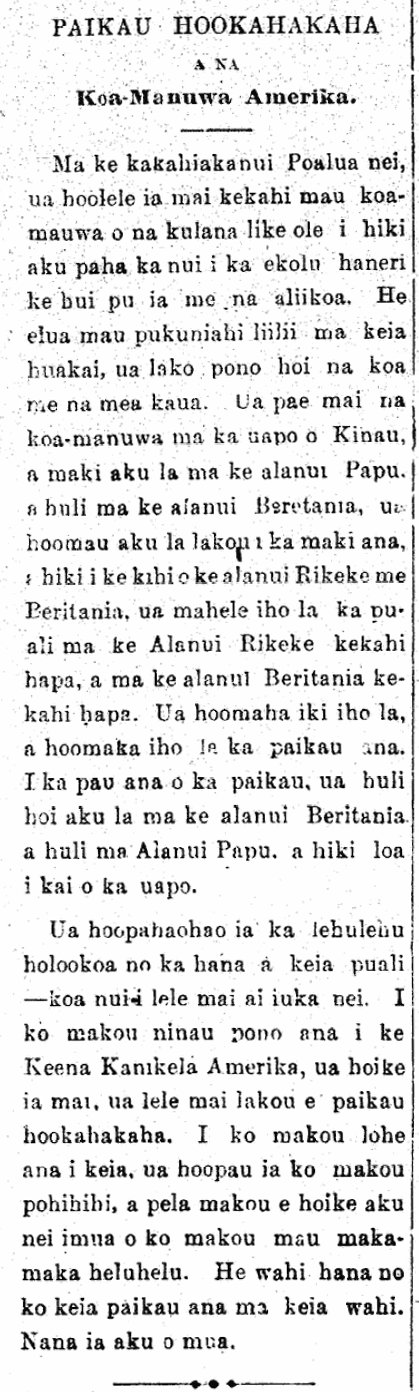
In the early morning of this Tuesday, some of the soldiers of all ranks from the warship were sent ashore, perhaps numbering three hundred when combined with the officers. There were two small cannons in this parade, and the soldiers were armed with weapons. The soldiers from the battleship landed at Kinau Wharf [uapo o Kinau], and marched on Fort Street and turned on Beritania where they continued marching until Richards and Beritania; the troops divided: some travelled on Richards Street and some on Beritania Street. They rested for a while, and then proceeded to drill. After drilling, they went back on Beritania Street and turned on Fort, until reaching the wharf.

Everyone was left puzzled by this action of the great number of the troops who came to shore. When we asked the Office of the American Consul directly, we were told that they landed to parade. When we heard this, our confusion was cleared, and so we report to our reader friends. The drilling here is part of their job. Let’s see what happens in the future.

(Leo o ka Lahui, 10/25/1893, p. 3)

PAIKAU HOOKAHAKAHA

Ka Leo o ka Lahui, Buke II, Helu 798, Aoao 3. Okatoba 25, 1893.