“Eia o Awini pali alii hulaana,” 1924.

[Found under: “Hiamoe o Kamaka Stillman Iloko o ka Maha”]

The mele below is one of the things which proves that Kamehameha was raised by Kahaopulani and that he was raised at Awini, thus:

Eia o Awini pali alii hulaana,
E noho ana Kahaopulani,
Hanai ia Paiea he alii,
I kohola maloko Kekuiapoiwa, Continue reading
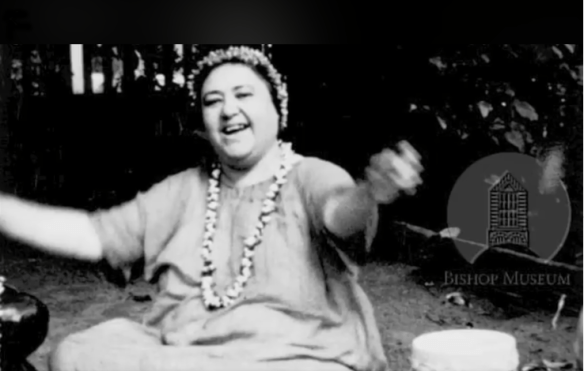
Kamaka Stillman refutes the story about Naeole raising Kamehameha, 1911.

A Response by “O-u-ka-maka-o-ka-wauke-oi-opiopio.”

Mr. Editor of Ke Au Hou:

With appreciation:—Please allow me my clarification pertaining to the one who raised Kamehameha I that was shown in the newspaper “Kuokoa Home Rula” on the 10th of February past, 1911, which said that it was Naeole. But forgive me for the tardiness of my response, for I soon received my issue of that paper mentioned above from a friend last week, and in order that the actual person who raised Kamehameha I is made known, that it is not Naeole as is being stated, that is why I am publishing this without intent to elevate chiefly genealogy, for the rude statements are embarrassing; there are so many people who are associated with alii, and covetous of alii who have genealogies that are printed in books. Pertaining to the parentage of Kamehameha, here it is: Continue reading

More on the arrival of Pele, 1862.

[Found under: “HE MOOOLELO NO HIIAKAIKAPOLIOPELE. Helu 9.]

Holo mai Pele mai Kahikina,
A kau ka waa i Mookini,
Noho kaua i Kumalae,
Hooku Pele ma i ke kii,
Noho i ke kii a Pele ma, a ka pua o koi,
Kanaenae Pele ma ilaila,
Kai a huakai mai Pele,
A ka lae i Leleiwi,
Honi i ke ala o ka hala,
O ka lehua o Mokaulele,
Oia ka Pele a kui la,
He kunana hale Puuloa,
He hale moe o Papalauahi,
He halau no Kilauea,
Haule mai Pele mai Kahiki mai,
O ka hekili o ke olai, o ka ua loku,
O ka ua paka, o Haihailaumeaiku, Continue reading

On Pele’s departure from Kahiki, 1906.

[Found under: “He Moolelo no Hiiakaikapoli-o-Pele.]

KAU HELU UMI-KUMAMAKAHI A HIIAKA.

1. Mai Kahiki ka wahine o Pele
2. Mai ka aina i Polapola
3. Mai ka punohu a Kane
4. Mai ke ao lalapa i ka lani
5. Mai ka opu la i Kahiki
6. Lapuka i Hawaii ka wahine o Pele
7. Kalai ka waa o Honuaiakea
8. Ko waa o Kamohoalii
9. Hoa mai ka moku a paa
10. Ua oki ka waa o ke akua
11. Ka waa o Kalaihonuamea
12. Holo mai ke au aeae Pele
13. Aeae ka lani, ai puni ka moku
14. Aeae kini o ke akua
15. Ia wai ka uli, ka hope o ka waa?
16. Ia Kamohoalii
17. Ia Ehu-a-menehune Continue reading

Upon the opening of Hulihee Palace, 1928.

Story of Hulihee Palace Told By Mrs. Swanzy On Even of New Dedication

The Daughters of Hawaii will dedicate the old Hulihee palace at Kailua, Kona, Hawaii, on noon of Kamehameha day, June 11, the ceremony to be followed by a luau at 1 o’clock.

Restoration of the old palace, the site of which was set aside by Governor Farrington for a Hawaiian museum to be maintained by and cared for under the management of the Daughter of Hawaii, has been one of the big accomplishments of the Daughters during the last year. The 1925 legislature appropriated $10,000 for its purchase. Continue reading

Hulihee Palace from Jared G. Smith, sent by the Advertiser to cover the dedication, 1944.

Hulihee Palace

By JARED G. SMITH

Kailua, principal port of Kona, Hawaii is rich in historical lore for it was here that Kamehameha the Great, founder of a dynasty which lasted until 1874, spent most of his life. He lived apart, the great stone platform where his immediate entourage resided being a few hundred yards westward from the present wharf beyond the great heiau, the station of his priesthood. The alii, or chiefs, his Court, were domiciled along the bay, eastward. Continue reading

Mary Jane Fayerweather Montano story lost conclusion? 1894.

MRS. MONTANO CORRECTS ERRORS IN HER STORY

Before proofs of Mrs. Montano’s story of old times in Honolulu could be corrected for historical accuracy, the instalment was published in the magazine section of yesterday’s issue of The Advertiser. Continue reading

Mary Jane Fayerweather Montano story part 3 continued, 1893.

FORMER BELLE TELLS OF SOCIETY IN OLD HONOLULU

(Continued from Page 5)

Dr. Ed. Hoffmann as chairman of the general committee, we went to the ball. There I met Miss Mary Burbank, Dr. Hoffmann’s young niece, who was assisting him to do the honors of the evening. It seemed in those days no function was complete without Dr. Hoffmann, who was a prominent gentleman here. He was deeply interested in Hawaiian affairs. A few years later, sometime in the 70s, he encouraged us to send Hawaiian fancy work to the Berlin exposition. I made pumpkin straw flowers made from the white, satiny fiber of the pumpkin stalks and a few months afterward I received a gold locket and chain as a prize. It was sent on in care of Dr. Hoffmann. Continue reading

Lines of familiar mele used in stories to elicit emotion, 1895.

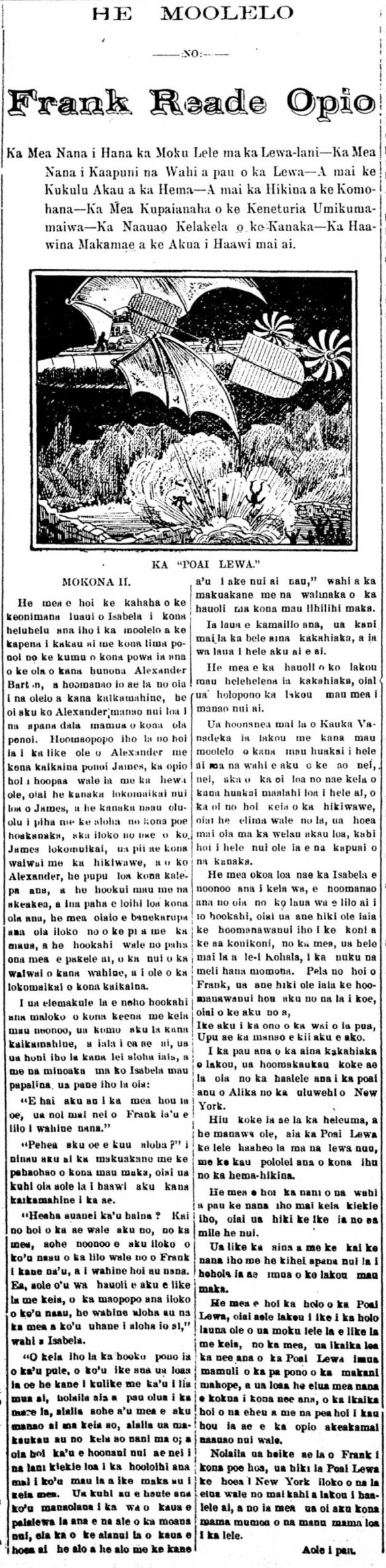
[Found in: “HE MOOLELO NO Frank Reade Opio”]

Ike aku i ka ono o ka wai o ia pua,
Upu ae ka manao e kii aku e ako.

[I know of the sweet nectar of that flower,
The desire wells up to go and pluck it.]

[The use of lines of well-known mele like from Thomas Linsey’s “Honesakala” above is a feature of Hawaiian storytelling. They elicit a feeling or mood to help the flow of the moolelo. This particular translation of  one of the Frank Reade Jr. stories ran in Hawaiian in the Kuokoa from 5/25/1895 to 11/9/1895 under the title “He Moolelo no Frank Reade Opio: Ka Mea Nana i Hana ka Moku Lele ma ka Lewa-lani…”]

(Kuokoa, 8/17/1895, p. 1)

Kuokoa_8_17_1895_1.png

Ka Nupepa Kuokoa, Buke XXXIV, Helu 33, Aoao 1. Augate 17, 1895.