Swim to be held at Punahou, 1922.

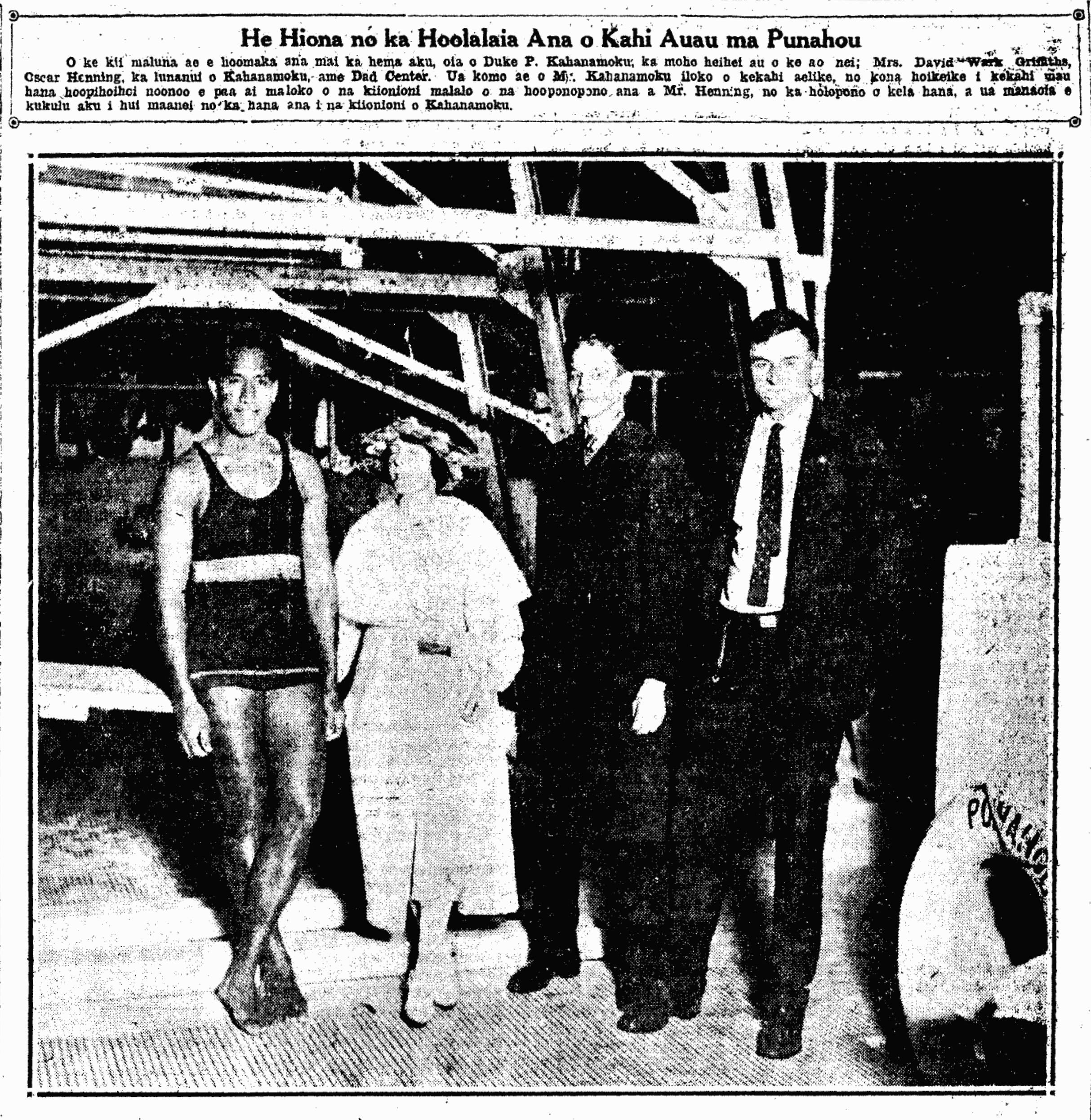
A Scene from Preparations for a Swim at Punahou

The picture above [below], beginning from the left is of Duke P. Kahanamoku, the world champion swimmer, Mrs. David Wark Griffith, Oscar Henning, the manager of Kahanamoku, and Dad Center. Mr. Kahanamoku entered into a contract for him to perform some astonishing feats to be made into a movie under the direction of Mr. Henning for the success of that endeavor, and it is believed that a company will be started here to produce Kahanamoku’s movies.

(Kuokoa, 2/10/1922, p. 5)

He Hiona no ka Hoolalaia Ana o Kahi Auau ma Punahou

Ka Nupepa Kuokoa, Buke LXI, Helu 6, Aoao 5. Feberuari 10, 1922.

Waikiki Wedding and Bing Crosby, 1936.

A FITTING HAWAIIAN SOUGHT

FOR WORKING ON HAWAIIAN STORY FOR A MOVIE

HOLLYWOOD, Sept. 1.—Mr. Bing Crosby will be landing in Honolulu next Thursday aboard the steamship Lurline, one of those who are writing the script of a movie called “Waikiki Wedding.” The news was heard from his studio that on this trip he is searching for a very famous woman in ancient Hawaiian hula, that understands the hand motion and the foot movements, as in ancient Hawaiian history; the hula of Hawaii that made it famous and was seen as one of the things that were taught to all women of Hawaii during those days. Also they are on the search for famous young musicians of Hawaii nei that know the proper mele for the hula foot movements of women, who know the string instruments and drums of the Hawaiians, and are not just handsome to look at, but true to the history that is written about: the ti-leaf whistle, the kilu drum, the puhenehene flute, the jew’s harp and bamboo ukeke. Continue reading

Bonine brings movies to Kalawao and Kalaupapa, 1909.

FIRST MOVING PICTURE SHOW TAKES SETTLEMENT BY STORM

On Thursday evening last a new miracle happened at Kalaupapa. On that evening R. K. Bonine, the moving-picture expert, threw his first picture on the screen before an audience of a thousand lepers, and there was a great gasp of awed astonishment and keen delight when the pictures really moved and did things. Cheers, tears, gasps and soul-satisfying laughter greeted the pictures in turn, and when the reels put aside for the first entertainment had been exhausted, the people of Kalaupapa and Kalawao, in a body, cheered their thanks to the man who had brought these wonders to them and to those in Honolulu who had through their contributions made these miracles possible.

It was a great day for the people of the Molokai Settlement, and it was a great day for Bonine. To the lepers had come a new marvel, greater far than the sight of the mighty White Fleet, which maneuvered past their shores last summer, greater than anything that had come to them. No place the world over have motion pictures made such a hit. Continue reading

Hot air balloon in Paris, riding a camel in India, then an elephant in Egypt…, 1911.

KE KII-ONIONI O KALAWAO
[Kakauia mai]

I Parisa aku nei au
I ka lele baluna poniuniu
A Inia aku nei au
I ke kau kamelo holo pupule
A Aigupita aku makou
I ke kau elepani ihu peleleu
Kupanaha e ka hana kahi kii doll
I ke ki malalo oni a o luna
Alawa iho oe a o ke kuene
Palamimo e ka lima i ka naau-kake
Hainaia mai ana ka puana
Ke kii onioni a o Kalawao
—K. Glee Club.

[Movie of Kalawao
(Submitted)

I was in Paris
On a dizzying hot-air balloon
I was in India
On a camel that went along crazily
We were in Egypt
On an elephant with a long trunk
Amazing is the action of this doll
Turn the key below and it moves above
Look at that waiter
Skilled are his hands with the sausage
Let the story be told
The movie of Kalawao.

Kalaupapa Glee Club.]

[Here is a mele about places far away, written it seems down in Kalawao after a movie of clips of various scenes was shown there. For the version more widely known today, see also “Palisa” in Na Mele o Hawaii Nei, pp. 84–85.]

(Au Hou, 8/24/1910, p. 12)

KE KII-ONIONI O KALAWAO

Ke Au Hou, Buke I, Helu 17, Aoao 12. Augate 24, 1910.

Diamond Kekona writes home, 1908.

A LETTER FROM FOREIGN LANDS.

This past week, Mr. D. K. Kekona received a letter from his child Dimond Kekona [Diamond Kekona], written in the city of Philadelphia, United States of America, telling of how they are doing and their progress of their work in the foreign lands.

These are Hawaiian boys who left the beloved shores of Hawaii nei and sailed to other lands in search of fortunes through singing and playing music with their various instruments. According to what he reported, their work is going well; they receive around $1,425 every week.

They are under the direction of a haole that shows movies named Mr. Lubin, and on the first night that showed the movies in the city of Philadelphia, along with their singing of Hawaiian songs, they received a huge sum of money, and on that night in their estimation, there was about ten-thousand people or more gathered there to see the performance of the Hawaiian boys which they heard about.

In their band is seven actual Hawaiian boys; each of their names are: Dimond Kekona [Diamond Kekona], Charles Kalahila, E. Davis, Frank Forest [Frank Forrest], Harry Parker, Sam and Willie Jones. There are many other Hawaiian bands in America and they travel all over the place.

Here is the gist of the letter:

To My Dear Papa,

Mr. D. K. Kekona, Aloha to you and all the family:—I have found the perfect time to write to you this letter to tell you how we are and how our work is here.

We opened a show in the city of Philadelphia before a large group of people that numbered about ten thousand. Mr. Lubin is our leader, and he shows movies with our assistance in our singing Hawaiian songs along with playing instruments. Hawaiian songs are very popular. The audience was filled with delight and were pleased until the time when the program let out for the night. The money we make is about $1,425 a week and we earn very good wages for the week. We will be touring other places with our singing.

There are just seven of us Hawaii boys. We are all doing good and are in good health. It is very cold here.

(Kuokoa, 11/20/1908, p. 4)

HE LEKA MAI NA AINA E MAI.

Ka Nupepa Kuokoa, Buke XLIII, Helu 47, Aoao 4. Novemaba 20, 1908.

J. C. K. Hopkins and his band travelling around America, 1914.

SOME HAWAIIAN BOYS TRAVELLING AMERICA SINGING AND PLAYING MUSIC

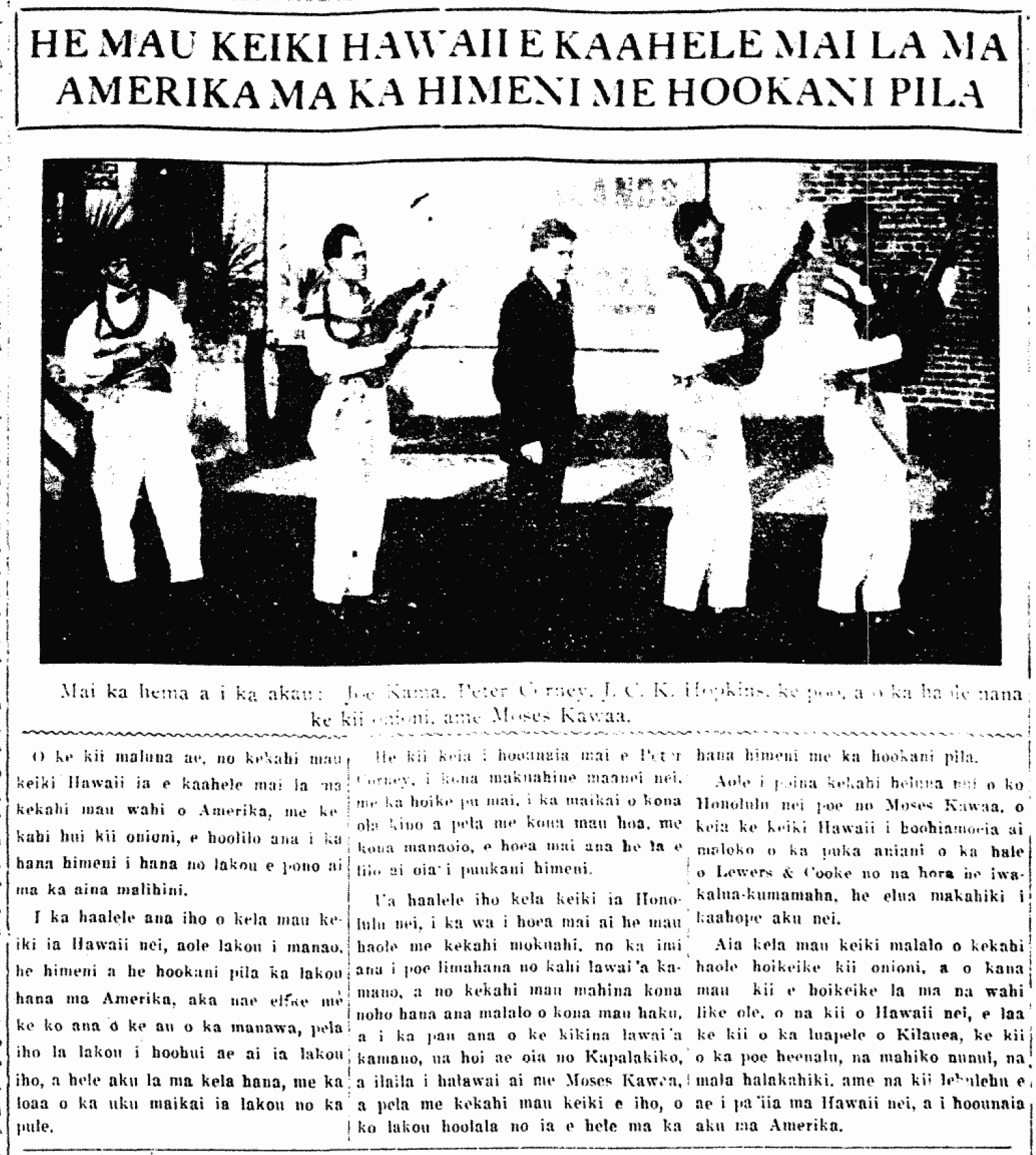
From the left to right: Joe Kama; Peter Corney; J. C. K. Hopkins, the leader; the haole to whom belongs the movies; and Moses Kawaa.

The picture above is of some Hawaiian boys travelling around some places in America, along with a movie company, using music to make a living in the unfamiliar lands.

When the Hawaiian boys left Hawaii nei, they did not imagine that they would be singing and playing music in America, but with the passing of time, they found themselves getting together with each other and started this job, getting paid well by the week.

This picture was sent by Peter Corney to his mother here and he also stated that he was in very good health as well as his friends, and that he believes that the day will come when he will become a singer.

This boy left Honolulu nei when some haole came with a steamship in search of workers for a salmon fishing outfit and he spent several months working under his supervisors, and when the salmon fishing season was over, he returned to San Francisco and there he ran into Moses Kawaa and with some other boys, and they planned to go around singing and playing music.

Many here in Honolulu have not forgotten Moses Kawaa, the Hawaiian boy who was made to sleep in the window of the Lewers & Cooke building for twenty-four hours, two years ago.

These boys work under a haole who shows movies, and the movies that he shows all over the place are of scenes of Hawaii, like shots of the crater of Kilauea, shots of surfers, the expansive sugarcane plantations, pineapple fields, and many, many scenes taken in Hawaii nei and sent to America.

(Kuokoa, 3/13/1914, p. 5)

HE MAU KEIKI HAWAII E KAAHELE MAI LA MA AMERIKA MA KA HIMENI ME HOOKANI PILA

Ka Nupepa Kuokoa, Buke LII, Helu 11, Aoao 5. Maraki 13, 1914.

Ikua Purdy in the movies, 1908.

IKUA PURDY SHOWN IN MOVIES.

Because the Hawaiian boy Ikua Purdy became champion at the steer roping held at Cheyenne, Wyoming, his picture is being shown in America in movie theaters, and from what is being said, the images of that champion of the world being shown are truly fine and beautiful, as if it actually is him chasing and roping the steer.

In one of the scenes showing the parading of the steer-roping cowboys, the Hawaiian boys are the finest as they don lei about their necks; and these movies are becoming highly acclaimed in lands outside Hawaii.

(Kuokoa, 10/16/1908, p. 8)

HOIKEIKE IA O IKUA PURDY ILOKO O KE KII ONIONI.

Ka Nupepa Kuokoa, Buke XLIII, Helu 42, Aoao 8. Okatoba 16, 1908.

Festivities at Hilo Union School, 1927.

A FAIR AT HILO UNION SCHOOL

This past Saturday there was held a fair on the school grounds of Hilo Union, under the direction of the parents of the students of this school.

The activities began at 1 in the afternoon until the evening. The classrooms on the first floor was where the work of the children being taught at that school were placed, so that the parents could view them. There were also flowers on display. There was also a large bag, and from within this bag an item was given to the the parents and the people who came.

In an area near the kitchen, there were tables of all sorts of goods from all the ethnicities. One of the tables was filled with all the many delicacies of the Hawaiians. Haupia, laulau, and the other good foods of the Hawaiians. On the table of the Chinese, there was Chinese foods like Chinese candy, rice made into sweets, and many other Chinese items. On the Japanese one, was Japanese goods, and so too with the Portuguese table, they had Portuguese bread. On all of these tables, the people taking care of the items were dressed in the clothing of their people.

Near the kitchen, there was a place decorated by Miss Alice Spencer. On this table, tea to drink was served by girls dressed in aprons of all colors skillfully [made?] by Miss Spencer. The decorations on these tables were identical to the clothes of the girls serving tea to those who wanted to drink tea. In one of the rooms all the way at the bottom of the school, a movie was shown, and this is something always done, and the teachers thought it would be good for the parents to see the type of movie seen all the time by the children. Below that play house of the children in times of rain, there were other activities to do, set up by the teachers, and it was thought that these activities would entertain the children, parents, and friends of this school.

[Just passed by Hilo Union the other day and thought I’d put this article up that I had put aside some time ago.]

(Hoku o Hawaii, 5/3/1927, p. 2)

HE FEA MA KE KULA UNION O HILO

Ka Hoku o Hawaii, Buke XX, Helu 49, Aoao 2. Mei 3, 1927.

Emalia Kaihumua in Kalaupapa and more, 1909.

The News of Kalaupapa.

Aloha no:—

Please be so kind as to allow a space on your deck for the few news items of this land of the sick, and it is for you to carry it away.

Movies are being showed all the time here, and the patients are very happy. There was an announcement for the patients who want to be seen by the doctors, an a portion of the patients came to the house of the doctor to sign up as per the offer. There were some people who hesitated and did not go to sign up. And as a result, the Doctor and the Superintendent sent a man from the workshop [hale oihana] to go amongst the houses to sign up those who wanted to be examined by the Doctor. The total of those who went to sign their names is 55, and they are who are listed below and the doctor they chose:

The Men. George Kukapu, William Limalu, William Kaha, Kealawaiole, Kelii Makakoa, Herbert Kaleleiki, D. Ku, Joe Kauhane, Peter Akim, Kalunakaahele, Leong Tung, Liloa Lovell, Hairam Pahau, Kaaihue, Hulihee, Hoaeae Nailima, Kuheleloa Liilii, ???? alewai Nailima, Bainamu, Solomon Momoa, Pakoma, ??? Kapela Maialoha, Kaeha, James Harvest, Naihe and Jon Waiwaiole, Total 27.

The Women. Kawai, Bela Liilii [? Kela Liilii], Kaua Lihau, Pelekila Ioane, Hanapule, Kauwe, Lizzie Aiamanu, Ane Mcmillan, Ellen Mcmillan, Emily Kaihumua, Ane Kekoa, Kailianu Kapiioho, Kala Opu, Rosse Meyer, Pahupiula, Rmma Kuaokala [? Emma Kuaokala], Loika Pauole, Holo Kapela, Makanui D. Umi, Nui, Agnes Holstein, Mary Naeole, Victoria Kaai, Mary Maialoha and Kamai Naihe. Total 25. These patients above are for Dr. Goodhue. For Dr. Wayson. Mary Kapukana (f), Malaia Makaula (f), and Kanaue (m). Total 3. The people who signed up at their own homes total 53; all together that makes 108, counted along with those chosen by the Legislature [Ahaolelo].

With great aloha for my lahui.

Sincerely,

S. K. M. NAHAUOWAILEIA.

Kalawao, Molokai, Aug. 27, 1909.

(Kuokoa Home Rula, 9/3/1909, p. 3)

Na Mea Hou o Kalaupapa.

Kuokoa Home Rula, Buke VII, Helu 36, Aoao 3. Sepatemaba 3, 1909.

“Early movies of Hawaii” follow up, 2012.

Mahalo to Connie Woyciesjes and Uluulu for their responses pertaining to the scenes shot by the “man famous for filming movies”!

Perhaps this was R. K. Bonine as Connie suggests, but i am not sure why he’d be arriving on the Wilhelmina, i assumed he was already here in Hawaii at that time. There are by the way many articles about Bonine taking movies. Here is one which i previously posted from 1915.

From Uluulu, there was the suggestion that maybe the reels labeled “Picturesque Hawaii ca. 1916” at Critical Past are the scenes in question. Look for instance at this short movie put out by the Ford Motor Company dealing with the pineapple and labeled 1916, (which was described in the article).