Detailed list of patients being examined at Kalawao, 1909.

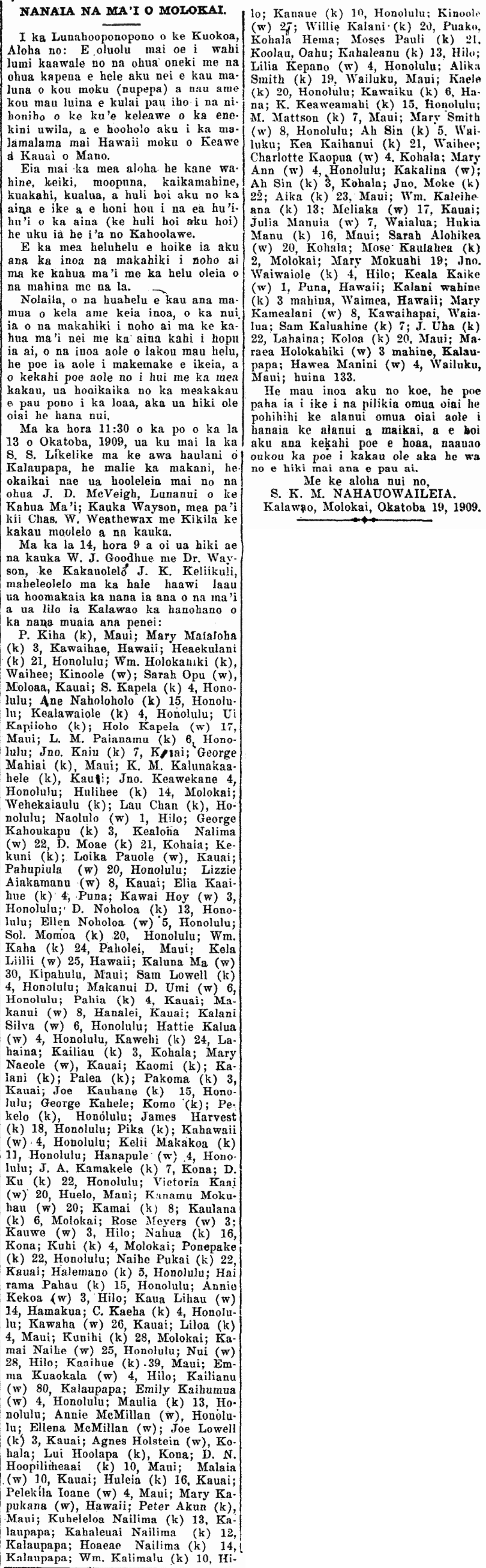
THE PATIENTS OF MOLOKAI ARE EXAMINED.

To the Editor of the Kuokoa, Aloha no: Please allow me some space on your deck along with the captain’s passengers travelling aboard your ship (newspaper) and it is for you and your sailors to [anybody care to offer insight into this nautical allusion? “a nau ame kou mau luina e kulai pau iho i na nihoniho o ke ku’e keleawe o ka enekini uwila…”] and to send knowledge from Hawaii, the island of Keawe, all the way to Kauai of Manokalanipo.

Here are your loved ones, a husband, a wife, a child, a grandchild, a daughter, a grand, a great grand; and they turn towards home, to see and to smell once again the cool air of the land (should they return); the fish is an uku, a fish of Kahoolawe.¹

O Reader, shown will be the names and the years they have lived here in the land of the sick without counting the months and days.

Therefore, the number placed before [after] each name is the total years lived here in the land of the sick and the land where they were taken from; for the names without numbers, they don’t want it to be known, and some have not met with the writer; the writer put great effort into completing it, but he could not for it was a big task.

At 11:30 at night on the 13th of October, 1909, the S. S. Likelike arrived at the restless harbor of Kalaupapa; the wind was calm, but the disembarking of the passengers was still rough, they being J. D. McVeigh, Superintendent of the Leprosy Colony; Dr. Wayson; photographer Charles W. Weatherwax and Kikila the secretary of the doctors.

On the 14th, at 9 or so, the doctors W. J. Goodhue and Wayson arrived with the Secretary J. K. Keliikuli, interpreter at the dispensary; and the examination of the patients began; and to Kalawao went the honor of the first examination, as follows:

P. Kiha (m), Maui; Mary Maialoha (m), 3, Kawaihae, Hawaii; Heaekulani (m) 21, Honolulu; William Holokahiki (m), Waihee; Kinoole (f); Sarah Opu (f), Moloaa, Kauai; S. Kapela (m) 4, Honolulu; Ane Naholoholo (m) 15, Honolulu; Kealawaiole (m) 4, Honolulu; Ui Kapiioho (m); Holo Kapela (f) 17, Maui; L. M. Paianamu (m) 6, Honolulu; John Kaiu (m) 7, Kauai; George Mahiai (m), Maui; K. M. Kalunakaahele (m), Kauai; John Keawekane 4, Honolulu; Hulihee (m) 14, Molokai; Wehekaiaulu (m); Lau Chan (m), Honolulu; Naolulo (f) 1, Hilo; George Kahoukapu (m) 3; Kealoha Nalima (f) 22; D. Moae (m) 21, Kohala; Kekuni (m); Loika Pauole (f), Kauai; Pahupiula (f) 20, Honolulu; Lizzie Aiakamanu (f) 8, Kauai; Elia Kaaihue (m) 4, Puna; Kawai Hoy (f) 3, Honolulu; D. Noholoa (m) 13, Honolulu; Ellen Noholoa (f) 5, Honolulu; Solomon Momoa (m) 20, Honolulu; William Kaha (m) 24, Paholei, Maui; Kela Liilii (f) 25, Hawaii; Kaluna Ma (f) 30, Kipahulu, Maui; Sam Lowell (m) 4, Honolulu; Makanui D. Umi (f) 6, Honolulu; Pahia (m) 4, Kauai; Makanui (f) 8, Hanalei, Kauai; Kalani Silva (f) 6, Honolulu; Hattie Kalua (f) 4, Honolulu; Kawehi (m) 24, Lahaina; Kailiau (m) 3, Kohala; Mary Naeole (f), Kauai; Kaomi (m); Kalani (m); Palea (m); Pakoma (m) 3, Kauai; Joe Kauhane (m) 15, Honolulu; George Kahele; Komo (m); Pekelo (m), Honolulu; James Harvest (m) 18, Honolulu; Pika (m); Kahawaii (f) 4, Honolulu; Kelii Makakoa (m) 11, Honolulu; Hanapule (f) 4, Honolulu; J. A. Kamakele (m) 7, Kona; D. Ku (m) 22, Honolulu; Victoria Kaai (f) 20, Huelo, Maui; Kanamu Mokuhau (f) 20; Kamai (m) 8; Kaulana (m) 6, Molokai; Rose Meyers (f) 3; Kauwe (f) 3, Hilo; Nahua (m) 16, Kona; Kuhi (m) 4, Molokai; Ponepake (m) 22, Honolulu; Naihe Pukai (m) 22, Kauai; Halemano (m) 5, Honolulu; Hairama Pahau (m) 15, Honolulu; Annie Kekoa (f) 3, Hilo; Kaua Lihau (f) 14, Hamakua; C. Kaeha (m) 4, Honolulu; Kawaha (f) 26, Kauai; Liloa (m) 4, Maui; Kunihi (m) 28, Molokai; Kamai Naihe (f) 25, Honolulu; Nui (f) 28, Hilo; Kaaihue (m) 39, Maui; Emma Kuaokala (f) 4, Hilo; Kailianu (f) 80, Kalaupapa; Emily Kaihumua (f) 4, Honolulu; Maulia (m) 13, Honolulu; Annie McMillan (f), Honolulu; Ellena McMillan (f); Joe Lowell (m) 3, Kauai; Agnes Holstein (f), Kohala; Lui Hoolapa (m), Kona; D. N. Hoopilimeaai (m) 10, Maui; Malaia (f) 10, Kauai; Huleia (m) 16, Kauai; Pelekila Ioane (f) 4, Maui; Mary Kapukana (f), Hawaii; Peter Akua (m), Maui; Kuheleloa Nailima (m) 13, Kalaupapa; Kahaleuai Nailima (m) 12, Kalaupapa; Hoaeae Nailima (m) 14, Kalaupapa; William Kalimalu (m) 10, Hilo; Kanaue (m) 10, Honolulu; Kinoole (f) 27; Willie Kalani (m) 20, Puako, South Kohala; Moses Pauli (m) 21, Koolau, Oahu; Kahaleanu (m) 13, Hilo; Lilia Kepano (f) 4, Honolulu; Alika Smith (m) 19, Wailuku, Maui; Kaele (m) 20, Honolulu; Kawaiku (m) 6, Hana; K. Keaweamahi (m) 15, Honolulu; M. Mattson (m) 7, Maui; Mary Smith (f) 8, Honolulu; Ah Sin (m) 5, Wailuku; Kea Kaihanui (m) 21, Waihee; Charlotte Kaopua (f) 4, Kohala; Mary Ann (f) 4, Honolulu; Kakalina (f); Ah Sin (m) 3, Kohala; John Moke (m) 22; Alika (m) 23, Maui; William Kaleiheana (m) 13; Meliaka (f) 17, Kauai; Julia Manuia (f) 7, Waialua; Hukia Manu (m) 16, Maui; Sarah Alohikea (f) 20, Kohala; Mose Kaulahea (m) 2, Molokai; Mary Mokuahi 19; John Waiwaiole (m) 4, Hilo; Keala Kaike (f) 1, Puna, Hawaii; Kalani wahine (m) 3 months, Waimea, Hawaii; Mary Kamealani (f) 8, Kawaihapai, Waialua; Sam Kaluahine (m) 7; J. Uha (m) 22, Lahaina; Koloa (m) 20, Maui; Maraea Holokahiki (f) 3 months, Kalaupapa; Hawea Manini (f) 4, Wailuku, Maui; total 133.

There are names left; perhaps they are those who knew the troubles ahead, for the road ahead is unclear, as the path is not laid out well, and some will return in confusion; wise are those who did not sign, but there will come a time when this will end.

With great aloha,

S. K. M. NAHAUOWAILEIA.

Kalawao, Molokai, October 19, 1909.

¹”He uku ia he i’a no Kahoolawe.” A traditional saying playing off the word “uku “which is a type of fish, but also means reward or recompense.

[Wow… this took a long time, but i think it is an awesome document well worth the time put in. My aloha goes out to S. K. M. Nahauowaileia and the type-setting boys of the Kuokoa!!]

(Kuokoa, 10/29/1909, p. 6)
NANAIA NA MA'I O MOLOKAI.

Ka Nupepa Kuokoa, Buke XLVI, Helu 44, Aoao 6. Okatoba 29, 1909.
The latest from Hana, Maui, 1877.

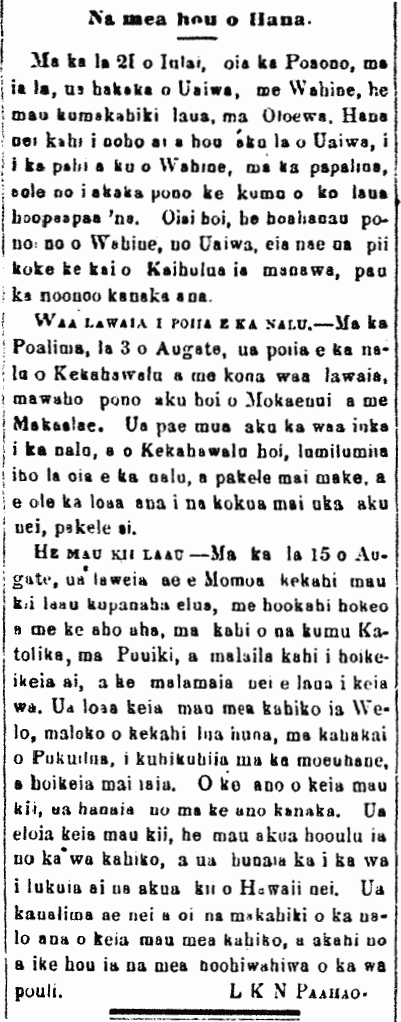
News from Hana.

On the 21st of July, that being Saturday, on that day, Uaiwa fought with Wahine, both of them being contract laborers; they live at Oloewa, Hana, and Uaiwa stabbed Wahine with a knife in the cheek, and the reason for their quarrel is not known. Wahine is an actual cousin of Uaiwa, and here yet his temper soon flared up [pii koke ke kai o Kaihulua] and he lost his senses.

A fishing canoe pounded by a wave.—On Friday, the 3rd of August, Kekahawalu and his fishing canoe was hit by a wave right outside of Mokaenui and Makaalae. The canoe came ashore first carried by the waves, and as for Kekahawalu, he was pounded by the waves and escaped nearly dying; without receiving help from those on shore he would not have escaped.

Some wooden idols [kii laau].—On the 15th of August, brought by Momoa were a couple of amazing wooden images, along with one gourd calabash [hokeo] and some cordage [aho aha], to the Catholic teachers in Puuiki; there it was displayed, and the two of them are caring for them until this day. These old things were found by Welo in a hidden cave, seaside of Pukuilua, which was revealed to him in a dream, and was shown to him. The kii are made in the shape of people. It is said that these kii were procreative gods of the olden days, and were hidden away during the time that the god images of Hawaii nei were being destroyed. These old things have been hidden for fifty or more years, and it is the first time these revered things of the dark ages are being seen again.  L. K. N. Paahao.

(Kuokoa, 9/15/1877, p. 3)

Na mea hou o Hana.

Ka Nupepa Kuokoa, Buke XVI, Helu 37, Aoao 3. Sepatemaba 15, 1877.

Suicide in Kalawao, 1883.

HANGING IN KALAWAO.

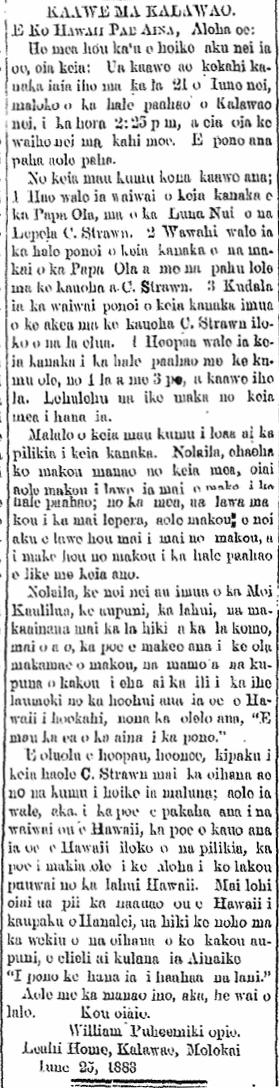
O Ko Hawaii Pae Aina, Aloha oe:

I have something to report to you, and that is this: A man hung himself on the 21st of this June, in the jail here in Kalawao, at 2:25 p. m., and he is now left to rest. Perhaps it will be set right, perhaps not.

Here is why he hung himself; 1. The estate of this man was confiscated by the Board of Health, the the superintendent of the Lepers, C. Strawn. 2. The residence of this man was torn down by the officers of the Board of health as well as his clothes trunk by the orders of C. Strawn. 3. The property of this man was auctioned off to the public by orders of C. Strawn over two days. 4. This man was imprisoned in the jail for no reason for 4 days and 3 nights, at which point he hung himself. There are many witnesses to what was done.

This is all why this man was troubled. And so we are pained by this, for we were not brought here to die in jail; because it is enough that we are inflicted with leprosy; we don’t wish for more sickness to befall us or for us to die again in jail like this.

Therefore I ask before King Kaulilua,¹ the nation, the lahui, the makaainana from where the sun rises to where it sets, from that side to this, those who care for our dear lives, the descendants of our kupuna who were wounded by the barbed spears to unify you O Hawaii as one, for whom is said, “E mau ke ea o ka aina i ka pono.”²

Please dismiss, transfer, and expell this haole C. Strawn from his job for the reasons shown above; and not just him, but those who plunder the wealth of you, O Hawaii; the people who drag you, O Hawaii into difficulties; and those who hold no aloha in their hearts for Hawaii. Don’t take your time, for your knowledge, O Hawaii, has climbed the heights of Hanalei, and you are qualified to occupy the highest positions of our government and be respected for your knowledge [e elieli ai kulana ia Ainaike.]

This is not said in spite, but for just cause [he wai o lalo]. Sincerely,

William Puheemiki, Jr.

Leahi Home, Kalawao, Molokai

June 25, 1883.

¹Kaulilua is another name for Kalakaua.

²”Ua mau ke ea o ka aina i ka pono,” is the famous proclamation of Kauikeaouli, Kamehameha III.

(Ko Hawaii Pae Aina, 7/7/1883, p. 4)

KAAWE MA KALAWAO.

Ko Hawaii Pae Aina, Buke VI, Helu 27, Aoao 4. Iulai 7, 1883.

Attempted theft from Iolani Palace, 1913.

SOME MIRRORS REMOVED FROM THE PALACE.

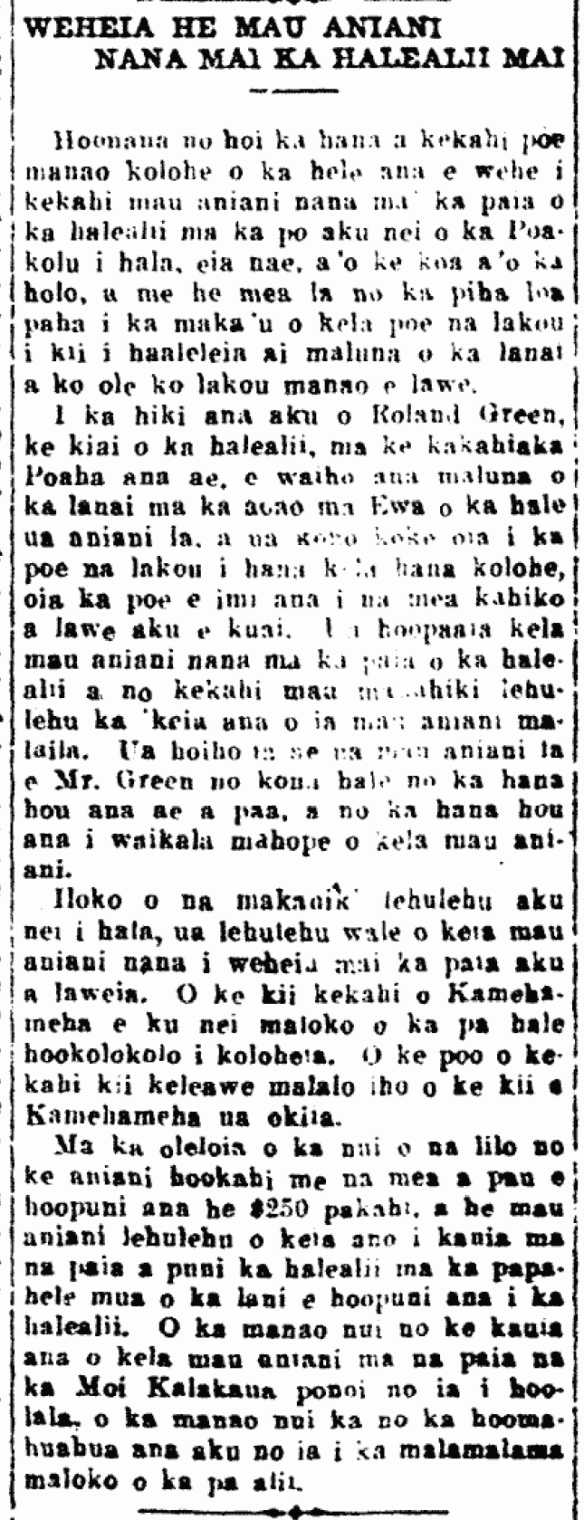
Flagrant was the actions of some vandals who went and removed some mirrors from the wall of the palace the other night of this past Wednesday; however, [as the saying goes,] “Learn to be a warrior; learn also to run away.” And perhaps it was as if due to their being full of fear, that the ones who went to take the mirrors, left them on the lanai without them succeeding in taking them.

When Roland Green, the palace guard, arrived the next Thursday morning, the mirrors were left on the Ewa-side lanai, and he immediately surmised that the people who carried out the vandalism were people who sought out antiquities to sell them.  These mirrors were hung on the wall of the palace and they were there for many years. They were taken by Mr. Green to his place to fix, and to reapply the mercury behind the mirrors.

In many years past, there were numerous mirrors removed from the walls and taken. The statue of Kamehameha standing on the grounds of the court house was also vandalized. One of the heads of a brass image below Kamehameha was severed.

According to what is said, the cost of one of the mirrors and related expenses is $250 each; and there are many of those mirrors that are hung around the first floor walls of the lanai surrounding the palace. The idea for the hanging of these mirrors on the walls was devised by King Kalakaua himself; the intent it is said was to brighten the grounds of the palace.

(Kuokoa, 1/17/1913, p. 6)

WEHEIA HE MAU ANIANI NANA MAI KA HALEALII MAI

Ka Nupepa Kuokoa, Buke XLIX, Helu 3, Aoao 6. Ianuari 17, 1913.

On taxation and leprosy patients, 1875.

The Leprosy Patients are Taxed!

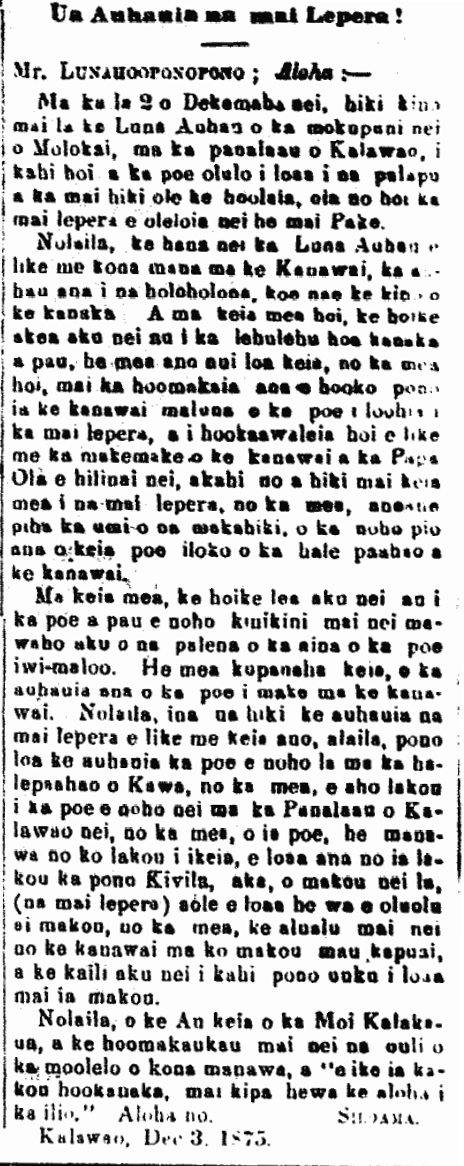
Mr. Editor; Aloha:—

On the 2nd of this December, the Tax Assessor [Luna Auhau] of this island of Molokai came in person to the colony of Kalawao, the place of the castaways who are afflicted with wounds of an incurable sickness, that being leprosy [mai lepera], which is called he Chinese sickness [mai Pake].

Therefore, the Tax Assessor is acting as per his power under the Law; the taxing of animals, all except the body of man. And as such, I am announcing before all of our fellow people, that this is a major thing, because from the beginning of the enforcement of this law upon people afflicted with leprosy and who are set apart as based on the intent of the edict of the Board of Health; this is the first time this sort of thing has come before the patience, as it has almost been ten years that these people have been living as prisoners in the penitentiary of the law.

Through this, I am announcing clearly to all the people living all over outside of the boundaries of the land of the skeletons. This is astonishing that those dead to the law are being taxed. So if leprosy patients are taxable in this way, then those imprisoned in Kawa [the government prison] should be taxed, for they are better off than those living here in the Colony of Kalawao; those people, there is a given time when they will once again receive their Civil rights, but we here (the leprosy patience), we will not have a time when we are relieved, because the law follows after our steps, and takes from us even the tiniest of rights that we have.

This is the Era of King Kalakaua, and the character of the history of his reign is being prepared; so “Recognize your fellow man, and don’t waste your aloha on dogs.” Aloha no. SILOAMA.¹

Kalawao, Dec. 3, 1875

¹Siloama is probably a pen name; it is the Protestant church in Kalawao.

(Kuokoa, 12/11/1875, p. 4)

Ua Auhauia na mai Lepera!

Ka Nupepa Kuokoa, Buke XIV, Helu 50, Aoao 4. Dekemaba 11, 1875.

Traditional and Wise Sayings, 1922.

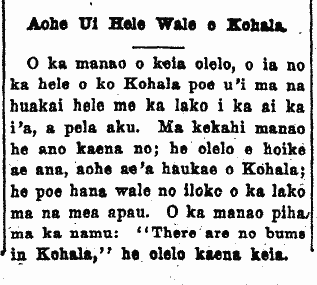
There Are No Youths of Kohala That Just Wander About.

The idea of this saying is that when Kohala youths go travelling, they take along provisions: vegetables, meat, and so forth. Looking at it in another way, it is like a boast; it is saying that Kohala has no vagrants; they are prepared in every way when doing things. In English, the whole thought goes: “There are no bums in Kohala,” and is a boast.

[During this period, there were many articles on traditional proverbs printed!]

(Kuokoa, 9/29/1922, p. 3)

Aohe Ui Hele Wale o Kohala.

Ka Nupepa Kuokoa, Buke LXI, Helu 39, Aoao 3. Sepatemaba 28, 1922.

Wise Sayings of the people of old. 1922.

PROVERBS.

In order for us to hold on to all of the olelo noeau and all of the ingenious deeds of the Hawaiian people, we very much want everyone to assist the Bishop Museum in their collecting and explaining of wise and witty sayings known amongst this race.

So that this endeavor will move forward, whenever an ancient olelo noeau comes to mind, or perhaps a riddle, do write it down and send it to the museum; and if not to there, send it directly to the Kuokoa with clarification of its hidden meaning or deep wit.

Here are some olelo noeau sent from the museum to this newspaper:

Uhiuhi lau mamane, kahe ka wai o Kapapala.

Hookahi no hawa’e, lauhue Kona.

Kau ke poo i ka uluna, o Welehu ka malama.

Aohe hana a Kauhikoa, ua kau ka waa i ke aki.

Haehae ka manu, ke aleale nei ka wai.

E aho hoi ka make i ke kaua, he nui na moepuu.

Nakeke na iwi o Hua i ka la.

Uliuli kai pali o Kahikinui, kolo mai ka ohu la he ino.

Ua komo ka i’a i ka makaha, ua puni i ka nae.

Kulia i ka nuu, i ka paepae kapu o Liloa.

Aohe loea i ka wae opae.

Hoi hou ka paakai i Waimea.

Aohe u’i hele wale o Kohala.

Wehea iho maluna o Hihimanu.

E ike ia kaua hoa kanaka, o kipa hewa ke aloha i ka ilio; he ilio hoi ia, e, he kanaka hoi au, a!

Ka poe unaunahi hee o Kula.

Hilinai Puna, kalele ia Kau.

Hihi Kaunoa, hihi Mana; aloha wale ia laau makua ole.

Kiilili pua hau o Kalena.

Maemae i ke kai ka pua o ka hala.

Maewa wale i ka pali o Kahiwa. Niniu Puna i ke ala.

Nui pumaia, ohaka oloko.

Eleelepi ka waha o kanaka.

He wa ulu keia o ka hoi.

Ua le’a kaina a ka la’i, ua malie.

Make ke kalo, ola i ka naio.

Aia i kula i ka alaalapuloa.

E hoomanao i ka lua o ka ohiki.

Ako Nuuanu i ka hale halauloa a ka makani; ako Manoa i ka hale a ka ehu.

Na manu kolea kau ahua.

[And presumably from the responses came the publication we all know today as “‘Ōlelo No‘eau: Hawaiian Proverbs and Poetical Sayings”. If you don’t have a copy, this is a must have…]

(Kuokoa, 9/21/1922, p. 2)

NA OLELO NOEAU.

Ka Nupepa Kuokoa, Buke LXI, Helu 38, Aoao 2. Sepatemaba 21, 1922.