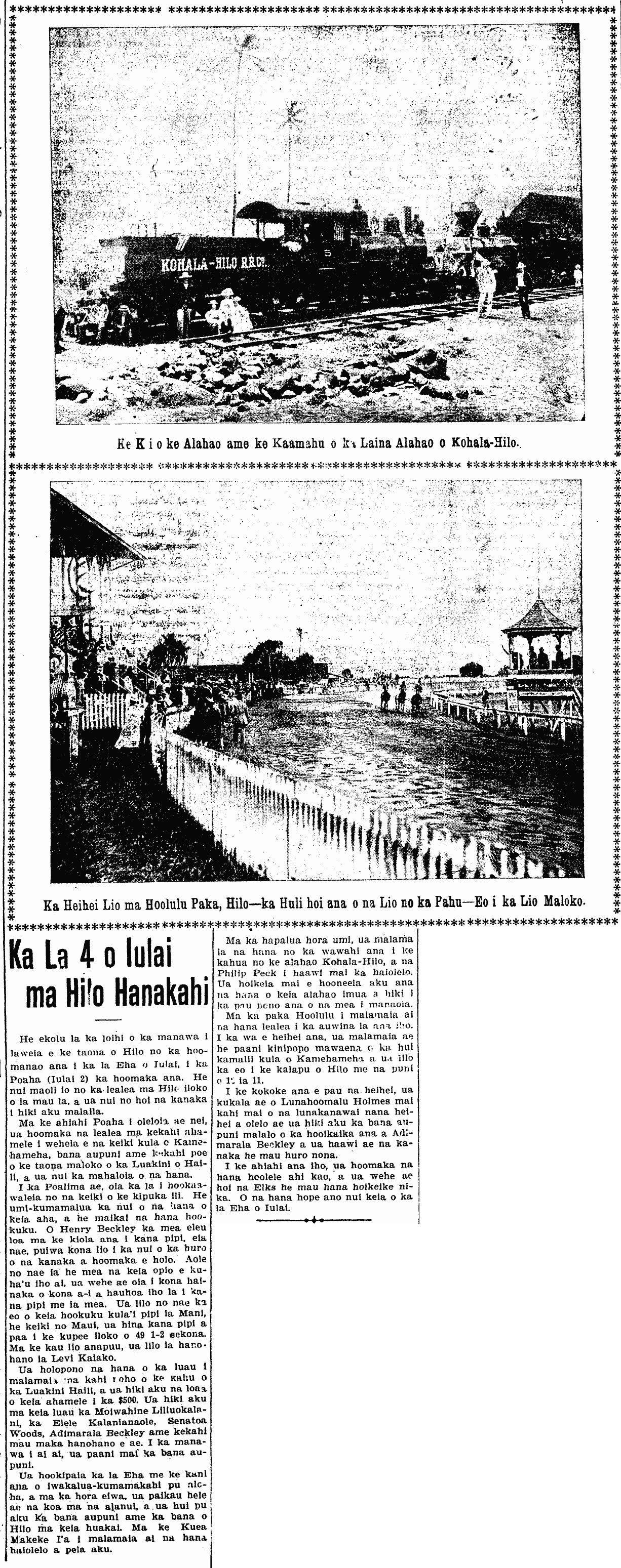
On Hoolulu Park, the recycling of pictures, the Kohala-Hilo R.R. Co., and the 4th of July, 1903.

A Picture of the Railroad [Alahao] and Steam Engine [Kaamahu] of the Kohala-Hilo Railway Line.

Horse Race at Hoolulu Park, Hilo—The Turning of the Horses for the Goal—The Horse on the Inside Wins.

The 4th of July in Hilo Hanakahi

The town of Hilo celebrated the Fourth of July for three days, beginning on Thursday (July 2). There truly was great joy in Hilo during those days, and there were many people who came.

In the evening of the said Thursday, the festivities began with a concert put on by the students of Kamehameha School, the government band, and some people of the town, in Haili Church, and it was greatly appreciated.

On the following Friday, that is the day set aside for the lassoing boys. There were twelve events of this meet, and there was good competition. Henry Beckley was the liveliest one at throwing his bull, however, his horse was alarmed at all of the cheering of the people, and began to run. But this was not something that made this youth falter; he removed his handkerchief from his neck and tied his bull with it. The victory for the contest to throw down the steer went to Mani, a Maui boy, and his steer was thrown down and tied in 49 1-2 seconds. For bronc riding, that honor went to Levi Kalako.

The luau went well, held at the residence of the kahu of Haili Church, and the proceeds of this concert came to $500. Appearing at this luau were Queen Liliuokalani, Representative Kalanianaole, Senator Woods, Admiral Beckley, and other distinguished people. When the eating began, the government band played.

The Fourth was greeted with the salute of twenty-one guns, and at nine o’clock, the soldiers marched on the streets, and the government band and the Hilo Band joined in this parade. At the Fish Market Square [Kuea Makeke I’a], speeches were held, and so forth.

At half after ten o’clock, the breaking ground for the Kohala-Hilo Railroad was held, and Philip Peck gave the speech. It was said that the work of this railroad will move forward until what was planned is completed.

At Hoolulu Park was held the festivities of that afternoon. When the races were going on, a ballgame went on with the school boys of Kamehameha, and the victory went to the Hilo club with the score of 12 to 11.

When the races were almost done, Chairman Holmes announced from the area of the race judges that the government band had arrived by the efforts of Admiral Beckley, and the people gave him a cheer.

Later that evening, fireworks were shot off, and the Elks put on a “nigger show [hoikeike nika].”¹ These were the last major events of this Fourth of July.

[This is the same picture of Hoolulu Park found later in the Kuokoa three years later, on 12/7/1906. This kind of recycling of pictures happened back in the day, just as we see it happening today, therefore sometimes it is difficult to date a picture that appears in the newspapers.]

¹This type of entertainment here can be seen spoken of in the Hawaiian newspapers from the mid-1800s to the early 1900s.

(Kuokoa, 7/10/1903, p. 1)
Ka La 4 o Iulai ma Hilo Hanakahi

Ka Nupepa Kuokoa, Buke XLI, Helu 28, Aoao 1. Iulai 10, 1903.
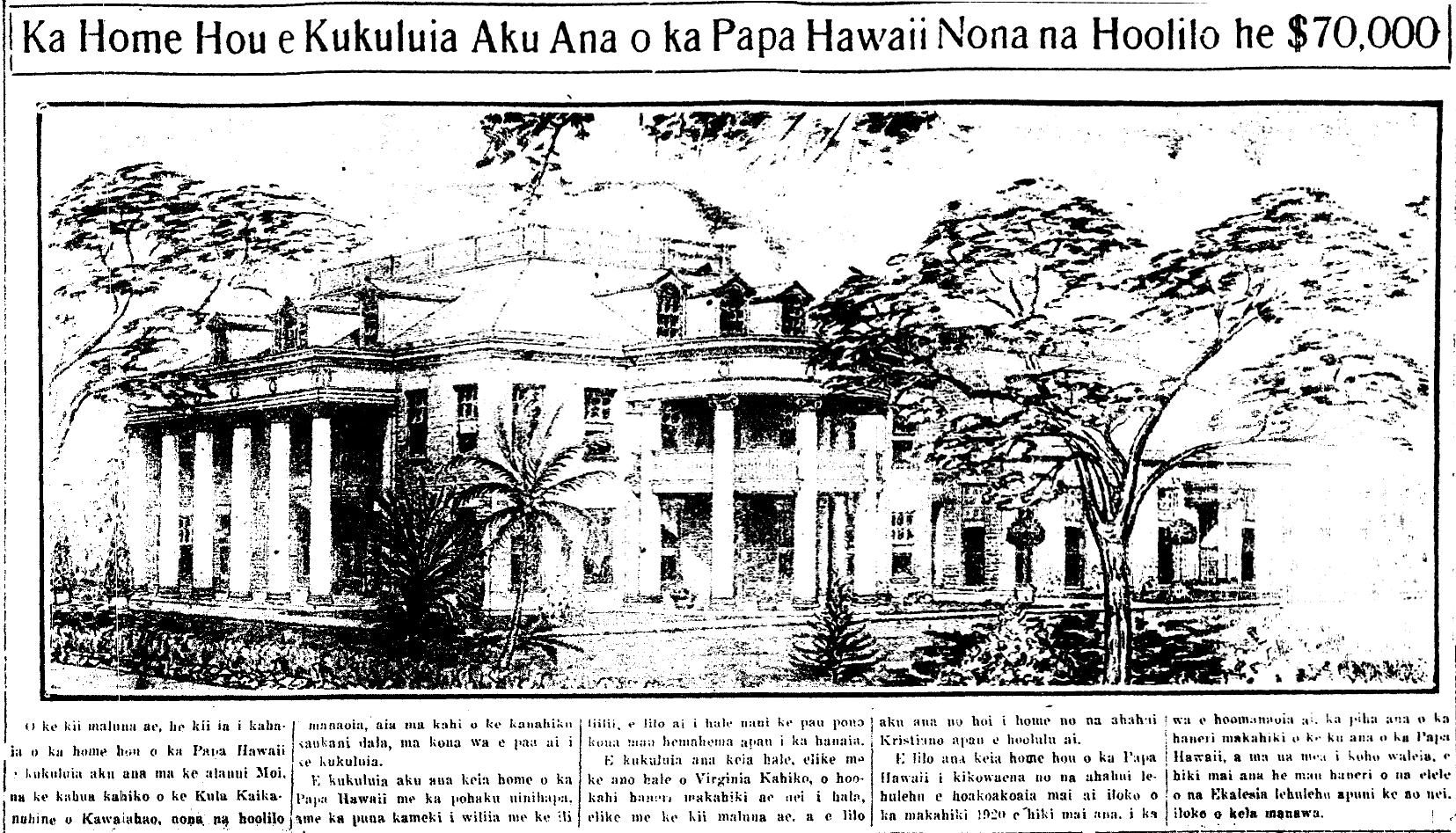
Plans for the building to commemorate the 100th anniversary of the coming of the missionaries, 1914.

New Home Being Built by the Hawaiian Evangelical Association to Cost $70,000

The picture above is a sketch drawn of the new home of the Hawaiian Evangelical Association [Papa Hawaii] to be built on King Street on the old site of the Kawaiahao Girls’ School [Kula Kaikamahine o Kawaiahao], that is estimated to cost about seventy thousand dollars at its completion.

This home of the Papa Hawaii will be built using brick and concrete, and it will be a beautiful house once all the finishing touches are completed.

This house will be build in the style of those of old Virginia of a hundred years ago, like the image above, and it will become a home for all the Christian associations at where to gather.

This new home of the Papa Hawaii will be a center for the many groups to gather during the coming year 1920 when the 100th anniversary of the Papa Hawaii is celebrated, and it is imagined several hundred representatives of the many Churches from around the world will come them.

(Kuokoa, 10/2/1914, p. 1)

Ka Home Hou e Kukuluia Aku Ana o ka Papa Hawaii Nona na Hoolilo he $70,000

Ka Nupepa Kuokoa, Buke LII, Helu 41, Aoao 1. Okatoba 2, 1914.

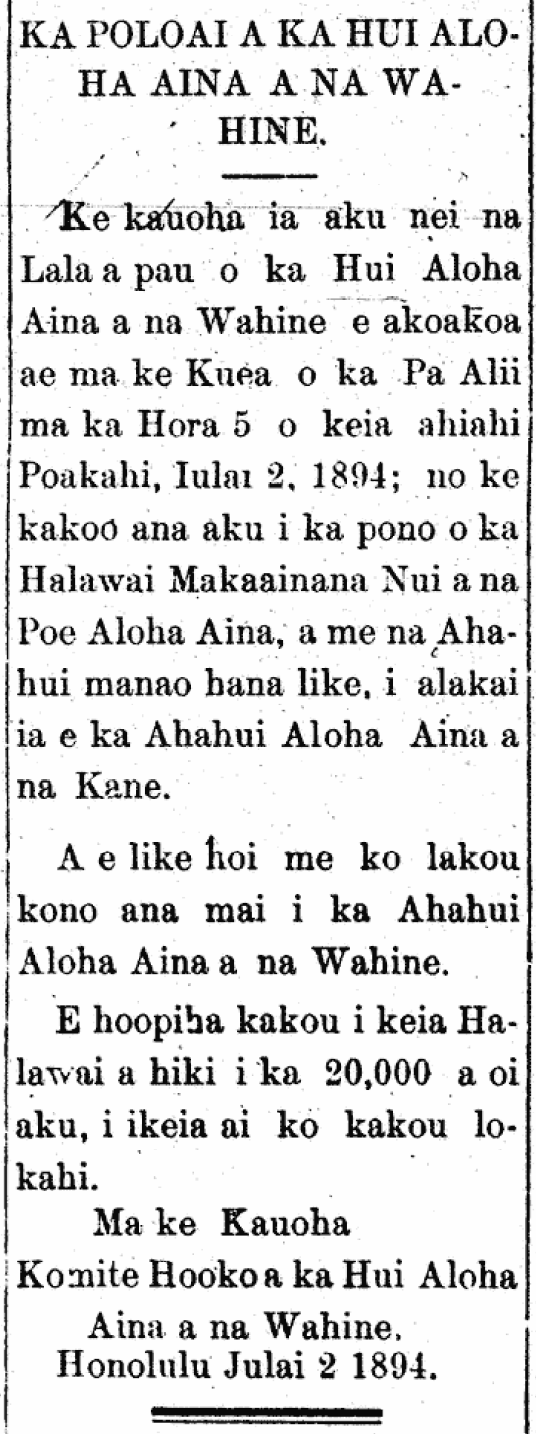
More on the protest rally of July 2, 1894.

PROCLAMATION OF THE WOMEN’S HAWAIIAN PATRIOTIC LEAGUE.

All of the members of the Hui Aloha Aina a na Wahine are directed to gather at Palace Square at 5 o’clock this evening, Monday, July 2, 1894; to support the rights of the Great Makaainana Rally of Patriots along with like-minded Organizations led by the Men’s Patriotic League [Ahahui Aloha Aina a na Kane].

And in accordance with their invitation to the Women’s Patriotic League.

Let us fill this Rally until we have 20,000 or more, so that our unity is made know.

By Order

Executive Committee of the Hui Aloha Aina a na Wahine.

Honolulu, July 2, 1894.

(Leo o ka Lahui, 7/2/1894, p. 2)

KA POLOAI A KA HUI ALOHA AINA A NA WAHINE.

Ka Leo o ka Lahui, Buke II, Helu 974, Aoao 2. Iulai 2, 1894.

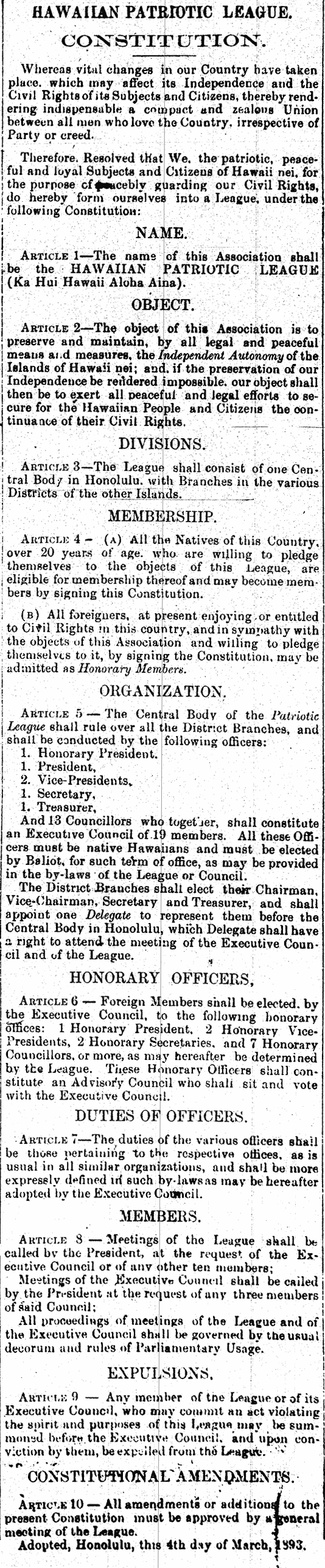
Constitution of the Hawaiian Patriotic League, in English, 1893.

HAWAIIAN PATRIOTIC LEAGUE.

CONSTITUTION.

Whereas vital changes in our Country have taken place, which may affect its Independence and the Civil Rights of its Subjects and Citizens, thereby rendering indispensable a compact and zealous Union between all men who love the Country, irrespective of Party or creed.

Therefore, Resolved that We, the patriotic, peaceful and loyal Subjects and Citizens of Hawaii nei, for the purpose of peaceably guarding our Civil Rights, do hereby form ourselves into a League, under the following Constitution:

NAME.

Article 1—The name of this Association shall be the HAWAIIAN PATRIOTIC LEAGUE (Ka Hui Hawaii Aloha AIna).

OBJECT.

Article 2—The object of this Association is to preserve and maintain, by all legal and peaceful means and measures, the Independent Autonomy of the Islands of Hawaii nei; and, if the preservation of our Independence be rendered impossible, our object shall then be to exert all peaceful and legal efforts to secure for the Hawaiian People and Citizens the continuance of their Civil Rights.

DIVISIONS.

Article 3—The League shall consist of one Central Body in Honolulu, with Branches in the various Districts of the other Islands.

MEMBERSHIP.

Article 4—(A) All the Natives of this Country, over 20 years of age, who are willing to pledge themselves to the objects of this League, are eligible for membership thereof and may become members by signing this Constitution.

(B) All foreigners, at present enjoying or entitled to Civil Rights in this country, and in sympathy with the objects of this Association and willing to pledge themselves to it, by signing the Constitution, may be admitted as Honorary Members.

ORGANIZATION.

Article 5—The Central Body of the Patriotic League shall rule over all the District Branches , and shall be conducted by the following officers:

1. Honorary President,

1. President,

2. Vice-Presidents,

1. Secretary,

1. Treasurer,

And 13 Councillors who together, shall constitute an Executive Council of 19 members. All these Officers must be native Hawaiians and must be elected by Ballot, for such term of office, as may be provided in the by-laws of the League or Council.

The District Branches shall elect their Chairman, Vice-Chairman, Secretary and Treasurer, and shall appoint one Delegate to represent them before the Central Body in Honolulu, which Delegate shall have a right to attend the meeting of the Executive Council and of the League.

HONORARY OFFICERS,

Article 6—Foreign Members shall be elected by the Executive Council, to the following honorary offices: 1 Honorary President, 2 Honorary Vice-Presidents, 2 Honorary Secretaries, and 7 Honorary Councillors, or more, as may hereafter be determined by the League. These Honorary Officers shall constitute and Advisory Council who shall sit and vote with the Executive Council.

DUTIES OF OFFICERS.

Article 7—The duties of the various officers shall be those pertaining to the respective offices, as is usual in all similar organizations, and shall be more expressly defined in such by-laws as may be hereafter adopted by the Executive Council.

MEMBERS.

Article 8—Meetings of the League shall be called by the President, at the request of the Executive Council or of any other ten members;

Meetings of the Executive Council shall be called by the President at the request of any three members of said Council;

All proceeding s of meetings of the League and of the Executive Council shall be governed by the usual decorum and rules of Parliamentary Usage.

EXPULSIONS.

Article 9—Any member of the League or of its Executive Council, who may commit an act violating the spirit and purposes of this League may be summoned before the Executive Council, and upon conviction by them, be expelled from the League.

CONSTITUTIONAL AMENDMENTS.

Article 10—All amendments or additions to the present Constitution must be approved by a general meeting of the League.

Adopted, Honolulu, this 4th day of March, 1893.

[See the Hawaiian-Language Constitution here!]

(Leo o ka Lahui, 3/22/1893, p. 3)

HAWAIIAN PATRIOTIC LEAGUE.

Ka Leo o ka Lahui, Buke II, Helu 667, Aoao 3. Maraki 22, 1893.

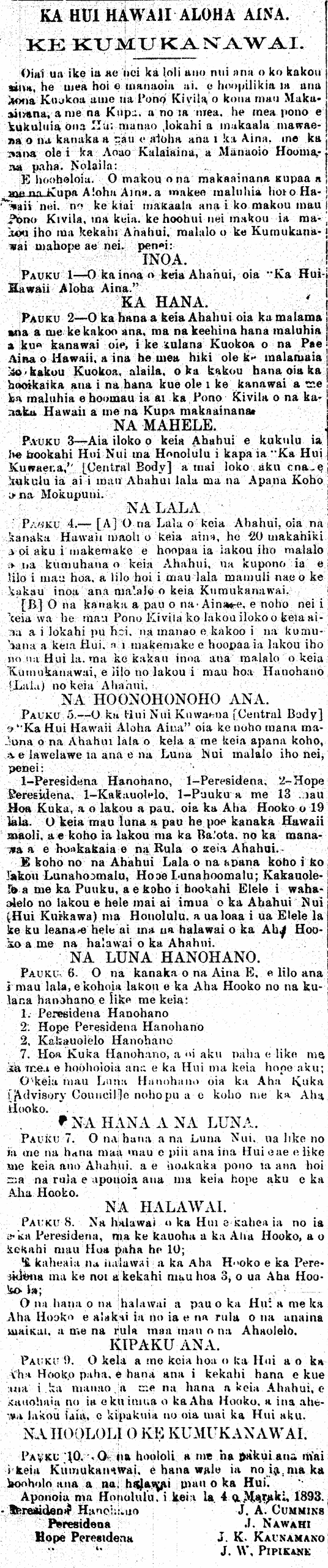
Constitution of the Hawaiian Patriotic League, in Hawaiian, 1893.

KA HUI HAWAII ALOHA AINA.

KE KUMUKANAWAI.

Oiai ua ike ia ae nei ka loli ano nui ana o ko kakou aina, he mea hoi e manaoia ai, e hoopilikia ia ana kona Kuokoa ame na Pono Kivila o kona mau Makaainana, a me na Kupa, a no ia mea, he mea pono e kukuluia ona Hui manao lokahi a makaala mawaena o na kanaka a pau e aloha ana i ka Aina, me ka nana ole i ka Aoao Kalaiaina, a Manaoio Hoomana paha. Nolaila:

E hooholoia. O makou o na makaainana kupaa a me na Kupa Aloha Aina a makee maluhia hoi o Hawaii nei, no ke kiai makaala ana i ko makou mau Pono Kivila, ma keia, ke hoohui nei makou ia makou iho ma kekahi Ahahui, malalo o ke Kumukanawai mahope ae nei. penei:

INOA.

Pauku 1—O ka inoa o keia Ahahui, oia “Ka Hui Hawaii Aloha Aina.”

KA HANA.

Pauku 2—O ka hana a keia Ahahui oia ka malama ana a me ke kakoo ana, ma na keehina hana maluhia a kue kanawai ole, i ke kulana Kuokoa o na Pae Aina o Hawaii, a ina he mea hiki ole ke malamaia ko lakou Kuokoa, alaila, o ka kakou hana oia ka hooikaika ana i na hana kue ole i ke kanawai a me ka maluhia e hoomau ia ai ka Pono Kivila o na kanaka Hawaii a me na Kupa makaainana.

NA MAHELE.

Pauku 3—Aia iloko o keia Ahahui e kukulu ia he hookahi Hui Nui ma Honolulu i kapa ia “Ka Hui Kuwaena,” [Central Body] a mai loko aku ona e kukulu ia ai i ma Ahahui lala ma na Apana Koho o na Mokupuni.

NA LALA.

Pauku 4—[A] O na Lala o keia Ahahui, oia na kanaka Hawaii maoli o keia aina, he 20 makahiki a oi aku i makemake e hoopaa ia lakou iho maloko o na kumuhana o keia Ahahui, ua kupono ia e lilo i mau hoa, a lilo hoi i mau lala mamuli nae o ke kakau inoa ana malalo o keia Kumukanawai.

[B] O na kanaka a pau o na Aina e, e noho nei i keia wa he mau Pono Kivila ko lakou iloko o keia aina a i lokahi pu hoi, na manao e kakoo i na kumuhana a keia Hui, a i makemake e hoopaa ia lakou iho no ua Hui la, ma ke kakau inoa ana malalo o keia Kumukanawai, e lilo no lakou i mau hoa Hanohano (Lala) no keia Ahahui.

NA HOONOHONOHO ANA.

Pauku 5—O ka Hui Nui Kuwaena [Central Body] o “Ka Hui Hawaii Aloha Aina” oia ke noho mana maluna o na Ahahui lala o kela a me keia apana koho, a e lawelawe ia ana e na Luna Nui malalo iho nei, penei:

1—Peresidena Hanohano, 1—Peresidena, 2—Hope Peresidena, 1—Kakauolelo, 1—Puuku a me 13 mau Hoa Kuka, a o lakou a pau, oia ka Aha Hooko o 19 lala. O keia mau luna a pau he poe kanaka Hawaii maoli, a e koho ia lakou ma ka Balota, no ka manawa a e hoakakaia e na Rula o keia Ahahui.

E koho no na Ahahui Lala o na apana koho i ko lakou Lunahoomalu, Hope Lunahoomalu; Kakauolelo a me ka Puuku, a e koho i hookahi Elele i wahaolelo no lakou e hele mai ai imua o ka Ahahui Nui (Hui Kuikawa) ma Honolulu, a ua loaa i ua Elele la ke kuleana e hele ai ma na halawai o ka Aha Hooko a me na halawai o ka Ahahui.

NA LUNA HANOHANO.

Pauku 6. O na kanaka o na Aina E, e lilo ana i mau lala, e kohoia lakou e ka Aha Hooko no na kulana hanohano e like me keia:

1. Peresidena Hanohano

2. Hope Peresidena Hanohano

2. Kakauolelo Hanohano

7. Hoa Kuka Hanohano, a oi aku paha e like me ka mea e hooholoia ana e ka Hui ma keia hope aku;

O keia mau Luna Hanohano oia ka Aha Kuka [Advisory Council] e noho pu a e koho me ka Aha Hooko.

NA HANA A NA LUNA.

Pauku 7. O na hana a na Luna Nui, ua like no ia me na hana maa mau e pili ana ina Hui e ae e like me keia ano Ahahui, a e hoakaka pono ia ana hoi ma na rula e aponoia ana ma keia hope aku e ka Aha Hooko.

NA HALAWAI.

Pauku 8. Na halawai o ka Hui e kahea ia no ia e ka Peresidena, ma ke kauoha a ka Aha Hooko, a o kekahi mau Hoa paha he 10;

E kaheaia na halawai a ka Aha Hooko e ka Peresidena ma ke noi a kekahi mau hoa 3, o ua Aha Hooko la;

O na hana o na halawai a pau o ka Hui a me ka Aha Hooko e alakai ia no ia e na rula o na anaina maikai, a me na rula maa mau o na Ahaolelo.

KIPAKU ANA.

Pauku 9. O kela a me keia hoa o ka Hui a o ka Aha Hooko paha, e hana ana i kekahi hana e kue ana i ka manao a me na hana a keia Ahahui, e kauohaia no ia e ku imua o ka Aha Hooko, a ina ahewa lakou iaia, e kipakuia no oia ma ka Hui aku.

NA HOOLOLI O KE KUMUKANAWAI.

Pauku 10. O na hoololi a me na pakui ana mai i keia Kumukanawai, e  hana wale ia no ia ma ka hooholo ana a na halawai mau o ka Hui.

Aponoia ma Honolulu, i keia la 4 o Maraki, 1893.

Peresidena Hanohano  J. A. Cummins

Peresidena  J. Nawahi

Hope Peresidena  J. K. Kaunamano

” ”  J. W. Pipikane

[See the English-language version here.]

(Leo o ka Lahui, 3/22/1893, p. 3)

KA HUI HAWAII ALOHA AINA.

Ka Leo o ka Lahui, Buke II, Helu 667, Aoao 3. Maraki 22, 1893.

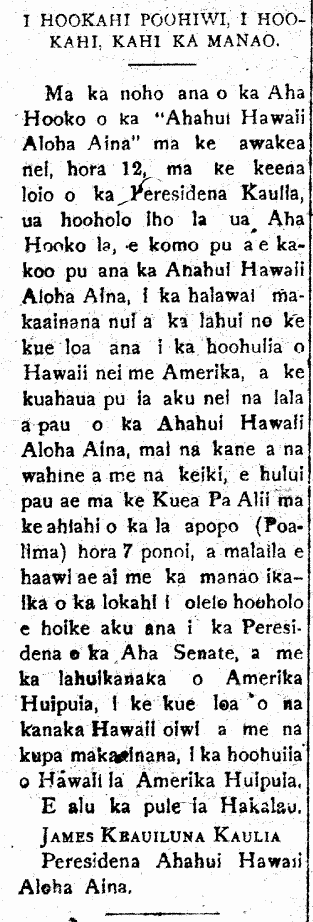
I hookahi, kahi ka manao, 1897.

LET US BE OF ONE SHOULDER,¹ LET US BE OF UNIFIED THOUGHT.

At the meeting of the Executive Committee of the “Ahahui Hawaii Aloha Aina” [Hawaiian Patriotic League] at noon, 12 o’clock, at the attorney’s office of President Kaulia, the said Executive Committee decided that the Patriotic League will join and support the great rally of the makaainana of the lahui to absolutely protest the annexation of Hawaii to America, and it is announced to all of the members of the Hawaiian Patriotic League, from the men, to the women, to the children, to assemble at the Palace Square [Kuea Pa Alii] tomorrow evening (Friday) at exactly 7 o’clock, and there will be presented with insistence and unity, the resolution informing the President of the Senate and the people of the United States, that the native Hawaiians and the long-time makaainana protest the annexation of Hawaii to the United States of America.

Let us combine our prayers to overcome Hakalau. [E alu ka pule ia Hakalau.]²

James Keauiluna Kaulia

President of the Ahahui Hawaii Aloha Aina.

¹Hearkening to the idea of “I hookahi umauma, i hookahi poohiwi, a i hookahi puuwai.” [Let us be of one chest, one shoulder, and of one heart.] Also from earlier that year, see by Samuel K. Kamakaia, “Nai Wale no Oukou A’oe Pau.”

²According to Mary Kawena Pukui’s Olelo Noeau (115): “A sorcerer at Hakalau once created havoc in his own and other neighborhoods. Many attempts to counter-pray him failed until a visiting kahuna suggested that all of the others band together to concentrate on the common enemy. This time they succeeded.”

(Aloha Aina, 10/9/1897, p. 3)

I HOOKAHI POOHIWI, I HOOKAHI, KAHI KA MANAO.

Ke Aloha Aina, Buke III, Helu 41, Aoao 3. Okatoba 9, 1897.

Secret Societies in Hawaii, 1914.

The Representatives of the Secret Societies Off To San Francisco

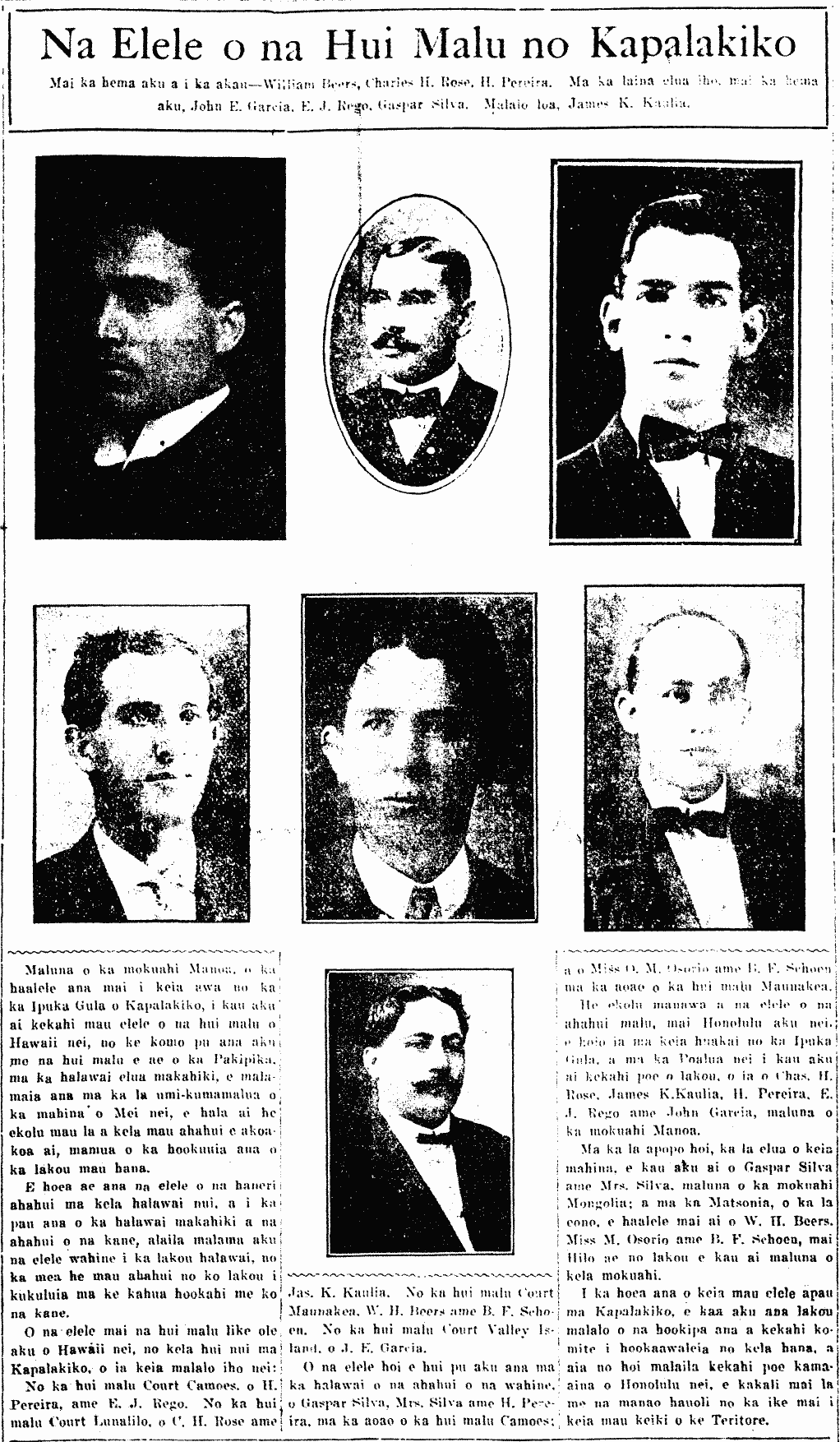
From the left to right—William Beers, Charles H. Rose, H. Pereira. On the second line below, from the left, John E. Garcia, E. J. Rego, Gaspar Silva. On the very bottom, James K. Kaulia.

Aboard the steamship Manoa leaving this port for the Golden Gate of San Francisco, rode some representatives of secret societies [hui malu] of Hawaii to join with other secret societies of the Pacific in their biennial meeting being held on the twelveth of this May, spending three days in meetings with these societies before their activities are let out.

The representatives of hundreds of secret societies will attend this great meeting, and at the conclusion of the annual men’s gathering, then the women will hold their meeting for they have established societies on the same foundation as the men.

The representatives from the various secret societies of Hawaii nei headed for this huge gathering in San Francisco are:

From the secret society of Court Camoes, H. Pereira and E. J. Rego. From the secret society Court Lunalilo, C. H. Rose and James Kaulia. From the secret society Court Maunakea, W. H. Beers and B. F. Shoen. From the secret society Court Valley Island, J. E. Garcia.

The representatives meeting at the women’s gathering are: Gaspar Silva, Mrs. Silva, and H. Pereira from the Camoes; and Miss D. M. Osorio and B. F. Shoen from the secret society of Maunakea.

The secret society representatives from Honolulu will be travelling to the Golden Gate in three trips; this Tuesday, some of them, Charles H. Rose, James K. Kaulia, H. Pereira, E. J. Rego, and John Garcia, boarded the steamship Manoa.

Tomorrow, the second of this month, Gaspar Silva and Mrs. Silva will board the Mongolia; and on the Matsonia of The sixth, W. H. Beers, Miss M. Osorio, and B. F. Shoen will leave, and it is from Hilo that they will board that steamship.

When all of the representatives reach San Fransico, they will come under the care of a committee set aside for that purpose, and there are people there who are kamaaina of Honolulu who await happily to see these keiki of the Territory.

[These all fall under the Ancient Order of Foresters.]

(Kuokoa, 5/1/1914, p. 1)

Na Elele o na Hui Malu no Kapalakiko

Ka Nupepa Kuokoa, Buke LII, Helu 18, Aoao 1. Mei 1, 1914.

Charles Auld, Hula, and Hawaiian Civic Club of Hilo, 1941.

Hawaiian Civic Club

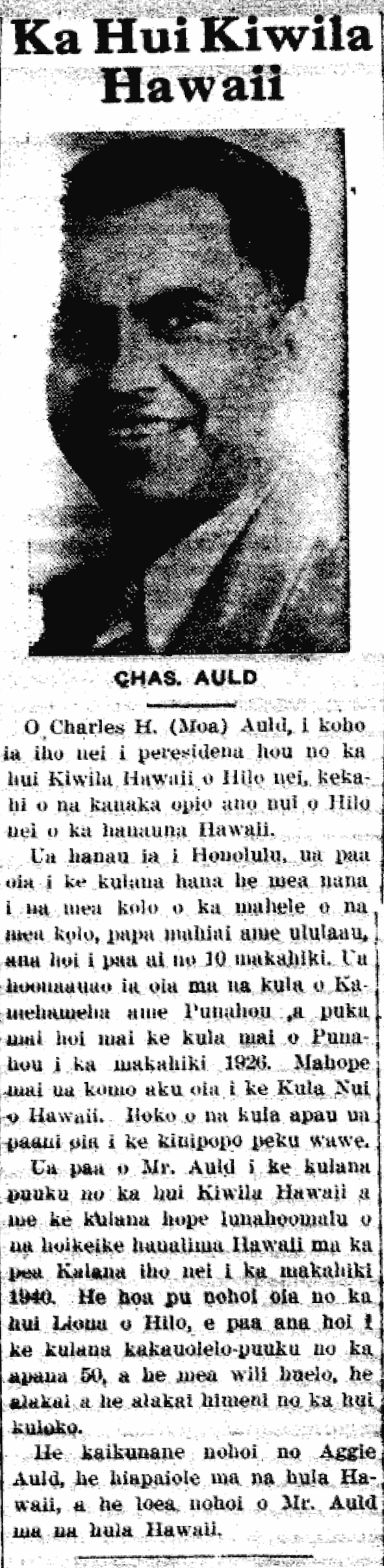
CHAS. AULD

Charles H. (Moa) Auld has been chosen as the new president of the Hawaiian Civic Club [hui Kiwila Hawaii] of Hilo nei, one of the important youths here in Hilo of Hawaiian ancestry.

He was born in Honolulu, and was employed as an inspector of insects in the insects division of the department of agriculture and forestry [papa mahiai ame ululaau], in which he was employed for 10 years. He was educated at the Kamehameha Schools and at Punahou, and he graduated from Punahou in 1926. Thereafter he attended the University of Hawaii. In each of these schools he played football [kinipopo peku wawae].

He is a brother also of Aggie Auld, and expert in Hawaiian hula, and Mr. Auld himself is adept at it as well.

(Hoku o Hawaii, 3/19/1941, p. 1)

Ka Hui Kiwila Hawaii

Ka Hoku o Hawaii, Volume XXXV, Number 47, Aoao 1. Malaki 19, 1941.

Liliuokalani’s horse riding association, 1892.

[Found under: “NU HOU KULOKO.”]

A Summons—All the members of the Liliuokalani Horse Riding Association and Carriage Riding Association are invited. To gather at Iolani Palace, on the Palace Grounds, at 1 p. m. on the 4th of February. Heed this call.

By the orders of the President of the Association.

(Leo o ka Lahui, 2/3/1892, p. 3)

He Leo Poloai

Ka Leo o ka Lahui, Buke II, Helu 382, Aoao 3. Feberuari 3, 1892.


Hilo Hawaiian Civic Club’s Annual Holoku Ball, 1941.

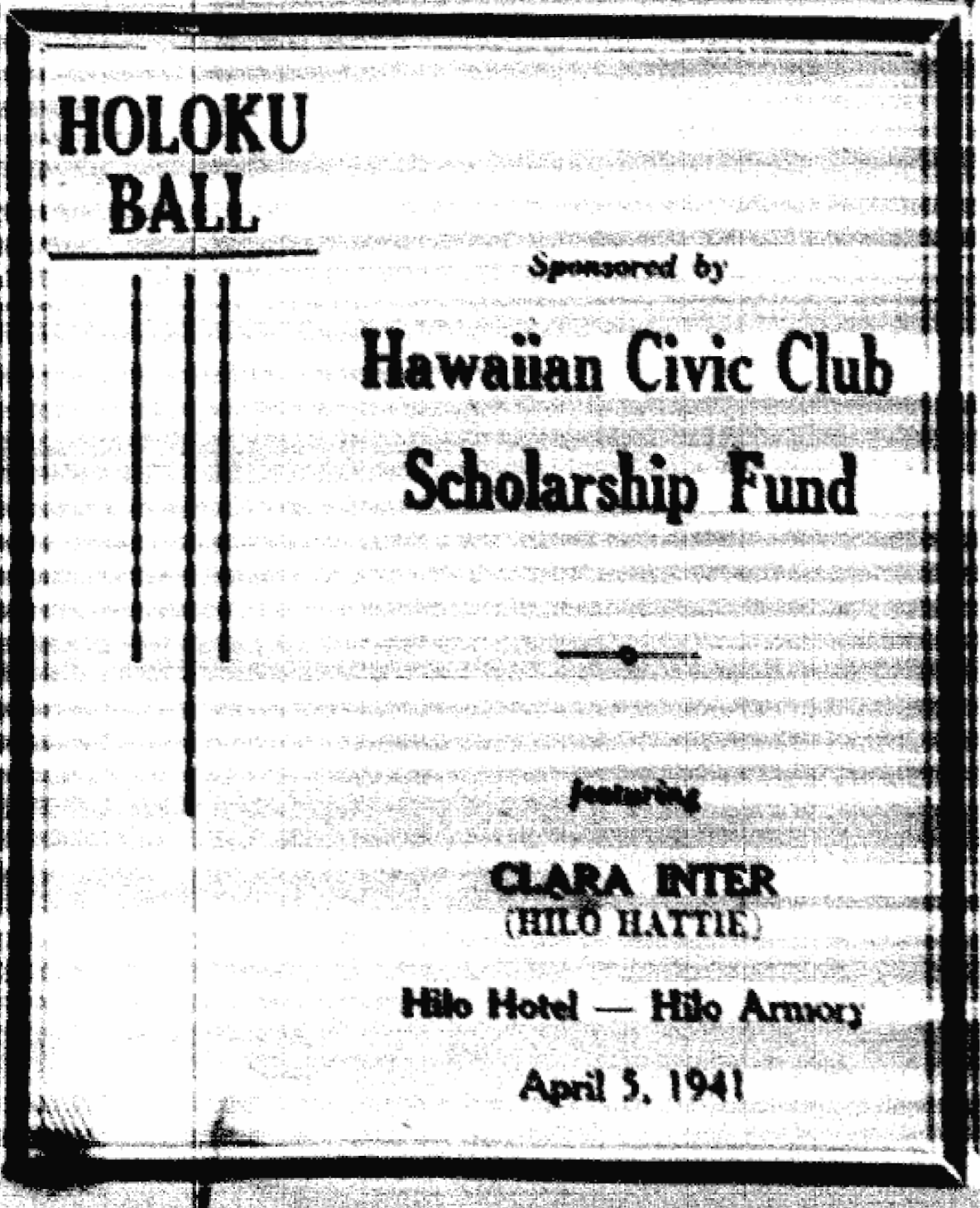
HOLOKU
BALL

Sponsored by

Hawaiian Civic Club

Scholarship Fund

featuring

CLARA INTER

(HILO HATTIE)

Hilo Hotel —Hilo Armory

April 5, 1941

(Hoku o Hawaii, 4/2/1941, p. 4)

HOLOKU BALL

Ka Hoku o Hawaii, Volume XXXV, Number 49, Aoao 4. Aperila 2, 1941.