More on Kaulia and Morgan, 1897.

DISAVOWAL.

Kaulia Censured for Signing the Request to Senator Morgan.

This will certify that Mr. James K. Kaulia, as President of the Hawaiian Patriotic League, had no authority to sign the invitation to the Hon. John T. Morgan to address Hawaiians on the subject of Annexation. The signature of Mr. Kaulia is his personal matter, not as President of our Association.

J. K. Kaunamano,
James L. Aholo,
M. Palau,
E. W. Palau,
S. K. Kaloa,
D. W. Kamaliikane,
G. W. Kualaku,
S. W. Kawelo,
E. K. Lilikalani.

Executive Committee.

(Independent, 9/29/1897, p. 2)

DISAVOWAL.

The Independent, Volume V, Number 701, Page 2. September 29, 1897.

D. L. Conkling, from bicyclist to treasurer, 1909.

BICYCLE RACER IS NOW TERRITORIAL TREASURER

David L. Conkling Is Given Fat Job in Hawaii

[Special Correspondence of the Call]

HONOLULU, July 2.—David Lloyd Conkling, formerly chief clerk of the territory, has been appointed territorial treasurer to succeed A. M. Campbell, whom the senate refused to confirm.

Conkling is a young man who came to Hawaii from San Francisco as a fancy bicycle rider and racer, having been well known on the coast tracks 10 years ago.

After the bicycle craze died out he became purser on one of the inter-island steamers and later was a reporter for the Honolulu papers. He was appointed chief clerk by Governor Carter and received his promotion from Governor Frear.

Conkling’s appointment has been received with general favor.

(San Francisco Call, 7/11/1909, p. 28)

BICYCLE RACER IS NOW TERRITORIAL TREASURER

San Francisco Call, Volume CVI, Number 41, Page 28. July 11, 1909.

Hawaii and the United States, 1911.

Hawaii is a Gold Mine for America

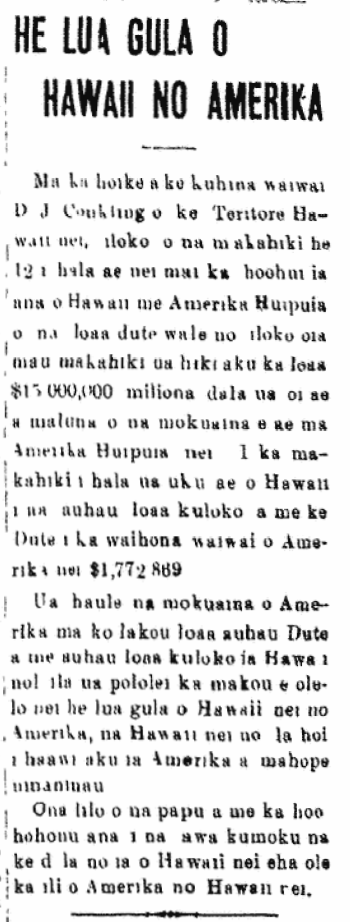
According to the report by the treasurer of the Territory of Hawaii, D. L. Conkling, in the 12 years which have passed since the annexation of Hawaii to America, the income just from duties during that time come to more than $15,000,000, more than the other states of the United States. In the past year, Hawaii paid $1,772,869 in income taxes and duties to the coffers of America.

The rest of the states fell behind Hawaii in duties and income taxes, and therefore what we say about Hawaii being a gold mine for America is true; it is Hawaii who gave it to America then asked questions.

All of the expenses for the forts and the dredging of the harbors are paid for by Hawaii’s dollars, and America suffers nothing for Hawaii.

(Kuokoa Home Rula, 8/11/1911, p. 1)

HE LUA GULA O HAWAII NO AMERIKA

Kuokoa Home Rula, Buke IX, Helu 32, Aoao 1. Augate 11, 1911.

On Hooulu Lahui, 1876.

SATURDAY, MARCH 4.

REPOPULATION.

The following is the text of the memorial of citizens which was presented to His Majesty on Tuesday last, by a committee of signers:

To His Majesty the King,

Sire:—We, the undersigned, subjects and residents of this kingdom and friends of your Royal Person, in view of what we deem a grave condition of public affairs, take the liberty to address you in a spirit of frankness and loyalty in order to point out the danger that threatens the state, and at the same time the necessary measures to avoid the national peril.

We desire to say at the outset, that we are prompted to take part in this address not only on account of a loyal and friendly regard for Your Majestyʻs person, but also by reason of our strong desire to see maintained, with ample honor and prosperity, the Independence of the Hawaiian Kingdom.

The propriety of according the privileges of independent sovereignty to a state so much reduced in people as Your Majestyʻs dominions is very much questioned, and the discussion is most detrimental to the dignity and permanence of the throne. This question was even raised in past years, when Hawaii numbered far more souls than at this time within her borders. When the commissioners of Kamehameha III presented the claims of this archipelago for recognition as an independent state to the Government of Great Britain in 1843, they were met at first with a peremptory refusal from Lord Aberdeen, the British foreign minister, on the ground that the state of Hawaii was a mere chieftaincy under foreign influences, and too small to be entitled to diplomatic courtesies and treaty making powers. And if such a view could be taken of our state thirty-three years ago, when we numbered about one hundred thousand people, what must be thought of our capability for independence now when perhaps we number barely fifty thousand souls, natives and foreigners all told? Continue reading

Re-population in the eyes of the haole, 1876.

Palapala Hoopii i ka Moi.

Ka Hooulu Lahui.

[This memorial urging re-population of the nation was probably an English document, translated here into Hawaiian. For the English and the interesting list of signatures, see the following post.]

(Kuokoa, 3/18/1876, p. 1)

Palapala Hoopii i ka Moi.

Ka Nupepa Kuokoa, Buke XV, Helu 12, Aoao 1. Maraki 18, 1876.

Hawaiians slighted? 1914.

THE CONTEMPT FOR HAWAIIANS IS CLEAR

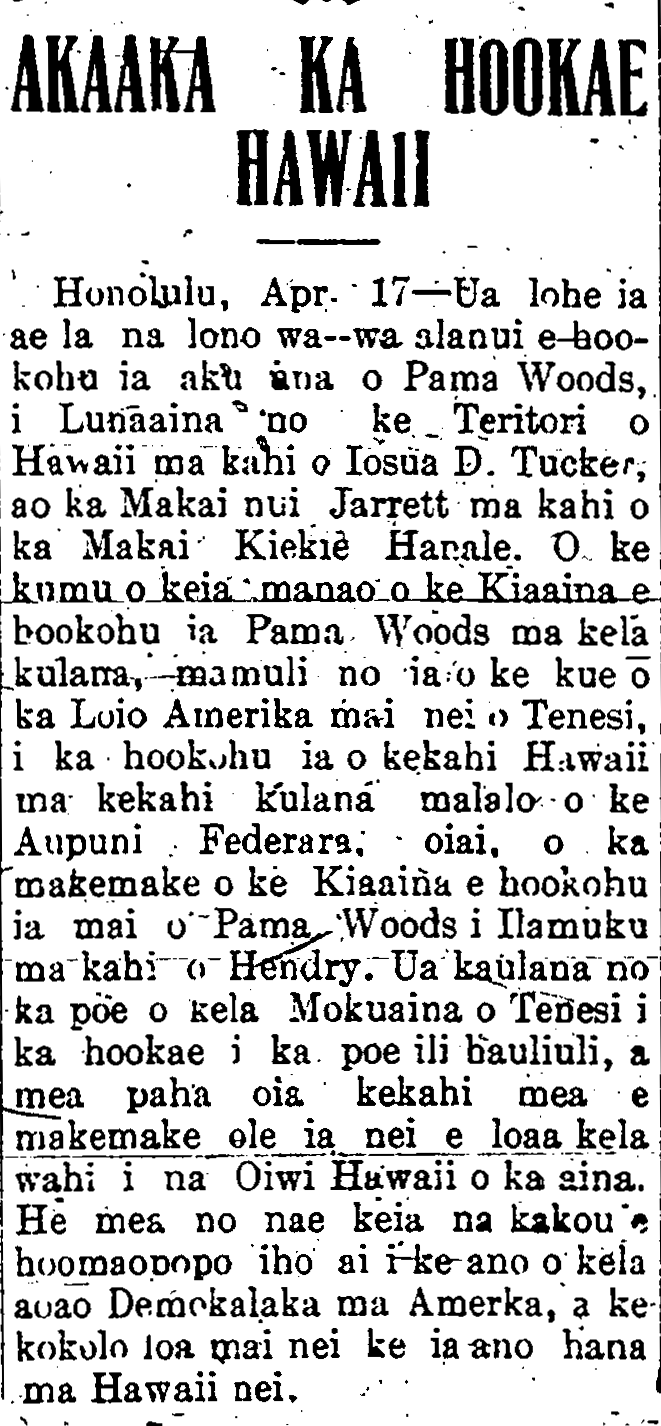
Honolulu, Apr. 17—We hear from the word that is buzzing on the streets that Palmer Woods [Pama Woods] has been selected as Land Commissioner [Lunaaina] for the Territory of Hawaii in place of Joshua D. Tucker [Iosua D. Tucker], and Sheriff Jarrett [Makai nui Jarrett] in place of High Sheriff Henry [Makai Kiekie Hanale]. The reason for this decision by the Governor to select Palmer Woods for this position was because of the objection by the United States Attorney from Tennessee to select a Hawaiian in a position under the Federal Government, although the Governor wanted to appoint Palmer Woods as Marshall [Ilamuku] in place of Hendry. The people of the state of Tennessee are infamous for their contempt of people of dark skin, and perhaps that is one reason that place does not desire Native Hawaiians. Through this we should recognize the nature of the Democrats in America, as this sort of action creeps all the way here to Hawaii nei.

[For some reason, the first 11 and a half years of Hoku o Hawaii (including the issue in which you can find this article) is not available yet online!]

(Hoku o Hawaii, 4/23/1914, p. 3)

AKAAKA KA HOOKAE HAWAII

Ka Hoku o Hawaii, Buke 8, Helu 46, Aoao 3. Aperila 23, 1914.

More Hawaiian-Language in English newspapers, 1922.

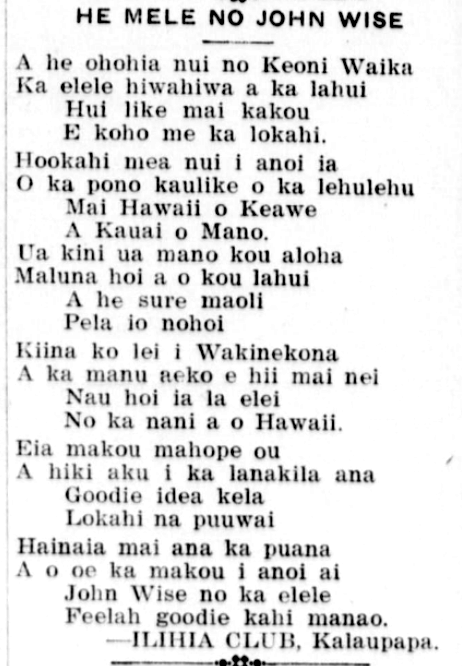
HE MELE NO JOHN WISE

A he ohohia nui no Keoni Waika
Ka elele hiwahiwa a ka lahui
Hui like mai kakou
E koho me ka lokahi.

Hookahi mea nui i anoi ia
O ka pono kaulike o ka lehulehu
Mai Hawaii o Keawe
A Kauai o Mano.

Ua kini ua mano kou aloha
Maluna hoi a o kou lahui
A he sure maoli
Pela io nohoi.

Kiina ko lei i Wakinekona
A ka manu aeko e hii mai nei
Nau hoi ia la elei
No ka nani a o Hawaii.

Eia makou mahope ou
A hiki aku i ka lanakila ana
Goodie idea kela
Lokahi na puuwai.

Hainaia mai ana ka puana
A o oe ka makou i anoi ai
John Wise no ka elele
Feelah goodie kahi manao.

—ILIHIA CLUB, Kalaupapa.

[Chronicling America only has newspapers up to 1922. I am not sure how much longer Hawaiian-Language articles appear in the Maui News, but it is pretty interesting to see that they did appear until at least 1922. Here is a political song written for Keoni Waika, the renaissance man, John Wise.]

(Maui News, 11/3/1922, p. 8)

HE MELE NO JOHN WISE

Semi-Weekly Maui News, 22nd. Year, Number 1215, Page 8. November 3, 1922.

Queen Liliuokalani, 1902.

SUPPORTS THE DELIVERER OF THE PEOPLE.

QUEEN LILIUOKALANI.

THE PICTURE ABOVE IS THE NEWEST OF QUEEN LILIUOKALANI, TAKEN RECENTLY BY MR. DAVEY, THE PHOTOGRAPHER OF THIS TOWN.

THE ROYAL AUNT LILIUOKALANI REVEALED HER THOUGHTS TO THE ALII KUHIO, SAYING: “IF YOU KNOW THAT THIS IS THE MEANS TO GAINING OUR WELL-BEING, THEN DO IT.”

(Kuokoa, 10/24/1902, p. 1)

KAKOO I KA HOOPAKELE O KA LAHUI.

Ka Nupepa Kuokoa, Buke XL, Helu 43, Aoao 1. Okatoba 24, 1902.

Political prisoners released by the Provisional Government, 1895.

Political Prisoners.

This past Thursday, Independence Day [La Kuokoa] and also Day of Thanksgiving to God for the deceitful ones, some political prisoners were released, they being W. H. Rickard [W. H. Rikada], T. B. Walker [T. B. Waka], Toma Pule, Kauai, D. Damien [D. Damiena], R. Palau, and Apelahama. As for the haole, after the two of them were read their pardons,  they were given the thanks of President Dole and some Hawaiians as well.¹ Some other political prisoners were no released, but perhaps will be released some time in the future.

¹See correction in comment below.

(Makaainana, 12/2/1895, p. 1)

Na Pio Kalaiaina.

Ka Makaainana, Buke IV—Ano Hou, Helu 23, Aoao 1. Dekemaba 2, 1895.

Mourning for the end of the Provisional Government? 1894.

Flags in Mourning.

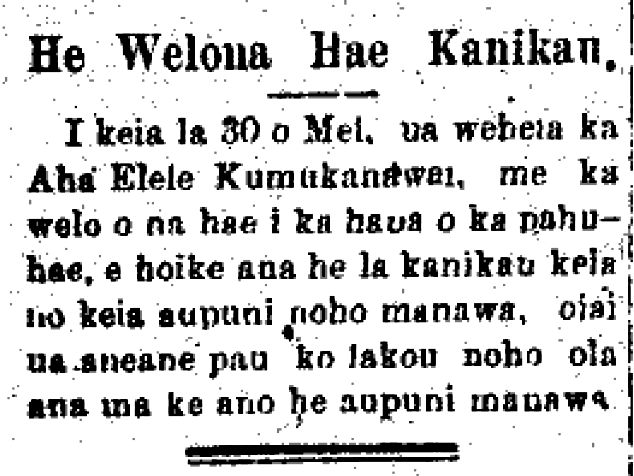
On this day, the 30th of May, the House of Representatives opened with flags at half staff, showing that this was a day of mourning for this provisional government, being that their life under this temporary government is almost at an end.

(Nupepa Ka Oiaio (puka pule), 6/1/1894, p. 2)

He Welona Hae Kanikau.

Nupepa Ka Oiaio (puka pule), Buke IV, Helu 22, Aoao 2. Iune 1, 1894.