Death of Stephen William Kekuewa, 1920.

THE REV. S. W. KEKUEWA PASSES ON

After being worn away by a debilitating illness for some time, the Rev. Stephen William Kekuewa grew weary of this life, at the home of his daughter, Mrs. John P. Kapua, on School Street, at four o’clock in the afternoon, on Wednesday of this past week; and in the afternoon of this past Sunday, his remains were carried to the Maemae Cemetery.

The Rev. S. W. Kekuewa was born at Luakaha, Nuuanu, on the 25th of February, 1842, therefore when he died he was over seventy-eight years old.

During his youth, he was educated at Lahainaluna School, under his teachers, S. E. Bishop and C. B. Andrews; and for some years he lived on the island of Micronesia on a mission he was sent on by the Hawaiian Evangelical Board [Papa Hawaii].

Because the health of his wife was not good, they returned to Hawaii nei, and he served as the kahu of the chruch at  Iole, Kohala, Hawaii for many years.

Because of the letter of the members of the church of Waianae which called for him to be the kahu of that church, he left the church of Kohala and went to live at Waianae; at that church he lived and worked until he was called by his Lord, and he went to his permanent home beyond. Continue reading

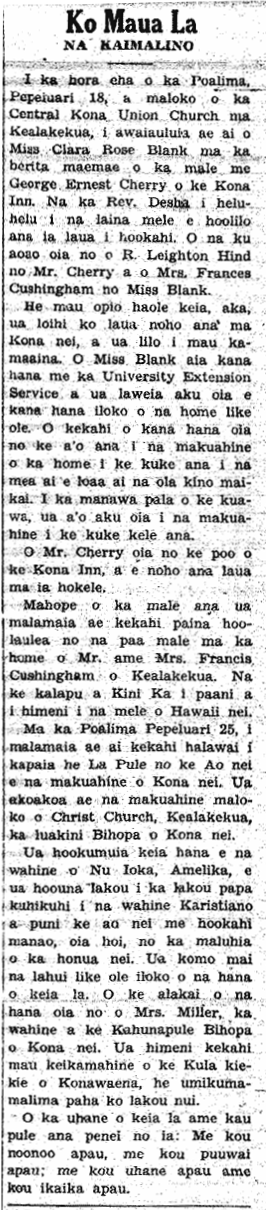
One more from the Deshas, 1944.

Our Day

THE CALM SEAS OF KONA

At four o’clock on Friday, February 18, and in the Central Kona Union Church, Miss Clara Rose Blank was joined in holy covenant of matrimony with George Ernest Cherry of Kona Inn. Rev. Desha read the lines of the mele which made the two of them into one. The attendants [ku aoao] were R. Leighton Hind for Mr. Cherry and Mrs. Frances Cushingham for Miss Blank.

These are haole youths, but they lived here in Kona for a long time, and have become kamaaina. Miss blank is working for the University Extension Service, and her work takes her into the different homes. One of her duties is to teach housewives how to cook nutritious foods. When guava is ripe, she taught the mothers how to make jelly.

Mr. Cherry is the head of Kona Inn, and they will live at the hotel.

 After the wedding a celebratory party was held for the married couple at the home of Mr. and Mrs. Francis Cushingham of Kealakekua. The club of Kini Ka played and sang the songs of Hawaii nei.

On Friday, February 25, a meeting was held called a Day of Prayer for the World by the mothers of Kona. The mothers gathered in Christ Church, Kealakekua, the Episcopal church of Kona nei.

This endeavor was begun by the women of New York, America, and they sent their program to Christian women all over the world who have the same thought, that is peace on earth. All the various ethnicities participated in the activities of the day. The leader of this exercise was Mrs. Miller the wife of the Episcopal pastor of Kona. Some girls of Kona Waena High School sang; there were perhaps eleven of them.

The spirit of the day and the prayer went like this: With all of your though, with all your heart, with all your soul, and with all your strength.

(Hoku o Hawaii, 3/8/1944, p. 2)

Ko Maua La

Ka Hoku o Hawaii, Volume XXXVIII, Number 46, Aoao 2. Maraki 8, 1944.

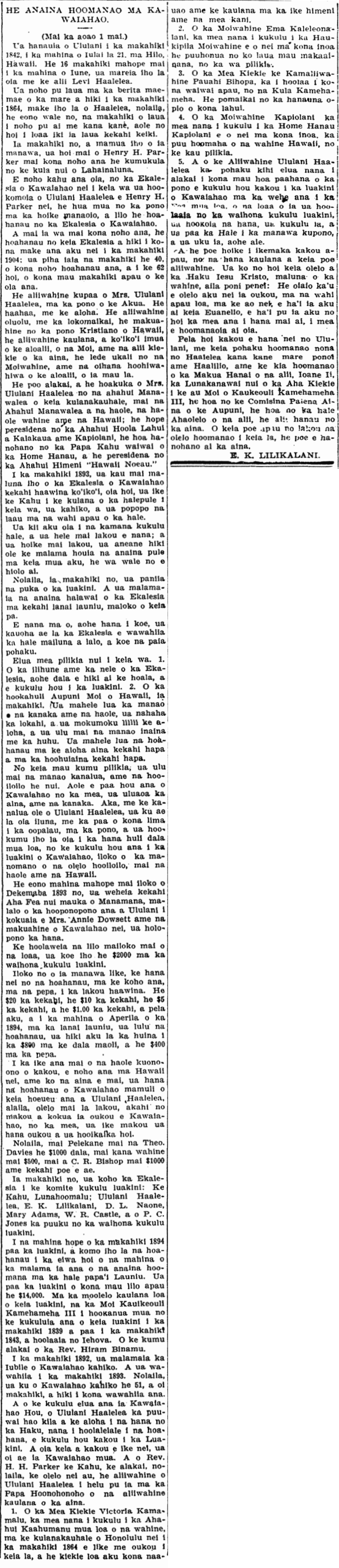
More on the commemorative tablets, but from the pen of Edward Kamakau Lilikalani himself, 1907.

COMMEMORATIVE SERVICE AT KAWAIAHAO

Memorial Tablets to the Alii of the Land are Unveiled.

This past Sunday the Kawaiahao Church was filled to listen to the commemorative program for John Ii, Haalilio, Haalelea, and Ululani; the people whose names are inscribed on the marble tablets placed in the church.

On the wall mauka at the pulpit of the pastor is where the marble tablet of John Ii is placed, and mauka of the central door to enter into the chapel [keena pule] is where the tablet of the last three names.

The Kaahumanu Society came in great numbers on this day, and one side of the church was filled with them, and there were many visitors who came to witness the events held on that day.

It was Rev. H. H. Parker who introduced the two that gave the speeches about the history of those who were being memorialized on that day, they being Rev. S. L. Desha and the Hon. E. K. Lilikalani.

Rev. S. L. Desha’s speech relied heavily upon his introductory words that morning about the woman who anointed the feet of Jesus, and just as the words of the Lord speaks of the actions of that woman becoming something remembered, in that same way Desha presented things about John Ii.

He spoke of the story of this man from his childhood, and he was one of the intelligent ones who gave great assistance in guiding the nation forward.

When the missionary teachers urged the King to educate him, he chose John Ii to be educated along with the younger brother of the King; this showed the King had much trust in this man.

In the administration of the nation, John Ii was the first amongst the Hawaiians who the King chose for an important post. When a commissioner was being chosen to give lands to the people, he was one who was selected, and he rose to the position of judge on the Supreme Court.

When the King received instruction from San Francisco to send someone from Hawaii to sit in the jury of that city pertaining to the crime committed by a Hawaiian [Harry Kaheleiki], it was indeed John Ii who the king chose to send to hear this case, and this man’s abilities and intelligence was seen through his actions.

In his attitude towards religion, he was a man who always stuck to what was right, and he gave sermons at the Church of Ewa. It is said that if it was heard that he was the one to be speaking, the church would be filled, and people stood outside, and on one Sunday when he went to go pray, when he was headed home, he fell from his horse and broke a rib, and that was his ailment which persisted until his death.

It is said in the history of this man, he was a man of strength, and the Alii were of great importance to him. As a result of an accident involving one of the Alii, that being the Alii falling from a horse, he did not wait to find out the cause of this distress to the Alii, but his outrage was focused upon the horse, and in his anger, with but one punch he struck the horse and it died.

After the words about John Ii was done, the Hon. E. K. Lilikalani stood and read the story of the second part of the events of that day, and we are printing what he presented for them, just as he read, and here it is below:

Whereas:—The second portion of the events of this day is the dedication of the commemorative tablet for Ululani and Haalelea which is affixed to the wall in front of this church.

This gift was not on account of just one person, but it is a present from the people. It is the members, intimates, and friends of the Kawaiahao Church showing the family of the ones who died their aloha and their never-ending remembrance of Ululani Haalelea.

The reason and the cause that this endeavor was carried out by the members and it was decided to place it here in this church of Kawaiahao:

Whereas, Ululani did a great deed for this church and its members, over a long period of time, during her lifetime, and she was a brethren of this Church.

With the auspices of the Church, along with this commemorative speech, will be attached the history of her life, her birth, her fine works, and the list of names of the intimates and friends who were involved, and will be gifted to the family of Ululani Haalelea here in Honolulu and in other places.

(See page 8.)

(Kuokoa, 10/18/1907, p. 1)

ANAINA HOOMANAO MA KAWAIAHAO

Ka Nupepa Kuokoa, Buke XLII, Helu 42, Aoao 1. Okatoba 18, 1907.

COMMEMORATIVE SERVICE AT KAWAIAHAO.

(From page 1.)

Ululani was born in they year 1842, in the month of July on the 21st, at Hilo, Hawaii. Sixteen years later, in the month of June, she was married to the alii, Levi Haalelea.

They lived in the holy covenant of matrimony until 1864, when Haalelea died; therefore, she only lived with her husband for six years, and they had not children.

In that very year, and a just before that time, Henry H. Parker came from his position as teacher at Lahainaluna College.

He was to serve as kahu of Kawaiahao Church, and it was then Ululani Haalelea was included into the church by this Henry H. Parker; she was the first fruit for righteousness in her confession of faith [hoike manaoio], and she became a member of the Kawaiahao Church.

And from then on she remained a member of the Church until her recent death in 1904; she was a member for 40 years, in her 62 years of life.

Mrs. Ululani Haalelea was a chiefess who was steadfast in the righteousness of God. She was humble with aloha. She was pleasant and benevolent, she was a mother for the Christian good in Hawaii, she was a famous chiefess and prominent among the Courts of the Monarchs, and the high chiefs of the land, she was an attendant of Queens, and held honored positions in the courts of those days.

Mrs. Ululani Haalelea was a leader and an adviser of the Beneficent association of this town, from the Beneficent Associations of the haole, to the haole women and to the Hawaiians; she was the vice president of the Ahahui Hoola Lahui of Kalakaua and Kapiolani, she was a distinguished member of the board of trustees of the Maternity Home, and a president of the Choir “Hawaii Noeau.”

In 1893, a difficult situation fell upon the membership of Kawaiahao, that being the Kahu realized the state of the church at that time; it was old and the wood all over the building was rotting.

He fetched carpenters and they came and looked; they said that shortly services could not be held in the near future; it was just a matter of time before it fell.

Therefore, that very year, the doors of the church were shut. And the meetings of the members were held in a coconut front lanai upon this grounds.

Looking on, there was nothing left to do; the members ordered the building be torn down from top to bottom, leaving only the stone walls.

There were two big problems at the time. 1. The poor and needy state of the Church; there was no money to reestablish and rebuild the church. 2. the overthrowing of the Monarchy of Hawaii that year. The thoughts of the Hawaiians and the haole were cleaved in two, the unity was broken, and aloha was broken into bits, and feelings of rage and anger grew. The church members were split in two with one group being patriots while the other group being for annexation.

Because of these problems, there grew many doubts and predictions of disaster. Kawaiahao would not be built anew for the land and the people were in turmoil. But Ululani Haalelea had no doubt, she stood up and holding a plow in her hand, in righteousness, and she set up the very first money-making event to rebuild Kawaiahao Church, among the many words of doom from the haole and Hawaiians alike.

Six months later, in December 1893, a great Fair [Aha Fea] was held in the uplands of Manamana, under the direction of Ululani assisted by Mrs. Annie Dowsett and the mothers of Kawaiahao, and the effort went smoothly.

Subtracting the expenses from the profits, what was left was $2000 in the funds to build the church.

At the same time, the members took action by figuring out on paper their donations. Some put $20, some $10, some $5, some $1.00, and so forth, and in the month of April of 1894, in the coconut frond lanai, the members gave their donations which totaled to $890 in cash, and $400 on paper.

When the wealthy haole amongst us living in Hawaii nei as well as in foreign lands saw that the members of Kawaiahao were taking action at the urging of Ululani Haalelea, they said, [“]We will now give you aid, O Kawaiahao, for we see that you are working and putting in great effort.[“]

Therefore, from Britain, from Theo. Davies, came $1000; from his wife $500; from C. R. Bishop $1000; and some others.

In that same year, the members chose a committee for the building of the church: The Kahu, Chairman; Ululani Haalelea, E. K. Lilikalani, D. L. Naone, Mary Adams, W. R. Castle, and P. C. Jones was the treasurer for the funds to build the church.

In the closing months of 1894, the church was completed, and the members entered after nine months of holding services in the Coconut frond  hut [hale papa’i Launiu]. The church was complete with the total expenses being $14,000. In the famous history of this church, it was King Kauikeaouli Kamehameha III who first set up the building of this church in the year 1839, and it was complete in 1843 and consecrated to Jehovah. Its head was Rev. Hiram Bingham [Rev. Hiram Binamu].

In 1892, the Jubilee of the old Kawaiahao was held. And it was torn down in 1893. Therefore the old Kawaiahao stood for 51 years before it was razed.

And in the reconstruction of the New Kawaiahao, Ululani Haalelea was the one with a steel heart of aloha in the works for the Lord who inspired the brethren, [“]Let’s rebuild the Church.[“] And this is what we see now, that it is better than the previous Kawaiahao. And Rev. H. H. Parker is the Kahu, the leader; therefore I say that Ululani Haalelea is a Chiefess who is ranked in the List of famous chiefesses of the land.

    1. Her Highness Victoria Kamamalu, was the one to establish the first Kaahumanu Society of women here in the town of Honolulu in 1864, just as you all on this day, and she was extremely intelligent and famous for her knowledge in singing and musical instruments.
    2. Queen Ema Kaleleonalani, was the one who established the Queen’s Hospital which is called by her name, a place of refuge for their [Queen Emma and Kamehameha IV] citizens in times of trouble.
    3. Her Highness, Princess Pauahi Bishop, dedicated all of her wealth for the Kamehameha Schools. A blessing for the generations of youth of her lahui.
    4. Queen Kapiolani was the one who established the Kapiolani Maternity Hospital called by her name, the place of rest for Hawaiian women for their periods of difficulty.
    5. And the Chiefess Ululani Haalelea, the second cornerstone, the one who lead her fellow laborers of good, [“]Let’s rebuild the Kawaiahao Church,[“] by establishing the first Fair [Fea], and the proceeds from it was dedicated to the funds for the construction of the church, and this was carried out, and it was built, and the Building was completed in time and paid off with no debt.

And we all are witnesses who see firsthand the famous works of these chiefesses. Those words of the Lord Jesus Christ about that woman who anointed him in oil were fulfilled: Verily I say unto you, Wheresoever this gospel shall be preached throughout the whole world, this also that she hath done shall be spoken of for a memorial of her.

In that way we are remembering Ululani, with this stone monument for her, for Haalelea, her own husband, and for Haalilio; along with the monument to the Hanai Parent of the chiefs, Ioane Ii, the great Judge of the Supreme Court during the reign of Kauikeaouli Kamehameha III,  a member of the National Boundary Commission, a member of the House of Nobles, and a native born chief. It was for all of them that the speeches of commemoration on this day were given, people who give pride to this land.

E. K. LILIKALANI.

[It is interesting to compare this account by E. K. Lilikalani with the account presented earlier in the PCA on 10/14/1907.]

(Kuokoa, 10/18/1907, p. 8)
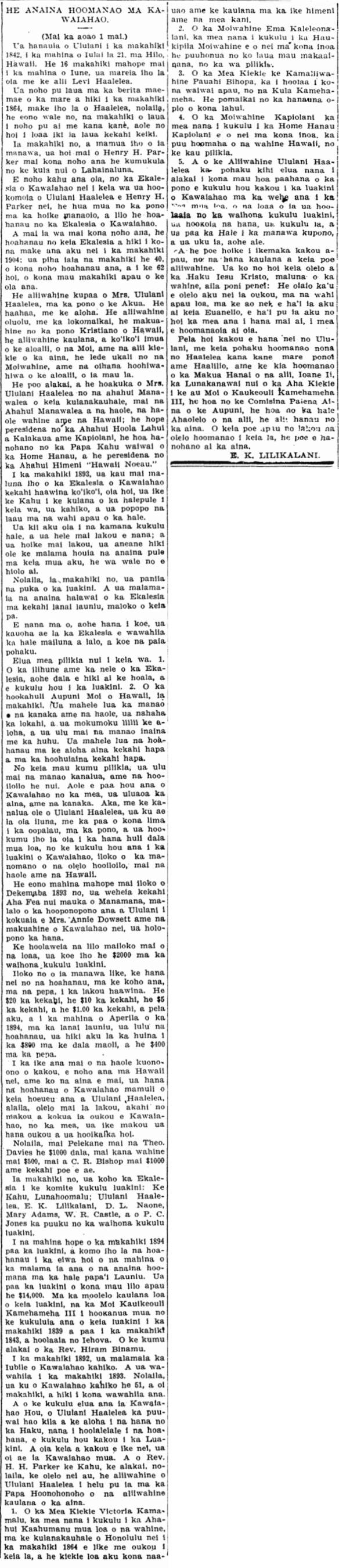
HE ANAINA HOOMANAO MA KAWAIAHAO.

Ka Nupepa Kuokoa, Buke XLII, Helu 42, Aoao 8. Okatoba 18, 1907.
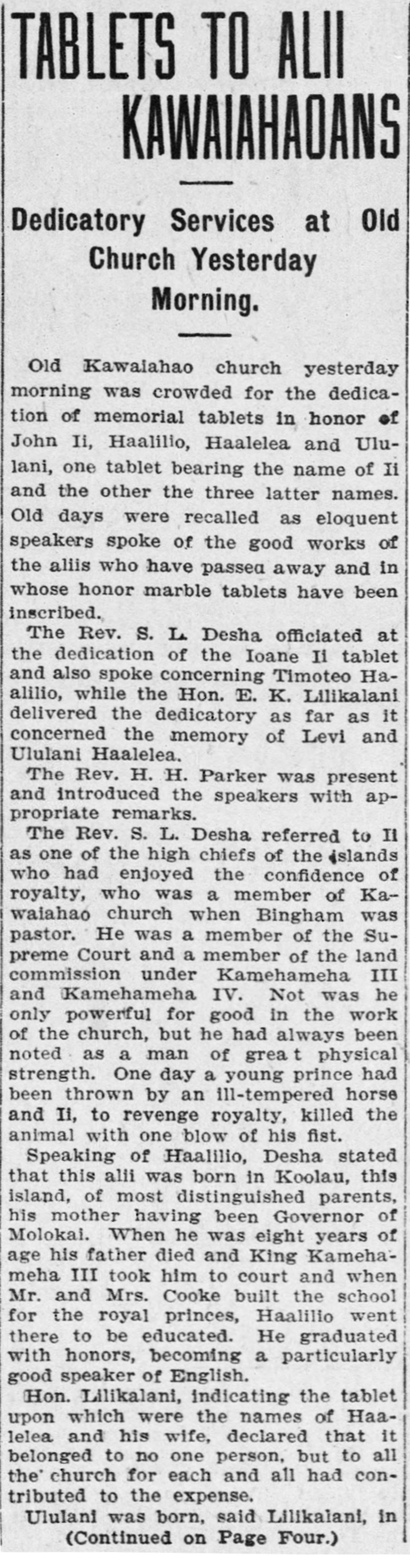
Memorial tablets in honor of John Papa Ii, Timoteo Haalilio, Levi Haalelea, and Ululani Haalelea, 1907.

TABLETS TO ALII KAWAIAHAOANS

Dedicatory Services at Old Church Yesterday Morning.

Old Kawaiahao church yesterday morning was crowded for the dedication of memorial tablets in honor of John Ii, Haalilio, Haalelea and Ululani, one tablet bearing the name of Ii and the other the three latter names. Old days were recalled as eloquent speakers spoke of the good works of the aliis who have passed away and in whose honor marble tablets have been inscribed.

The Rev. S. L. Desha officiated at the dedication of the Ioane Ii tablet and also spoke concerning Timoteo Haalilio, while the Hon. E. K. Lilikalani delivered the dedicatory as far as it concerned the memory of Levi and Ululani Haalelea.

The Rev. H. H. Parker was present and introduced the speakers with appropriate remarks.

The Rev. S. L. Desha referred to Ii as one of the high chieffs of the islands who had enjoyed the confidence of royalty, who was a member of Kawaiahao church when Bingham was pastor. He was a member of the Supreme Court and a member of the land commission under Kamehameha III and Kamehameha IV. Not was he only powerful for good in the work of the church, but he had always been noted as a man of great physical strength. One day a young prince had been thrown by an ill-tempered horse and Ii, to revenge royalty, killed the animal with one blow of his fist.

Speaking of Haalilio, Desha stated that this alii was born in Koolau, this island, of most distinguished parents, his mother having been Governor of Molokai. When he was eight years of age his father died and King Kamehameha III took him to court and when Mr. and Mrs. Cooke built the school for the royal princes, Haalilio went there to be educated. He graduated with honors, becoming a particularly good speaker of English.

Hon. Lilikalani, indicating the tablet upon which were the names of Haalelea and his wife, declared that it belonged to no one person, but to all the church for each and all had contributed to the expense.

Ululani was born, said Lilikalani, in…

(Continued on Page Four.)

(Pacific Commercial Advertiser, 10/14/1907, p. 1)

TABLETS TO ALII KAWAIAHAOANS

The Pacific Commercial Advertiser, Volume XLVI, Number 7857, Page 1. October 14, 1907.

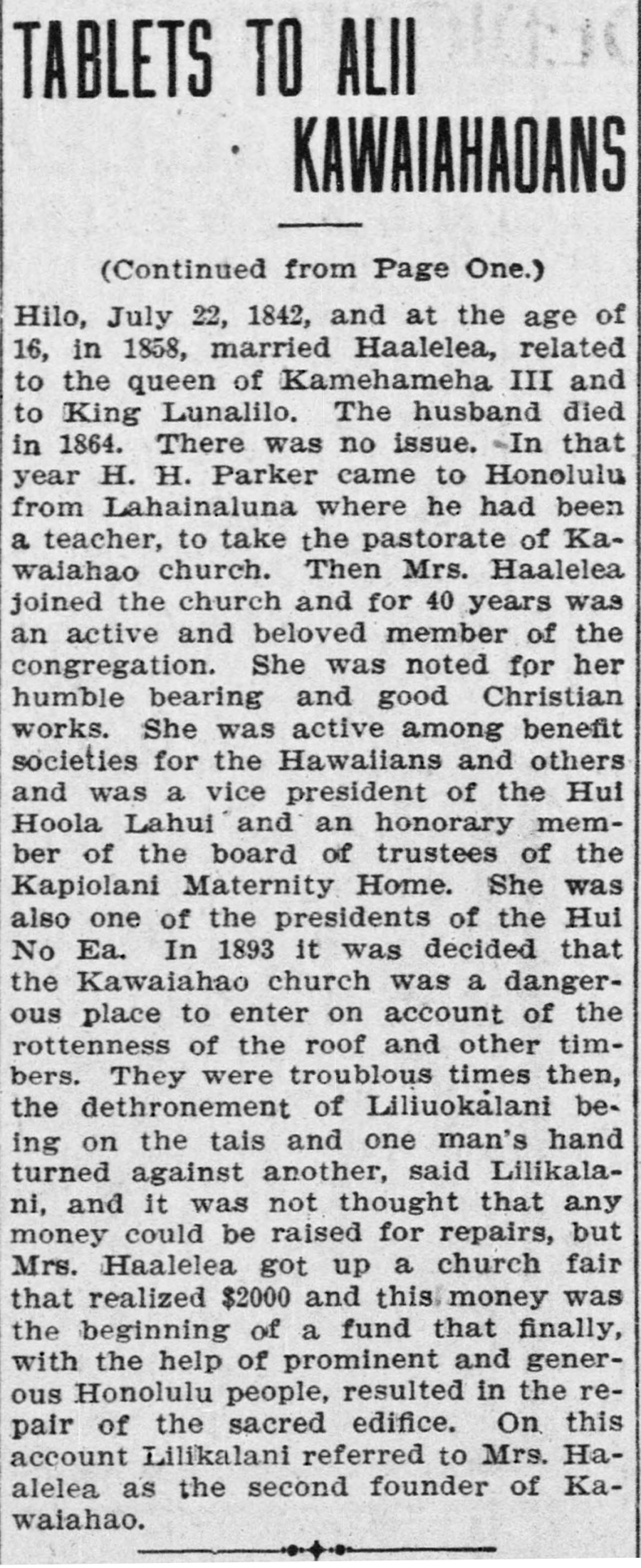
TABLETS TO ALII KAWAIAHAOANS

(Continued from Page One.)

Hilo, July 22, 1842, and at the age of 16, in 1858, married Haalelea, related to the queen of Kamehameha III and to King Lunalilo. The husband died in 1864. There was no issue. In that year H. H. Parker came to Honolulu from Lahainaluna where he had been a teacher, to take the pastorate of Kawaiahao church. Then Mrs. Haalelea joined the church and for 40 years was an active and beloved member of the congregation. She was noted for her humble bearing and good Christian works. She was active among benefit societies for the Hawaiians and others and was a vice president of the Hui Hoola Lahui and an honorary member of the board of trustees of the Kapiolani Maternity Home. She was also one of the presidents of the Hui No Ea. In 1893 it was decided that the Kawaiahao church was a dangerous place to enter on account of the rottenness of the roof and other timbers. They were troublous times then, the dethronement of Liliuokalani being the tais and one man’s hand turned against another, said Lilikalani, and it was not thought that any money could be raised for repairs, but Mrs. Haalelea got up a church fair that realized $2000 and this money was the beginning of a fund that finally, with the help of prominent and generous Honolulu people, resulted in the repair of the sacred edifice. On this account Lilikalani referred to Mrs. Haalelea as the second founder of Kawaiahao.

[Check out this article on the same topic found in one of the Hawaiian-Language Newspapers, written by E. K. Lilikalani himself!]

(Pacific Commercial Advertiser, 10/14/1907, p. 4)

TABLETS TO ALII KAWAIAHAOANS

The Pacific Commercial Advertiser, Volume XLVI, Number 7857, Page 4. October 14, 1907.

John Kaalouahi dies at Kalaupapa,1924.

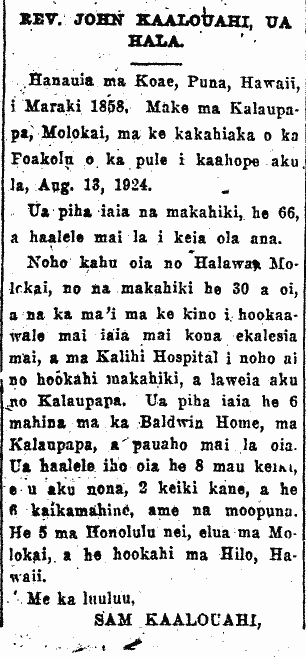
REV. JOHN KAALOUAHI HAS GONE.

He was born at Koae, Puna, Hawaii, in March 1858. He died at Kalaupapa, Molokai, on the morning of Wednesday of last week, Aug. 13, 1924.

He was 66 years old when he left behind this life.

He served as reverend for Halawa, Molokai for 30 or more years, and it was this sickness of body that took him away from his church, and he resided at Kalihi Hospital for one year and then was taken to Kalaupapa. He spent 6 months at Baldwin Home in Kalaupapa, and he passed away. He leaves behind 8 children who grieve for him, 2 boys and 6 girls, along with grandchildren. Five are here in Honolulu, two on Molokai, and one in Hilo, Hawaii.

With grief,

SAM KAALOUAHI.

(Kuokoa, 9/4/1924, p. 6)

REV. JOHN KAALOUAHI, UA HALA.

Ka Nupepa Kuokoa, Buke LXIII, Helu 36, Aoao 6. Sepatemaba 4, 1924.

More on Restoration Day, 1843.

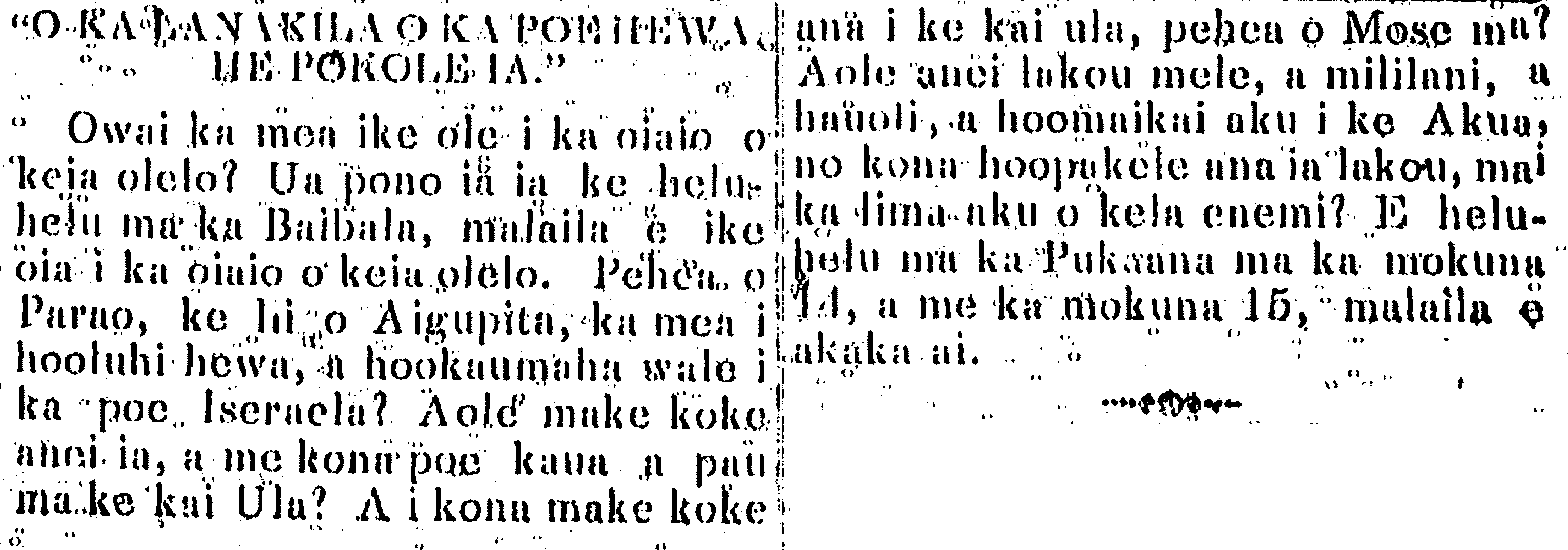
“THE VICTORY OF WRONGDOERS IS BUT FOR A MOMENT.”

Who does not know the truth of this statement? He must read the Bible; it is there that he will see the truth in this statement. What of Pharaoh [Parao], the ruler of Egypt [Aigupita], the one who overburdened and oppressed the Israelites? Did he not die at once, along with all of his warriors in the Red Sea? And with his quick death in the Red Sea, what happened to Moses and his people? Did they not sing, exalt, rejoice, and praise God for his saving them from the hands of their enemy? Read Exodus [Pukaana] chapter 14 and chapter 15, and there it will be clarified.

[Considering this particular outcome, this was quite a boost for Christianity.]

(Nonanona, 8/8/1843, p. 27)

"O KA LANAKILA O KA POE HEWA, HE POKOLE IA."

Ka Nonanona, Buke 3, Pepa 6, Aoao 27. Augate 8, 1843.

Alexander Kalei Kamahele and Mabel Kaholomoku Harvest wed, 1947.

Joined Together

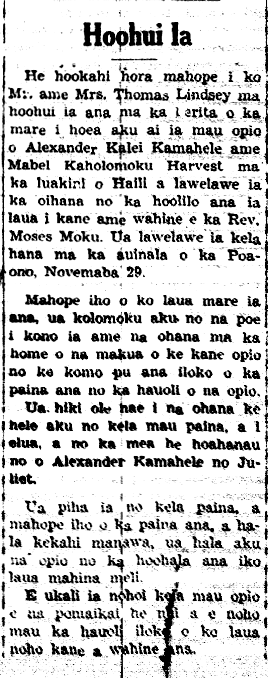
One hour following the joining of Mr. and Mrs. Thomas Lindsey¹ in the covenant of marriage, those youths, Alexander Kalei Kamahele and Mabel Kaholomoku Harvest appeared at Haili Church and the service to make them man and wife was carried out by Rev. Moses Moku. This act was carried out in the afternoon of November 29.

After they were married, those invited, and the ohana followed on [?? kolomoku] to the home of the parents of the young man to join in on the celebration of the happiness of the young ones.

The family could not attend both of the parties, because Alexander Kamahele is a cousin of Juliet’s.

The party was filled, and after the celebrating, and after some time, the youths left to spend their honeymoon [mahina meli].

May these young ones be accompanied by much good fortune, and may happiness reside with them living as man and wife.

¹Juliet Nathaniel and Thomas Milimili Lindsey

(Hoku o Hawaii, 12/3/1947, p. 1)

Hoohui Ia

Ka Hoku o Hawaii, Volume XLI, Number 14, Aoao 1. Dekemaba 3, 1947.

Belina Elizabeth, Sacred Hearts teacher passes on, 1894.

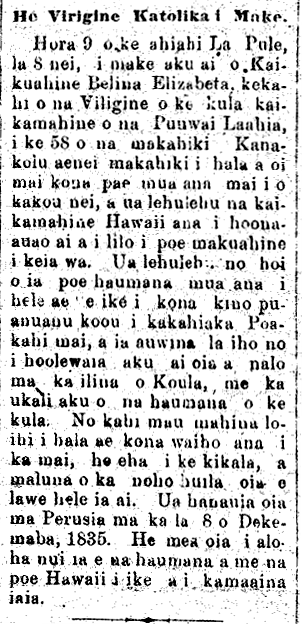
A Catholic Nun Dies.

At 9 o’clock in the evening on this past Sunday, the 8th, Sister Belina Elizabeth, one of the Nuns [Viligine] at Sacred Hearts girls’ school, at 58 years old. It was thirty or more years ago that she first landed here amongst us, and there have been numerous Hawaiian girls who were taught by her and who have become mothers today. And many of those early students of hers came to see her cold, clammy [i am sure there is a much better image for “koou”!] remains in the morning of the following Monday, and that evening, her funeral was held, and at the Koula Cemetery she was no more to be seen, accompanied by the students of the school. For many months she was ill with pains in her hip, and she was taken around on a wheelchair [noho huila]. She was born in Persia [Perusia] on the 8th of December, 1835. She was greatly beloved by the students, and by the Hawaiians who knew her and were close to her.

(Makaainana, 4/16/1894, p. 1)

He Virigine Katolika i Make.

Ka Makaainana, Buke I—-Ano Hou, Helu 16, Aoao 1. Aperila 16, 1894.


St. Andrew’s, the early days, 1909.

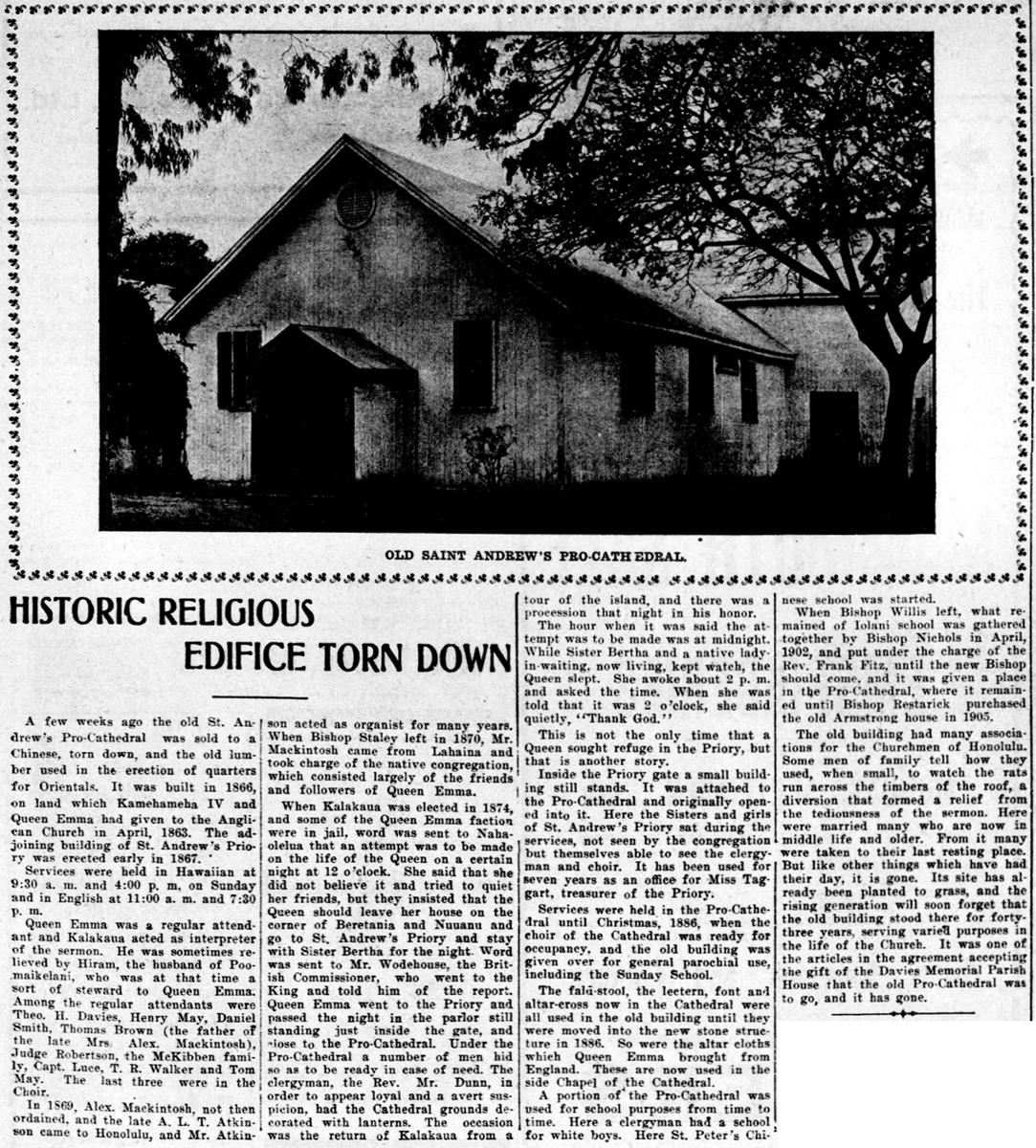
OLD SAINT ANDREW’S PRO-CATHEDRAL.

RELIGIOUS EDIFICE TORN DOWN

A few weeks ago the old St. Andrew’s Pro-Cathedral was sold to a Chinese, torn down, and the old lumber used in the erection of quarters for Orientals. It was built in 1866, on land which Kamehameha IV and Queen Emma had given to the Anglican Church in April 1863. The adjoining building of St. Andrew’s Priory was erected in 1867.

Services were held in Hawaiian at 9:30 a. m. and 4:00 p. m. on Sunday and in English at 11:00 a. m. and 7:30 p. m.

Queen Emma was a regular attendant and Kalakaua acted as interpreter of the sermon. He was sometimes relieved by Hiram, the husband of Poomaikelani, who was at that time a sort of steward to Queen Emma. Among the regular attendants were Theo. H. Davies, Henry May, Daniel Smith, Thomas Brown (the father of the late Mrs. Alex. McKintosh), Judge Robertson, the McKibben family, Capt. Luce, T. R. Walker and Tom May. The last three were in the Choir.

In 1869, Alex. Mackintosh, not then ordained, and the late A. L. T. Atkinson came to Honolulu, and Mr. Atkinson acted as organist for many years. When Bishop Staley left in 1870, Mr. Mackintosh came from Lahaina and took charge of the native congregation, which consisted largely of the friends and followers of Queen Emma.

When Kalakaua was elected in 1874, and some of the Queen Emma faction were in jail, word was sent to Nahaolelua that an attempt was to be made on the life of the Queen on a certain night at 12 o’clock. She said that she did not believe it and tried to quiet her friends, but they insisted that the Queen should leave her house on the corner of Beretania and Nuuanu and go to St. Andrew’s Priory and stay with Sister Bertha for the night. Word was sent to Mr. Wodehouse, the British Commissioner, who went to the King and told him of the report. Queen Emma went to the Priory and passed the night in the parlor still standing just inside the gate, and close to the Pro-Cathedral. Under the Pro-Cathedral a number of men hid so as to be ready in case of need. The clergyman, the Rev. Mr. Dunn, in order to appear loyal and a avert suspicion, had the Cathedral grounds decorated with lanterns. The occasion was the return of Kalakaua from a tour of the island, and there was a procession that night in his honor.

The hour when it was said the attempt was to be made was at midnight. While Sister Bertha and a native lady-in-waiting, now living, kept watch, the Queen slept. She awoke about 2 p. m. and asked the time. When she was told that it was 2 o’clock, she said quietly, “Thank God.”

This is not the only time that a Queen sought refuge in the Priory, but that is another story.

Inside the Priory gate a small building still stands. It was attached to the Pro-Cathedral and originally opened into it. Here the Sisters and girls of St. Andrew’s Priory sat during the services, not seen by the congregation but themselves able to see the clergyman and choir. It has been used for seven years as an office for Miss Taggart, treasurer of the Priory.

Services were held in the Pro-Cathedral until Christmas, 1886, when the choir of the Cathedral was ready for occupancy, and the old building was given over for general parochial use, including the Sunday School.

The fald-stool, the lectern, font and altar-cross now in the Cathedral were all used in the old building until they were moved into the new stone structure in 1886. So were the altar cloths which Queen Emma brought from England. These are now used in the side Chapel of the Cathedral.

A portion of the Pro-Cathedral was used for school purposes from time to time. Here a clergyman had a school for white boys. Here St. Peter’s Chinese school was started.

When Bishop Willis left, what remained of Iolani school was gathered together by Bishop Nichols in April, 1902, and put under the charge of the Rev. Frank Fitz, until the new Bishop should come, and it was given a place in the Pro-Cathedral, where it remained until Bishop Restarick purchased the old Armstrong house in 1905.

The old building had many associations for the Churchmen of Honolulu. Some men of family tell how they used, when small, to watch the rats run across the timbers of the roof, a diversion that formed a relief from the tediousness of the sermon. Here were married many who are now in middle life and older. From it many were taken to their last resting place. But like other things which have had their day, it is gone. Its site has already been planted to grass, and the rising generation will soon forget that the old building stood there for forty-three years, serving varied purposes in the life of the Church. It was one of the articles in the agreement accepting the gift of the Davies Memorial Parish House that the old Pro-Cathedral was to go, and it has gone.

(Pacific Commercial Advertiser, 9/18/1909, p. 3)

HISTORIC RELIGIOUS EDIFICE TORN DOWN

The Pacific Commercial Advertiser, Volume L, Number 8459, Page 3. September 18, 1909.

Alatau Tamchiboulac Atkinson, organist for Kawaiahao Church, 1873.

[Found under: “NA MEA HOU KULOKO.”]

Mr. A. T. Atkinson has been made the organist [hookani ogana] for the Kawaiahao Church, and beginning this week, he will perform alone for the first time.

[This is just a tiny episode in the amazing life of Alatau Atkinson. There will be a talk on his life given by visiting author and journalist Nick Fielding at the Center for Biographical Research, UH Manoa today from noon to 1:15 at Henke Hall!]

(Au Okoa, 1/23/1873, p. 3)

Ua hooliloia iho nei...

Ke Au Okoa, Buke VIII, Helu 41, Aoao 3. Ianuari 23, 1873.