Renovation of Kawaiahao Cemetery, 1867.

[Found under: “LOCAL NEWS”]

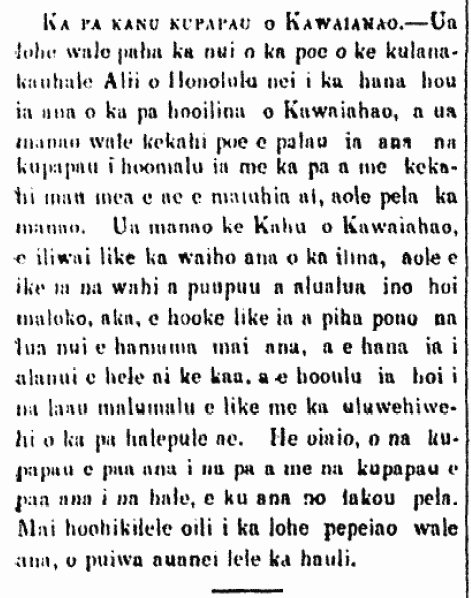
Graveyard of Kawaiahao.—Most of the people of the Capital City of Honolulu have perhaps heard that the cemetery of Kawaiahao is being renovated, and some people have imagined that the bodies laid there to rest, along with the yard and other things at peace there will be plowed up, but this is not the case. The Kahu of Kawaiahao wants to flatten out the graveyard so that there are no humps or holes, to flatten out and fill in the depressions that lay open, and also to make a road for carts to travel on, and to grow shade trees like the greenery of other church yards. It is the truth, the bodies that lay in the yard and the bodies in the crypts will remain as is. Don’t get worked up over what you hear, lest you be shocked.

(Kuokoa, 4/27/1867, p. 3)

Ka pa kanu kupapau o Kawaiahao...

Ka Nupepa Kuokoa, Buke VI, helu 17, Aoao 3. Aperila 27, 1867.

More on Orramel Gulick, 1874.

[Found under: “Local News”]

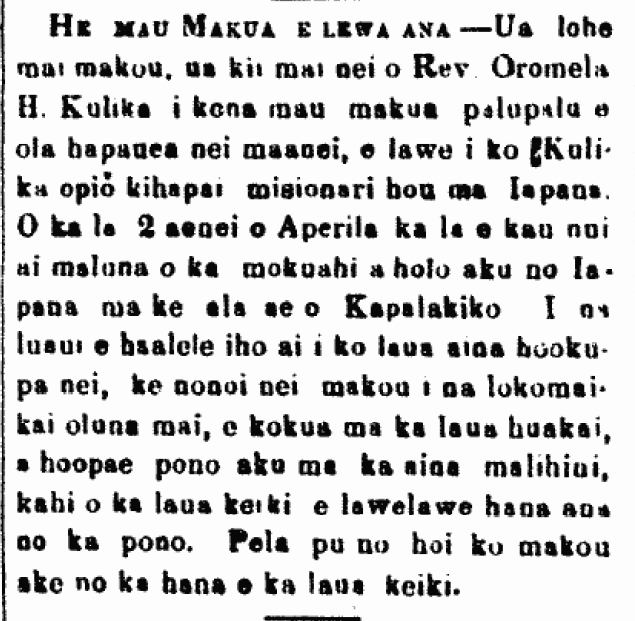
Parents will be voyaging—We hear that Rev. Orramel H. Gulick came to get his weak parents [Peter Johnson Gulick and Fanny Hinckley Thomas Gulick] living here in a feeble state to take them to the young Gulick’s [Luther Halsey Gulick] new missionary parish in Japan.It is on the coming 2nd of April that they will all board the steamship to make their journey to Japan by way of San Francisco. To his parents who are leaving this land which they grew accustomed, we hope for blessings from above, to help them on their journey, and to give them safe landing at this foreign land, where their child works for righteousness. So too is our hopes for the endeavors of their child.

[For more on Orramel Hinckley Gulick, see also: The Pilgrims of Hawaii, by Rev. and Mrs. Orramel Hinckley Gulick (1918).]

(Kuokoa, 3/14/1874, p. 2)

He mau Makua e lewa ana...

Ka Nupepa Kuokoa, Buke XIII, Helu 11, Aoao 2. Maraki 14, 1874.

How sad it must be to be denied marriage to someone you love, 1902/2012.

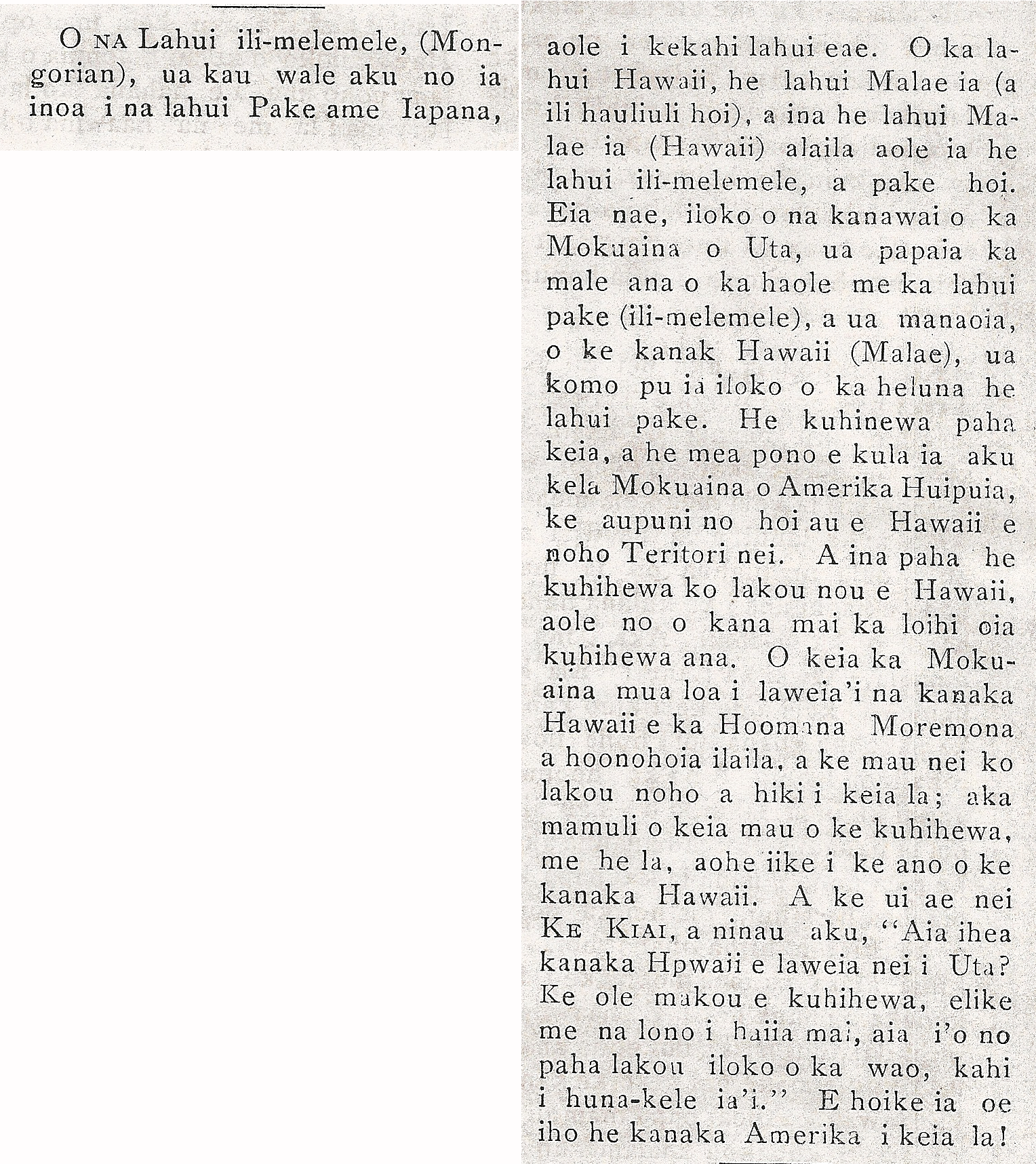
THE yellow-skinned races (Mongolian), include the Chinese and Japanese, and not other lahui. The Hawaiian Race is of the Malae race (the brown-skinned), and if the Hawaiians are Malae, then they are not yellow-skinned, or Chinese. And yet, under the law of the state o Utah, haole are not allowed to marry Chinese (yellow-skins), and it is believed that Hawaiians (Malae) are included amongst the Chinese. This is perhaps a mistake, and that state of the United States needs to be educated of the nation in which you live as a Territory. And if they are mistaken about you, O Hawaii, this error is incredibly long standing. This is the first state to which Hawaiians were brought by the Mormon Faith to live, and they are still there to this day; but because of this continued misunderstanding, it is as if they do not know the nature of Hawaiians. The Kiai questions and asks, “Where in Utah are Hawaiians being taken? If we are not mistaken, and according to what is reported, they are perhaps in the desert, where they are hidden away.” Reveal yourself to be an American today!

(Kiai, 9/11/1902, p. 1)

O NA Lahui ili-melemele...

Ke Kiai, Buke 1, Helu 3, Aoao 1. Sepatemaba 11, 1902.

Six blind men and an elephant, 1867.

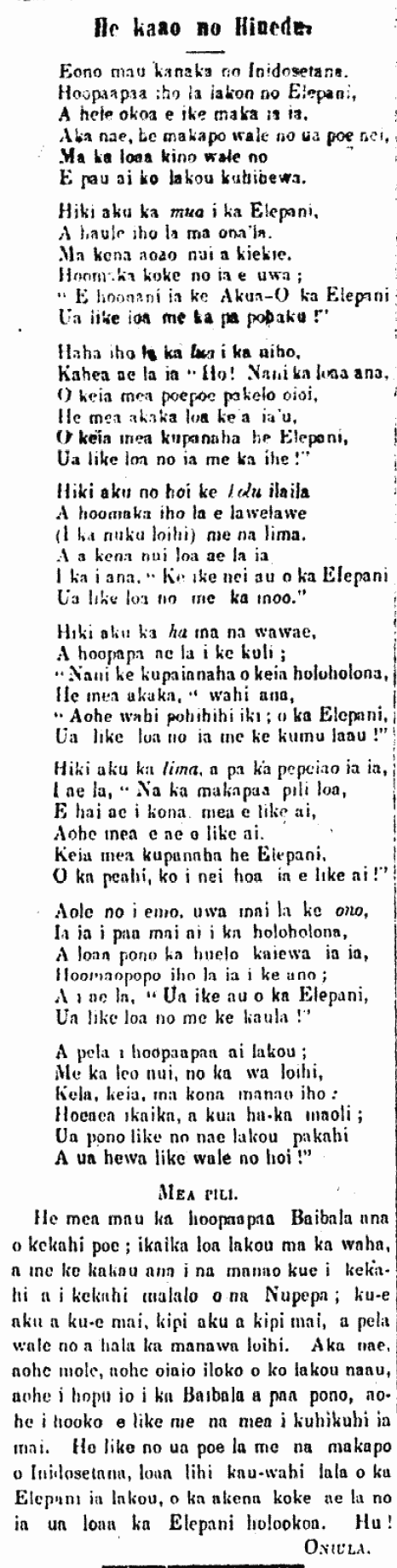
A TALE FROM HINDU.

[The story of the blind men who feel different parts of an elephant and give their varied impressions of what an elephant is, comes from India. But it was adapted into the poem “The Blind Men and the Elephant” by American, John Godfrey Saxe. This poem is then interpreted into Hawaiian in 1867 by Oniula, who submits many translations of foreign tales. The Saxe version can be found readily online…]

. . .

How it is related.

Some people constantly argue over the Bible; they are very outspoken, and write forcefully in the Newspapers, contradicting this person or that; arguing back and forth, conspiring back and forth, over long periods of time. However, there is no basis, no truth in their hearts; they don’t grasp the Bible firmly; they don’t do as they say. Those people are like the blind men of Indostan; they know just a small appendage of the Elephant, and then they boast that they know the whole Elephant. Hu!

Oniula.

(Kuokoa, 2/2/1867, p. 4)

He kaao no Hinedu.

Ka Nupepa Kuokoa, Buke VI, Helu 5, Aoao 4. Feberuari 2, 1867.

Early Consolidated Amusement and movies on Sundays, 1915.

ASKED FOR APPROVAL TO SHOW MOVIES.

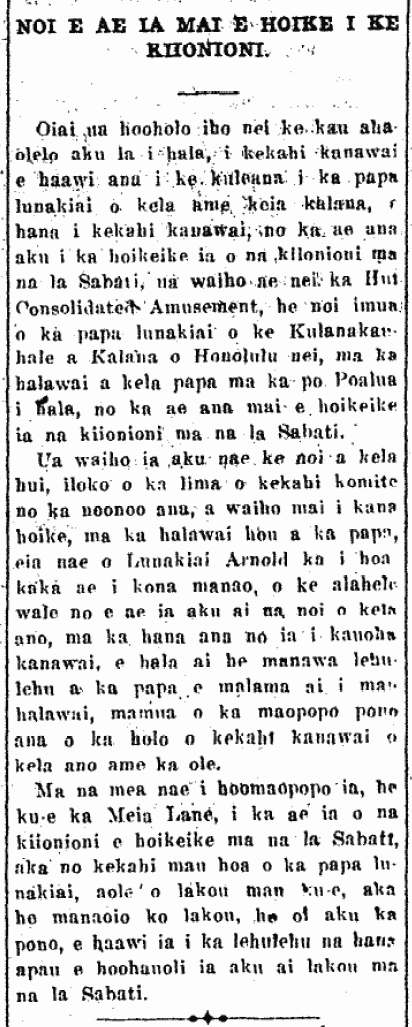
Being that a law was passed in this past legislative session giving the responsibility to the board of supervisors of each county to make laws to approve showing movies on the Sabbath; the Consolidated Amusement Company put a request before the board of supervisors of the City and County of Honolulu at the meeting of that board on this past Tuesday night, to ask for approval to show movies on Sundays.

But the request by that company was placed in the hands of a committee to consider, and to give its findings at the next meeting of the board; however Supervisor Arnold made his opinion clear that the only means by which those sorts of requests will be approved is by making an announcement of the law for which the board will spend much time holding meetings, before it is clear whether or not a law of that kind will pass or not.

From what is understood, Mayor Lane opposes the approval of movies being shown on Sunday, but some of the board members do not disapprove, but they believe that it is more important to give to the public all things that will make them happy on Sundays.

[Consolidated was entertaining Hawaii before 1917? That classic movie trailer we all are familiar with: Consolidated Amusement.]

(Kuokoa, 5/14/1915, p. 5)

NOI E AE IA MAI E HOIKE I KE KIIONIONI.

Ka Nupepa Kuokoa, Buke LIII, Helu 20, Aoao 5. Mei 14, 1915.

On the trail of the Japanese New Testament gifted to Kalakaua, 2011.

[So i am still looking for that Bible given at the Yokohama Union Church to King Kalakaua, when he visited there in 1881. Check out these other articles found in The Friend]

HIS MAJESTY IN JAPAN.

And the other article referred to therein,

Cast Thy Bread upon the Waters and Thou Shalt find it after Many Days.

Liliuokalani plays the first organ at Kawaiahao Church, 1867.

First Playing of the Organ of Kawaiahao Church.

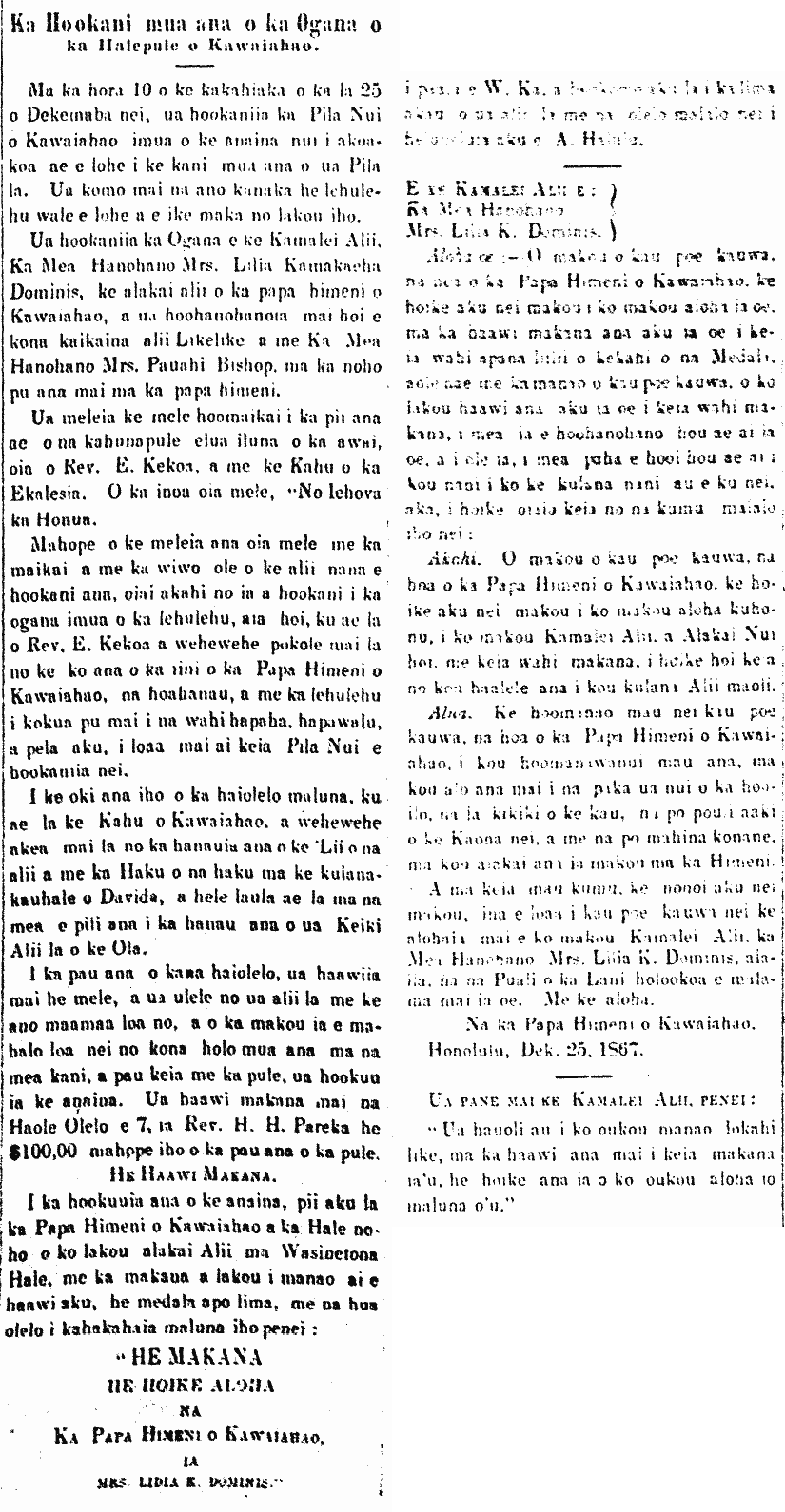
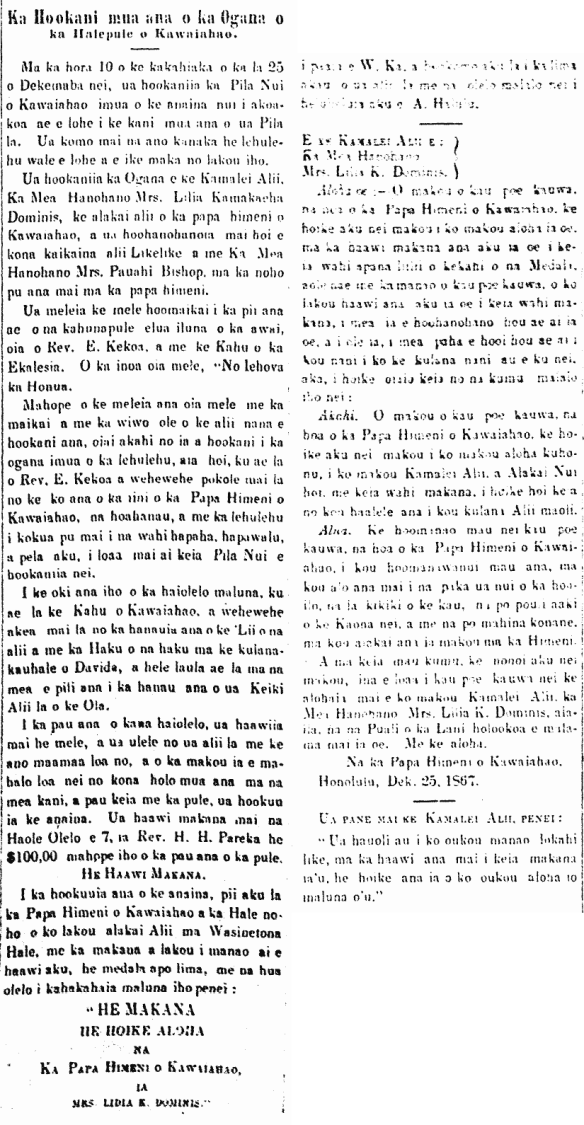
At 10 in the morning of the 25th of December, the great musical instrument of Kawaiahao was played before the great crowd who gathered there to hear it being played for the first time. A great assortment of people came to hear and to see for themselves.

The Organ was played by the Princess, the Honorable Mrs. Lilia Kamakaeha Dominis, the royal leader of the Kawaiahao choir, and she was honored by her royal younger sister, Likelike, as well as the Honorable Mrs. Pauahi Bishop, who sat in the choir.

A song of gratitude was sung while the two pastors walked up to the pulpit, they being the Rev. E. Kekoa and the Kahu of the Church. The name of the hymn was “No Iehova ka Honua.”

After the singing of the hymn, nicely and fearlessly by the royal one who performed it, albeit this was the first time she played the organ before a crowd; then Rev. E. Kekoa stood and explained briefly the fulfilling of the dream of the Kawaiahao Choir, the church members, and the public, who helped with their 25¢ and their 12½¢ so that we could have this Great Instrument which is being played.

At the closing of this speech above, the Kahu of Kawaiahao stood and explained to all the birth of the King of kings, and the Lord of lords in the city of David, and expanded on things related to the birth of that Prince of Life.

At the conclusion of his speech, a hymn was given, and that alii lept into action, like she was very accustomed to it; and we are greatly appreciative for her advancement in musical instruments; and this was followed by a prayer, and then the congregation was released. The 7 foreign language speaking haole [?] gifted to Rev. H. H. Parker, $100.00 after the end of the prayer.

PRESENTING OF A GIFT.

After the congregation was let go, the Kawaiahao Choir went up to the Residence of their royal leader, to Washington Place, with a gift they wanted to present to her, a medal [?] bracelet with words engraved upon it, thusly:

“A GIFT
AN EXPRESSION OF ALOHA
BY
The Kawaiahao Choir
TO
MRS. LIDIA K. DOMINIS.”

which was [….] by W. Ka, and it was placed on the right hand of that royal one with the words below [….] by A. H[…..].

O Princess:
The Honorable
Mrs. Lilia K. Dominis.

Aloha oe:—We are your servants, the members of the Kawaiahao Choir, we show our aloha for you by presenting you with this gift of a small part of a Medal [?]; but it is not with thoughts of your servants, that their giving you this gift is something that should give you more honor, or that perhaps it will increase your already beautiful nature, but as a true expression of the things below:

One. We, your servants, the members of the Kawaiahao Choir, show our deep aloha to our Princess, and our Leader, with this small gift, as a symbol for your leaving your true Alii status [?]

Two. Your servants, the members of the Kawaiahao Choir, constantly think of your everlasting patience as you face the heavy rains of the winter, the scorching sun of the summer, the pitch dark nights of Town, and the bright moonlit nights, as you lead us in our Hymns.

And for these reasons, we ask of you, should your servants have the aloha of our Princess, the Honorable Mrs. Lilia K. Dominis, then let the Army of the wide Heavens watch over you. With aloha.

The Kawaiahao Choir.

Honolulu, Dec. 25, 1867.

—————

The Princess Replied Like This:

“I am joyful at your combined thought in gifting me with this present; it is a symbol of your true love for me.”

(Kuokoa, 12/28/1867, p. 3)
Ka Hookani mua ana o ka Ogana o ka Halepule o Kawaiahao.

Ka Nupepa Kuokoa, Buke VI, Helu 52, Aoao 3. Dekemaba 28, 1867.