Timoteo Haalilio, 1845.

SOME THINGS PERTAINING TO HAALILIO.

Koolau, Oahu, was where he was born; his parents were prominent people. His father died when he was a youth, and thereafter his mother (that being Eseka who is still living) became Governor of Molokai. When he was 8 years old, he joined the family of the King, Kamehameha III, and lived with them. They were at Hilo at this time. When he was 13, Haalilio entered the school of Bingham [Binamu] in Honolulu, and he studied English and…

(Elele, 4/25/1845, p. 13)

Elele_4_25_1845_13.png

Ka Elele, Buke I, Pepa 2, Aoao 13, Aperila 25, 1845.

Continue reading

Passing of Mrs. Kauhane Kanahele, 1922.

MRS. KAUHANE KANAHELE HAS GONE.

MRS. KAUHANE KANAHELE.

O Mr. Editor:—Please give me some open space of your paper, so that the fellows and friends will know that Mrs. Kauhane Kanahele has left this life.

For many months past she was wasting away with sickness, and a cure was sought in any way that would keep her alive; however, because of the strength of the sickness which she suffered, the silver thread was severed, and the bucket at the spring was smashed, and she went to sleep the sleep of all seasons; and it is with great sorrow and endless aloha that I grieve for her.

Mrs. Kauhane Kanahele was born at Keei, South Kona, Hawaii, in the month of May, 1864. There were two of them, two girls from the same loins; her elder sister died first, that being Mrs. Oneha. She married a man earlier in her youth, and from the two of them there are two children surviving; a son in America, and a daughter living with her many children. Continue reading

Makawao Union Church comes to an end, 1916.

Memories Awakened By Passing Of Old Church

June 25th was a memorable day at the Makawao Union Church of Paia because it was the last Sunday during which religious services were to be held previous to the dismantling of the building.

The exercises were especially marked by a beautiful solo by Mrs. Jones, and an interesting sermon of a semi-historical nature, entitled—”The Passing of the Old Church”, by Rev. A. C. Bowdish.

The first building of the church was a small wooden structure at Makawao on the site now occupied by the cemetery. The change of location was made to the present situation for two reasons, first because of the shifting of the center of the district’s population and second because of the present position marks the place where the late Mr. H. P. Baldwin nearly lost his life. Continue reading

Great choral competition a hundred years ago, 1916.

SONG CONTEST

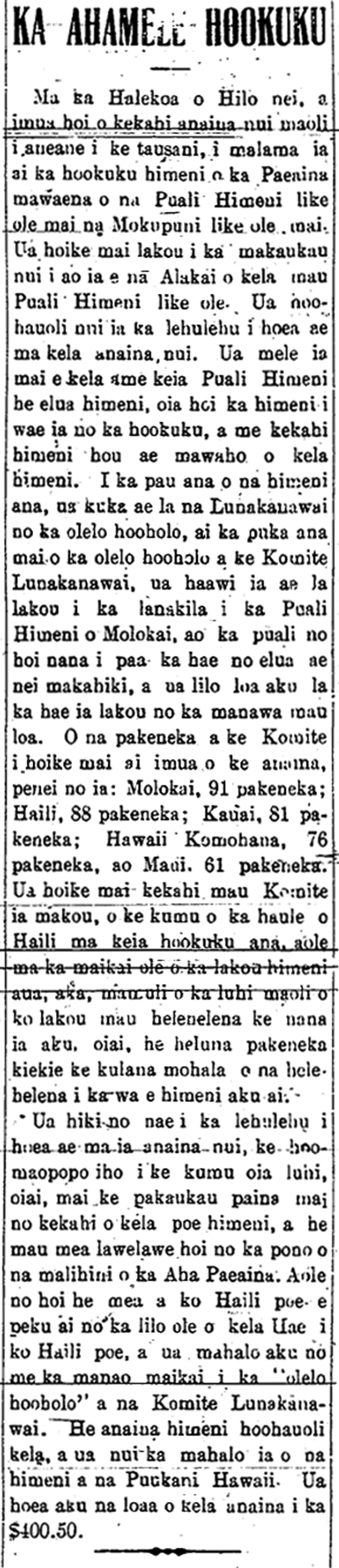
At the Hilo Armory [Halekoa o Hilo], before a truly huge audience reaching nearly a thousand people, an Archipelago-wide song contest between different Choirs [Puali Himeni] from the different Islands was held. They showed their great proficiency taught to them by the Leaders of the different Choirs. The crowd who attended this big gathering was really entertained. Each group sang two songs, that being the song chosen for the competition and another outside of that song. After the singing, the Judges conferred over the decision, and when the decision of the Judging Committee was announced, they gave the championship to the Choir of Molokai, the group that took the banner for the two previous years, and the banner went to them for all times. The percentages announced by the Committee before the crowd was this: Molokai, 91 percent; Haili, 88 percent; Kauai, 81 percent; West Hawaii, 76 percent; and Maui, 61 percent. Some of the Committee told us that the reason Haili lost the competition was not because their singing was not fine, but because of the apparent exhaustion on their faces, being that good appearance while singing is a big part of the scoring.

The crowd that came in the large audience could understand the reason for that exhaustion, being that some of those singers came from the banquet table, and they were attendants for the guests of the Hawaiian Evangelical Conference [Aha Paeaina]. That the banner was not taken by those of Haili is not something to kick them for, and the decision of the Judging Committee was appreciated with good feelings. This was an entertaining concert, and the performances of the Hawaiian Singers was much appreciated. The proceeds from that gathering was $400.50.

(Hoku o Hawaii, 7/13/1916, p. 2)

HokuoHawaii_7_13_1916_2.png

Ka Hoku o Hawaii,  Buke 11, Helu 6, Aoao 2. Iulai 13, 1916.

Wife of Rev. Adam Pali dies, 1903.

Mrs. Lilia Paaoao Pali has Passed on.

Lahaina, April 4th, 1903.

O Greatest one of the People, the Kuokoa. Please insert in an empty space of your konane board, the words appearing above, and it will be you that announces to the friends and companions of that Mrs. Lilia Paaoao Pali has died and has gone on the companionless path.

On the 28th of March, 1903, at the hour of 5:30 p. m., the great dread of the world arrived like a thief in the night, and swiftly took the living breath of the greatly loved mother.

Lilia Paaoao Pali was born of the loins of S. Poholopu and Nahooikaika (f) at Lahaina, Maui, in 1845. Her days in this world number 58 years and some months. Continue reading

Adam Pali dies, 1903.

[From: “LAHAINA LINES.”]

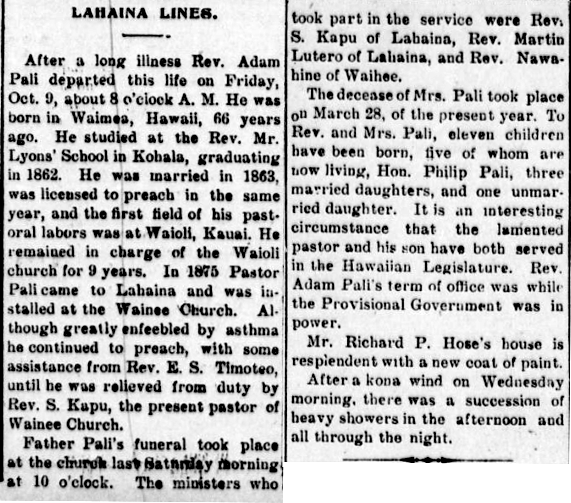
After a long illness Rev. Adam Pali departed this life on Friday, Oct. 9, about 8 o’clock A. M. He was born in Waimea, Hawaii, 66 years ago. He studied at the Rev. Mr. Lyons’ School in Kohala, graduating in 1862. He was married in 1863, was licensed to preach in the same year, and the first field of his pastoral labors was a Waioli, Kauai. He remained in charge of the Waioli church for 9 years. In 1875 Pastor Pali came to Lahaina and was installed at the Wainee Church. Although greatly enfeebled by asthma he continued to preach, with some assistance from Rev. E. S. Timoteo, until he was relieved from duty by Rev. S. Kapu, the present pastor of Wainee Church.

Father Pali’s funeral took place at the church last Saturday morning at 10 o’clock. the minister who took part in the service were Rev. S. Kapu of Lahaina, Rev. Martin Lutero of Lahaina, and Rev. Nawahine of Waihee.

The decease of Mrs. Pali took palce on March 28, of the present year. To Rev. and Mrs. Pali, eleven children have been born, five of whom are now living, Hon. Pilip Pali, three married daughters, and one unmarried daughter. It is an interesting circumstance that the lamented pastor and his son havve both served in the Hawaiian Legislature. Rev. Adam Pali’s term of office was while the Provisional Government was in power.

(Maui News, 10/17/1903, p. 3)

MauiNews_10_17_1903_3

Maui News, Volume VIII, Number 8, Page 3. October 17, 1903.

Keep politics off of the pulpit, 1894.

THE DOORS OF WAINEE CHURCH ARE SHUT.

When the steamer Iwalani arrived on the morning of this past Friday, news of the Paupili rain of Lele [Lahaina] was heard, saying that the doors of Wainee Church were shut by the brethren. The story we heard was this below.

One day on the previous week, in the sermon of the kahu of that Church, A. Pali, he spoke about God, and at the very end of his talk, he revealed this:

“I am a true American, inside and out, from top to bottom;” and other inappropriate words; and the congregation began to fidget, and at the close of his prayer, the brethren told him, you are not good, O Pali, and we tell you that you will not pray in this Church from now forward.” Continue reading

Marble memorial to Lorenzo Lyons, 1886.

A CALL TO THE SUNDAY SCHOOLS ALL AROUND THE ARCHIPELAGO.

By the kindness of the Father, God, and Lord Jesus Christ, taken from the circle of our living was our dearly beloved father, Rev. L. Laiana, and he left behind his benevolent works for which our people are greatly indebted, as a monument [kia hoomanao] before our eyes, and before all of the Sunday School students around the Archipelago [Pae Aina].

Therefore, at the meeting of your Executive Committee [Komite Hooko], held on the 9th of November, at Kaumakapili, it was unanimously decided to erect a Marble Monument for the father, Rev. L. Laiana, and to enclose it in a fine iron fence.
Continue reading

Conclusion of the Interview of William E. Rowell, 1916.

INTERVIEW WITH W. E. ROWELL
Dec. 6, 1915

(Continued from last issue.)

The shingles were imported and were boiled in whale oil before they were put on. They lasted a long, long time, 25 years, until they were fairly worn out, by explosure to the elements.

Yes, as you say, my father was a good mechanic. He had a lathe with which he litterally turned out four poster koa beds, and other articles of furniture, and up in the mountains he had a saw-pit where he whip-sawed out koa and kauwila lumber, one man above and one below with the log resting on skids. You say there is some of that koa lumber there in the house now?—yes very likely, we left a lot of it there.

We had kauwila posts I remember, for our front fence. I sent my brother, in New York, some of them, out of which he had furniture made, and this cane that I carry and which is so useful to me in my blindness, is made out of one of them. You say it ought to go to some historical society, [???] that first church table, well perhaps so.

My father was very much of a student as you say; yes he always read from the Greek Testament at family worship. Continue reading

Recollections of Kauai boy, William E. Rowell, 1916.

INTERVIEW WITH W. E. ROWELL
Dec. 6, 1915

The following interview with the late W. E. Rowell, who died recently in Honolulu, was read at the meeting of the Kauai Historical Society last week by J. M. Lydgate:

I was born at Hanalei in 1845. My father followed Alexander there for a couple of years. When I was about one year old were moved to Waimea. We came by canoe I believe, bag and baggage. No I don’t remember anything about it. Mr. Gulick I understand had built the house at Waimea. Mr. Whitney had died I think just before our arrival or soon after so that the whole work and responsibility of the station fell on my father. The Whitney house stood just about where the Hofgaard house is now, while ours stood near by. No, no, the Whitney house wasn’t built of adobie, but of stone coral sand stone. I remember very distinctly how it cracked because of imperfect foundation and the walls bulged out and had to be shoved up with heavy timber props. The house was demolished finally for the stone which was taken to build the Kekaha chimney. I think they paid $100 for it. Mother Whitney lived there for a good many years. In the division of the mission sands there was some difficulty about coming to an amicable decision, for, you know, these old missionaries were quite human in spite of the fact that they were missionaries. Mrs. Whitney wanted about everything that was any good.

We got a piece of pasture land on the east of the river called Mahai-hai: it was there we kept our stock, and in dry times they fairly grubbed up the roots of the manienie.

We had an old man who took the stock back and forth: he took them to the river and they swam across and when he wanted them he called them and they came across the river.

When Mrs. Whitney died she left her land to the native church. The minister was to live at the Whitney place, but that was inconvenient so an exchange was made for a kuleana in the valley, and I bought the balance of the land for $1800. That is the basis of the church fund to this day.

There was a grass church in those days down on the beach west of the river, where afterwards the school house stood and about where the Chinese church is now. There were two services on Sunday and a prayer meeting on Wednesday afternoon. No, the crowds were not very large and the church was not as big as the stone church built later. The church was built of pili grass, closed in, as I remember it, on the mauka and windward side, but open makai on the lee side. There were no windows, at least no glazed windows. The people sat on mats on the floor. The matter of windows, reminds me that I made quite a little money in my boyhood days, making window and door cases for Hawaiian grass houses. Yes, all the houses at that time were of grass. Continue reading