A sound sentence? 1888.

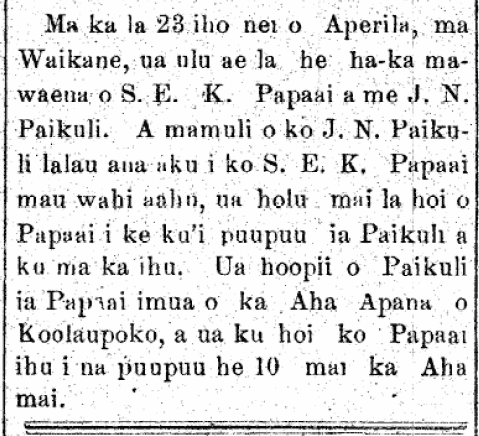
On the 23rd of this past April, in Waikane, there arose an altercation between S. E. K. Papaai and J. N. Paikuli. And as a result of J. N. Paikuli grabbing S. E. K. Papaai’s clothing, Papaai threw a punch at Paikuli and hit him in the nose. Paikuli sued Papaai before the District Court of Koolaupoko, and Papaai received 10 punches to the nose from the Court.

(Alakai o Hawaii, 4/30/1888, p. 3)

Ma ka la 23 iho nei o Aperila...

Ke Alakai o Hawaii, Buke 3, Helu 43, Aoao 3. Aperila 30, 1888.

The “Chinese Disease,” 1865.

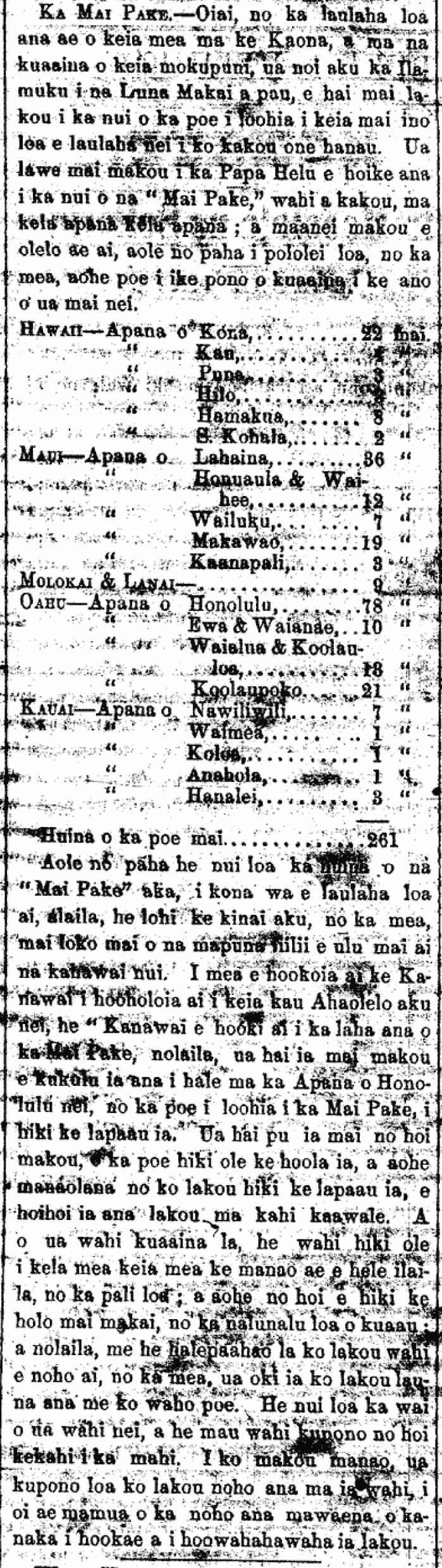
Leprosy [Mai Pake]—As this is greatly spreading about Town and in the country of this island, the Sheriff [Ilamuku ?] has requested that all of the District Sheriffs [Luna Makai ?] to report the number of people inflicted with this horrible sickness that is spreading in our homeland. We have taken the List showing the number of “Chinese Disease,” as we call it, in each district; and we say here that this is probably not accurate, because there is no one in the country who knows for certain what the symptoms are.

Hawaii—District of Kona, . . . 22 sick.
” of Kau, . . . 4 ”
” of Puna, . . . 3 ”
” of Hilo, . . . 3 ”
” of Hamakua, . . . 8 ”
” of S. Kohala, . . . 2 ”
Maui—District of Lahaina, . . . 36 ”
” of Honuaula & Waihee, . . . 12 ”
” of Wailuku, . . . 7 ”
” of Makawao, . . . 19 ”
” of Kaanapali, . . . 3 ”
Molokai & Lanai— . . . 9 ”
Oahu—District of Honolulu, . . . 78 ”
” of Ewa & Waianae, . . . 10 ”
” of Waialua & Koolauloa, . . . 18 ”
” of Koolaupoko, . . . 21 ”
Kauai—District of Nawiliwili, . . . 7 ”
” of Waimea, . . . 1 ”
” of Koloa, . . . 1 ”
” of Anahola, . . . 1 ”
” of Hanalei, . . . 3 ”
Total of sick . . . 261
Maybe the total of the number of “Mai Pake” is not so great, but when it truly spreads, then it will be too late to extinguish, for it is from tiny springs which great rivers grow forth. In order to comply with the law which was passed this last session of the legislature, “An Act to Prevent the Spread of Leprosy,” we are told that structures will be built here in Honolulu for those inflicted with leprosy so that they may be treated. We are also told that for those who are incurable, and for those for whom there is no hope in treating, they will be sent to a place set apart. And that country side will be a place that no one will think about going to, because of great cliffs; and it cannot be accessed by sea because of the rough conditions of the lagoon. So where they live will be like a prison, for their association with those on the outside will be cut off. There is much water there, and it is also a place suitable for farming. In our opinion, it is better for them to live there than for them to live amongst people who hate and scorn them.
(Au Okoa, 6/26/1865, p. 2)
Ka Mai Pake

Ke Au Okoa, Buke I, helu 10, Aoao 2. Iune 26, 1865.

Johnny Noble’s band, 1925.

Johnny Noble’s Singing Group

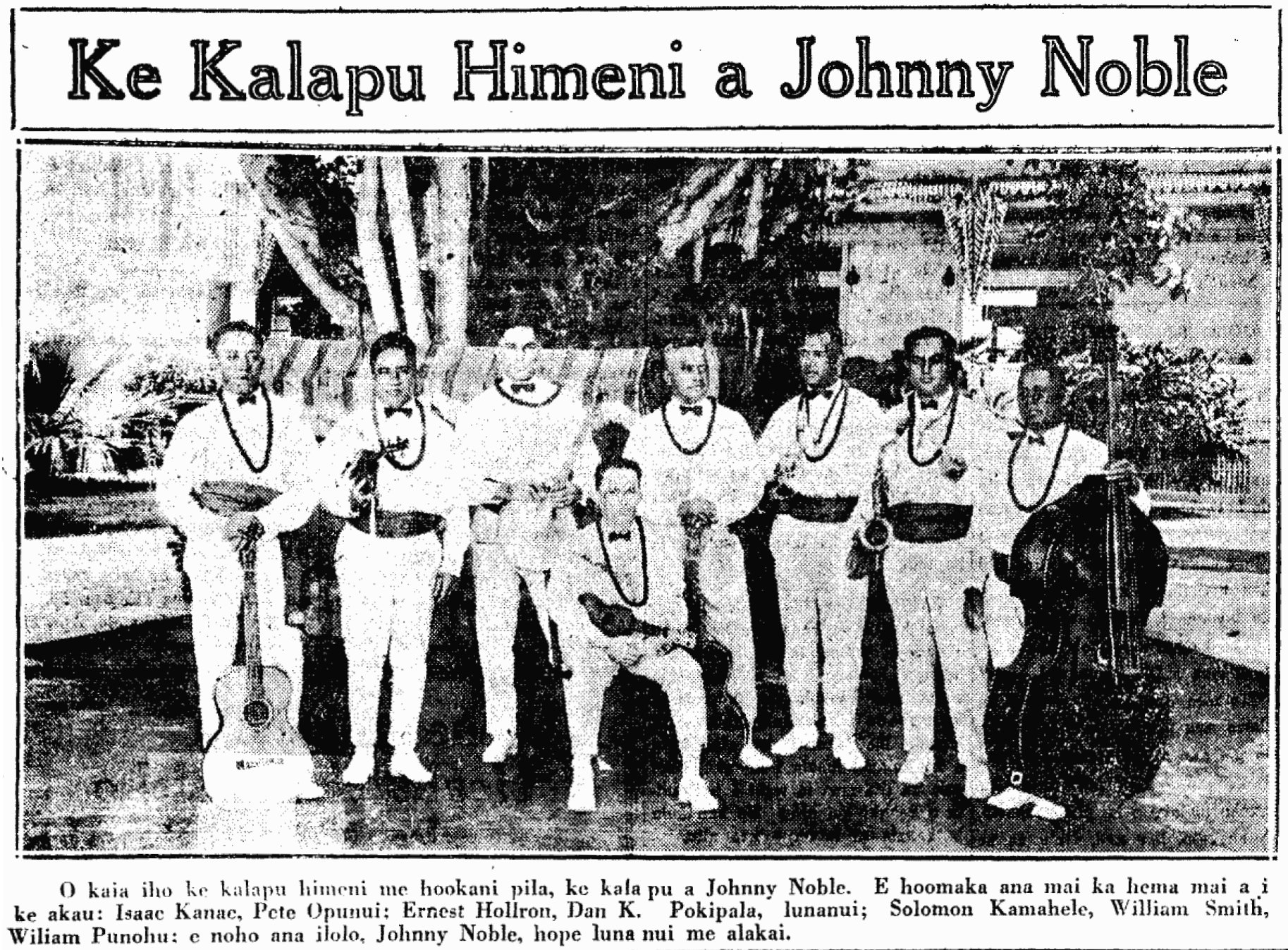
This is the singing group and band, the club of Johnny Noble. Starting from the left to right, Isaac Kanae, Pete Opunui, Ernest Hollron, Dan K. Pokipala (manager), Solomon Kamahele, William Smith, William Punohu, and seated is Johnny Noble (second in charge and leader of the band).

[If this image looks familiar to you and you were following the Hoolaupai page on Facebook, i am reposting past articles i previously put up there, so that they can be easily searched here at http://nupepa-hawaii.com. I try to categorize it under “repost” when i remember…]

(Kuokoa, 4/23/1925, p. 5)

Ke Kalapu Himeni a Johnny Noble

Ka Nupepa Kuokoa, Buke LXIV, Helu 17, Aoao 5. Aperila 23, 1925.

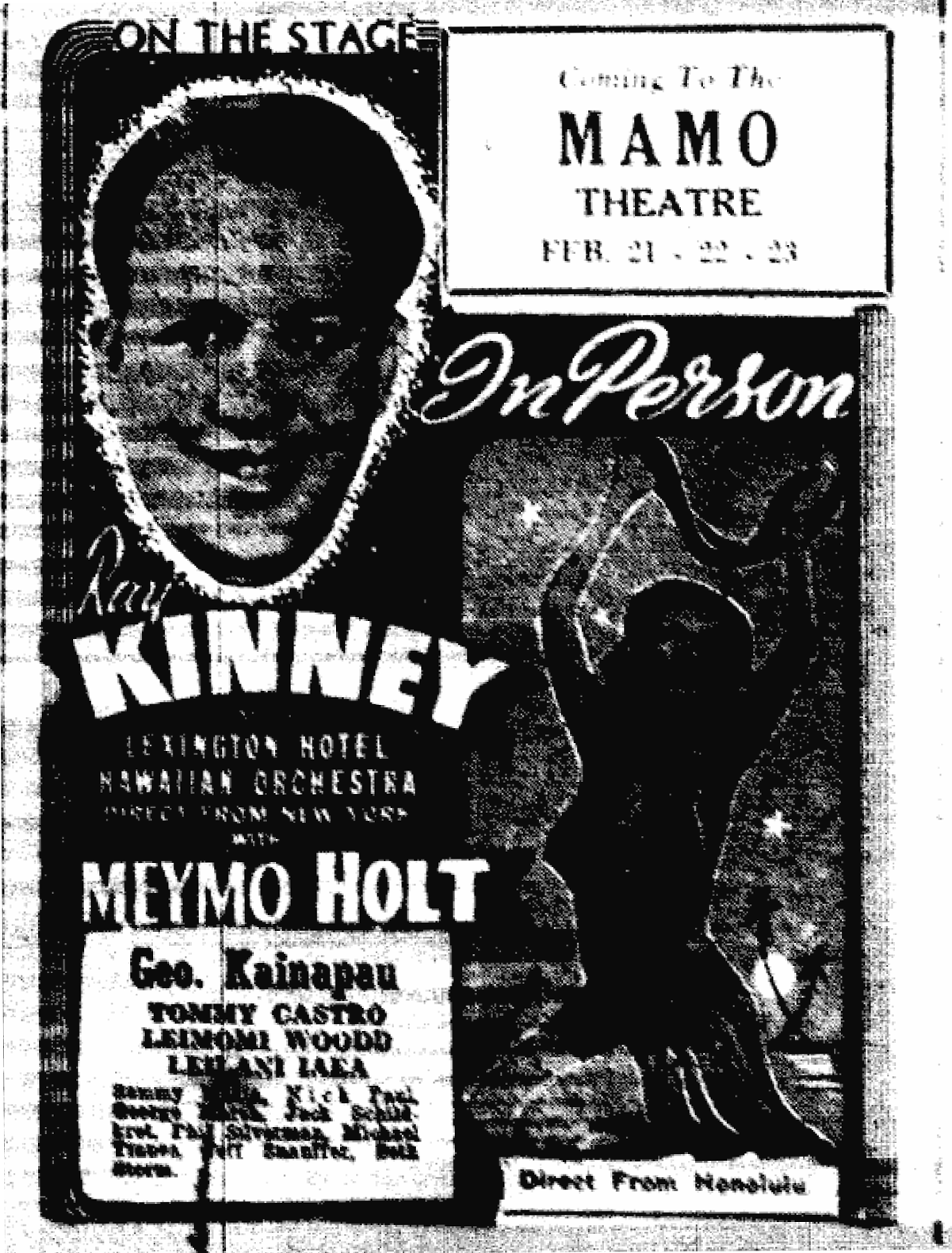
Ray Kinney and group from the Lexington Hotel performing in his hometown, Hilo, 1940.

ON THE STAGE

Coming To The

MAMO

THEATRE

FEB 21 – 22 – 23

In Person

Ray

KINNEY

LEXINGTON HOTEL

HAWAIIAN ORCHESTRA

DIRECT FROM NEW YORK

WITH

MEYMO [Ululani] HOLT

George Kainapau

TOMMY CASTRO

[Lillian] LEIMOMI WOODD

LEILANI IAEA

[illegible group of names]

Direct From Honolulu

[It seems the Senate Honored the entertainers and workers of the Lexington Hotel’s Hawaiian Room on its 75th anniversary just the other month!

There is also going to be a presentation related to this at the Distinctive Women in Hawaiian History Program on Saturday, September 15, 2012)

Unfortunately, the available digital image is as seen below, the actual  newspaper image should probably be much more clear and legible.]

(Hoku o Hawaii, 2/21/1940, p. 4)

ON THE STAGE

Ka Hoku o Hawaii, Volume XXXIV, Number 43, Page 4. Pepeluali 21, 1940.

A Touching letter from Diamond Kekona, in far away Britain, to his father in Hawaii, 1916.

LETTER FROM BRITAIN

Dear Papa:–Here are some words for you; my wife and I are healthy, and we are believing that you and the family are doing likewise. My dear wife is completely cured of her sickness, after I put great efforts into finding a cure–partly as a result of the doctors and partly because of the Lord Jesus Christ–as I prayed all the time to the Lord to give health to my wife, as you instructed me earlier.

She was sick for 12 weeks from the time she gave birth, and because of God’s love she regained her health. I take her walking around every day for 2 hours, and she is beginning to eat and regain her weight.

Father, I have joined the armed forces, as I told you earlier. The doctor gave his permission, and I received my papers, to the regiment #30, of married men, under the command of Lord Derby. I wear the symbol of my regiment on my left arm, just as other soldiers do in the army of Britain. I will receive my orders in June or July to proceed to the battlefield without delay for the honor of the Hawaiian people and for the flag of the homeland of my beloved wife.

We will send you a picture on the next boat, and when I receive my uniform, I will send you a picture, and that will be my last picture for who knows how long, but I find my relief in God. Tell August Kekona, don’t come to this land; there are no jobs, no money, there is lack in daily needs; tell him to go to America because it is a land where you can make it, where you can make money and get other things to make you happy. I say this because I was there for many years. Tell him my advice. I am thinking this is enough writing for the time being. Papa, give my love to Kuku Makalohi and uncle, Mrs. Lonohiwa, Bro. August and Hugo Kekona, and the rest of my love, to you my Papa. You son,

DIAMOND KEKONA,
87 Blackwell St., Kidderminster, England.

Aloha Papa:–Here are some thoughts to you, those being these: I am doing well, I am over my sickness, because of the tireless efforts of my loving Daimana for me.

Papa, tell August Kekona, don’t leave Hawaii. If he listens to my advice, he will be happy; he should live in Honolulu with you. There is no work for men here; women work, and take care of their husbands. Women are more than half of the workforce here in Britain now. Also, the pay here is very low. Papa, you are probably puzzled that my Daimana has joined the 30th regiment of married men, under the command of Lord Derby. I believe that this war is one of the worst; I am very afraid. There will be many more casualties of the men joining this war–both from the Allied side and the German side, before the war is over.

Daimana and I sent our picture to you, but my picture isn’t so good because I have just recovered from my sickness. I will go again later to take a picture and send it to you. I look at my picture and it is as if I am a totally different girl. I think I will end here. I wish you and everyone there the best in this new year. Papa, don’t forget to give my aloha to Mrs. Lawe Lonohiwa (I will write her when I have some time). Give my love to August Kekona. Your daughter,

AMY KEKONA.
78 Blackwell St., Kidderminister, England.

(Kuokoa, 2/18/1916, p. 2)

LETA MAI PELEKANE MAI.

Ka Nupepa Kuokoa, Buke LIV, Helu 7, Aoao 2. Feberuari 18, 1916.
Speaking of Hawaiians serving in the military, does anyone remember Diamond Kekona? 1916.

A Son of Hawaii Goes to War for Britain

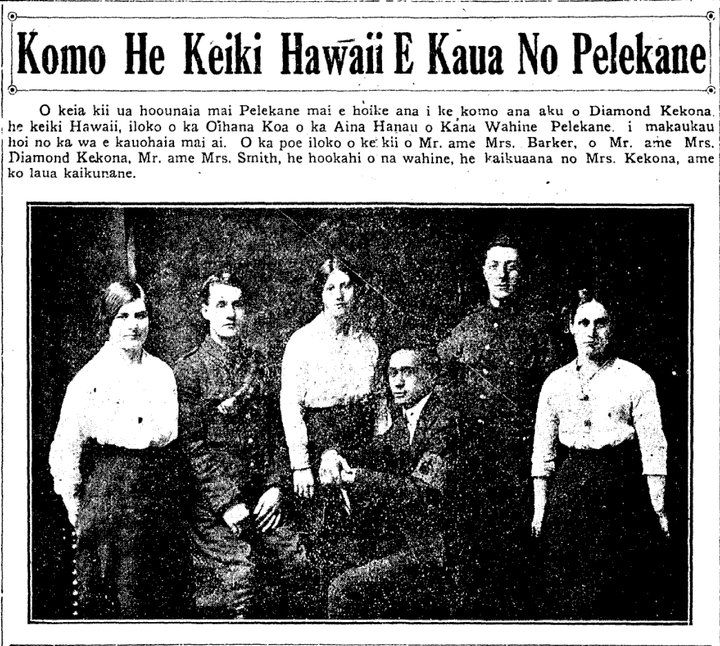
This picture was sent from Britain giving notice that Diamond Kekona, a Hawaiian, was enlisting in the Military of the homeland of his wife, Britain. He is prepared for when he will be called to service. Those in the picture are Mr. and Mrs. Barker, Mr. and Mrs. Diamond Kekona, and Mr. and Mrs. Smith. One of the women is an older sister of Mrs. Kekona’s. And one of the men is their brother.

[When i was posting to the old Hoolaupai Face Book page, there were many letters sent by Diamond Kekona from England to his father Dick [Richard Kekona] which were posted. If anyone wants to see them reposted here, where they will be easily searchable, i can do that. I will post the first letter i found in the papers right after this as an example.]

(Kuokoa, 3/31/1916, p. 1)

Komo He Keiki Hawaii E Kaua No Pelekane

Ka Nupepa Kuokoa, Buke LIV, Helu 13, Aoao 1. Maraki 31, 1916.

Hawaiian Opera, 1925.

Glee Club of Charles E. King

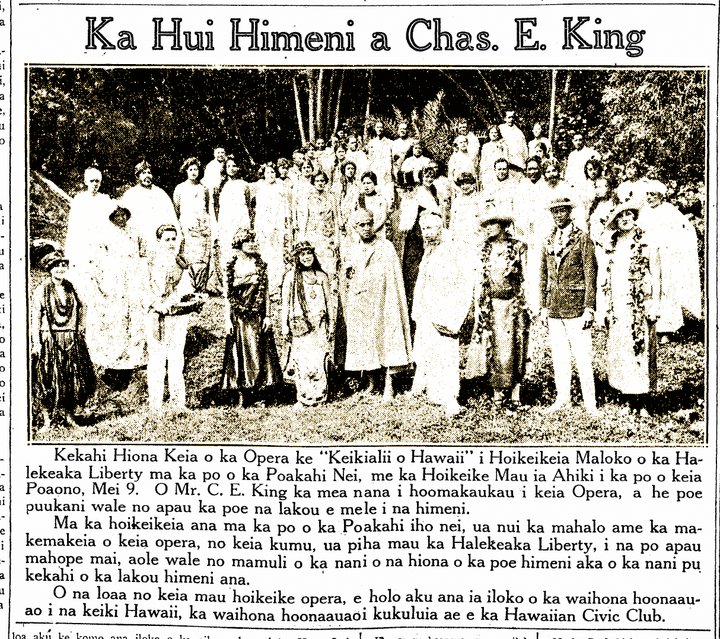
This is a scene from the Opera “Prince of Hawaii” presented at the Liberty Theater on the night of Monday last, continuing its performance until the night of Saturday, May 9. Mr. C. E. King put together this Opera, and there are only talented singers who perform the songs.

There was much lauding of the performance of Monday night, and for that reason, Liberty Theater has been full every night since–not just for the beautiful appearance of the singers, but also because of the beauty of their singing.

The proceeds of this opera will go to funding the education of Hawaiian children; for a scholarship set up by the Hawaiian Civic Club.

[I’m not much into opera, but I still would like to have witnessed this first hand!]

(Kuokoa 5/7/1925, p.1)

Ka Hui Himeni a Chas. E. King

Ka Nupepa Kuokoa, Buke LXIV, Helu 19, Aoao 1. Mei 7, 1925.

More plays! 1925.

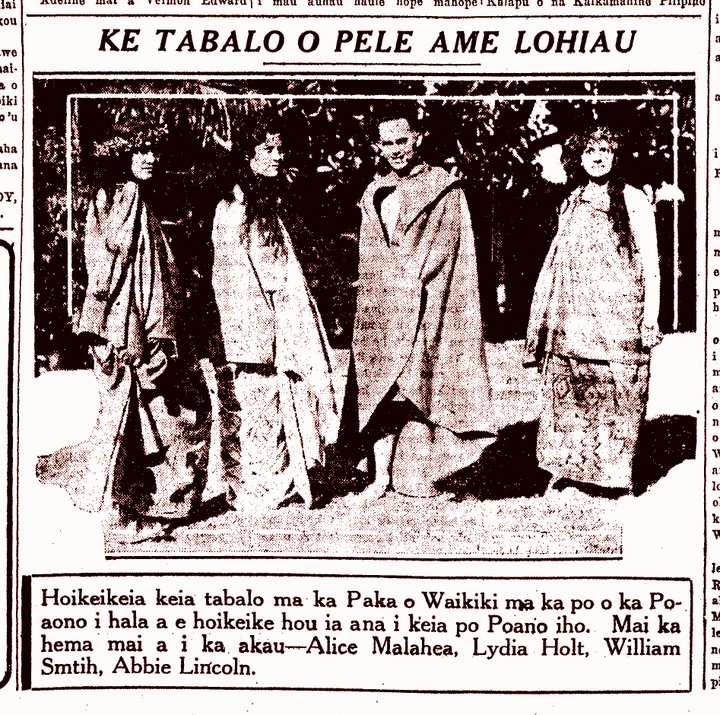
TABLEAU OF PELE AND LOHIAU

This play was shown at Waikiki Park on this past Saturday, and will be shown again on this Satrday night. From the left to the right—Alice Malahea, Lydia Holt, William Smith, Abbie Lincoln.

[This is another i wish i could have seen! This is a repost from the abandoned Hoolaupai Facebook page of times past. I like the format of http://nupepa-hawaii.com because it is very easily searched!]

(Kuokoa, 5/21/1925, p. 5)

KE TABALO O PELE AME LOHIAU

Ka Nupepa Kuokoa, Buke LXIV, Helu 21, Aoao 5. Mei 21, 1925.

“Beautifying” Waikiki: Have we changed that much in a hundred years? 1912.

CORAL BLOWN UP AT A SWIMMING SPOT IN WAIKIKI.

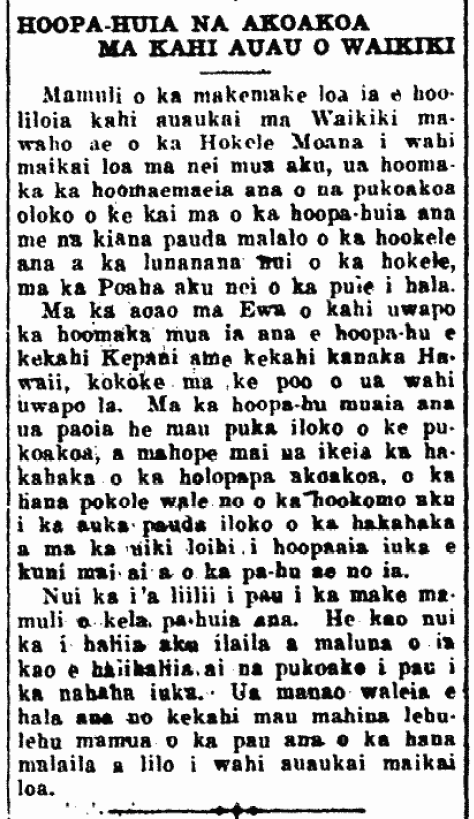
Because of a great desire to make the swimming area in Waikiki outside of the Moana Hotel great in the future, they have begun to clear coral from the ocean by blowing it up using giant powder [kiana pauda] under the direction of the general manager of the hotel, on Thursday of last week.

The blasting has begun on the Ewa side of the wharf, by some Japanese and Hawaiians, near the head of that wharf. In the first blasting, holes were dug into the coral, and after, cracks were seen in the coral bed. It was quick work putting in some explosives in the cracks while lighting it using a long fuse held on shore  and then it exploded.

There were many small fishes killed because of the blast. There was a big scow taken there and the coral that was blown off was carried away upon it. It is imagined that it will be several months before the work there will be done and the area will then be a fine bathing spot.

(Kuokoa, 7/26/1912, p. 4)

HOOPA-HUIA NA AKOAKOA MA KAHI AUAU O WAIKIKI

Ka Nupepa Kuokoa, Buke XLVIII, Helu 30, Aoao 4. Iulai 26, 1912.

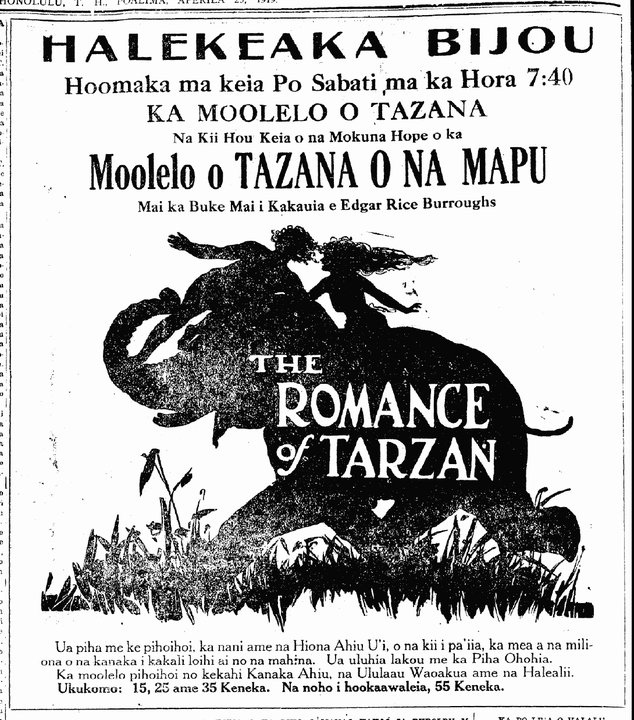
Tarzan ad, 1919.

BIJOU THEATRE

Starting this Sunday Night at 7:40

THE STORY OF TARZAN

These are Pictures From the Last Chapters of the

Story of TARZAN OF THE APES

From the Book by Edgar Rice Burroughs

THE ROMANCE OF TARZAN

Filled with excitement, magnificence, and Wild Beauty; the images taken are what millions of people have been awaiting for months. They are overcome with total fascination.

The thrilling story of a Primitive Man, Jungle Wilds, and Palaces.

Entrance fee: 15, 25, and 35 Cents. Reserved seating: 55 Cents.

[Chronicling America does not have any Honolulu papers up yet for this year, so here is a similar ad printed in The Garden Island, 5/27/1919, p. 3.]

(Kuokoa 4/25/1919, p. 2)

HALEKEAKA BIJOU

Ka Nupepa Kuokoa, Buke LVII, Helu 17, Aoao 2. Aperila 25, 1919.