Names not to be forgotten, 1893.

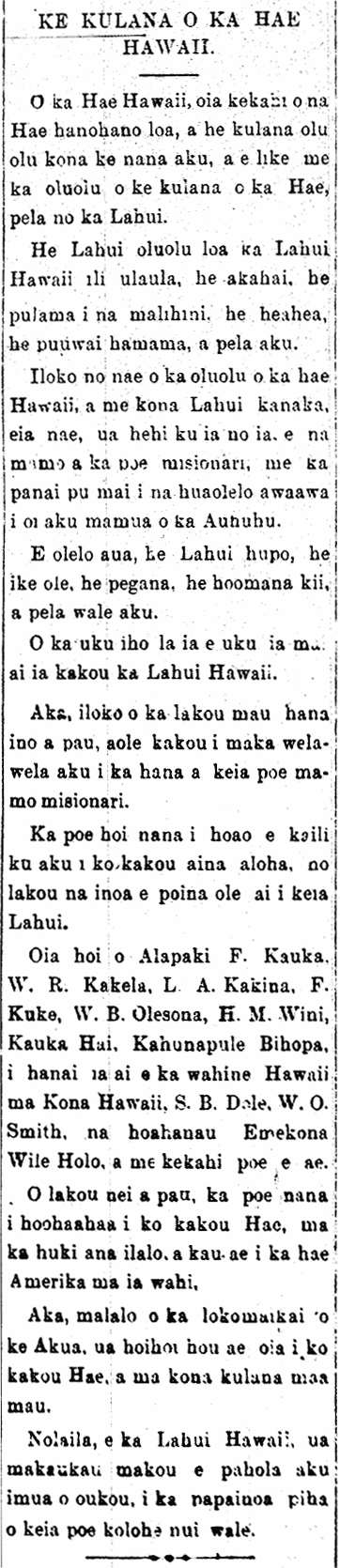
THE NATURE OF THE HAWAIIAN FLAG.

The Hawaiian Flag is one of the most glorious Flags, and it is so pleasant to look upon, and like the nature of the Flag, so too the People.

The brown-skinned [ili ulaula] Hawaiian Lahui are a kind People, are modest, treasure malihini, are welcoming, have open hearts, and so forth.

But even if the Hawaiian Flag and her People are kindhearted, they have been trampled upon by the descendants of the missionaries, and are being paid back with poisonous words, even more so than the Auhuhu.¹

It is being said that they are a Lahui that is stupid, know nothing, pagan, idol worshiper, and on and on.

That is what we the Hawaiian People get in return.

But despite all of their abuse, we are not full of hate at the actions of these missionary descendants.

The people who tried to grab our beloved land; and their names shall not be forgotten by this Lahui.

They being: Albert Francis Judd [Alapaki F. Kauka]; William Richards Castle [W. R. Kakela]; Lorrin Andrews Thurston [L. A. Kakina]; Amos Francis Cooke [F. Kuke]; William Brewster Oleson [W. B. Olesona]; Henry Martyn Whitney [H. M. Wini]; Dr. Charles M. Hyde [Kauka Hai]; Sereno Edwards Bishop [Kahunapule Bihopa], who was raised by a Hawaiian woman at Kona, Hawaii; Sanford Ballard Dole [S. B. Dole]; William Owen Smith [W. O. Smith]; the Emerson brothers [na hoahanau Emekona]; William W. Hall [Wile Holo]; and some others.

All of them is who brought down our Flag, by lowering it and raising the American flag in its place.

However, under God’s benevolence, our flag has been returned to its rightful place.

So therefore, O Hawaiian People, we are prepared to lay out before you the full list of names of these great transgressors.

¹Auhuhu is a plant that was used in fishing as a fish poison.

(Leo o ka Lahui, 10/13/1893, p. 2)
KE KULANA O KA HAE HAWAII.

Owana Wilcox Belliveau tries to break the will of Princess Pauahi, 1918.

FIGHTING OVER THE ESTATE OF PAUAHI

Honolulu, Dec. 29—Perhaps because the desire of Mrs. Owana Wilcox Belliveau for the estate of Queen Liliuokalani was not fulfilled, she is now trying to fight for the estate of  the Chiefess Pauahi, and is looking for a way to break the Will because of her relationship with Chiefess Pauahi. Why does she keep trying to start this kind of thing? Continue reading

Hawaii artists, 1901.

Works Painted by Our People.

Some of These Paintings Shown Last Monday.

In their Exhibition Room in Progress Hall, on the corner of Fort and Beretania Streets, our artists showed some of the paintings they created with patience. Hawaii is one of the best places for artists because the land is beautiful, the mountains are beautiful, the plants are beautiful, everywhere is beautiful, and they always have a subject to paint at any time. When observing the paintings shown at their exhibition room, those paintings show that our men and women artists know the beauty of the land and they used their brushes to situate this beauty upon the paper or canvas painted by them. Continue reading

Kaona, 1897.

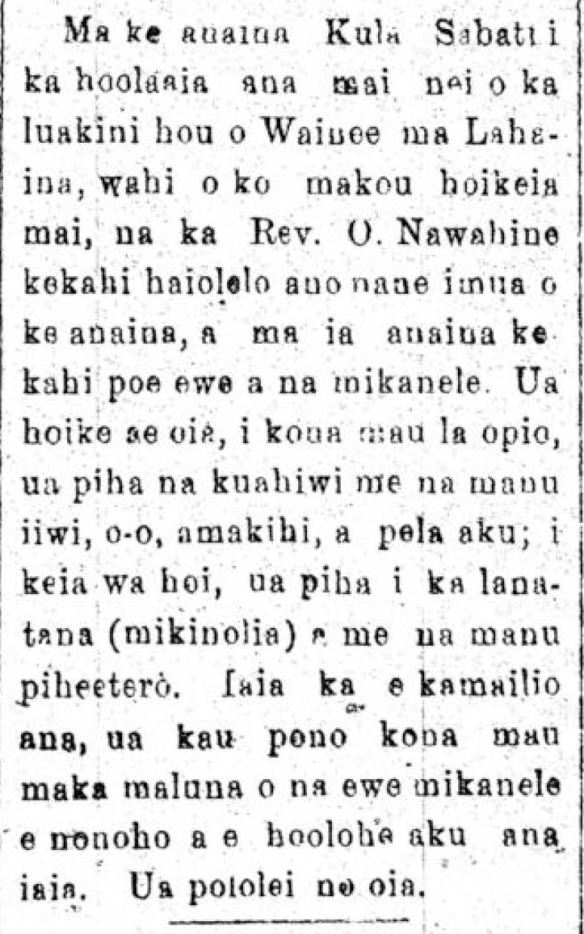
[Found under: “KE ALEALE NEI KA WAI.”]

At the Sunday School service where the new Wainee Church in Lahaina was being dedicated, according to what was told to us, Rev. O. Nawahine gave a cryptic sermon, and in that congregation were some missionary descendants. He said in the days of his youth, the mountains were filled with the birds: iiwi, o-o, amakihi, and so forth; but now it is filled with lantana and mynah birds. While he spoke, his gaze was set on the missionary descendants listening to him. He is so right.

(Makaainana, 5/10/1897, p. 5)

Makaainana_5_10_1897_5.png

Ka Makaainana, Buke VII—Ano Hou, Helu 19, Aoao 5. Mei 10, 1897.

Timeless, 1899 and beyond.

Our Rocking Chair.

We are printing here in our paper under the title shown above, truly appropriate things for parents to read before their children regularly.

“MAI NANA I KO HAI KEE.”

No ke kamailio ana i ko hai kee,
Mai poina no hoi oe i kou;
Pela ka poe mea hale aniani e hoonee,
O pa ka pohaku iluna o lakou.

Ina aohe a kakou mea e hana ai,
O ka nema wale no i ko hai hala;
E pono mai kauhale aku e hoomaka’i,
A mai laila mai imihala. Continue reading

Irony, 1893.

[Found under: “LOCAL AND GENERAL NEWS.”]

The new Hawaiian daily paper, “La Kuokoa,” started the other day printed about 1200 copies. Out of this number only 80 copies were circulated. Such is the native Hawaiian’s love for annexation. Continue reading

Law on naming, 1863.

Pertaining to Names.

Because we come across all sorts of names, and because we believe that the Law passed on the 24th of August, 1860; that being the Law called, “An Act to regulate names” [“He Kanawai e hooponopono ana i na inoa”] has not been followed, therefore, we wanted to discuss this Important matter with our friends. So that our friends do not fail to recognize this, we print the aforementioned Law, and here it is:

AN ACT
TO REGULATE NAMES.

Be it enacted, By the King, the Nobles and Representatives of the Hawaiian Islands, in Legislative Council assembled:

Section 1. All married women now living, and all that may be married hereafter on these Islands, shall, from and after the passage of this Act, adopt the names o f their husbands as a family  name.

Section 2. All children born in wedlock after the passage of this Act shall have their father’s name as a family name. They shall, besides, have a Christian name suitable to their sex.

Section 3. All illegitimate children born after the passage of this Act shall have their mother’s name as a family name. They shall, besides, have a Christian name suitable to their sex.

Section 4. All children up to the age of twenty years shall adopt the names of their fathers as a family name.

Section 5. All names so adopted shall be reported to the agents appointed to take the census of the people during the present year.

Section 6. It shall not be lawful to change any name adopted or conferred under the law. It shall also not be lawful to change any name adopted or conferred before the operation of this.

Section 7. The father or mother of any child born subsequently to the passage of this Act, shall report the name or names of such child to the Registrar of births for the district in which such child was born, within three months after the birth of such child.

Section 8. This law shall take effect from and after the date of its passage.

Approved this 24th of August, A. D. 1860.

KAMEHAMEHA,
KAAHUMANU.* Continue reading

Missionary advice about mele, 1860.

Pertaining to Mele

Perhaps all of the mele of the olden days are almost gone; those who know them are but a few. This is regretful because through those mele we can know how people lived a long, long ago, and the stories of the land as well. The means by which the mele will survive forever and not disappear is by printing them in books and maybe in newspapers; that way the future generations can read and contemplate and know of the misconceptions of their kupuna and not follow in their misguided footsteps. Continue reading

What will happen to the people suffering from leprosy? 1893.

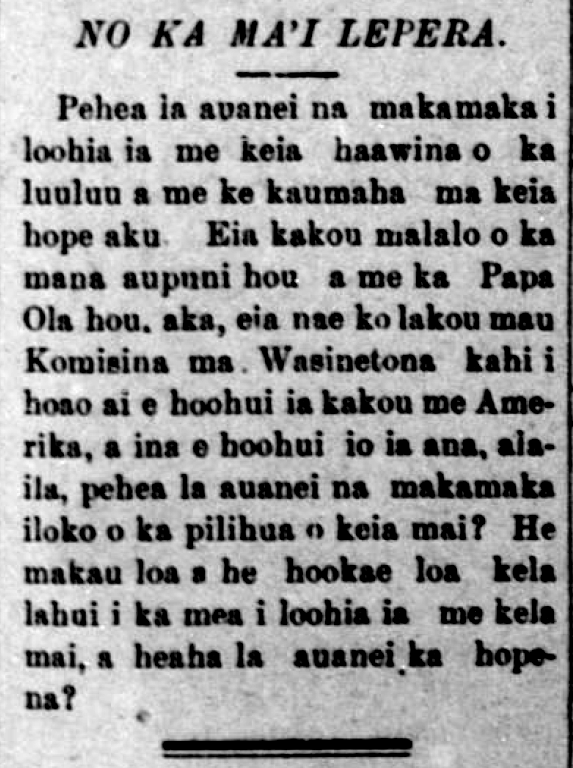
PERTAINING TO THE MA’I LEPERA.

What will become of the friends who are suffering from being dealt with that hand of grief and sadness from here on. We are now under a new government and new Board of Health [Papa Ola], but their Commissioners are in Washington where they are trying to annex us with America, and if we are indeed annexed, what will happen to our friends who are afflicted with this sickness? That nation is very frightened and hateful of those who have the disease, and what in the world will be the outcome?

(Hawaii Holomua, 3/11/1893, p. 3)

HawaiiHolomua_3_11_1893_3.png