Pauahi and Likelike and the edible mud of Kawainui, 1872.

[Found under: “LOCAL NEWS”]

Excursion to eat the mud.—During the most recent days of rest and relaxation of our royal one, Mrs. B. Pauahi Bishop, at her vacation place, Hanakamalaelae, Heeia, Koolaupoko, she and Mrs. Likelike Cleghorn went to see for themselves the edible mud of the pond of Kawainui in Kailua, and they formed an excursion. While precipitation from the clouds fell heavily, the two of them boarded a canoe and the mud was dove for; the beloved ones, as well as the multitudes of Kailua, Kaneohe, and Heeia ate heartily. The feast went nicely and the attractive items there were the pandanus-frond [lauhala] bowls that were woven expertly by the women. The characteristics of this mud is that it is speckled pink and gelatinous like pia; it’s taste is like cooked pia and it is so smooth going down. It is perhaps 8 feet to the bottom from the surface of the water where this mud is found. There are two amazing things heard of in relation to this Kawainui Pond: this mud, and the fish entrancing stick (Makalei) which was why the number of fish increased in the pond. Maybe it is because Kailua had no food that God made this mud?

J. B. Keliikanakaole

[Does anyone know if Hanakamalaelae is documented on any map? And also does anyone have information on J. B. Keliikanakaole?]

(Kuokoa, 10/26/1872, p. 2)

Moe kaoo i ka ai lepo.

Ka Nupepa Kuokoa, Buke XI, Helu 43, Aoao 2. Okatoba 26, 1872.

Canoe Building, 1924.

The Art of Canoe Building is Being Revived in Hawaii

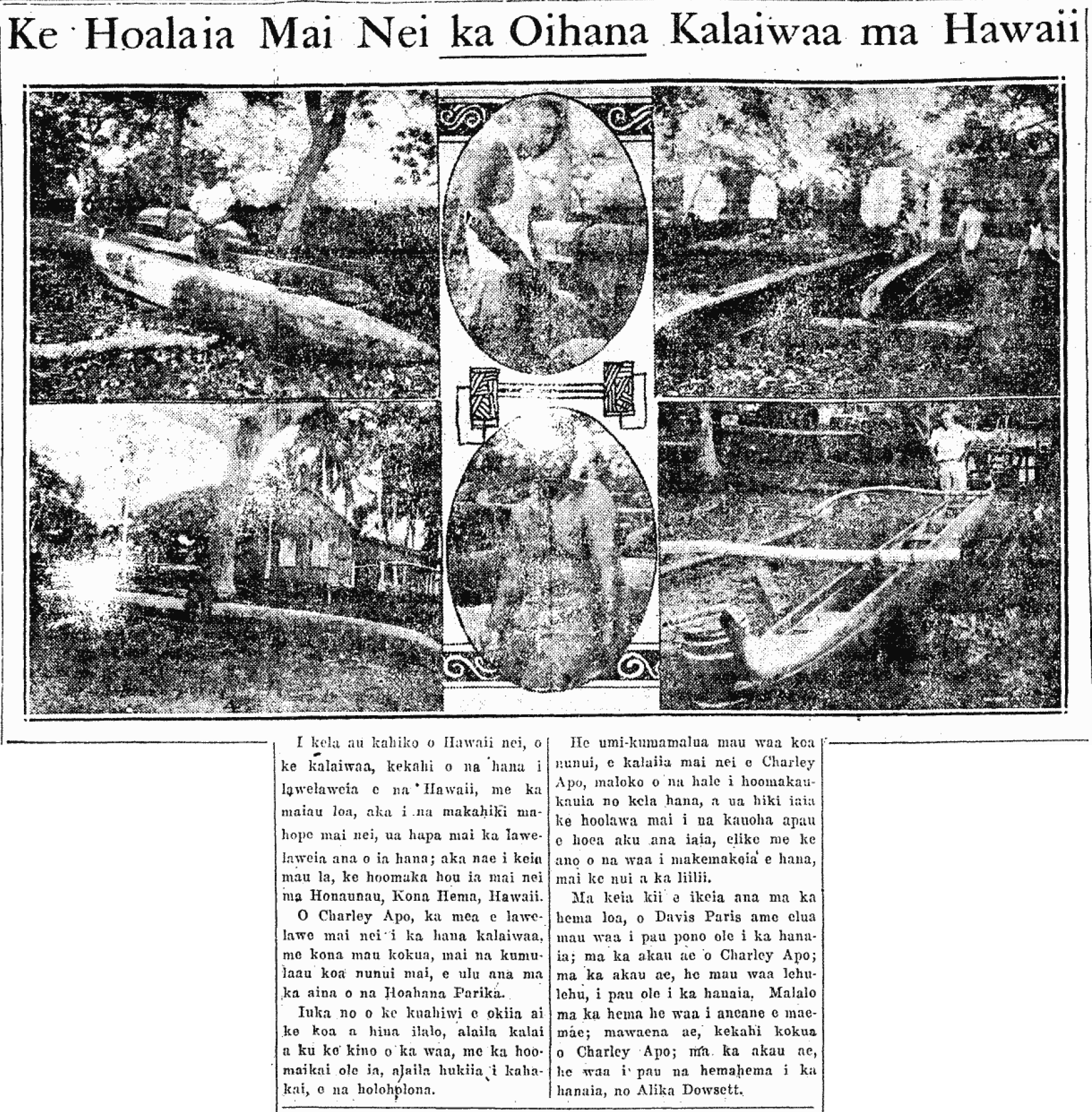
In the olden days of Hawaii nei, canoe building [kalaiwaa] was one of the occupations deftly done by Hawaiians, but during the years since, this work has gone down to but a fraction; but these days, it is being started up once again in Honaunau, South Kona, Hawaii.

Charley Apo along with his assistants are undertaking this endeavor of carving waa from large koa trees growing on the land of Paris and Company [Hoahana Parika ?].

The koa is fell in the high mountains, then it is roughly carved out into the form of a waa, and then dragged to sea by animals.

Twelve large waa are being carved by Charley Apo in a building prepared for this work, and he is able to fill all orders that he receives as per specifications wanted, from large to small.

In the picture on the far left, Davis Paris can be seen with two waa that are unfinished; to the right is Charley Apo ; to the right of that are many unfinished waa. Below on the left is a nearly finished waa; in the middle is an assistant of Charley Apo; to the right of that is a roughly completed waa for Alika Dowsett.

[I wish the newspapers were reshot clearly so not only the words are sharp and legible, but so that pictures and images are as clear as possible…]

(Kuokoa, 6/5/1924, p. 2)

Ke Hoalaia Mai Nei ka Oihana Kalaiwaa ma Hawaii

Ka Nupepa Kuokoa, Buke LXIII, Helu 23, Aoao 2. Iune 5, 1924.

Sap of the Kukui, 1867.

[Found under: “LOCAL NEWS: Oahu”]

Kukui Sap.—On the evening of last Wednesday, one of our friends was walking by the Royal Court at Waikiki Kai, and there he was given the pilali of the kukui tree mixed with sugar and other things; it was just so delicious. According to some people, there are people who eat a lot of  ti [probably the baked root of the ti plant], however it is better.

[Has anyone ever tried either of these? Does anyone still do this today?]

(Kuokoa, 4/20/1867, p. 2)

Pilali Kukui.

Ka Nupepa Kuokoa, Buke VI, Helu 16, Aoao 2. Aperila 20, 1867.

Poisonous seaweed, 1877.

POISONOUS LIMU OF MUOLEA.

Dear Mr. Editor: Aloha oe:—

Please allow me to talk about some matters dealing with the poisonous limu of Muolea in Hana, East Maui.

In ancient times, it did not grow profusely like it does now, and the kamaaina living near those tide pools didn’t know this was poisonous, however, this is what is known; When the children went to those tide pools and gathered the small fish [ohua] and ate them, if they ate a lot of the ohua, they grew dizzy and lay unconscious by the tide pools, and after being given medicine, they revived.

Later, a man from Honaunau in Kona, Hawaii arrived, and it was he that found that this was poisonous. After all the sweet potato was eaten by the pigs, he fetched some of the limu and smeared it over sweet potato and when the pigs ate again, they died, and not one of them lived. If dogs came and licked the vomit of the dead pig, the dogs died as well; it is from this that the limu was known to be poisonous, for that limu grows in Honaunau, Hawaii as well.

If you grab the limu with your fingers, your fingers will rot and fall off.

The proper thing to do is to prod at it with a stick, and if it sticks to the stick, place it in ti leaves or taro leaves [?].

When that limu is touched, it shrinks and wilts, somewhat like sleeping grass [pua hilahila wale]. It is not long like the other limu, but when you look at it, it somewhat resembles the suckers of an octopus.

On some sacred nights of the year, a red light is seen from those places.

In the year 1841 perhaps, those tide pools were paved over with rocks, but these days, they are growing wild again and is spreading.

The fish that go around that place, they don’t die, but should you eat the fish from those tide pools, you will end up dying.

This is a strong poison taking effect immediately, similar to the powerful poisons of the haole, and perhaps even stronger.

For this reason, the locals of that place have restricted access to that place, not allowing anyone without authority to go there.

With appreciation to the typesetting boys of the press and to the Editor goes my aloha.

Abraham Kauhi.

Muolea, Hana, Aug. 11, 1877.

[The image of this article is very hard to read. The original newspapers need to be rescanned before it is too late!]

(Lahui Hawaii, 8/23/1877, p. 2)

KA LIMU MAKE O MUOLEA.

Ka Lahui Hawaii, Buke III, Helu 34, Aoao 2. Augate 23, 1877.

Makalei Cave, North Kona, Hawaii, 1924.

ENJOYMENT OF TIME

DESCRIPTION OF MAKALEI

This is a cave to the south of the hill of Akahipuu, and it was there that a man named Ko’amokumoku-o-hueia [Ko’amokumokuoheeia] lived, who came from Koolau and settled here, living as a newcomer.

And he lived here with his family: his wife, whose name was Kahaluu; and their two daughters; and one young son named Makalei.

And it was for this boy that this cave is called the cave of Makalei until this day.

While this man was living here, he began to farm taro, sweet potato, banana, sugar cane, and awa; and it all appeared to be well watered.

The natives of the area came to him and said, “The problem with this land is the water; it is a land without water, and you have to get water from the cave, but the places to store water here are kapu and cannot be fetched from in secret; if you are caught, you will be killed by the one who the water belongs.

Ko’amokumoku-o-heeia heard this talk of the locals, and this caused him to contemplate about where he and his family could get their water; and therefore, he made a reservoir [pa-o wai ?] for himself, and when the rains returned, water would fill receptacles [haona] then be held in the reservoir.

While living there with the family, one day, the boy went to relieve himself at a ravine behind their house, and while he was throwing the old waste into a plain old hole, right then wind blew out from that hole, and Makalei examined it and saw this deep, dark hole.

This boy was however not frightened at all; he stood up and went to where his father was farming and said:

“I went over there to defecate, but this is the astonishing thing, there was a lot of wind coming from that pit, maybe it is a hole of winds.”

“Where?” the father asked. “Down there,” and the father went to see.

When Ko’amokumoku-o-heeia reached the area and cleared away the stones covering the hole, he saw that it was a deep cave and wind rose from it as if it came from the mountains.

He turned and said to the child, “We have our place to hold water for our life here in this land without water, and I will make a hole for us to defecate in.”

The mouth to the cave was finished off nicely and there they defecated; while one side of the opening was made so that a person could enter.

No kamaaina knew of this cave, and he did not tell his wife, and nor did he talk of it again to his son; he totally refused to speak of the things pertaining to this cave.

One day, he entered the cave and saw the great vastness, and that he could walk upright without his head touching the wall above, and there was a lot of water dripping down; he decided to make containers [waa] of ohia, and containers of wiliwili.

In the night he fetched wiliwili and carried it on his back inside the cave, and it was inside of the cave that he dug until he made the opening of the wiliwili water container; the ohia chosen was dug out by the farmer and he carried it on his back into the cave. The inside of the cave grew criss-crossed with water troughs of wiliwili and ohia; there was just so many of the water containers that continued to be fitted inside.

When the dry season of this land returned as always, he did nothing other than farm, and he had ample water and had no problems with it.

It was at night that he fetched water and filled containers and gourds [olo], until the reservoir was full, and this was their drinking water for the month, and so forth.

The locals were suspicious about where these people go their water from, being that they did not see the source of their water, and they spoke often about the water of these malihini.

This cave still remains, and the entrance is very small but made like the entrance to a house, but within is very spacious and the walls are very tall.

When Maguire lived at Huehue, a great water catchment was built inside of the cave and a pipe was laid from the catchment until his house because he wanted cold water like ice water; also, pipes were laid above the catchment so that more water would go into it.

The story of this boy, Makalei is a beautiful one, along with his father, and it is a very long story; and should the writer have time to write this touching entertainment, then Makalei will be seen, the one whose name this cave is named after, Makalei Cave.

Here we will list the famous storied places [wahi pana kaulana] of these ahupuaa, from the sea until the summit of the mountain of Hualalai. With their names that they were called by the people of old.

1. Kileo hill.

2. Kaaialalaua.

3. Kapuukao.

4. Pahulu.

5. Moanuiahea.

6. Puumamaki.

7. Puuiki.

8. Puukoa.

9. Kaiwopele [Kaiwiopele].

10. Puuuhinuhinu.

11. Kahuaiki.

12. Kamawae.

13. Hikuhia, in the uplands of Napua.

14. Uau pooole [Uaupooole].

15. Na hale o Kaua [Nahaleokaua].

16. Kipuka o Oweowe.

17. Pualala.

18. Kawahapele.

19. Keoneeli.

20. Hinakapoula.

21. Kalulu.

22. Na puu Mahoe [Napuumahoe].

23. Kumu mamane [Kumumamane].

24. Kaluamakani.

25. Pohokinikini.

26. Hopuhopu.

27. Kipahee.

28. Hanakaumalu.

29. Kapuu o Honuaula [Honuaula Hill].

30. Ka puu o Hainoa [Hainoa Hill].

31. The summit of Hualalai and the pit of Milu.

32. Kipahee.

33. Makanikiu, Hill.

The pit of Milu [lua o Milu] spoken of is the pit which Hikuikanahele went to fetch Kawelu under the [Nuu ?] of Milu, the chief of the dark night; this is the round pit atop the summit of Hualalai which still remains to this day; it is a very deep hole and if you drop a rock down the pit, you will not hear the rattling of the rock.

The width of the mouth of this pit is perhaps about 6 to 7 feet in my estimation as I am familiar with those regions.

The water of Kipahee is a pit which goes down and reaches a spring.

It is not rippling water from which to scoop water out of, but it is moss [limu] which you collect until the container is full and then return to the top.

Climbing back up is troublesome; should you try to go straight up thinking you will exit immediately, you won’t be able to because you will keep sliding back until you are sitting after exhaustion from sliding down. In order to return to the top with ease, you have to climb zigzag, turning to the right and then to the left, and that is how you climb back to the top easily.

(Not complete.)

[This article continues into the next issue (6/5/1924, p. 4) and is signed: “Ka Ohu Haaheo I na Kuahiwi Ekolu. Kona Hawaii, April 30 1924.”]

(Hoku o Hawaii, 5/29/1924, p. 4)
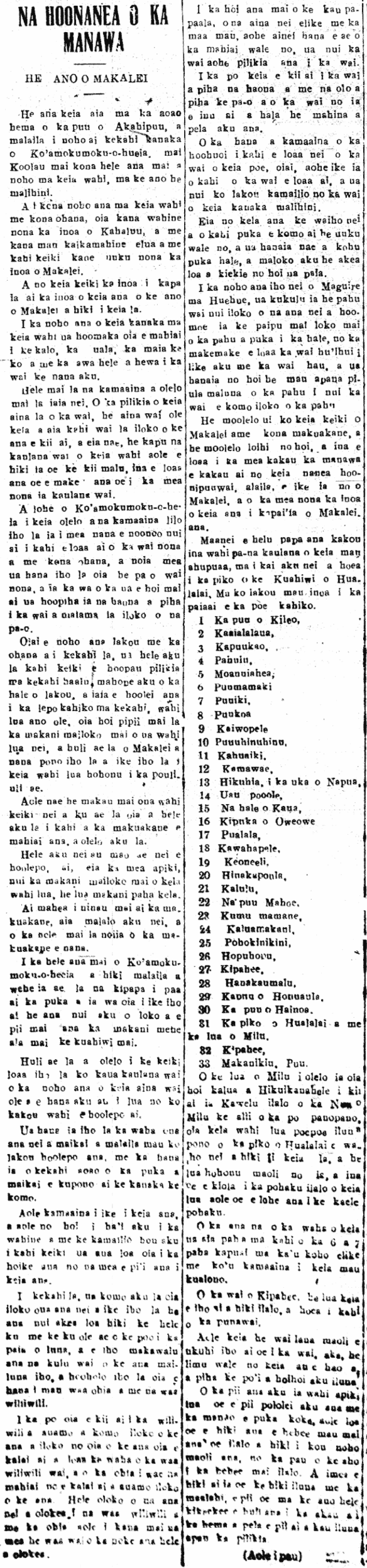
NA HOONANEA O KA MANAWA

Ka Hoku o Hawaii, Buke XVIII, Helu 1, Aoao 4. Mei 29, 1924.
Pond atop Punchbowl? 1902.

Mysterious Pond.

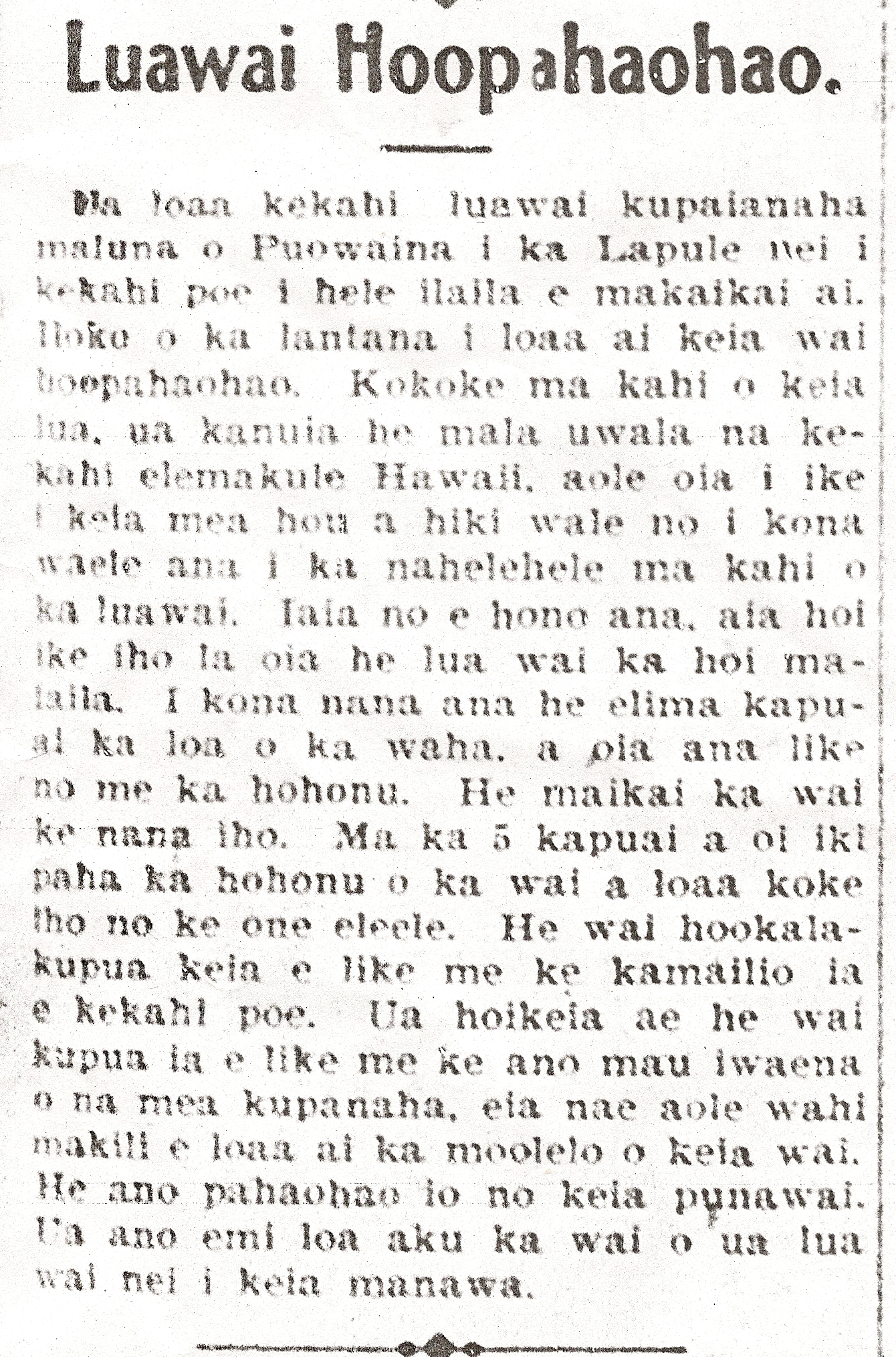
An amazing pond was found atop Puowaina by  some people who visited there; they found this amazing waters among lantana plants. Close to this pond was planted a patch of sweet potatoes by an old Hawaiian man; he did not know of this new thing until he was weeding near the pond. While he was working [hono ana ?], to his surprise, he saw this pond their. When he looked at it, its mouth was five feet long, and so too of the depth. The water is five feet or more then you reach black sand. According to what some people say, this is magical waters. It is said to be kupua water, like what is common among amazing things, but there is no trace of the story of this water. It is truly a mysterious spring. The water in the pond these days has somewhat receded.

(Kuokoa, 6/27/1902, p. 5)

Luawai Hoopahaohao.

Ka Nupepa Kuokoa, Buke XL, Helu 26, Aoao 5, Iune 27, 1902.

The above image was taken directly from the microfilm. Here for comparison is the same article as it appears online:

Luawai Hoopahaohao.

Ka Nupepa Kuokoa, Buke XL, Helu 26, Aoao 5. Iune 27, 1902.

Replanting of native plants, 1901!

HAWAIIAN PLANTS WILL BE GROWN AGAIN.

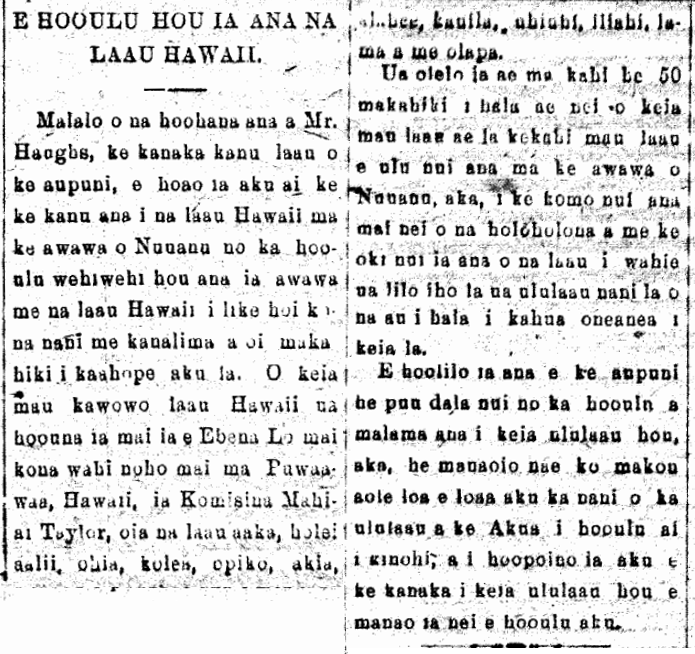
Under the direction of Mr. Haughs, the nurseryman of the government, the planting of Hawaiian plants in the valley of Nuuanu will be attempted, to make that valley verdant once again with native plants, so that it will be just as beautiful as it was fifty or more years ago. These seedlings were sent by Ebena Lo [Eben Low] from his residence at Puuwaawaa, Hawaii, to Commissioner Taylor, those being aaka, holei, aalii, ohia, kolea, opiko, akia, alahee, kauila, uhiuhi, iliahi, lama, and olapa.

It is said that it has been about 50 years that these plants were growing in abundance in Nuuanu Valley, for with the influx of animals and the mass cutting of trees for firewood, the beautiful forest of times gone by became a barren field.

The government will spend a sum of money to grow and foster this new forest, however, we believe that there is no way that the beauty of the forest which God grew originally and which was damaged by man will be attained by this new forest which is intended to be grown.

(Aloha Aina, 12/7/1901, p. 4)

E HOOULU HOU IA ANA NA LAAU HAWAII.

Ke Aloha Aina, Buke VII, Helu 49, Aoao 4. Dekemaba 7, 1901.

Lost turtle? 1857.

TURTLE THAT TRAVELLED FAR INLAND.

O Hae Hawaii:

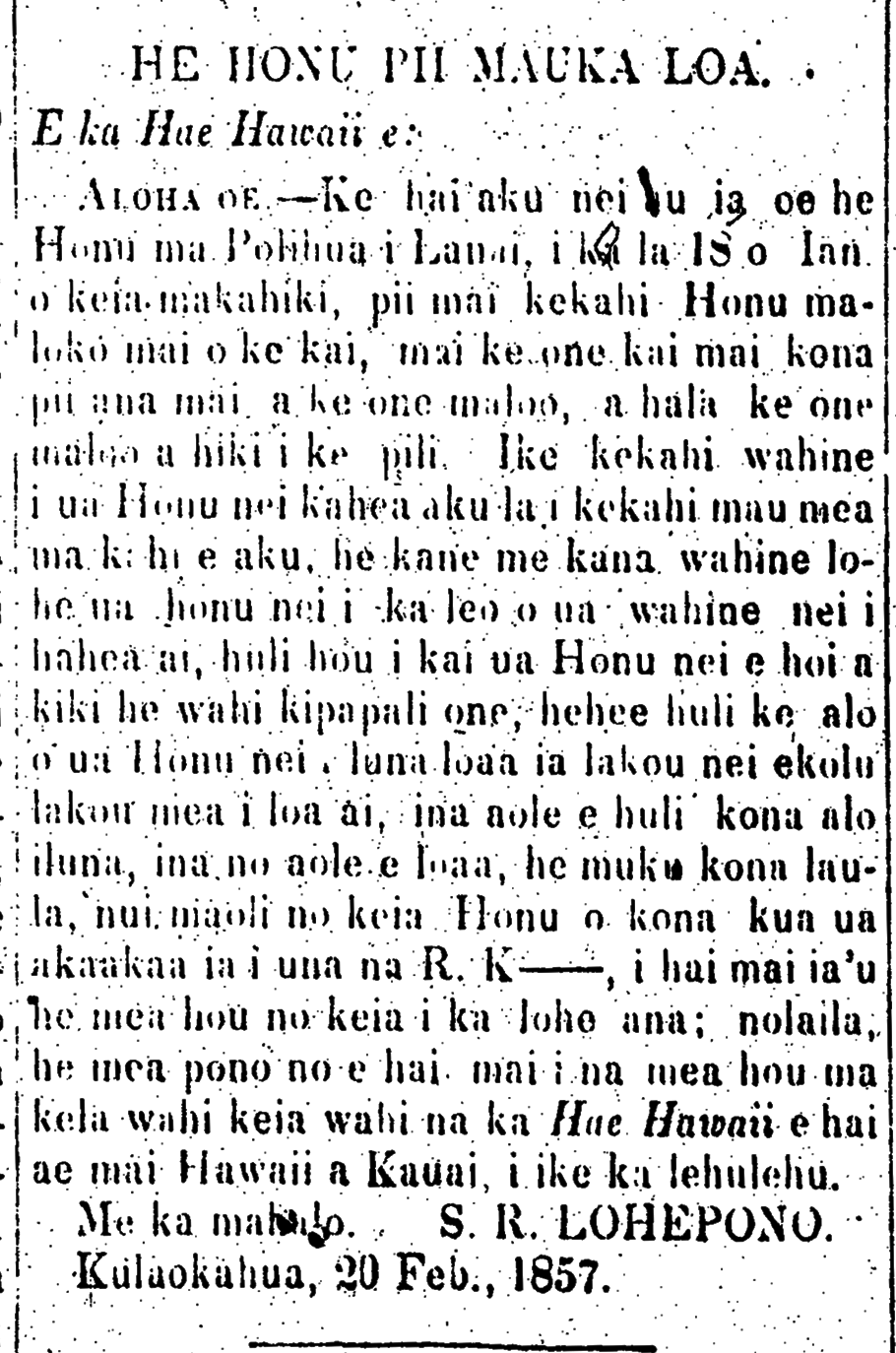
Aloha to you:—I am informing you about a Turtle at Polihua, Lanai: on the 18th of January of this month, a Turtle travelled from within the ocean; it went from the wet sands to the dry sands; passed the dry sands until where the pili grass grows. A woman saw this Honu, and called some people who were elsewhere, a man and his wife; the Turtle heard the voice of the woman that was calling out, and it turned back to return to the sea; it came upon a sandy cliff [kipapali one?] and the Honu slid and flipped over; the three got what they were after, but if it had not flipped over they wouldn’t have caught it; it was a muku¹ in width; the Honu was huge; the shell was removed by R. K_____, who said to me that this was something not heard of; so it is important that the Hae Hawaii covers news from all over so that all from Hawaii to Kauai can know.

With appreciation, S. R. LOHEPONO.

Kulaokahua, 20 Feb. 1857.

¹Muku is when you stretch out both arms, the length from the fingertips of one hand to elbow of other arm.

(Hae Hawaii, 3/4/1857, p. 1)

HE HONU PII MAUKA LOA.

Ka Hae Hawaii, Buke 2, Ano Hou.—Helu 1, Aoao 1. Maraki 4, 1857.

More Lei Day in Hilo, 1928.

DAY TO CELEBRATE LEI IN HILO

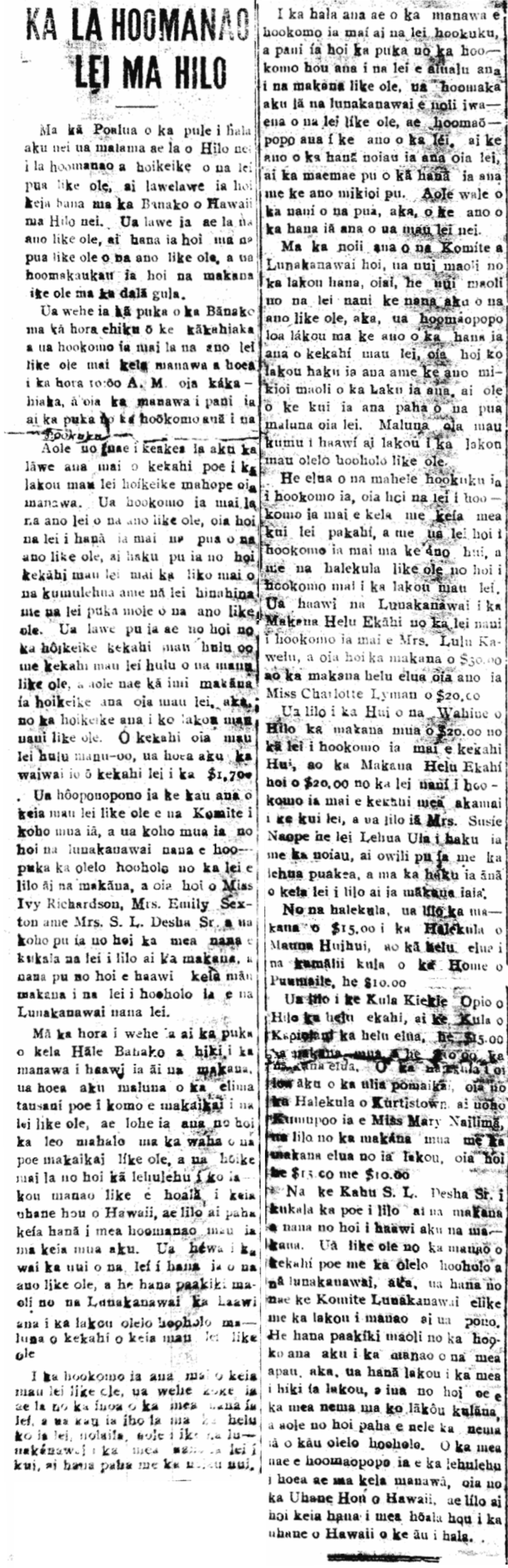
On Tuesday last week, Hilo held a celebration and display of flower lei of all sorts, and this was done at the Bank of Hawaii in Hilo. All types of lei were brought down and they were made will all kinds of flowers of all types, and prizes of all kinds were prepared of gold coins [dala gula].

The doors of the Bank were opened at seven in the morning, and lei of all types were brought in from then on until 10:00 A. M. of that morning, and then the doors were closed to bring in the judges.

However the bringing in of lei to put on display by others after that was not barred. Entered were all types of lei of all sorts; for instance, lei made of various flowers, and some lei were woven with the buds of the lehua, and lei hinahina, and lei pukamole of all sorts. Also brought for display were some oo bird feathers, and feather lei of various birds, but they were not there for judging, they were just there to show the many beautiful kinds. Some of those lei of oo bird feathers are valued at $1,700 for one.

The placing of the various lei were organized by the Committee chosen earlier, and also chosen before were the judges who would decide which lei won the prizes, and they were Miss Ivy Richardson, Mrs. Emily Sexton, and Mrs. S. L. Desha, Sr. Also selected was the one who would announce the winning lei and he would also hand out the prizes decided upon by the lei judges.

From the time when the Bank was opened until the time when the awards were given, there was approximately five-thousand visitors who entered to look at the many lei, and voices of appreciation were heard from the mouths of many attendees, and the crowd expressed their joint feelings to rouse this new Hawaiian spirit, and that this event will be commemorated always from now on. There were countless [hewa i ka wai] lei that were crafted of all sorts, and it was truly a difficult task for the Judges to give their decision on some of these lei.

When the many lei were brought in, the name of the maker was immediately announced, and a number was given to the lei, so therefore the judges did not know who strung the lei, or crafted them with great skill.

When the period for the competition lei to be entered was over and the doors were closed to the entry of lei competing for the various prizes, the judges began to examine each lei, paying attention to make up of the lei, and how it was crafted, and how cleanly it was made and how neat they were as well. [They were judged] not on just how pretty the flowers were, but on how the lei were made.

In the examination by the Judging Committee, their job was tremendous, being that there were just so many beautiful-looking lei of all sorts, but some were distinguished by how they were made, in that they were woven with true craftsmanship, or by how the flowers were sewn into the lei. By those qualities did they hand down each of their judgements.

There were two competition divisions that were entered, those being lei entered by individual lei makers, and lei entered by a group, and many different schools entered their lei. The Judges awarded the First Place Prize to the beautiful lei entered by Mrs. Lulu Kawelu, and that was a prize of $30.00 and the second place prize went to Miss Charlotte Lyman, $20.00.

To the Women’s Association of Hilo went the first prize of $20.00, for the lei entered by a group; and the First Place Prize of $20.00 for the beautiful lei entered by a skilled maker of lei—to Mrs. Susie Naope with a lei of Red Lehua skillfully woven  and wound with white lehua, and by weaving this lei, that prize went to her.

As for the schools, the prize of $15.00 went to the Mauna Huihui School, and the second place to the school children of Puumaile Home, a prize of $10.00.

To Hilo Junior High School went the first place, and to Kapiolani School the second place; $15.00 was the first prize and $10.00 was the second prize. The school that was the luckiest was the Kurtistown School, whose principal is Miss Mary Nailima—to them went the first prize and second prize, $15.00 and $10.00.

Kahu S. L. Desha, Sr. announced the winners of the prizes and it was he who presented the prizes. Some people had all sorts of ideas regarding the decisions of the judges, but the Judging Committee did as they thought was right. It is difficult indeed to please everyone, but they did what they could, and should you, O Fault Finders, be in their place, there mostly surely would be those faulting your decisions. The thing sensed by the crowd there at that time was the new Hawaiian spirit; and this event will become something that reawakens the spirit of Hawaii of times past.

(Hoku o Hawaii, 5/8/1928, p. 2)

KA LA HOOMANAO LEI MA HILO

Ka Hoku o Hawaii, Buke XXI, Helu 48, Aoao 2. Mei 8, 1928.