David Kanealii and his new wife visits the home of his parents, 1918.

SEEING THE BELOVED HOME OF MY PARENTS.

O Editor of the Nupepa Kuokoa:—Please have patience for my package that I put before you, and place it upon one of the open decks of our newspaper, which will send it out so those from Hawaii Island will see it and those of Lehua Island will hear it.

On the 14th, Mrs. Napewai [Naapuwai] Kanealii and her husband D. Kanealii left this town and went to Kauai, and in the morning of the 15th, we landed in Nawiliwili, were taken by the tossing of the machine to Wainiha and were lovingly welcomed in the home of Joseph Kanealii. Continue reading

Queen Emma on Kauai, 1871.

The Queen’s Travels to the Island to the West.

O Ke Au Okoa;—Aloha oe:

At 3 o’clock yesterday afternoon, Lawai was left by the entourage of

“Maikai ka Waikini he nani ke nana,
Ka hemolele oia uka me ke onaona,
Ua hele a nolu pe i ka lehua maka noe,
Ua ike maka iho nei i ka nani o Aipo.”

[Fine is Kawaikini, beautiful to see,
The uplands are perfect in its fragrance,
The misty-eyed lehua are drenched
Beheld was the beauty of Aipo.]

The travels of Kaleleonalani continued on into dusk; the good home of the Hon. J. Kauai in Waimea nei was visited, and he gave them the entire house for the alii to do as she pleased. That is the fashion in which the well-to-do son of Waimea gave. Continue reading

The new steamship, the Mikahala, 1887.

The New Steamship.

This Wednesday, the new steamer of Foster [Poka] and company arrived; 8 days from San Francisco. “Mikahala” is its name, and it was named after the name of Mrs. J. Robinson, the wife of James [Kimo] of Pakaka. It is a large vessel like the Lilinoe, and it is speedy. We hear that it is headed for Kauai in the coming days. We do not know who the Captain is.

(Nupepa Elele, 1/15/1887, p. 2)

Ka Mokuahi Hou.

Ka Nupepa Elele, Buke VIII, Helu 29, Aoao 2. Ianuari 15, 1887.

More on the Hokulea, 1980.

Editorial

We should not look upon the voyage of Hokuleʻa with the thought that out ethnic pride and awareness will be re-vitalized. This type of pride we search for should emulate [emanate] from within ourselves and should be a constant part of our daily lives. We must not rely wholly upon occasional events to stir up reminders of our dignity and abilities lest we become fleeting images for display; pieces in a show case.

The importance of the upcoming voyage of Hokuleʻa lies in a different discovery: the opportunity we have to discover how our ancestors conceptualized their world, how they responded to the challenges after leaving their homelands and how they attempted to survive in this new land, today our homeland. Grasping this knowledge we too can be committed to accept the challenges before us with the same determination of our ancestors.

[Some thoughts from thirty-four years ago. How have things changed? How have things stayed the same?]

(Alahou, 2-3/1980, p. 12)

Ka ʻOlelo a Na Luna hoʻoponopono

Ke Alahou, Helu 4, Aoao 12. February/March 1980.

Kau ka pea, holo ka waa, 1980.

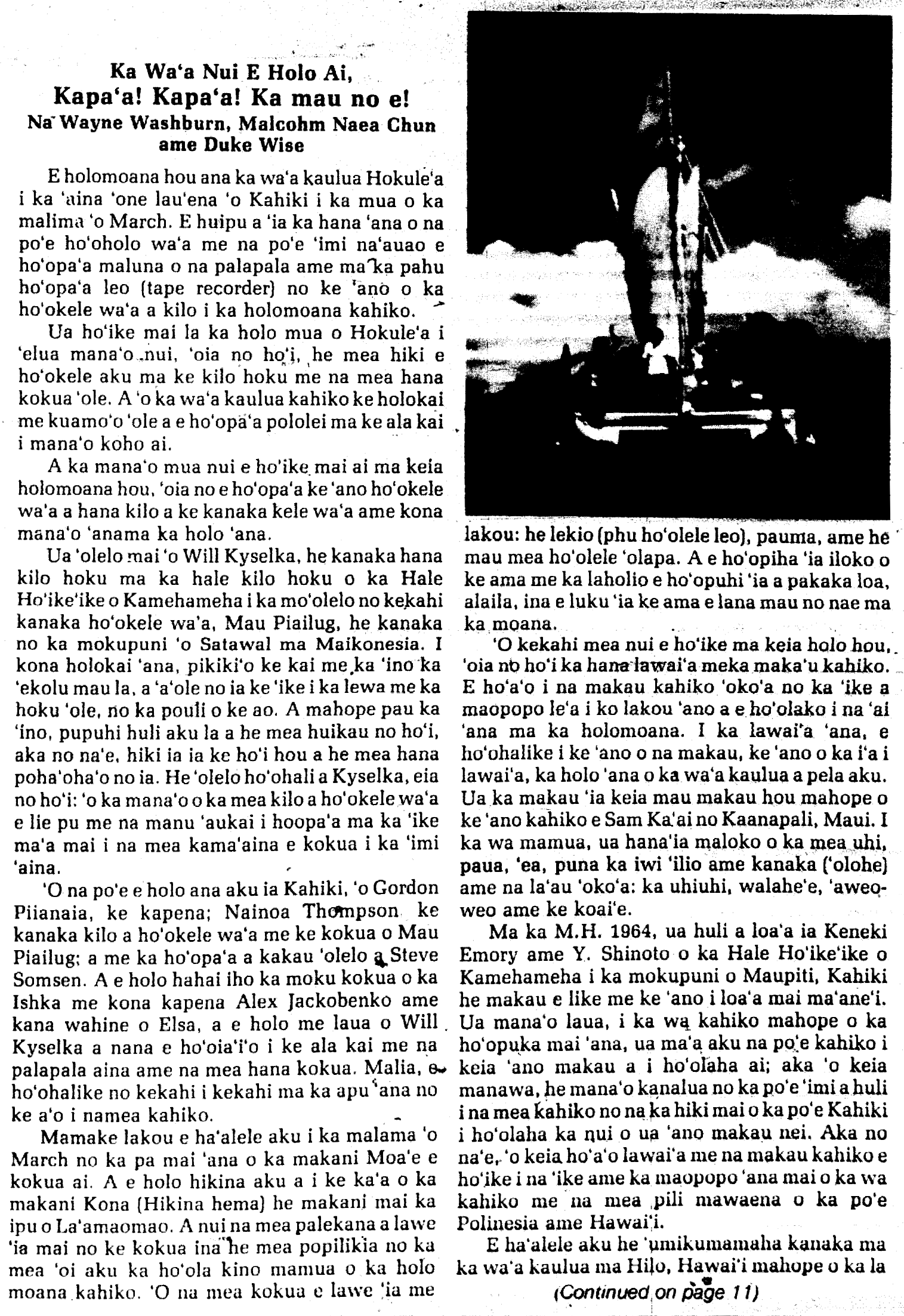
HOKULEʻA SAILS AGAIN

Hold on to the course! Hold on to the course! Continue On!

by Wayne Washburn, Malcolm Naea Chun and Duke Wise

In early March the Hokuleʻa will again set sail in hopes of reaching first landfall somewhere near Tahiti. Crewmen and scientists will concentrate efforts on documenting the thinking process, and methods, which may have been used by the ancient Polynesian navigators.

Without first voyage demonstration to the modern world two important findings. First, was that navigation by the stars without use of modern navigational instruments can be successfully used when travelling between Tahiti and Hawaii. Second, a Polynesian double-hulled canoe without keels or deep centerboards is able to sail to windward, and thus maintain planned course. For the present voyage celestial navigation will once again be of primary importance. Where the first voyage showed that celestial navigation was possible, the presēnt will pay particular attention to the recording of the thought process of the navigator.

Dr. Will Kyselka of the Bishop Museum Planetarium, and an assistant to the project, cited an incident involving a highly skilled non-instrument navigator from Satawal, Mau Piailug. Once caught in a storm for three days, Mau was unable to sail or use celestial markers for assistance. After the storm, though his course direction had been turned around many times, Mau miraculously found his way home to his tiny atoll of Satawal. Dr. Kyselka suggested that maybe there are maps within some of the more skilled navigators’ minds. He mentioned that pigeons are said to find their bearings in flight by being able to sense the difference magnetic fields given off by certain structures. Using the changes in magnetic fields the pigeons are able to draw a mental map and find their way home. Did the Polynesians possess this ability or something which would enable them to find Tahiti and Hawaii with regularity?

Captaining the voyage down will be Gordon Piianaia. Navigating for the trip will be Nainoa Thompson. There to assist Thompson will be Mau Piailug, the navigator from the 1976 voyage. Crew member Steve Somsen will be documenting the navigation process. This will be done by conferring with Nainoa and Mau and then orally recording it through the use of a tape recorder. Hopefully this will shed more light on the Polynesians’ navigational thought process.

The Ishka, a sailing vessel captained by Alex Jackobenko with assistance from his wife Elsa will follow some distance behind Hokuleʻa. Dr. Kyselka will be on board to study and document the route of the Hokuleʻa using modern navigational instruments and charts. On completion of the voyage the two styles of navigation will be compared for scientific value.

March has been designed for departure because it is the season that tends to favor the northeast tradewinds which are important for the first half of the voyage. Like the 1976 voyage the canoe will travel southeasterly for about 1000 miles. Once “easting” is accomplished winds blowing from the southeast will be used to rēach first landfall or Tahiti from a windward approach. This “easting” is important in that not enough movement in that direction might cause them to sail west of Tahiti and miss the islands completely. Certain safety features have been added to the canoe in order to avoid swamping problems encountered in previous inter-island trips. The gunwales and hatches have been raised to help prevent water seepage into the hulls. Also on board will be six hand pumps, a radio and flares. The radio will be used to notify the Hokuleʻa’s escort boat in case of an emergency. Certain sections of the hulls will contain inflated rubber. In the event that the hulls are accidentally smashed these will enable the canoe to remain afloat. Although non-instrumental navigation is the paramount research project of this voyage, other projects are being encouraged on a smaller scale. One of these is to fish using traditional types of fishhooks to learn how they were used. This hopefully will also provide a supplement to the crew’s diet by adding fresh fish. While conducting the fishing experiments crew members will record how the differences of fishhooks: design, material and size; the speed of the canoe; the types of fish caught and other factors affect fishing in the deep sea. These fishhooks are being faithfully copied from authentic fishhooks under the supervision of Sam Ka’ai of Kaanapali, Maui. Ancient fishhooks were made from materials such as shell, coral, turtle shell, dog and human bones and even hard woods.

In 1964, Drs. Kenneth Emory and Y. Sinoto of the Bernice Pauahi Bishop Museum, found a Tahitian one-piece fishhook at Maupiti in the Society Islands. They proposed a theory that this type of fishhook is the same as found in various sites in Hawaii. After its initial introduction they believe it became a major type used by the ancient Hawaiians, Today, other anthropologists are not as certain if Tahitian migrations caused the popularity of this fishhook, but nonetheless, the experiments conducted by crew members of the Hokuleʻa should provide some information that may help the on going research in finding common links between the ancient Hawaiian society and the Southern Polynesians.

With a crew of fourteen, the Hokuleʻa is scheduled to depart from Hilo on…

(Ke Alahou, 2-3/1980, p. 1)

Ka Waʻa Nui E Holo Ai...

Ke Alahou, Helu 4, Aoao 1. February/March 1980.

…the first favorable day after March 2.

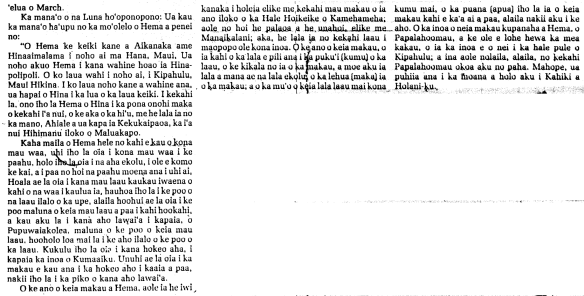
Editor’s comment: The projects conducted by the crew of the Hokuleʻa remind us of the legend of Hema, a pan-Polynesian legend about a great super chief.

Hema was the son of Aikanaka and his wife Hinaaimalama of Hana, Maui. Hema’s wife was called Hina-polipoli and they lived at Kipahulu, East Maui. When she was pregnant with their second child, Hina craved for the eyeball of a large fish of the open, deep sea. This fish had a tail like that of the shark, Ahiale and was called Kekukaipaoa.

Hema prepared all his fishing gear and made ready the double-hulled canoe by loading enough food and water for several days. He covered his canoes with many mats, lashing them down with cords so that sea water could not seep in. When the canoe was covered securely, he hung his fishing line, Pupuwaiakolea, above the top of the poles that were between the hulls of the canoes. He put the end of the line through a knot he had tied and then he set up his cord calabash, which was called Kumaaiku. He took out the fishhook and tied the end of the fish line tightly around it fastening it to the pole.

Hema’s fishhook was not made of human bone like some of those found in the Bishop Museum, nor was it made of whale bone or turtle shell like Manaiakalani. It was made of a branch of wood whose name is not known today. The kikala or the intersection of the barbs, is found at the branch closest to the trunk of the tree. When this branch is laid flat, three other branches project from it. These branches are broken so they are short and sharp. This joint is called lehua, perhaps after the flower. The shank knob of the fishhook is called muʻo and this is where the fish line is tied. The name of Hema’s fishhook is Papalahoʻomau and still survives today as the name of the Congregational Church in Kipahulu.

It was later on in the story that Hema was blown off course and his voyage to Kahiki or Holani-ku began.

(Alahou, 2-3/1980, p. 11)
ʻelua o March.

Ke Alahou, Helu 4, Aoao 11. February/March 1980.

Newspapers, translation, and a mele for the Merrie Monarch, 1913 / Timeless.

You can find various translations for the beautiful song, “Kaipoleimanu” in the archives of the Bernice Pauahi Bishop Museum, online, and on liner notes. None however seems to acknowledge that Kaipoleimanu itself was a wahi pana, along with its neighboring hau of Maihi, ulu of Weli [also seen as Wehi], and hala of Mapuana.

There is a priceless church meeting report/travelogue appearing in the Kuokoa from 12/5/1913 to 2/6/1914: Ka Ike Hou ana o ke Kamahele i ka Mokupuni o Kauai [The Traveler Sees Once More the Island of Kauai], signed, Kamahele. Amongst all the fascinating information found in this report is a description of the places hearkened to in the mele Kaipoleimanu, to which the traveller is taken by his guide, the Deputy Sheriff of Hanalei, William Werner. He says: Continue reading

Royal huakai, 1865.

[Found under: “BITS OF NEWS OF HAWAII NEI.”]

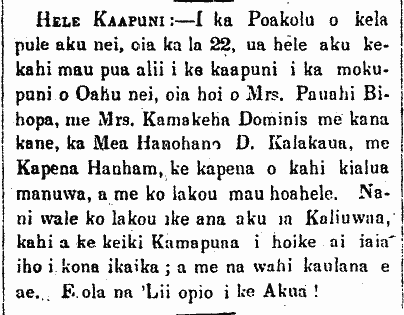
Circuit:—On Wednesday of the week last, that being the 22nd, some of the royal descendants made a circuit of Oahu nei, that being Mrs. Pauahi Bishop, Mrs. Kamakeha Dominis [Kamakaeha Dominis] and her husband, the Honorable D. Kalakaua, and Captain Hanham, the captain of a single-masted warship, along with their travelling companions. Splendid was their view of Kaliuwaa, where the youth Kamapuaa revealed himself and his strength; along with the other famous sites. Long live the young Alii in God!

(Kuokoa, 3/30/1865, p. 2)

Hele Kaapuni...

Ka Nupepa Kuokoa, Buke IV, Helu 13, Aoao 2. Maraki 30, 1865.

Another mountain-climbing mele for Emalani, 1871.

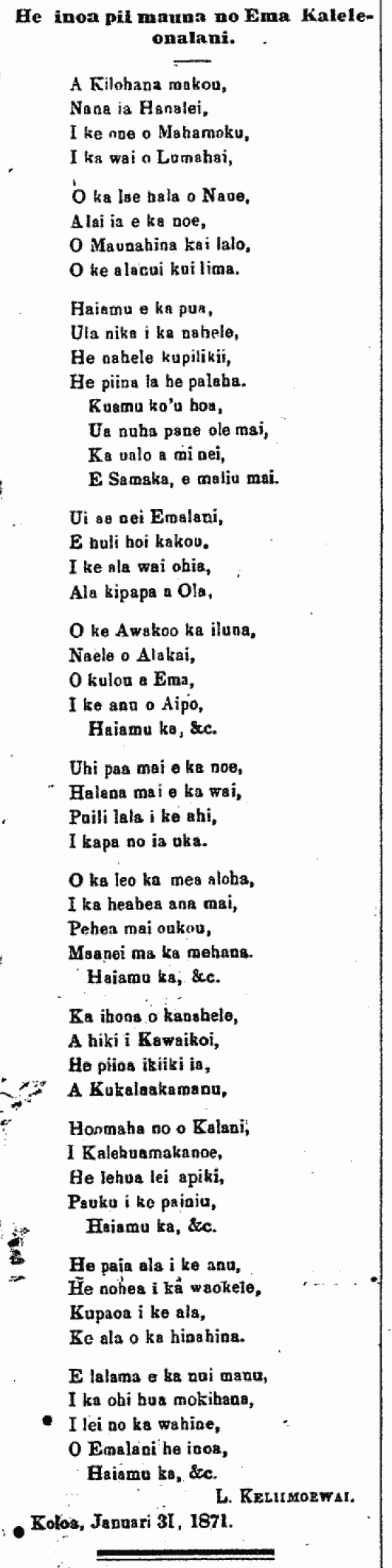
A mountain-climbing name song for Ema Kaleleonalani.

A Kilohana makou,
Nana ia Hanalei,
I ke one o Mahamoku,
I ka wai o Lumahai,

O ka lae hala o Naue,
Alai ia e ka noe,
O Maunahina kai lalo,
O ke alanui kui lima.

Haiamu e ka pua,
Ula nika i ka nahele,
He nahele kupilikii,
He piina la he palaha.
Kuamu ko’u hoa,
Ua nuha pane ole mai,
Ka ualo a mi nei,
E Samaka, e maliu mai.

Ui ae nei Emalani,
E huli hoi kakou,
O ke ala wai ohia,
Ala kipapa a Ola,

O ke Awakoo ka iluna,
Naele o Alakai,
O kulou a Ema,
I ke anu o Aipo,
Haiamu ka, &c.

Uhi paa mai e ka noe,
Halana mai e ka wai,
Puili lala i ke ahi,
I kapa no ia uka.

O ka leo ka mea aloha,
I ka heahea ana mai,
Pehea mai oukou,
Maanei ma ka mehana.
Haiamu ka, &c.

Ka ihona o kanahele,
A hiki i Kawaikoi,
He piina ikiiki ia,
A kukalaakamanu,

Hoomaha no o Kalani,
I Kalehuamakanoe,
He lehua lei apiki,
Pauku i ke painiu,
Haiamu ka, &c.

He paia ala i ke anu,
He nohea i ka waokele,
Kupaoa i ke ala,
Ke ala o ka hinahina.

E lalama e ka nui manu,
I ka ohi hua mokihana,
I lei no ka wahine,
O Emalani he inoa,
Haiamu ka, &c.

L. Keliimoewai.

Koloa, Januari 31, 1871.

[This is another mele honoring Queen Emma and her famous travels through Kauai. It seems the eight lines starting “Haiamu e ka pua” is repeated like a chorus after every two verses.

This seems to be a more “complete” version of the one printed in “He Lei no Emalani,” pp. 90–91.]

(Au Okoa, 2/9/1871, p. 1)

He inoa pii mauna no Ema Kaleleonalani.

Ke Au Okoa, Buke VI, Helu 43, Aoao 1. Feberuari 9, 1871.

Paper Lei and Hawaiian foods popular in New York. 1912.

PAPER LEI ARE MUCH SOUGHT AFTER IN NEW YORK.

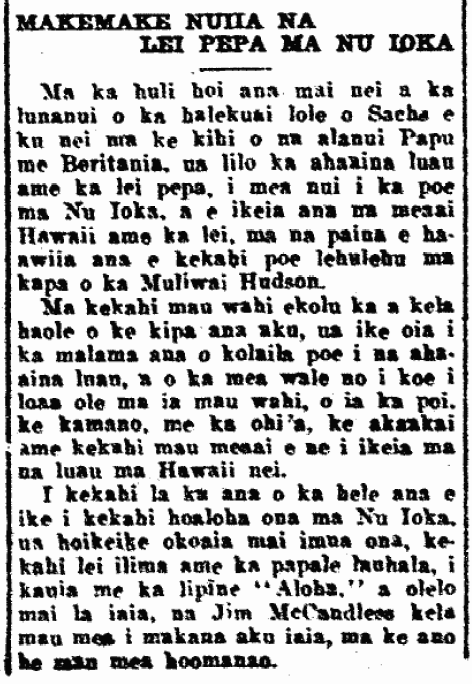
At the return of the head manager of the clothiers, Sachs, which stands at the corner of Fort and King Streets; [he said,] “Luau and paper lei have become popular with New Yorkers, and Hawaiian foods and lei are seen at parties given by many people on the banks of the Hudson River.

Supposedly at three places that haole went to visit, he saw people holding luau parties, and the only thing missing at those places was poi, salmon, tomatoes, onions and some other foods seen at luau in Hawaii nei.

One day when he went to go see one of his friends in New York, shown before him was an ilima lei and a lauhala hat upon which was a ribbon which read “Aloha,” and he said that they were a gift from Jim McCandless, as a memento.

(Kuokoa, 8/9/1912, p. 6)

MAKEMAKE NUIIA NA LEI PEPA MA NU IOKA

Ka Nupepa Kuokoa, Buke XLVIII, Helu 32, Aoao 6. Augate 9, 1912.

More from the Pacific Northwest, but a little more “recent,” 1912.

A LETTER FROM AFAR

(Written by Sam K. Nainoa.)

The following letter is written by Sam K. Nainoa from Seattle, after the passing of several weeks since he left his homeland with his queen, on their travels, explaining some major things that they saw in their sightseeing of these foreign lands, and this will be something which the readers of the Kuokoa will rejoice in because of the progress witnessed by the two of them made by the Hawaiian youths living in that foreign land.

SEATTLE, May 16, 1912, Aloha oe:—Here we are, staying in this town; we’ve been here almost two weeks, meeting with the Hawaiian boys, and we are full of joy.

There is a great number of my classmates living here, all of them Hawaiians; they are playing music and singing, and they are making a lot doing this work; and some of them married haole women, and they are truly taken by this land, with no desire at all to return to the land of their birth.

Some of them have land and are well off; according to what they tell me, their thoughts of returning to Hawaii are no more; this is where they will live and they will leave their bones in this foreign land.

We went touring around another area farther across this expansive ocean for a few days and came right back, and am writing this letter to you. We went sightseeing at a wood mill, at a place called Port Blakeley, which is one of the largest mills in the world.

What I saw was truly amazing. There are many Hawaiian boys indeed living there, and to go from one area to the next, you travel by steamship. The Hawaiians take a fancy to living there, and for work, they do lumbering.

Hawaiians have no problem with jobs there; they have work at all times.

Some boys from Port Blakeley came to Seattle and got together with us and the band boys who live in Seattle; they insisted that we go with them to where they live, and there was not refusing the hospitality of the kamaaina, so we went aboard a steamship, spending a few days there and immediately returning back.

There were two Hawaiian women there with their husbands, and they have become mothers to the Hawaiian boys there; their living is easy, and they get along lovingly; I would not be mistaken to say there is a place for them in this land without their parents [he mua a he hope ka noho ana o ka aina makua ole ?]

There is bountiful food there, and when we arrived, two pigs were roasted as is the custom of Hawaiians, and all the luau foods were prepared like inamona, limu eleele, dried fish, alamihi crab, raw fish, and their poi was poi palaoa [flour poi].

Here they have dried opelu and dried nehu and many other things so that Hawaiians living here have nothing to complain about; they have everything, perhaps even more than Hawaii.

We enjoyed ourselves, and there was but one thing to do, that is to sing and to play music, and we were terribly happy. There is an over abundance of palai fern there, it is protects your feet [he pale wawae ia mea he palai ?] and it grows all the way until the ocean. When we went pole fishing, we caught poopaa and also large kuahonu crabs. There is a fish that looks like opelu here, and perhaps it is opelu; so too with the puhikii, which is good eating raw.

There are so many delicacies here: salmon worked in with tomatoes and onions; and according to what these Hawaiians say, there is no food that you can’t get here, you have so much to choose from to satisfy your wants.

These people were very kind to us, and we are greatly indebted to them for their hospitality, and these Hawaiians of ours are blessed in making this place somewhere that they look for their livelihood.

This is enough for now, and maybe there will be more free time here after to write more of our travels. All the Hawaiians here give their aloha to our lahui.

Your friend,

S. K. NAINOA.

(Kuokoa, 6/7/1912, p. 6)

HE LEKA MAI NA AINA MAMAO MAIA

Ka Nupepa Kuokoa, Buke XLVIII, Helu 23, Aoao 6. Iune 7, 1912.