Hawaii and the United States, 1911.

Hawaii is a Gold Mine for America

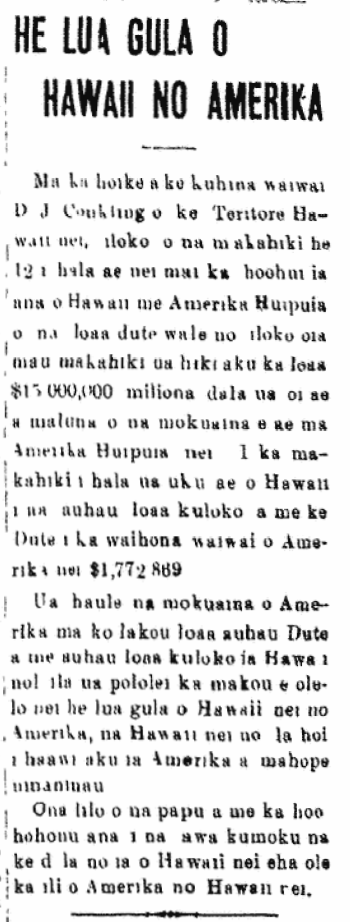
According to the report by the treasurer of the Territory of Hawaii, D. L. Conkling, in the 12 years which have passed since the annexation of Hawaii to America, the income just from duties during that time come to more than $15,000,000, more than the other states of the United States. In the past year, Hawaii paid $1,772,869 in income taxes and duties to the coffers of America.

The rest of the states fell behind Hawaii in duties and income taxes, and therefore what we say about Hawaii being a gold mine for America is true; it is Hawaii who gave it to America then asked questions.

All of the expenses for the forts and the dredging of the harbors are paid for by Hawaii’s dollars, and America suffers nothing for Hawaii.

(Kuokoa Home Rula, 8/11/1911, p. 1)

HE LUA GULA O HAWAII NO AMERIKA

Kuokoa Home Rula, Buke IX, Helu 32, Aoao 1. Augate 11, 1911.

“Missionary Herald,” 1821–.

 Here is another reference available online. This publication was put out by the American Board of Commissioners for Foreign Missions (ABCFM), reporting home to America on their work throughout the world. Of particular interest to us is what they say about Hawaii. Here for instance is an article appearing in the year of the overthrow, 1893.

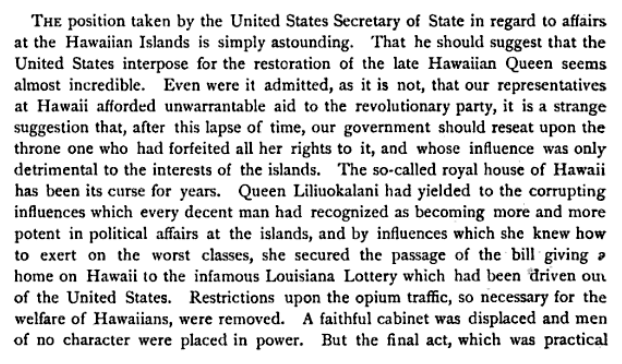
The position taken by the United States Secretary of State in regard to affairs at the Hawaiian Islands is simply astounding. That he should suggest that the United States interpose for the restoration of the late Hawaiian Queen seems almost incredible. Even were it admitted, as it is not, that our representatives at Hawaii afforded unwarrantable aid to the revolutionary party, it is a strange suggestion that, after this lapse of time, our government should reseat upon the throne one who had forfeited all her rights to it, and whose influence was only detrimental to the interests of the islands. The so-called royal house of Hawaii has been its curse for years. Queen Liliuokalani had yielded to the corrupting influences which every decent man had recognized as becoming more and more potent in political affairs at the islands, and by influences which she knew how to exert on the worst classes, she secured the passage of the bill giving a home on Hawaii to the infamous Louisiana Lottery which had been driven out of the United States. Restrictions upon the opium traffic, so necessary for the welfare of Hawaiians, were removed. A faithful cabinet was displaced and men of no character were placed in power. But the final act, which was practical…

(Missionary Herald, 12/1893, p. 510.)


The position taken...

The Missionary Herald, Volume LXXXIX, Number XII, Page 510. December 1893.

…suicide of the monarchy, was the attempt on her part to abrogate the Constitution and by sheer force establish a new one of her own making. Even her subservient ministers refused to endorse the scheme, yet she insisted upon it and sought to incite the populace to stand by her in her autocratic plans. It was then that all the better classes united as one man and deposed her. Never was there a revolution more warranted by facts, never was one more peacefully accomplished, and a queen of worthless character was set aside and the monarchy by its own act came to an end. If Minister Stevens or the commander of the Boston erred in judgment in any transaction, which we are not prepared to admit, yet there is no valid ground for the interference of our government to reverse the revolution months after it was consummated. We do not speak here of the political question as to what it is expedient for the United States to do in reference to a protectorate or to annexation. Opinions of these points may differ, but it would seem as if there were no room for difference of opinion in regard to this question of reestablishing the old monarchy on Hawaii. The best portion of her citizens have asked for some form of connection with the United States. Our government has a perfect right to say yes or no to all these proposals. And the Provisional Government at Honolulu has a right to say to us, “Either accept our proposal or hands off.” We regret to be obliged to speak in such terms of propositions that come from our national administration. We certainly should not do so did we not believe that any attempt to restore the Hawaiian Queen to her throne would be a gross outrage, and would be followed by the most serious consequences to the moral and religious interests of the islands, as well as to their material prosperity. We cannot think that our people will tolerate any intervention which has for its object the replacing upon the throne of a sovereign whose influence will be only for evil.

(Missionary Herald, 12/1893, p. 511.)

Continue reading

On Aloha Aina, 1893.

“Breathes there a man with soul so dead,
Who never to himself hath said,
This is my own my native land.”
(Scott.)

Many of those who support honestly the present state of affairs, have done so in the full hope and belief, that thereby the flag of their country—the Stars and Stripes—will float over the land in perpetuity. Not a single Hawaiian, however, even those few whose signatures to annexation petitions (not 200 in number and mostly convicts.) have been bought or forced by necessity from them, desires to see any foreign flag replace his own. Continue reading

Queen Liliuokalani, 1902.

SUPPORTS THE DELIVERER OF THE PEOPLE.

QUEEN LILIUOKALANI.

THE PICTURE ABOVE IS THE NEWEST OF QUEEN LILIUOKALANI, TAKEN RECENTLY BY MR. DAVEY, THE PHOTOGRAPHER OF THIS TOWN.

THE ROYAL AUNT LILIUOKALANI REVEALED HER THOUGHTS TO THE ALII KUHIO, SAYING: “IF YOU KNOW THAT THIS IS THE MEANS TO GAINING OUR WELL-BEING, THEN DO IT.”

(Kuokoa, 10/24/1902, p. 1)

KAKOO I KA HOOPAKELE O KA LAHUI.

Ka Nupepa Kuokoa, Buke XL, Helu 43, Aoao 1. Okatoba 24, 1902.

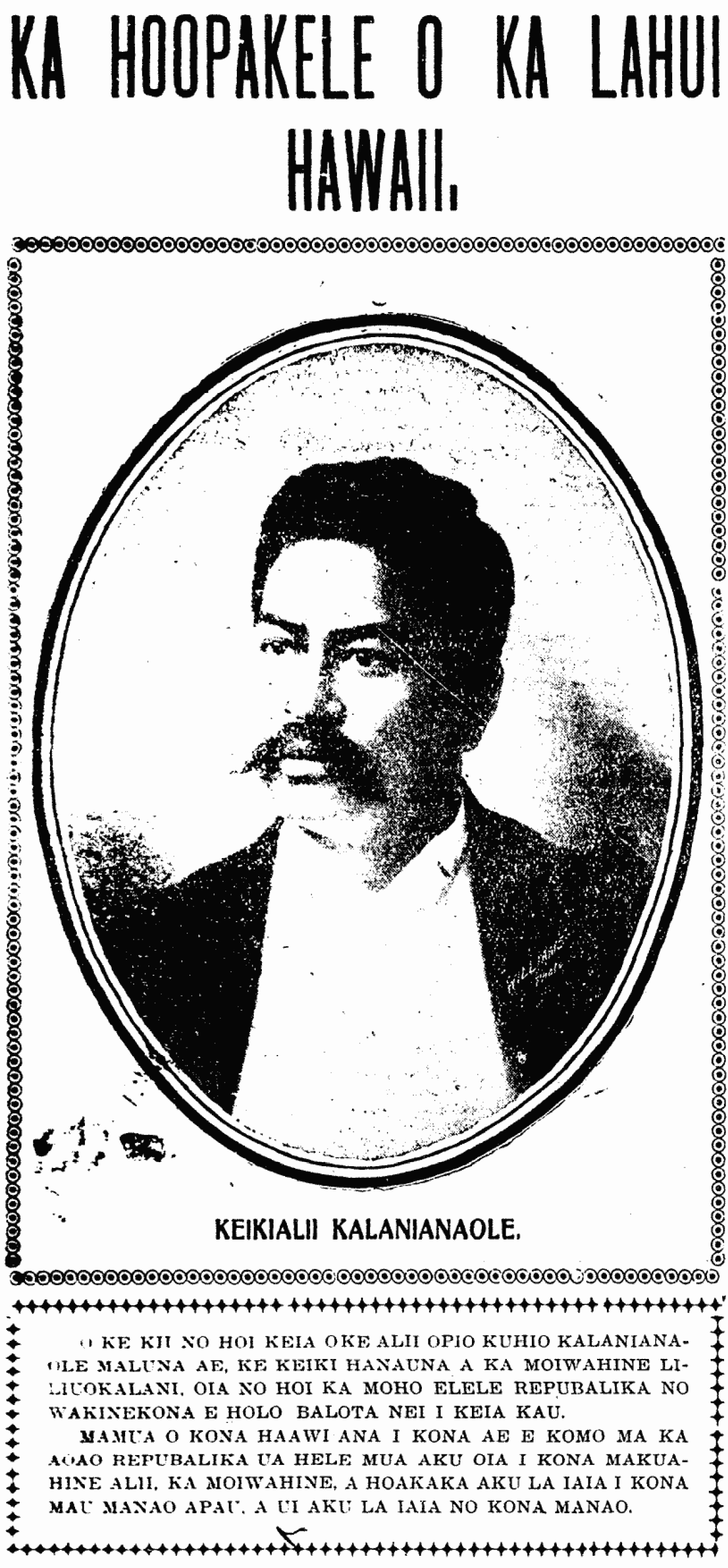
Jonah Kuhio Kalanianaole, 1902.

THE DELIVERER OF THE HAWAIIANS.

PRINCE KALANIANAOLE.

THE PICTURE ABOVE IS OF THE PRINCE KUHIO KALANIANAOLE, THE NEPHEW OF QUEEN LILIUOKALANI; HE IS THE REPUBLICAN CANDIDATE FOR THE REPRESENTATIVE TO WASHINGTON RUNNING THIS SEASON.

BEFORE HE AGREED TO JOIN THE REPUBLICAN PARTY, HE WENT FIRST TO HIS ROYAL AUNTY, THE QUEEN, AND EXPLAINED TO HER ALL OF HIS THOUGHTS, AND ASKED FOR HER THOUGHTS.

(Kuokoa, 10/24/1902, p. 1)

KA HOOPAKELE O KA LAHUI HAWAII.

Ka Nupepa Kuokoa, Buke XL, Helu 43, Aoao 1. Okatoba 24, 1902.

More on Mrs. Heleluhe going to take the place of Kahele Nahaolelua, and name variations, 1897.

MRS. HELELUHE HEADED FOR AMERIKA.

Because Mrs. Kahele Nahaolelua has been away from the presence of the Queen due to her illness, Mrs. Vakeki Heleluhe has been ordered to  seek out the Royal One in Washington; she will be leaving the mother land on the Australia of this next Wednesday, May 5th, for the skin-nipping cold of America, and while she is treads through San Francisco, her care will be under the guidance of J. A. Palmer [Pama], the Queen’s secretary. And for you, O Mrs. Vakeki Heleluhe, is our prayer, that your ocean voyage be accompanied by God’s protection and may he put you ashore on dry land in good health, and may he be with you on water and on land. And when you meet with the Heavenly Alii of the lahui, give the royal one our great aloha.

[According to David Forbes, from the new edition of “Hawaii’s Story,” Mrs. Heleluhe was sometimes referred to as “Waikiki”. Here we see her as “Vakeki”.

See another article on Mrs. Heleluhe’s departure here.

Also, to be added to the index of the new edition should be:

Heleluhe, Wakeke Ululani, 106, 258, 338, 385, 391]

(Aloha Aina, 5/1/1897, p. 6)

MRS. HELELUHE NO AMERIKA.

Ke Aloha Aina, Buke III, Helu 18, Aoao 6. Mei 1, 1897.

On this day, perhaps it is appropriate to remember further indignity faced by the Queen, 1901.

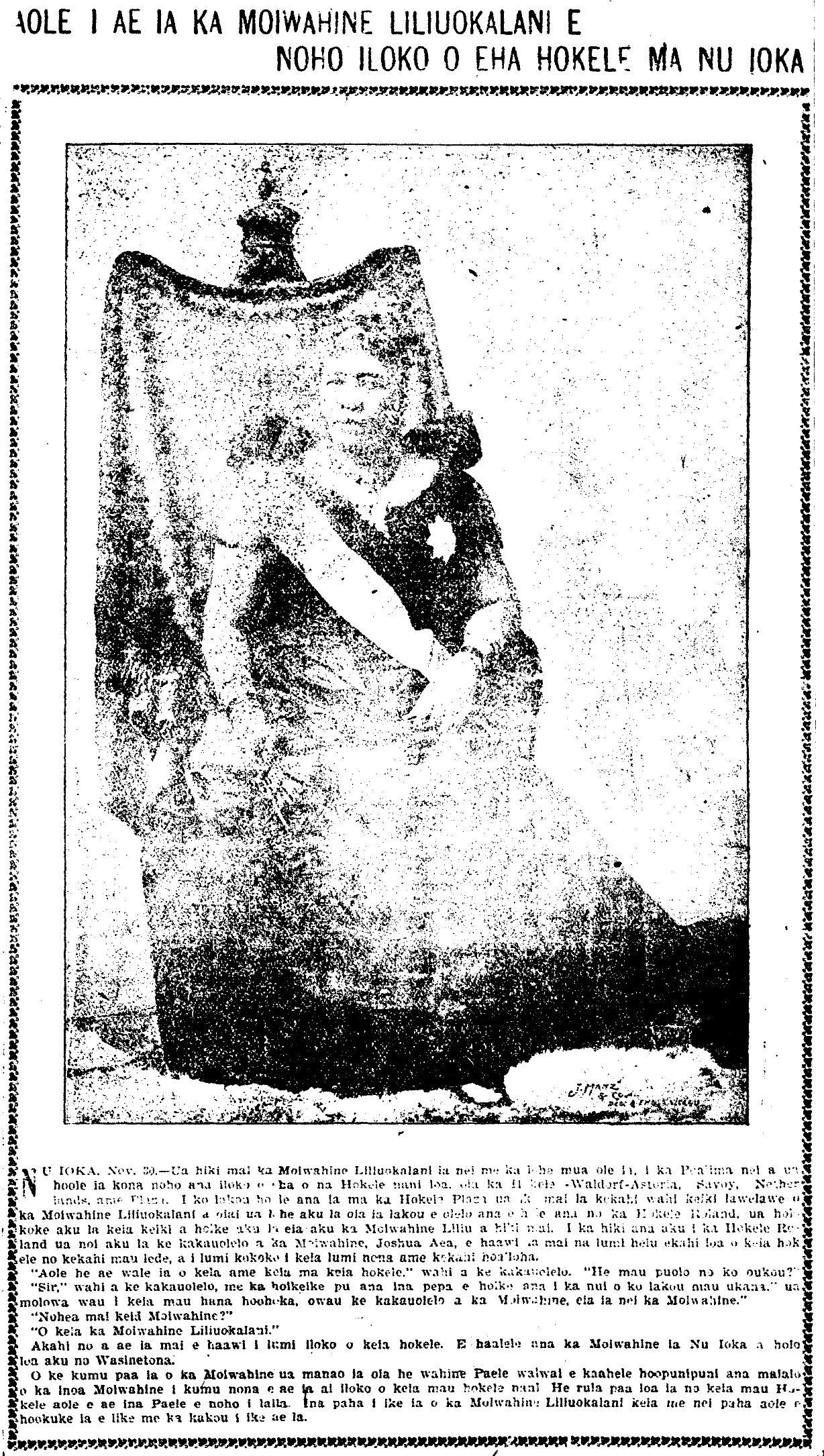
Queen Liliuokalani was Refused Stay at Four Hotels in New York.

New York. Nov. 30.—Queen Liliuokalani arrived here last Friday unannounced, and she was refused stay at four posh hotels: The Waldorf-Astoria, Savoy, Netherlands, and Plaza. After being refused by the Plaza, one of the Queen’s servants saw this and and being that he heard them saying they were headed to the Hotel Roland, he went at once and announced that the Queen would be arriving. When Joshua Aea, her secretary, asked for their best room for some ladies, and for a room nearby for him and his friends.

“Not just anyone is allowed admittance here to this hotel,” said the hotel staff [“kakauolelo” seems to be a misprint]. “Do you have baggage?”

“Sir,” the secretary said while showing a list of their baggage, “I have had enough of all of these frustrations; I am the secretary of the Queen; the Queen is here.”

“Where is this Queen from?”

“This is the Queen Liliuokalani.

Only then was a room in the hotel given. The Queen will be leaving New York for Washington.

The reason  the Queen was barred was that she was thought to be a rich Black [Paele] woman going around trying to pass as a Queen, so that she would be allowed to stay at these beautiful hotels. All of those hotels have a policy not to allow Blacks to stay there. Perhaps if they knew she was the Queen, perhaps she would not have been driven off as we have seen above.

(Kuokoa, 12/13/1901, p. 1)

AOLE I AE IA KA MOIWAHNE LILIUOKALANI E NOHO ILOKO O EHA HOKELE MA NU IOKA

Ka Nupepa Kuokoa, Buke XXXIX, Helu 24, Aoao 1. Dekemaba 13, 1901.

Queen Emma affronted, 1866.

We Do Not Approve.

As we read the words which President Johnson spoke at his audience with Queen Emma, we nearly ridicule them. Were he instead the greatly beloved Abraham Lincoln, were it perhaps during his time, then the words would have been splendid. He was a very humble man, whereas this President is arrogant. It is unfortunate that it was him, and that he is the head of the Nation which we love. Here are his good for nothing words:—

“I offer you my esteem as you enter the Nation’s capital, for a people of 30,000,000” [He knows that Hawaii is a tiny Nation, and is boasting of America’s greatness.] “It is not because you are Royalty that I give you my regard, but because you are a woman who has looked out for the interest of your people.” [What is wrong with showing aloha in her Royal status?] “I can say that in our country, we are all royalty, we are all Kings and Queens. Therefore, when you speak to one of our people, you are speaking Monarch to Monarch.” [Queen Emma is aware of how America is; what purpose does it serve to speak those words in a welcoming address? You’d imagine that he would have words of aloha for Hawaii. America couldn’t be more against their President [? Oi ole kue ko Amerika i ko lakou Peresidena].

[Johnson’s speech as quoted in Memphis, Tennessee’s Public Ledger of August 24, 1866, is as follows:

“I am most happy to renew to your Majesty the assurances of profound regard and esteem made to you by the Acting Secretary of State, and it affords me pleasure to offer you a cordial welcome to the capital of these United States, the seat of government for over thirty millions of people. And in according you this earnest welcome, permit me to assure you that it is not because you bear the title of Queen; it is induced solely by the prestige that has preceded you, that has assured us of your virtues as a woman, and especially of your efforts in the cause of Christianity, civilization and education among the people of your country. It is more on that account than of the rank or appellation that you bear. If I were disposed to be facetious on this occasion, I might say that while none of the people of these United States wear crowns, while no man is acknowledged as a king and no woman as a queen, yet while you are here in these United States, you will have none but queens to associate with.”]

(Kuokoa, 10/27/1866, p. 3)

Makemake ole.

Ka Nupepa Kuokoa, Buke V, Helu 43, Aoao 3. Okatoba 27, 1866.

Local coverage of Queen Emma’s visit to New York, 1866.

LOCAL NEWS.

NEW YORK AND THE VICINITY.

Movements of the Queen Dowager of Hawaii—She attends church twice yesterday—Interesting interview with deaf mutes—Queen Emma passed a comparatively quiet day on Saturday. She had her photographs taken in various positions at two photographic galleries in the morning, being accompanied by Miss Spurgin, Major Hopkins, her maid servant, and Mr. John Welsh. She also, in company with Miss Spurgin, did some shopping on Broadway during the day. The Rev. Dr. Gallaudet, Rector of St. Ann’s Church for Deaf Mutes, visited Her Majesty in the evening, and invited her to attend his church yesterday. The invitation was accepted. Gen. Darling and Col. Gerhard, of Gov. Fenton’s staff, also called and extended a formal invitation to the Queen to visit Albany, which she promised to do on her return from Boston, in the evening Her Majesty and suite dined with Hon Moses H. Grinneli and suite, and at 10 o’clock the royal party returned to the Brevcort House.

Early yesterday morning Old Trinity was crowded in every part by visitors, who, from appearances, had been attracted there by the announcement that the Queen would be present. At about half-past ten  her Majesty entered the Church accompanied by her suite, and proceeded up the main aisle, proceeded by the sexton and Rev. Dr. Vinton, who conducted her to the pew which the Prince of Wales occupied when he was here. The royal [unclear line] In the first pew were her Majesty Queen Emma, and Mr. Odel (Hawaiian Consul) and [unclear] Second—Major Hopkins, Miss Spurgin, and Mr. Chilton, Government Agent from Washington. Third—Mr. John Walsh, Mr. J. V. B. Marshall and the Swiss maid servant. As her Majesty entered the pew she knelt and remained some moments in silent prayer, and as she rose an elegant prayer book bearing a suitable inscription, and bound in royal purple with illuminated rubrics was presented to her. A suitable writing was also within the book, staiting that it was presented to her Majesty in memory of her visit and her fellowship with the Apostolic Church. Morning prayer was intoned throughout by the Rev. Dr. Vinton; the first lesson was read by Rev. Joseph J. Kinegood, of Eastern Pennsylvania. The second by Rev. Sidney Corbett, of Quincy, Ill. In the ante-communion service the epistic was read by Rev. Mr. Elesegood, and the gospel by Rev. Dr. Vinton. The music was splendid and consisted of Onseley’s service in G. the anthem, “O! Lord our Governor.” Ps. VIII, V. 1, 3, 4, by Marcello, also in G. This was the anthem sung at the Coronation of the Queen of England, and at the visit of the Prince of Wales to Trinity Church. The 41st hymn concluded the musical portion of the exercices. The solos were by Master Knowles and Mr. Yatman. In the anthem both organs were used, as they were in the [unclear] Voluntary (hallelujah chorus) Organists, Mr. W. A. M. Diller and Mr. Arthur G. Messeter. In the morning service the prayer for a safe return from sea was said, it having special reference to the Royal party. The Rev. Dr. Vinton preached the sermon from the words, “If I perish, I perish.” Esther IV: 16. He gave an account of the deposition of Queen Vashti and the elevation of Queen Esther, and remarked that this must have been no chance work, but was pre-ordained by the Almighty for the preservation of her people. He concluded by directing all to do their duty fearlessly in this world and Christ would hold out the golden sceptre of his love to those and bring them to this presence. A collection was then taken up for the benefit of the church in the Sandwich Islands, after which the congregation retired. As the Queen entered her carriage she was loudly cheered by the crowds who had collected outside the church. The party then retired to the hotel. The Queen and suite again attended St. Ann’s Church on Eighteenth street, near Fifth avenue, at 3 1/2 P. M. and witnessed the service for deaf mutes. The Rev. Dr. Gallandet explained many of the signs before the service commenced and stated some interesting circumstances connected with the church. The services were conducted by Rev. Dr. Vinton, and the sermon was preached by the Rev. Eastman Benjamin, the whole being interpreted by Rev. Dr. Gallaudet in the sign language. At the close an address was delivered by Rev. Dr. Vinton, who stated that the present was an occasion of thankfulness, inasmuch as a lady born in one of the isles of the sea and who had been lifted to a throne, had come among them to witness the miracle which had been performed, of causing the deaf to hear and the dumb to speak. It was delightful to show this miracle to her Majesty, whom God had made the instrument of making a nation Christian, which only a few years ago had been steeped in heathenism. She was now on a mission for the purpose of raising houses of mercy in her own land, and he hoped God would prosper it. By invitation, the Queen and suite remained after service, and a number of questions were asked the mutes and answered. Her Majesty, who by the way writes an elegant female hand, wrote the following, and handed it to one of the lady deaf mutes:—”My delight has been very great at being able to have prayed with you this day. I shall always remember brothers and sisters in you here when I am far away in my own land, far off, in my prayers. Do you believe we shall meet in Heaven and why?—Emma R.” The lady mute immediately wrote the following—”We, deaf mutes, are very happy to see her Majesty Queen Emma, of the Sandwich Islands to-day; and moreover we are greatly delighted in sitting with you in the house of the Lord. For myself I believe that there will be a mutual recognition in heaven.” Her Majesty then shook hands with several of the mutes, and also with the clergyman. She was accompanied to the carriage by the Rev. Dr. Gallaudet, who pressed her hand  and said, “God bless you.” She thanked him with a smile, and was driven to the hotel. This morning the Queen and suite will take the eight o’clock train to Philadelphia, en route to Washington. Mr. Cheiton, the special envoy from Mr. Seward, will accompany the royal party. The Queen will be received at Washington by Attorney General Stansbury, Acting Secretary of State.

(New York Sun, 8/13/1866, p. 1)

LOCAL NEWS.

The New York Sun, Year 33, Number 10,629, Page 1. August 13, 1866.