John Harbottle visits Hilo, 1943.

Just in Hilo.

This past week the kamaaina of the land renowned for the Apaapaa Wind, of Kohala with its hills that move along together, Kalahikiola and Pili, that is John Harbottle, and after some days he returned to his famous lands.

Looking at him, he is still in good health, he has not changed, as if it is still in the days of his youth, when I first met him 27 years ago, when I arrived in his famous aina.

He spent some days with his daughter and son-in-law, Mr. and Mrs. Eddie Nelson, of Keaukaha.

(Hoku o Hawaii, 9/8/1943, p. 1)

Ka Hoku o Hawaii, Volume XXXVIII, Number 20, Aoao 1. Sepatemaba 8, 1943.

Ka Hoku o Hawaii, Volume XXXVIII, Number 20, Aoao 1. Sepatemaba 8, 1943.
Anyone know who Laulani Koki is? 1890.

HE INOA NO LAULANI KOKI

Hanohano Hanalei i ka ua nui
He pakika i ka limu o Manuakepa
Anu hewa i ka wai o Lumahai
Kalehuamakanoe o Luluupali
Alai e ka noe paa o Naue
E ena Haena i ka ehukai
I maliu i ke ala o ka lauae
A heaha ka hana a Lohiau ipo
O ka li’a i ka wai Kuauhoe
O ka nihi a ke ahi i Makuaiki
Haaheo i ka haka o Nualolo
Ka anohi uakoko i ka moana
Wehiwehi Polihale i ka Pahapaha
I ka lei makahehi a ka malihini
Ua nani Mana i ka liula
Ka anapa ka alohi aiai na ike
Ike i ke one kani o Nohili
Kohu Vaiolina ke hone mai
Haina ia mai ana ka puana
O Halia Laulani ko’u inoa. Continue reading

David Kanealii and his new wife visits the home of his parents, 1918.

SEEING THE BELOVED HOME OF MY PARENTS.

O Editor of the Nupepa Kuokoa:—Please have patience for my package that I put before you, and place it upon one of the open decks of our newspaper, which will send it out so those from Hawaii Island will see it and those of Lehua Island will hear it.

On the 14th, Mrs. Napewai [Naapuwai] Kanealii and her husband D. Kanealii left this town and went to Kauai, and in the morning of the 15th, we landed in Nawiliwili, were taken by the tossing of the machine to Wainiha and were lovingly welcomed in the home of Joseph Kanealii. Continue reading

Wahi Pana of Oahu nei, 1899.

[Found under: “NU HOU HAWAII”]

I ka i’a hamau leo—ikea ke kula o Kaupea—kiei ia Nanakuli—oku ana kahi mea hewa—hoomaha i Poka-i—kaalo ae o Mauna Lahilahi—lele mai Makaha me he ao opua la—”malolo kai me moana kai” ka’u i lohe—ne hone ana ke one kani o aMkua [Makua], alawa iho oe ma ka aoao, he neneeia na ke one opiopio—hoea i Keawaula—ike ia Kilauea—noho mai Pohaku-o-Kauai—maopopo ka Lae-o-Kaena—ike i ka pohaku olelo—maalo ana Leina-a-ka-Uhane—o ana i Aiea—pawehe o Kawaihapai—laula o Mokuleia—hoea makou ilaila, ua hele a Walikanahele—O Waimea i ka pohina a ka noe, pulupe i ka hunakai—pupuu a hoolei loa “na u o Lewa” kau iluna—hoaumoe i Kihene, ilaila makou ike i ka iniki huihui a ke kehau—hooipo me Laieikawai, i ke kiowai kapu o Waiapuka.

(Kuokoa, 1/20/1899, p. 3)

I ka i'a hamau leo...

Ka Nupepa Kuokoa, Buke XXXVIII, Helu 3, Aoao 3. Ianuari 20, 1899.

For you mele people, check this one out on Kahuku lewa, 1922.

E KUIIA ANA A LAWA PONO NA WAHI PANA LEI KAU A-I NO KAHUKU LEWA

He iki wale no o Kahuku lewa,
Aole e puni i ke Anahulu po,
O ka lae o Kahipa kau mailuna,
E huli pono ana i ka hikina.
Na Waiuolewa kau maluna,
Alewa iluna a lewa ilalo,
O ka luahuna ae ia a Maui,
O Kaalae nui Huapi.
O Kaauhelemoa a he moa ia,
O ka hoa paio o Kamapuaa!
O Kaniakamoa a he haka moa ia,
Na ke alii Olopana Oahu nei
A polou au, louia a paa,
I ole e panee ka holo ohope,
A punamano au ike i ka u’i.
Na pou olelo me ka uwila,
O ke amia aku ia a ka mano,
A na misini e hoohana nei,
A punahoolopa he naele aku ia,
I ka lua o ke kaau hoi ae oe,
O ke aiwa aku ia o kanana,
O ke kupaianaha a olalo aku,
O kapukaulua a he loko ia, Continue reading

Lohiauipo’s house disappears, 1892.

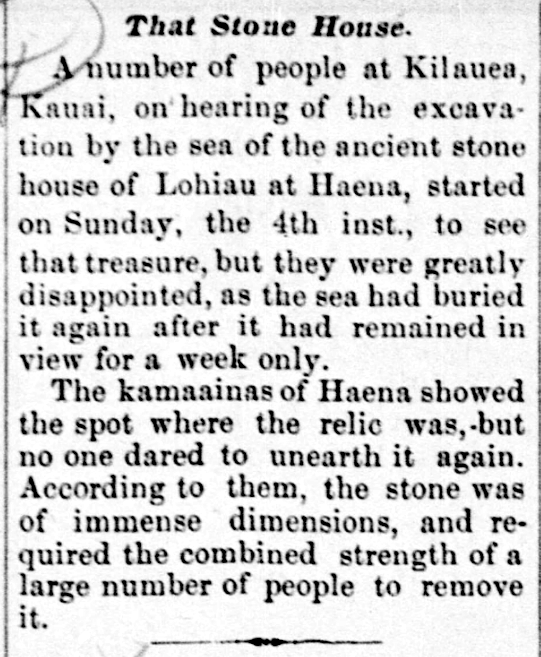
That Stone House.

A number of people at Kilauea, Kauai, on hearing of the excavation by the sea of the ancient stone house of Lohiau at Haena, started on Sunday, the 4th inst., to see that treasure, but they were greatly disappointed, as the sea had buried it again after it had remained in view for a week only.

The kamaainas of Haena showed the spot where the relic was, but no one dared to unearth it again. According to them, the stone was of immense dimensions, and required the combined strength of a large number of people to remove it.

(Pacific Commercial Advertiser, 12/13/1892, p. 3)

That Stone House.

The Pacific Commercial Advertiser, Volume XVI, Number 3251, Page 3. December 13, 1892.

More on the stone house of Lohiau, 1892.

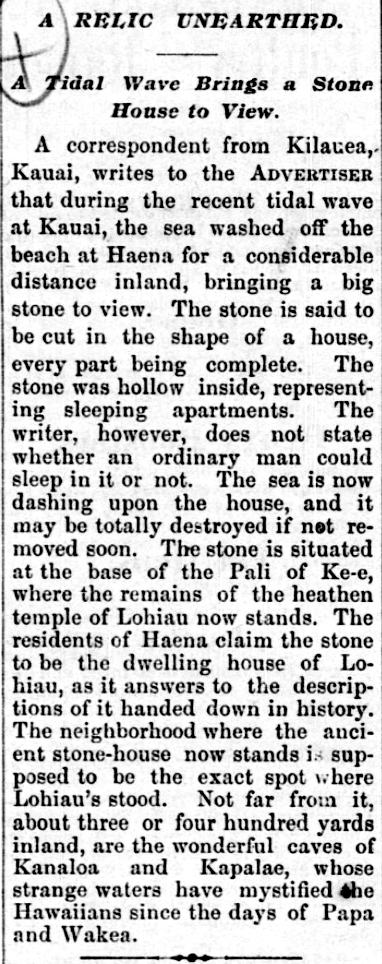
A RELIC UNEARTHED.

A Tidal Wave Brings a Stone House to View.

A correspondent from Kilauea, Kauai, writes to the Advertiser that during the recent tidal wave at Kauai, the sea washed off the beach at Haena for a considerable distance inland, bringing a big stone to view. The stone is said to be cut in the shape of a house, every part being complete. The stone was hollow inside, representing sleeping apartments. The writer, however, does not state whether an ordinary man could sleep in it or not. The sea is now dashing upon the house, and it may be totally destroyed if not removed soon. The stone is situated at the base of the Pali of Ke-e, where the remains of the heathen temple of Lohiau now stands. The residents of Haena claim the stone to be the dwelling house of Lohiau, as it answers to the descriptions of it handed down in history. The neighborhood where the ancient stone-house now stands is supposed to be the exact spot where Lohiau’s stood. Not far from it, about three or four hundred yards inland, are the wonderful caves of Kanaloa and Kapalae, whose strange waters have mystified the Hawaiians since the days of Papa and Wakea.

(Pacific Commercial Advertiser, 12/5/1892, p. 3)

A RELIC UNEARTHED.

The Pacific Commercial Advertiser, Volume XVI, Number 3244, Page 3. December 5, 1892.

The appearance of the lost hale of Lohiau in Haena, 1892.

THAT AMAZING STONE BUILDING

Some people from Kilauea, Kauai, when they heard that that ancient stone house of Lohiau in Haena was dug up by the sea and visible, they went immediately on Sunday, the 4th of this month to witness one of the famous ancient places of Kauai. However, they were dumbfounded that the stone structure was reburied by the sea after being visible for but a short week.

The kamaaina of Haena pointed out where they saw that relic, however, none of them was willing to attempt to dig it up again. Because they saw that it was a massive rock, and its size was fantastic, and that it would be a feat for them to re-raise that rock; this would only be possible with a huge amount of people, and that is why they thought that; or perhaps, that this was a magical occurrence, and just as its appearance was wondrous, so too was its disappearance.

[It is unfortunate that there are no digital images of this important newspaper available online yet.]

(Hawaii Holomua, 12/15/1892, p.2)

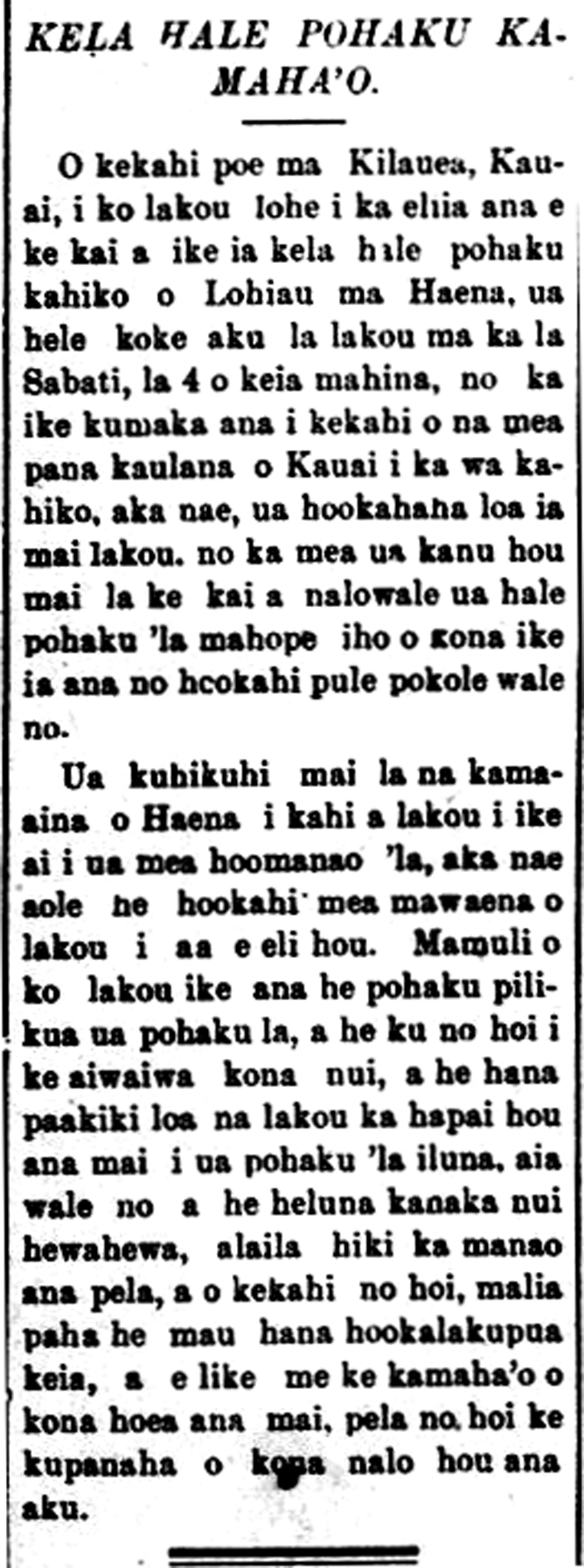
KELA HALE POHAKU KAMAHA'O.

Hawaii Holomua, Buke III, Helu 120, Aoao 2. Dekemaba 15, 1892.

Storied places of Kiholo and Luahine Wai, 1923.

THE PLEASURES OF TIME

Luahine Wai

It is a big pool close to Kiholo and Laemano. It is a famed bathing spot for the alii of old. Its waters are numbing, and it is said that one cannot swim its circumference because it is cold like ice water.

It is said that within this pond is a hole where you enter into a hidden cave where the bones of the old chiefs are laid. It is said that Kamehameha’s bones are there as well. As for the truth of it all, it is not certain, until some living person enters this hidden cave; then there will be a witness to verify what is in this cave.

This pond is about 5 fathoms deep at its deepest, which is at its center, where it is very cold. And if you dive to the bottom, you will soon feel your body grow cold, and you won’t be able to stay there long. You will shoot up and swim for the edge.

A person that dives down to that deep area will turn red, like the red of coral [? puko’a] Continue reading

Newspapers, translation, and a mele for the Merrie Monarch, 1913 / Timeless.

You can find various translations for the beautiful song, “Kaipoleimanu” in the archives of the Bernice Pauahi Bishop Museum, online, and on liner notes. None however seems to acknowledge that Kaipoleimanu itself was a wahi pana, along with its neighboring hau of Maihi, ulu of Weli [also seen as Wehi], and hala of Mapuana.

There is a priceless church meeting report/travelogue appearing in the Kuokoa from 12/5/1913 to 2/6/1914: Ka Ike Hou ana o ke Kamahele i ka Mokupuni o Kauai [The Traveler Sees Once More the Island of Kauai], signed, Kamahele. Amongst all the fascinating information found in this report is a description of the places hearkened to in the mele Kaipoleimanu, to which the traveller is taken by his guide, the Deputy Sheriff of Hanalei, William Werner. He says: Continue reading