Hawaiian-Language Newspapers and the past and the future, 1906.

The History of Your Native Land.

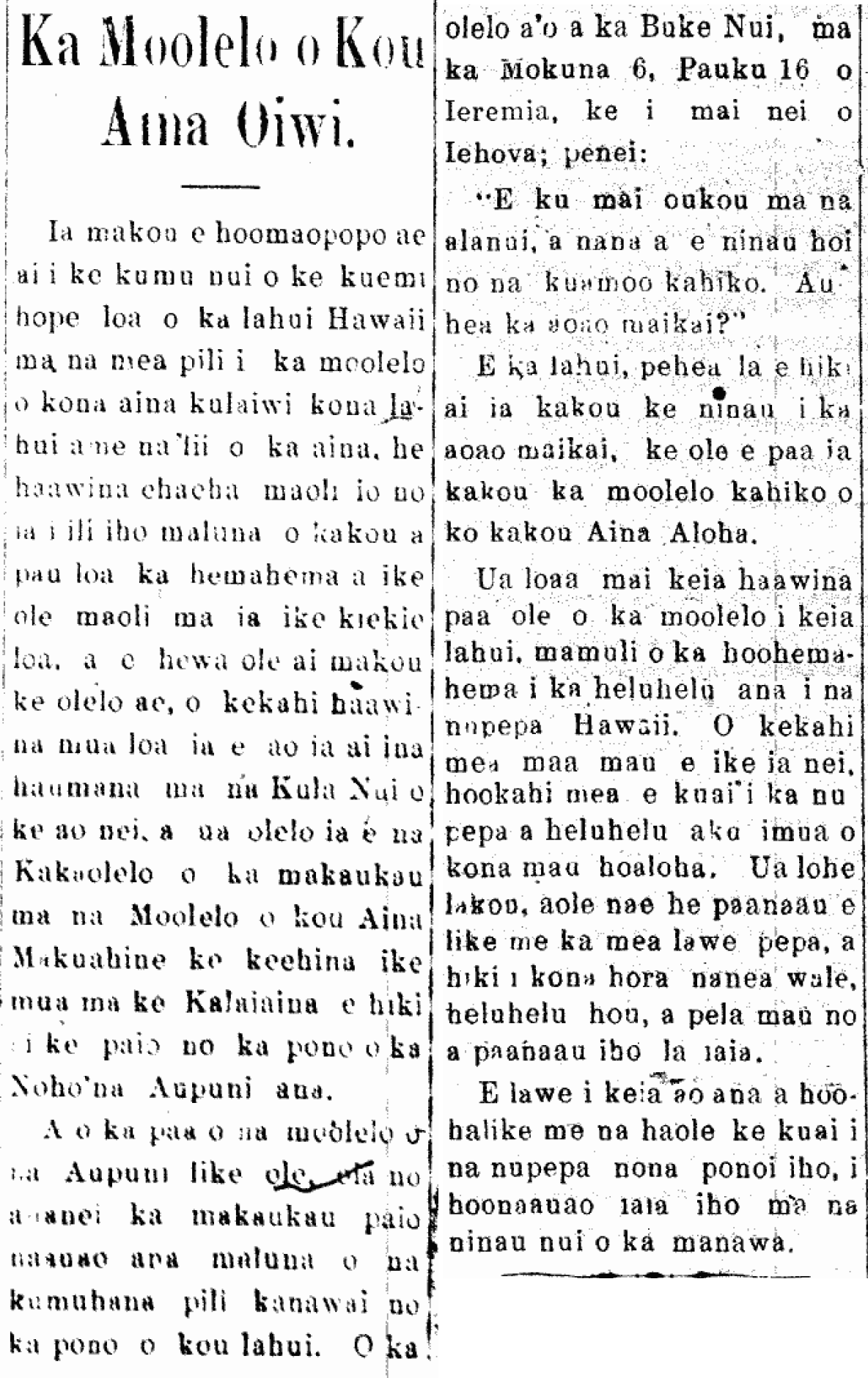
As we contemplate the main reason for the falling far behind of the Hawaiian people in matters dealing with the history of their homeland, their lahui, and the alii of the land, we are all racked with intense pain at the haphazard and total lack of knowledge in this terribly important study; and it would not be wrong for us to say that it should be one of the first subjects that should be taught to the students at schools of higher education across the world; and it is said by the Orators that being knowledgeable in the History of your Motherland is the first step in Politics where you’d be able to fight for the good of the Rule of the Nation.

And understanding the histories of all Nations is what will prepare you to fight intelligently on legal grounds for the benefit of your lahui. In the teachings of the Great Book, in Jeremiah 6:16, Jehovah says to us:

“Stand ye in the ways and see and ask for the old paths. Where is the good way?”

O Lahui, how will we be able to ask of the right way if we do not know the old history of our Beloved Aina?

This lack of knowledge of the history of this people comes from not consistently reading the Hawaiian newspapers. Something frequently seen is one person buying a paper and reading it before his friends. They hear it but they don’t retain it like one who subscribes to the paper, who can re-read it at his leisure and thus commit to memory the information.

Learn from this instruction, and do as the haole, who buys his very own newspapers to educate himself in current events.

[The Hawaiian-Language Newspapers is a massive history book—a history on the most part told by Hawaiians living while the “history” was happening. As it was argued more than a hundred years ago, in order to fight for things like Sovereignty, Land, and Water, shouldn’t we know the history as told by Hawaiians? Perhaps we shouldn’t focus solely on what is written down in law books, but also on what Hawaiians actually said and did about these laws, about water rights, about land ownership, about fishing bans, etc., etc. etc.?

For sure this is no easy task. The original newspapers aren’t going to last forever. The current images for many of them are not totally clear (if there are images at all). They need to be word-searchable so that if you search for something, you will find it. There needs to be more people doing translations of them. But then again, Kamehameha Paiea didn’t exclaim, “Forward my younger brothers and drink of the sweet waters”…]

(Na’i Aupuni, 1/17/1906, p. 2)

Ka Moolelo o Kou Aina Oiwi.

Ka Na'i Aupuni, Buke I, Helu 44, Aoao 2. Ianuari 17, 1906.

Water pipes laid in town, 1912.

[Found under, “Local News”]

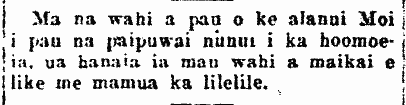
All through King Street the large water pipes have all been laid, and those areas have been repaired so that they are as lustrous as ever.

(Kuokoa, 2/16/1912, p. 8)

Ma na wahi a pau...

Ka Nupepa Kuokoa, Buke XLVIII, Helu 6, Aoao 8. Feberuari 16, 1912.

Kuhio and the water of Wahiawa, 1912.

KUHIO OPPOSES THE SALE OF WAHIAWA’S WATER

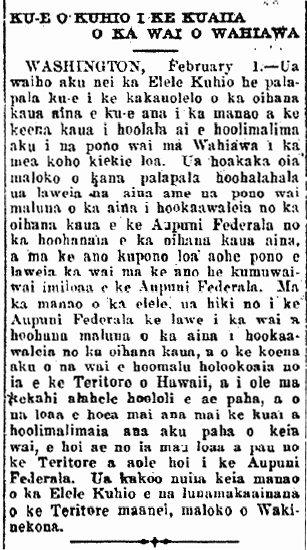
WASHINGTON, February 1.—Delegate Kuhio submitted a protest to the secretary of the department of war opposing the plan announced by the war department t0 lease out the rights to the water rights of Wahiawa to the highest bidder. He clarified in his complaint that the land and water rights of lands set aside for the military by the Federal Government for the use of the military, and by right it is improper that the water be taken as an income-making commodity for the Federal Government. The delegate feels that the Federal Government is allowed to take and use the water on the lands set aside for the military, but the the entirety of the remaining water should fall under the authority of the Territory of Hawaii; or perhaps a different route, that the income made from sale or lease of this water should all come back to the Territory and should not go to the Federal Government. This idea of Delegate Kuhio’s  is greatly supported by the representatives of this Territory in Washington.

(Kuokoa, 2/16/1912, p. 5)

KU-E O KUHIO I KE KUAIIA O KA WAI O WAHIAWA

Ka Nupepa Kuokoa, Buke XLVIII, Helu 7, Aoao 5. Feberuari 16, 1912.

Lahainaluna School news, 1867.

Items from Lahainaluna College.

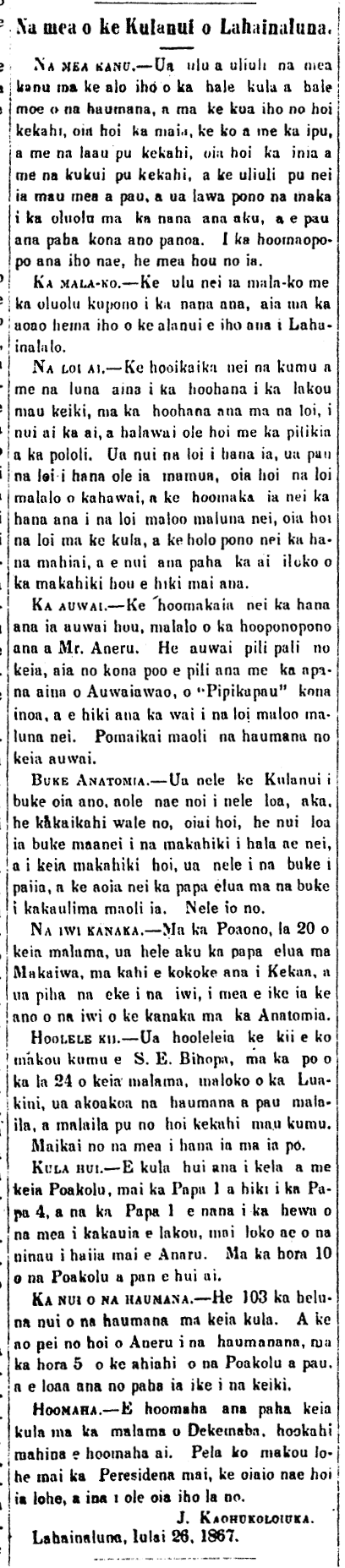
Crops.—The plants are thriving in front of the school house and the student’s dormitory, as well as in the back; those being: bananas, gourds, and trees as well, such as the pride of India, and kukui, which are all also thriving; it is very pleasant to look at, and the barrenness will perhaps be no more. But this is a considerably new thing.

The sugar cane patch.—The cane patch seems to be growing well, it is on the left side of the road going down to Lahainalalo.

The taro patches.—The teachers and land supervisors are putting effort into working the students in the patches to increase food so that they will not face problems with hunger. The patches being worked are large, and the loi that were not used before are being worked, those being the ones below the river, and the ones above it are starting to be worked (the ones at the school), and the farming is going well, and the taro production will perhaps increase in this upcoming year.

The canal.—The new auwai is being started under the direction of Mr. Andrews. This auwai runs next to the pali, and it’s source is in the district of Auwaiawao; it is called “Pipikapau” and the water will reach the dry patches here above. The students will be truly blessed by this auwai.

The anatomy book (“Anatomia”).—The College is lacking a volume of this type, but it is not totally without, there are a few; although there were a great many in the past years, this year, they are without the printed book, and the second class is being taught from a handwritten book. They are terribly lacking.

Human bones.—On Saturday, the 20th of this month, the second class went to Makaiwa, close to Kekaa, and bags were filled with bones so that they could see the kinds of bones as in Anatomia.

Lantern slides.—Pictures were projected by our instructor, S. E. Bishop, on the night of the 24th of this month in the Church; all the students gathered together, and also there were some of the teachers.
The activities that night were fine.

Joint school.—Every Wednesday, all the grades join together, from the 1st class to the 4th, and the 1st class checks the mistakes in what is written by the other classes in response to the questions given by Andrews. They join together at 10 o’clock on every Wednesday.

The enrollment.—There are 103 students at this school. And Andrews teaches the students at 5 o’clock in the evening every Wednesday, and perhaps the children are acquiring this knowledge.

Break.—The school might go on vacation during the month of December, for a month. This is what we hear from the President, whether it be true or not.

J. Kaohukoloiuka.
Lahainaluna, July 26, 1867.

(Kuokoa, 8/3/1867, p. 3)

Na mea o ke Kulanui o Lahainaluna.

Ka Nupepa Kuokoa, Buke VI, Helu 31, Aoao 3. Augate 3, 1867.

More drought on Maui, 1912.

[Found under: “Local News”]

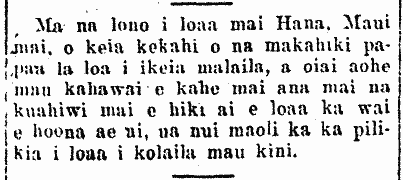
According to the news from Hana, Maui, this is one of those years that great drought is seen there, and being that there are no rivers flowing down from the mountains to bring satiating water, the people there are facing serious trouble.

(Kuokoa, 2/2/1912, p. 8)

Ma na lono i loaa mai Hana...

Ka Nupepa Kuokoa, Buke XLVIII, Helu 5, Aoao 8. Feberuari 2, 1912.

Drought in upcountry Maui, 1912.

KULA CRIES OVER THE SCORCHING SUN

We have received word that the district of Kula, Maui is once again faced with humid heat, and they are distressed over water; there is little water flowing through the pipes of Kula both day and night. There is a great need for rain to fall in this district, because the crops are beginning to dry out, and the animals are also suffering. Before, Waihee was known never to have water shortages, but they are starting to see problems due to lack of water because of the length of this period of drought with no rainfall.

(Aloha Aina, 2/3/1912, p. 1)

UWE O KULA I KA WELA A KA LA

Ke Aloha Aina, Buke XVI, Helu 5, Aoao 1. Feberuari 3, 1912.

More from Orramel Gulick, 1871.

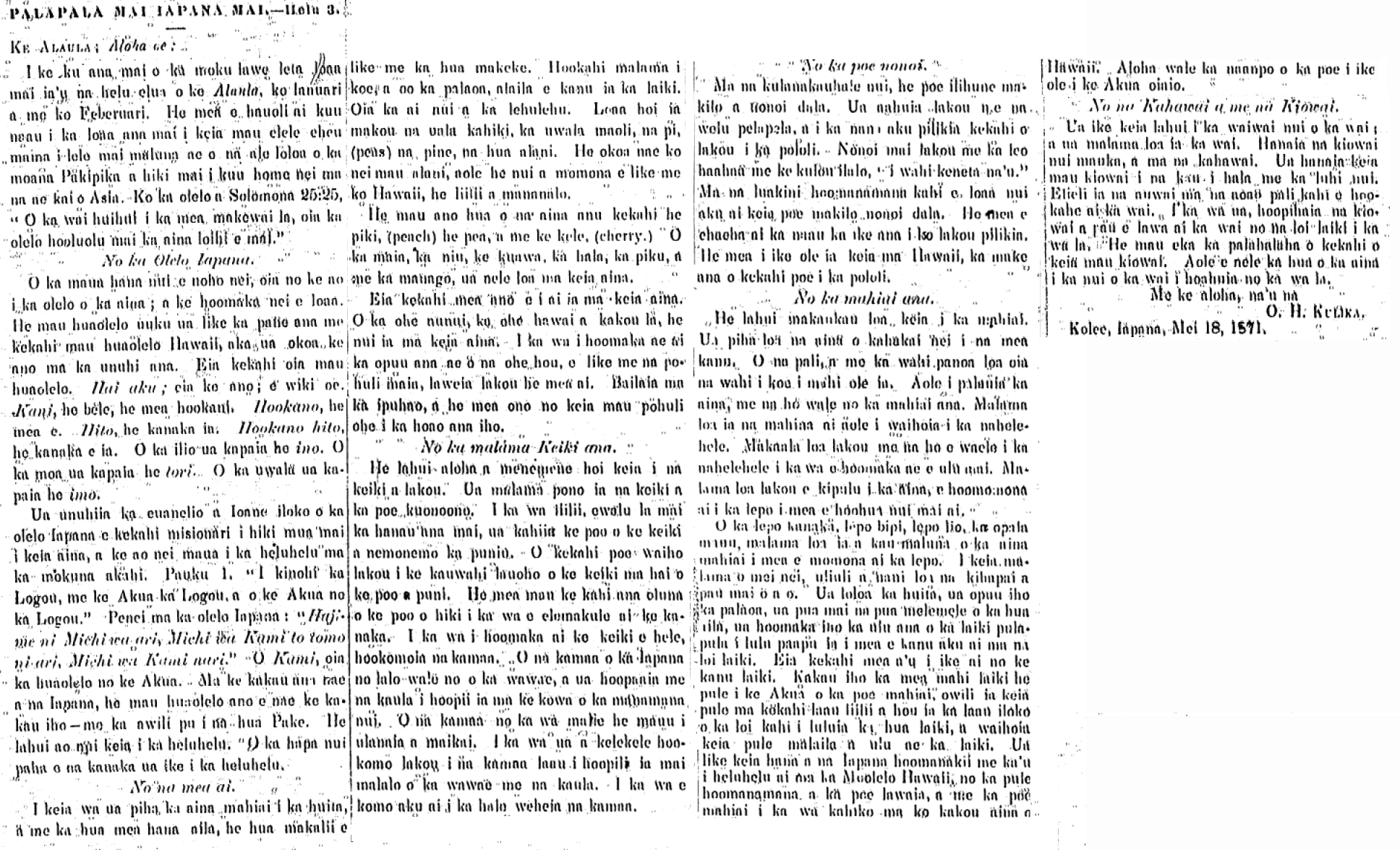
LETTER FROM JAPAN.—Number [2].

Ke Alaula: Aloha oe:

When the postal ship arrived, I received two issues of Ke Alaula, January’s and February’s. It made my heart happy, receiving these quick-winged messengers who flew above the great waves of the Pacific Ocean and reaching my home here on the shores of Asia. According to the words of Proverbs 25:25, “Like cold water to a weary soul is good news from a distant land.”

About the Japanese Language.

Our great task at hand is learning the language of this land; and we have begun. Some of the short words, the pronunciation is the same as in Hawaiian, but the translation is different. Here are some of those words. Hai aku [Hayaku]; this is the meaning; hurry up. Kani [Kane], a bell, something that sounds. Hookano [Hoka no], a different thing. Hito, a person. Hookano hito, a different person. Dogs are called ino [inu]. Chickens are called tori. Sweet potato is called imo.

The Gospel of John was translated into Japanese by a missionary who came to this land before, and we are learning to read from the first chapter. Chapter 1. “In the beginning was the Word, and the Word was with God, and the Word was God.” Here it is in Japanese: “Hajime ni Michi wa ari, Michi wa Kami to tomo ni ari, Michi wa Kami nari.” When they write it however, they write in strange letters mixed with Chinese characters. The people study reading intensely. Perhaps more than half of the people can read.

About the food.

At this time, the fields are filled with wheat and oil producing fruit, which is a tiny fruit like that of the black mustard. In a month, the wheat will be mature, then rice will be planted. That is the main staple of the people. We have potatoes, sweet potatoes, peas, beans [pine?], and oranges. Their oranges are different, they are not large and sweet like those of Hawaii, they are small and bland.

They also have fruit of cold lands: peaches, pears, and cherries. Bananas, coconuts, guavas, pandanus, figs, and mangoes are not to be found here.

Here is something strange eaten here. Large bamboo, what we call ohe hawai, is found in abundance here. When the new shoots begin to sprout, like a banana sprout, they harvest it to eat. It is boiled in a pot, and this bamboo shoot is good if it is tried.

On Child rearing.

These are a people who love and are compassionate towards their children. The children of the wealthy are well taken care of. When they are little, eight days after birth, the head of the child is shaved smooth. Some leave some hair circling the edge of the child’s head. It is customary to shave the top of the head until they are elderly. When the child begins to walk, they are fitted with sandals. The sandals of the Japanese are just under the feet and are fastened with with straps going up from between the space between the big toes. The sandals used for nice days are made of finely-woven grass. On rainy and muddy days, they wear wooden sandals fastened below the feet with straps. When they enter the house, the sandals are removed.

On beggars.

In large cities, there are poor who beg for money. They are clothed in rags, and when looking at them some of them seem to be suffering from starvation. They beg with soft voices and heads bowed down, “Please may I have a few cents.” These beggars are found in large numbers at places of worship. Seeing their suffering breaks one’s heart. This is something not seen in Hawaii, someone dying of starvation.

On farming.

This is a nation very skilled at farming. The lowlands are full of plants. The places left unfarmed are the cliffs and very dry areas. The land is not plowed, but is only worked with a hoe. Farms are well cared for, and are not left to go wild. They watch vigilantly and clear weeds with their hoe, when they begin to grow. They pay much attention to fertilizing the land to fortify the soil so that much fruit is produced.

Night soil, cow feces, horse feces, and waste vegetation are kept and placed on the farmland to fertilize the soil. In this month of May, the farms as far as the eye can see are green and beautiful. The wheat is long, and the ears of wheat are forming, the yellow flowers are blossomed, the rice sprouts are beginning to be grown, sprinkled out all crowded, to be planted in the rice paddies. Here is something else I’ve seen of rice cultivation. The rice farmer writes a prayer to the God of farmers, this prayer is rolled about a small stick, and the stick is then stuck into the paddy where the rice seeds are spread, and this prayer is left there until the rice grows. This custom by the idol-worshiping Japanese is like what I read in Hawaiian History about the prayers of the fishermen and farmers of the ancient times in our land of Hawaii. How pitiful is the ignorance of those who don’t know of the true God.

On Rivers and Reservoirs.

This nation knows the great value of water, and water is well cared for. Large reservoirs are made in the uplands, and by rivers. These reservoirs were made in times past with much labor. Canals are dug on sides of cliffs where water flows. In rainy periods, the reservoirs are filled to supply water to the rice paddies on dry periods. Some of these reservoirs are acres wide. The land will not lack fruit because of the great water reserved for dry periods.

With aloha, me,

O. H. Gulick.

Kobe, Japan, May 18, 1871.

(Alaula, 7/1871, p. 16)
PALAPALA MAI IAPANA MAI.

Ke Alaula, Buke VI, Helu 4, Aoao 16. Iulai, 1871.