Sigh, 2018.

Did you see last week Monday’s post on Welo Hou? It is funny how mele written by someone from a long time ago can stir up personal memories, both good and bad. Thomas Lindsey’s “Honesakala” is timeless. Does anyone know which Thomas Lindsey this was.

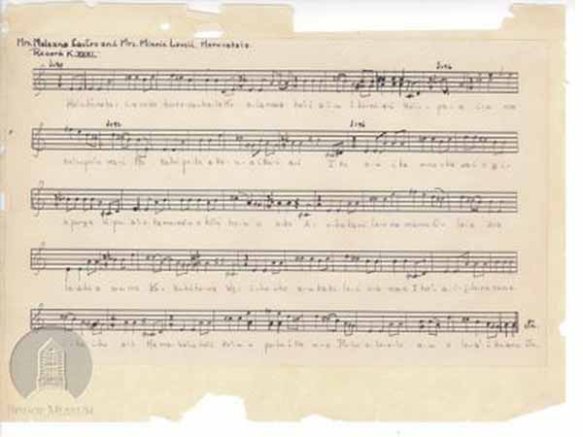
Click the sheet music below to check it out:

MS_SC_Roberts_2_2_Honesakala_BMWM-1-400x300.jpg

MS SC Roberts 2.2, p. 3. “Honesakala”

Welo Hou and the Helen H. Roberts Collection at the Bishop Museum, 2018.

It seems the Welo Hou blog has been up since November of 2017, with posts every Monday. If you are a mele person, or a history person, or are from Hawaii nei, you should check it out and start a dialogue! This is its opening post from last year [click anywhere below to link to the blog]:

Welo Hou: Building Connections to the Helen Roberts Mele Collection

 How has mele informed your understanding of a Hawaiian worldview?

As I ponder this question framed within the context of the above quote, my mind begins to churn with examples stemming from my own life and learning experiences. I recall my early childhood years in keiki hula class where I proudly chanted “Kūnihi ka mauna” while oblivious to the meaning of the words that were resonating from my mouth. Yet even in my naivety, I understood the function and purpose of that oli kahea. Though my mind was too young to comprehend the arbitrary words formed by my lips, I was fully aware that I had to be focused and present-minded in order to be granted permission into the hālau. This is a small example of how, even at 5 years old, mele/oli had already begun to shape my perspective to be one that reflects a Hawaiian way of thinking and behaving. “Kūnihi ka mauna” followed me into the academic arena where I eventually learned how to dissect the mele word for word, structure by structure, phrase by phrase, and sound by sound. I learned about the different places referenced in the mele and discovered the kaona behind words. I came to know the story by which the mele was inspired and I internalized the knowledge gained through the deconstruction and reconstruction of this mele. I share these thoughts with the hope that we can collectively become even more conscious of the way in which mele is able to shed light on aspects that are often considered obscure in research and Hawaiian knowledge acquisition.

                As we meet here weekly for Mele Monday, I invite you to ponder deeply on the pieces we will discuss from the Roberts’ Mele Collection over the next two years. The purpose of this blog is to cultivate a community of mele enthusiasts who would like to dialogue about the gems uncovered from within the mele we will explore over the coming weeks. Please feel free to ask questions, share manaʻo, and post comments that will contribute to the facilitation of thoughtful and respectful discourse.

                If you feel so inclined, I invite you to leave a comment expressing your thoughts on the quote and question posed above. 

E hea i ke kanaka e komo ma loko…..

More on Kahuku connection to Waipahu, 1939.

ADDING TO MRS. LAHILAHI WEBB’S STORY OF WAIPAHU

Editor The Advertiser:

May I add a little to Lahilahi Webb’s story of Waipahu.

On Tuesday Miss Titcomb took Lahilahi Webb and me to interview Mrs. Kapeka Baker, one of the two remaining old timers of that locality. Continue reading

Kahuku connected to Waipahu by underground channel, 1939.

Underground Channel May Connect Kahuku, Waipahu

By ORINE HAMMOND

Are there underground channels from one side of the Island to the other?

Is there, Kamaainas of Waipahu, a stream which begins as Punahoolapa—the “Bright Spring”—in Kahuku, disappears and worms its way underground across the Island to reappear in your own Waipahu spring? Continue reading

Charles Reed Bishop honored at Kamehameha Schools, 1946.

Arrived 100 Years Ago

Kamehameha To Honor Memory Of C. R. Bishop

Charles Reed Bishop, a builder of Hawaii in the field of education as well as business during the 19th century, and who arrived in the Hawaiian Islands 100 years ago this week, on October 12, 1846, will be remembered at centennial services at the Kamehameha Schools Friday and Saturday. Continue reading

Founder’s Day, 1894.

IT IS FOUNDER’S DAY.

FORMAL OPENING OF GIRLS’ SCHOOL AND THE MUSEUM ANNEX.

Exercises In Bishop Hall—Addresses By Col. W. F. Allen, Mrs. Haalelea, Miss Pope.

This is Kamehameha School Founder’s Day. It is the anniversary of the birth of that noble woman, Bernice Pauahi Bishop. This Hawaiian calendar feature was marked by the formal opening of the Kamehameha School for Girls and the Chas. R. Bishop Museum Annex.

The exercises began at 2 o’clock this afternoon. With the literary program, the sports and viewing the new school and the Annex, to say nothing of the manual training department, there were visitors on the grounds till after 3 o’clock. Continue reading

E o, e ka wahine hele la o Kaiona! 1894.

Day of Remembrance for the Chiefess Pauahi.

This past Wednesday was a grand day indeed on the campus of the Kamehameha Schools, as usual. In the early morning the students went together upon large buses, as banners waved and the instruments of their band sounded, along with flowers and greenery, they maneuvered the roads headed to the Royal mausoleum in the uplands of Maunaala. Continue reading

Dr. Yosihiko Sinoto and the great canoe, conclusion, 1978.

EXPEDITION CREW—Tim Lui-Kwan holds an unfinished canoe bailer found preserved on Huahine Island in Tahiti. Other early Polynesian artifacts on the table include Tahitian war clubs, called patus, and a tapa beater. From left are Elaine Rogers-Jourdane, Toni Han and archaeologist Yosihiko Sinoto.—Star-Bulletin Photo by Warren R. Roll.

PRESERVED LOG—A mastlike post is recovered from the Huahine pond.—Bishop Museum photo.

CANOE RELIC—Yosihiko Sinoto is shown digging a trench to look for the end of a plank believed to be part of an ancient double-hulled canoe.—Bishop Museum Photo.

Pieces of Ancient Canoe Found

Continued from Page One

…canoe plank, because of the L-shape, so what is it? That was the big question.

“SURPRISINGLY, we found a second piece about one foot below. The two pieces are the same size and the same shape.”

He said the logs that they found were round and well-worked and one was a boom to lash a canoe hull and an outrigger. “The form was very close to the Tahitian sailing canoe,” he noted.

After he returned to the museum, he began searching material on canoes in Oceania and studying canoe models to try and identify the large planks. Continue reading

Clarice B. Taylor on Koihala, conclusion, 1949.

LITTLE TALES

All About Hawaii

By Clarice B. Taylor

RETRIBUTION  IS DEALT KO’IHALA

The ohia log, destined to be carved into a god for the heiau at Makanau, was partially raised up the temple walls with the assistance of the High Chief Ko’ihala.

The priests in charge of the work had persuaded Ko’ihala to exert his mana (spiritual power) by placing his hands upon the log as the men on the upper heiau wall pulled up on the lines attached to the log.

THE LOG STALLS

When the log had been raised to a distance just above the chief’s head, it seemed to be stalled again. The chief had stepped back to survey the work.

#     #     #

The priest turned to Ko’ihala and urged him to  step under the log and press his hands up against it as the men pulled on the lines.

#     #     #

Ko’ihala complied with the request.

At a signal from the priest, the men hauled the log up a foot or so and then let it drop on their chief. Continue reading