Our Museum, continued, 1900.

OUR MUSEUM

The Bishop Collection of Curios.

One of the Most Interesting Sights In Honolulu Pleasantly Described.

(Concluded.)

Death seems to have played an important part in the ancient regime, as the kings and chiefs had the power of life and death over their subjects. Then too, the priesthood, or kahunas, exercised what is termed the “tabu,” which prescribed certain rules and regulations for the natives, any violation of which was punishable by death; for instance a chief placed “tabu” sticks at the entrance to his hut; that meant to one and all, “Do not enter or pass within the shadow of the tabu sticks under pain of death;” if a Hawaiian subject, and even a petty chief, violated this tabu, he was instantly put to death; supplication was of no avail. The power of the kahunas in their exercise of the tabu, was so great and the superstitious awe of the common native so intense, that its effects have not died out even in this day and age. The common natives are yet prone to believe in their kahunas, and believe that they have the power to pray them to death; in olden days, if an enemy obtained any part of the body of another, a hair, a part of the finger nail, spittle, or anything of the body itself, he would give it to a kahuna and ask him to pray the other one to death; with great ceremony the kahuna would perform certain mysterious functions over the hair, say strange words, offer it before the poison god, and then announce that he was praying the native to death; this being told to the native so great his superstitious fear, he would go to his hut and in reality become sick over the thought of the dread summons made by the kahuna, and in many cases they actually died of the fright thus given them; and to this day many of the natives place more faith in their kahunas than in the “haole” or foreign physicians. If the praying did not perform the evil work, then a piece of the poison god was steeped and the fluid given the sufferer, it is said, which, acting upon his heart, killed him. On every hand in the museum are the evidences of kahunaism and death. There are stones, peculiarly shaped, (like a gourd,) with a small neck; these stones were suspended from the low door of a grass house in such a way that the person entering after the trap was set, would probably be crushed by the fall of the stone. They are made from lava rock. Continue reading
Still Our Museum Today! 1900.

OUR MUSEUM

The Bishop Collection of Curios.

One of the Most Interesting Sights In Honolulu Pleasantly Described.

HONOLULU, Feb. 8.—Above the inner entrance to the Museum of Hawaiian and Polynesian History is a tablet of polished mottled stone, in which is engraved in letters of gold the following inscription:

To the Memory of
BERNICE PAUAHI BISHOP,
FOUNDER OF THE KAMEHA-
MEHA SCHOOLS OF HO-
NOLULU.
A Bright Light Among Her Peo-
ple; Her Usefulness Survives
Her Earthly Life.

A Bernice Pauahi, she was related to the royal family of the Kamehameha dynasty, and the cousin of Queen Emma, two women who have indelibly inscribed their names upon the hearts of…

BERNICE PAUAHI BISHOP.

…all Hawaiians, whether by birth of association. She married the Hon. C. R. Bishop, and with her immense wealth and her kindly deeds through life, created a new life among the Hawaiians. Upon her death she left most of her wealth to endow the Kamehameha Schools, a separate school for boys and a separate one for girls. These schools are kept up entirely from the income of her estates, which have become so vast as to render it necessary to erect other buildings throughout the Islands in order to expend the revenue. In memory of his wife, the Hon. C. R. Bishop dedicated the museum in her name, laying aside a princely endowment. Collectors have scoured the Hawaiian Islands for curios of historical and intrinsic value and have succeeded by the most diligent effort and at great expense, in depositing in the museum an invaluable collection of ancient materials which would warm the cockles of the antiquarian’s heart beyond measure. Calabashes, large and small, ancient and modern, have come into the museum; some were in the possession of families, relics passed from one generation to another; others were found in the caves where in ancient times were buried kings and chiefs. Idols of grotesque shapes, dedicated to all the elements of nature, good and evil; some dedicated to Pele, the Goddess of Volcanoes; others to the poison god and to the fish god; some made of stone, others of the valuable koa and kou woods; one made of the trunk of the poison tree, its wood, upon being steeped in water, being a most powerful, yet undetectable poison which acts upon the heart, and which was used by the kahunas and chiefs. Beautiful feather cloaks of wonderful sheen and delicate texture, worn by Kamehameha the Great during his tour of conquest a century ago. Continue reading

Queen Emma in New York, 1866.

THE DISTINGUISHED VISITOR.

Emma, the Queen Dowager of the Sandwich Islands, Visits Brooklyn, the Navy Yard, and Sails Down the Bay—Callers at Her Hotel Yesterday, &c.

Her Majesty of the Sandwich Islands, Emma, is determined, it would appear, to see the lions of the famed city of New York while she has the opportunity, and yesterday she extended the pardonable curiosity, which it is not scandalum magnatum to say her Majesty shares with the rest of her sex, to the sister city of Brooklyn. At half-past nine in the morning Queen Emma left her hotel, accompanied by Miss Grinnell, Miss Spurgeon, Major Hopkins, and lady-in-waiting, and drove down Broadway, to the Fulton ferry, whence Her Majesty and suite crossed to Brooklyn. The first place visited was Greenwood cemetery, with the beautiful scenery around which the party was much delighted. On the way back, they stopped at the photographic gallery in Fulton street, where the Queen sat for her portrait.

VISIT TO THE BROOKLYN NAVY YARD.

Pursuant to the announcement made in yesterday’s Herald the entire party then paid a visit to the Brooklyn Navy Yard. The hour appointed for her arrival was half-past one o’clock, and for one hour an assemblage of the citizens of Brooklyn and elsewhere commenced collecting until the mass numbered upwards of three thousand persons. The gates of the yard were closed to all persons except those who had passes signed by the chief officers. Half-past one arrived, but no tidings were received of the Queen. The crowd commenced to get impatient, jokes were passed to and fro to the parties on both sides of the street, when at length, at twenty minutes to two, two open carriages appeared in sight, containing the Queen, suite and attendants. It was observed as the carriages entered the yard that the first one contained her Majesty, Miss Spurgen, maid of honor; Mr. and Miss Odell; and the second Major C. Gordon Hopkins, of the Hawaiian army, and Miss Grinnell, maid of honor. As the party entered the gates the marine guard were formed in line and received her Majesty at “present arms.” She returned the compliment with a polite bow, the carriages proceeding to Admiral Bell’s quarters, in the Lyceum building. Arriving at this point the honored guest was received and assisted from her carriage by Captain Alexander M. Pennock, chief executive officer of the Navy Yard, who in turn introduced her to Rear Admiral Charles H. Bell, the commandant. The Admiral tendered his arm to the Queen, who promptly accepted it, and the party proceeded to the portico on the second story of the Lyceum. When Queen Emma alighted, the Marine battalion, commanded by Captain Collier, were drawn up in line, presented arms, while the Navy Yard band played the air of “Hail Columbia.” A detachment of the crew of the United States ship Vermont fired a salute of twenty-one guns from the Cob deck battery, and the Hawaiian flag was displayed at the main topgallant masthead. Continue reading

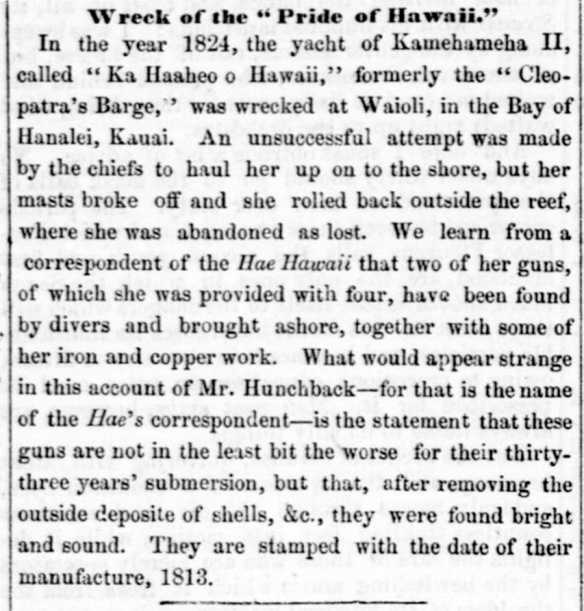
Cannons from the Haaheo o Hawaii wreck, 1857.

Wreck of the “Pride of Hawaii.”

In the year 1824, the yacht of Kamehameha II, called “Ka Haaheo o Hawaii,” formerly the “Cleopatra’s Barge,” was wrecked at Waioli, in the Bay of Hanalei, Kauai. An unsuccessful attempt was made by the chiefs to haul her up on to the shore, but her masts broke off and she rolled back outside the reef, where she was abandoned and lost. We learn from a correspondent of the Hae Hawaii that two of her guns, of which she was provided with four, have been found by divers and brought ashore, together with some of her iron and copper work. What would appear strange in the account of Mr. Hunchback—for that is the name of the Hae‘s correspondent—is the statement that these guns are not in the last bit the worse for their thirty-three year’s submersion, but that, after removing the outside deposite of shells, &c., they were found bright and sound. They are stamped with the date of their manufacture, 1813.

(Polynesian, 5/23/1857, p. 5)

Polynesian_5_23_1857_5.png

The Polynesian, Volume XIV, Number 3, Page 5. May 23, 1857.

Another beached whale, 1901.

WHALE WASHED ASHORE AT KEEI

NATIVES WAX RICH FROM BIG FIND MADE ON HAWAII LAST WEEK.

Some of the natives living at Keei, Hawaii made a rich find last Saturday. They caught a 32 foot whale. The leviathan was not harpooned while in the deep water but was washed ashore and caught close to the beach.

Just how the whale came to be washed ashore is not certain. It was alive when it was first discovered in the shallow water early Saturday morning. It is not improbable that a drove of sharks attacked the monster and in desperation the whale swam madly in shore in the hopes of escaping from the attacks of the sharks. If such had been the desire, the attacks of the sharks were escaped but the surer attacks from the natives followed. Continue reading

Conclusion of the Interview of William E. Rowell, 1916.

INTERVIEW WITH W. E. ROWELL
Dec. 6, 1915

(Continued from last issue.)

The shingles were imported and were boiled in whale oil before they were put on. They lasted a long, long time, 25 years, until they were fairly worn out, by explosure to the elements.

Yes, as you say, my father was a good mechanic. He had a lathe with which he litterally turned out four poster koa beds, and other articles of furniture, and up in the mountains he had a saw-pit where he whip-sawed out koa and kauwila lumber, one man above and one below with the log resting on skids. You say there is some of that koa lumber there in the house now?—yes very likely, we left a lot of it there.

We had kauwila posts I remember, for our front fence. I sent my brother, in New York, some of them, out of which he had furniture made, and this cane that I carry and which is so useful to me in my blindness, is made out of one of them. You say it ought to go to some historical society, [???] that first church table, well perhaps so.

My father was very much of a student as you say; yes he always read from the Greek Testament at family worship. Continue reading

Recollections of Kauai boy, William E. Rowell, 1916.

INTERVIEW WITH W. E. ROWELL
Dec. 6, 1915

The following interview with the late W. E. Rowell, who died recently in Honolulu, was read at the meeting of the Kauai Historical Society last week by J. M. Lydgate:

I was born at Hanalei in 1845. My father followed Alexander there for a couple of years. When I was about one year old were moved to Waimea. We came by canoe I believe, bag and baggage. No I don’t remember anything about it. Mr. Gulick I understand had built the house at Waimea. Mr. Whitney had died I think just before our arrival or soon after so that the whole work and responsibility of the station fell on my father. The Whitney house stood just about where the Hofgaard house is now, while ours stood near by. No, no, the Whitney house wasn’t built of adobie, but of stone coral sand stone. I remember very distinctly how it cracked because of imperfect foundation and the walls bulged out and had to be shoved up with heavy timber props. The house was demolished finally for the stone which was taken to build the Kekaha chimney. I think they paid $100 for it. Mother Whitney lived there for a good many years. In the division of the mission sands there was some difficulty about coming to an amicable decision, for, you know, these old missionaries were quite human in spite of the fact that they were missionaries. Mrs. Whitney wanted about everything that was any good.

We got a piece of pasture land on the east of the river called Mahai-hai: it was there we kept our stock, and in dry times they fairly grubbed up the roots of the manienie.

We had an old man who took the stock back and forth: he took them to the river and they swam across and when he wanted them he called them and they came across the river.

When Mrs. Whitney died she left her land to the native church. The minister was to live at the Whitney place, but that was inconvenient so an exchange was made for a kuleana in the valley, and I bought the balance of the land for $1800. That is the basis of the church fund to this day.

There was a grass church in those days down on the beach west of the river, where afterwards the school house stood and about where the Chinese church is now. There were two services on Sunday and a prayer meeting on Wednesday afternoon. No, the crowds were not very large and the church was not as big as the stone church built later. The church was built of pili grass, closed in, as I remember it, on the mauka and windward side, but open makai on the lee side. There were no windows, at least no glazed windows. The people sat on mats on the floor. The matter of windows, reminds me that I made quite a little money in my boyhood days, making window and door cases for Hawaiian grass houses. Yes, all the houses at that time were of grass. Continue reading

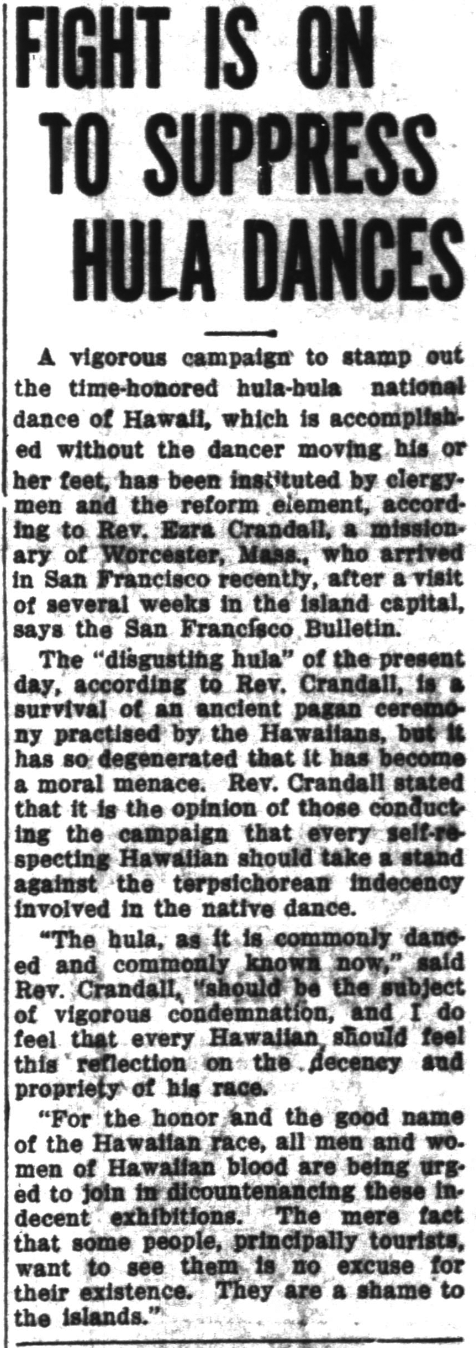
Hula fought against by the church, 1917.

FIGHT IS ON TO SUPPRESS HULA DANCES

A vigorous campaign to stamp out the time-honored hula-hula national dance of Hawaii, which is accomplished without the dancer moving his or her feet, has been instituted by clergymen and the reform element, according to Rev. Ezra Crandall, a missionary of Worcester, Mass., who arrived in San Francisco recently, after a visit of several weeks in the island capital, says the San Francisco Bulletin.

The “disgusting hula” of the present day, according to Rev. Crandall, is a survival of an ancient pagan ceremony practiced by the Hawaiians, but is has so degenerated that it has become a moral menace. Rev. Crandall stated that it is the opinion of those conducting the campaign that every self-respecting Hawaiian should take a stand against the terpsichorean indecency involved in the native dance.

“The hula, as it is commonly danced and commonly know now,” said Rev. Crandall, “should be the subject of vigorous condemnation, and I do feel that every Hawaiian should feel this reflection on the decency and propriety of his race.

“For the honor and the good name of the Hawaiian race, all men and women of Hawaiian blood are being urged to join in discountenancing these indecent exhibitions. The mere fact that some people, principally tourists, want to see them is no excuse for their existence. They are a shame to the islands.”

(Star-Bulletin, 6/15/1917, p. 14)

StarBulletin_6_15_1917_14

Honolulu Star-Bulletin, Volume XXIV, Number 7854, Page 14. June 15, 1917.

The Pacific Commercial Advertiser ridicules the women of the Patriotic League, 1893.

PATRIOTIC WOMEN.

They Object to the Wording of a Memorial.

The Hawaiian Women’s Patriotic League held its third business meeting yesterday morning at Arion Hall. Mrs. F. W. Macfarlane, President, called the meeting to order promptly at 10 o’clock. After reading the minutes by the Secretary, Mrs. Grace Kahalewai, the proposed memorial to United States Commissioner Jas. H. Blount was taken up. The Secretary read it once in Hawaiian, but the ladies in the rear part of the building could not hear her. They requested her to again read the rather lengthy memorial, which was done. The memorial was briefly in this wise: Continue reading