Hauoli La Hanau, e Kaleiohawaii! 1877.

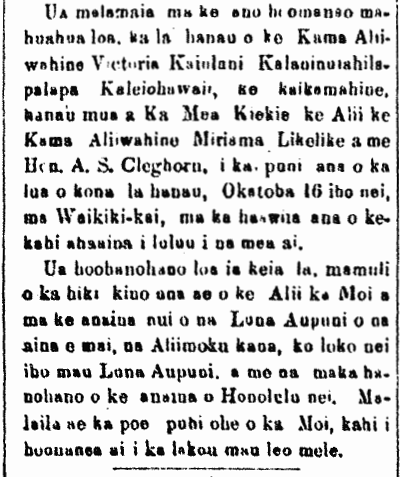
Held with much celebration was the birthday of the Princess Victoria Kaiulani Kalaninuiahilapalapa Kaleiohawaii, the first-born daughter of Her Highness the Alii the Princess Miriam Likelike and Hon. A. S. Cleghorn, on her second birthday, on this past October 16th, at Waikiki Kai, by way of the holding of a banquet laden with much food.

This day was greatly honored by the arrival of the Alii, the King, and by the great attendance of the Officers from foreign nations, the Captains of the warships, the domestic Officers, and the prominent ones of Honolulu nei. Also present was the band of the King, which entertained folks with their songs.

(Kuokoa, 10/20/1877, p. 2)

Ua malamaia ma ke ano hoomanao mahuahua loa...

Ka Nupepa Kuokoa, Buke XVI, Helu 42, Aoao 2. Okatoba 20, 1877.

Pretty darned romantic, 1881.

Kalakaua to Kapiolani!

The King of the Archipelago to His Queen.

Composed aboard the Oceanic, Feb. 16, 1881.

On the Meridian of Honolulu,

At 33° Latitude, 157° 30′ Longitude.

O ka ike lihi aku i na ae one ma o,
Ka ko’u mau maka e ake nei,
Me ka pule e hoea hou au ilaila,
Mai ae i ka’u upu e ko ole!

O na nalu huakea lelehuna,
O ia ae one; he aloha au,
A ke huli kuu alo no ka huakai home,
E nalo na manao hele auwana.

E kuu aloha e kali ala, nou ko’u haupu,
Me ka lei maile ma kou a-i!
O, e hai mai, e ke kai kupikio inaina,
A hea pau kau kokohi ana ia’u?

Ano, o ka hui me oe, he mea hiki ole,
Oiai ua okia e ke kai nui,
E puana aku nae au e ka ipo aloha,
He manaolana ko’u e hui hou kaua.

O kou aloha me ka manao oiaio,
Ke kiai ma ko’u alahele,
A ke ike au i ka poepoe honua,
I makana na’u ia aloha.

[A glimpse of the sandy strand beyond,
Is what my eyes now long for,
With a prayer that I arrive there once more,
Do not allow my hopes to go unfulfilled!

The white misting waves,
Of that sandy shore; is my love,
I turn and face the road home,
Gone are my thoughts of roaming.

O My dear that waits, for you are my recollections,
With a maile lei about your neck!
Oh, tell me, O Angry wild sea,
When will you stop restraining me?

I cannot be with you right now,
For we are separated by the great ocean,
But I proclaim, O Dear sweetheart,
I hope to be with you again.

Your aloha and your faith,
Guide me on my path,
And as I see the world,
A gift to me is that aloha.]

(Elele Poakolu, 4/20/1881, p. 5)

Kalakaua ia Kapiolani!

Ka Elele Poakolu, Buke II, Helu 7, Aoao 5. Aperila 20, 1881.

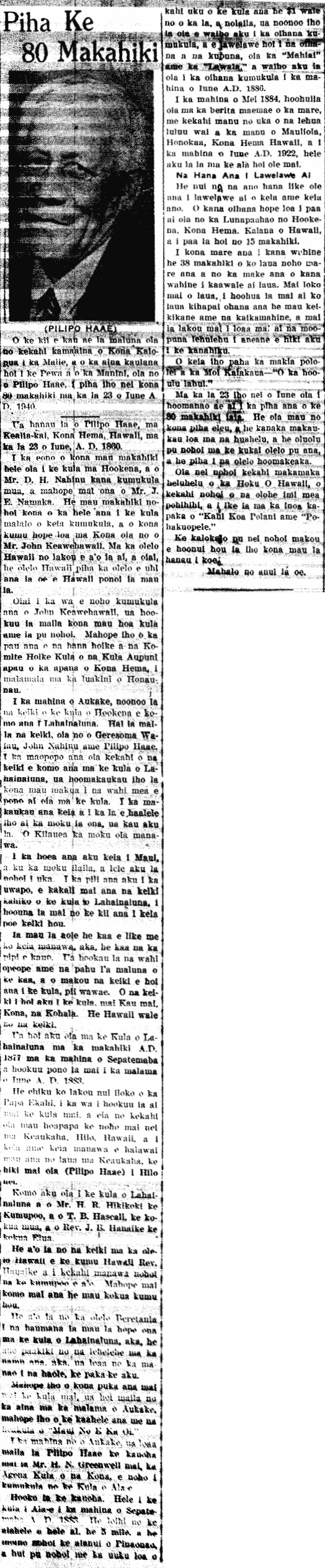
Sweet article on the 80th birthday of Pilipo Haae, 1940.

80 Years Old

(PILIPO HAAE)

The picture placed above is of one of the kamaaina of Kona of the horizon clouds in the calm, and the land famed for the Tail of the Manini [ke Pewa a o ka Manini],¹ that being Phillip Haae who just made 80 years old on the 23rd of June, A. D. 1940.

Pilipo Haae was born in Kealia Kai, South Kona, Hawaii, on the 23rd of June, A. D. 1860.

When he was six years old, he went to the school at Hookena, and Mr. D. H. Nahinu was his first teacher, and after him was Mr. J. E. Namaka. He went to school under this teacher for some years, and his last teacher in Kona was Mr. John Keawehawaii. They were taught in the Hawaiian language, being that during those days, O Hawaii’s Own, it was that the Hawaiian language which fully enveloped you.

While John Keawehawaii served as the teacher, Haae’s classmates and he as well were graduated. This was after the conclusion of the School Testing [Hoike Kula] of all of the Government Schools of South Kona which took place at the church of Honaunau.

In the month of August, the children of the Hookena school were considered for matriculation into Lahainaluna. The children were told, they being Geresoma Waiau, John Nahinu, and Phillip Haae. When he found out that he was one of the children to enter Lahainaluna School, his parents prepared what was necessary for him to go to school. When this was ready, and when the day came for his boat to leave, he got on. The Kilauea was the ship during those days.

When it reached Maui, and the ship stopped there, he got off on land. When the ship got to the dock, the upperclassmen from Lahainaluna were waiting, being sent to retrieve the new children.

In those days, there were no cars like today, but there were carts pulled by oxen. Their bundles and the fish boxes [? pahu I’a] were placed upon the cart, and we children who were headed to the school went up by foot. The children returning to the school came from Kau, Kona, and Kohala Loko and Kohala Waho. The children were all Hawaiian.

He entered into Lahainaluna School in 1877 in the month of September, and graduated in the month of June in 1883.

There were seven of them in the Senior Class [Papa Ekahi] the year that he graduated, and one of his classmates is still living here in Keaukaha, Hilo, Hawaii, and the two of them regularly get together at Keaukaha when Pilipo Haae comes to Hilo.

He entered into Lahainaluna School, and the Head Instructor [Kumupoo] was Mr. H. R. Hitchcock [H. R. Hikikoki], and T. B. Hascall was the first assistant, and Rev. J. B. Hanaike was the second assistant.

The children were taught in the Hawaiian language by the Hawaiian teacher, Rev. Hanaike, and sometimes they were instructed by the head teacher. Afterwards new assistant teachers came.

English was taught to the students during his later days at Lahainaluna School, but it was difficult for the lips to speak, and the haole understood what was being said when spoken all garbled [paka-ke].

After he graduated, he returned to his land in the month of August, after travelling about with his classmates of “Maui, The Greatest” [Maui No E Ka Oi].

In the month of August, Phillip was assigned by Mr. H. N. Greenwell, the School Agent of North and South Kona, to work as teacher at Ala-e School.

He carried out his assignment. He went to Ala’e School in September, 1883. The road to there was long; 5 miles, the roads of Pinaonao were bad; this along with the very meager pay from his school, just a $1 a day, therefore, he decided to leave the teaching job and to take on the occupation of his ancestors, that being “Farming” and “Fishing,” and so he left his teaching position in the month of May, 1886.

In the month of May, 1884, he was joined in holy matrimony with one of the birds from the uplands, of the lehua drooping with nectar of the birds of Mauliola, Honokaa, South Kona, Hawaii, and in the month of June, 1922, she left on the road of no return.²

The Work He Undertook

He did all sorts of jobs. His last position he held was the Head of the Prison of Hookena, South Kona, Hawaii County, which he held for 15 years.

In his marriage to his wife, they lived together for 38 years, and it was the death of his wife which separated the two of them. Betwixt them, their family garden bore fruit with boys and girls, and from them they have many grandchildren almost reaching seventy.

This perhaps is the true motto of King Kalakaua—”Increase the lahui.”

On this past 23rd of June, his 80th birthday was celebrated. He remains active as ever, and he is very good at numbers [makaukau loa ma na huahelu], and is pleasant to talk to, and is full of funny things to say.

He is one of our readers of the Hoku o Hawaii, and is an expert at seeking veiled information [as in riddles], and he is known by the pen names, “Kahi Koa Polani” and “Pohakuopele.”

We pray as well that he is given more birthdays to come.

¹A reference to the bay, Kapewaokamanini in Kona.

²Kahulaleaokeakealani, daughter of S. M. Paauhau was born on June 14, 1867 and died June 7, 1922.

[Just plain wow.]

(Hoku o Hawaii, 9/25/1940, p. 2)
Piha Ke 80 Makahiki

Ka Hoku o Hawaii, Volume XXXV, Number 22, Aoao 2. Sepatemaba 25, 1940.
Keeaumoku ahuula destroyed in Peleioholani house fire, 1901.

Couple of years ago, I posted two articles on an insurance claim by Peleioholani after a priceless ahuula was destroyed in the great Chinatown fire of 1900. I just ran across this just now:

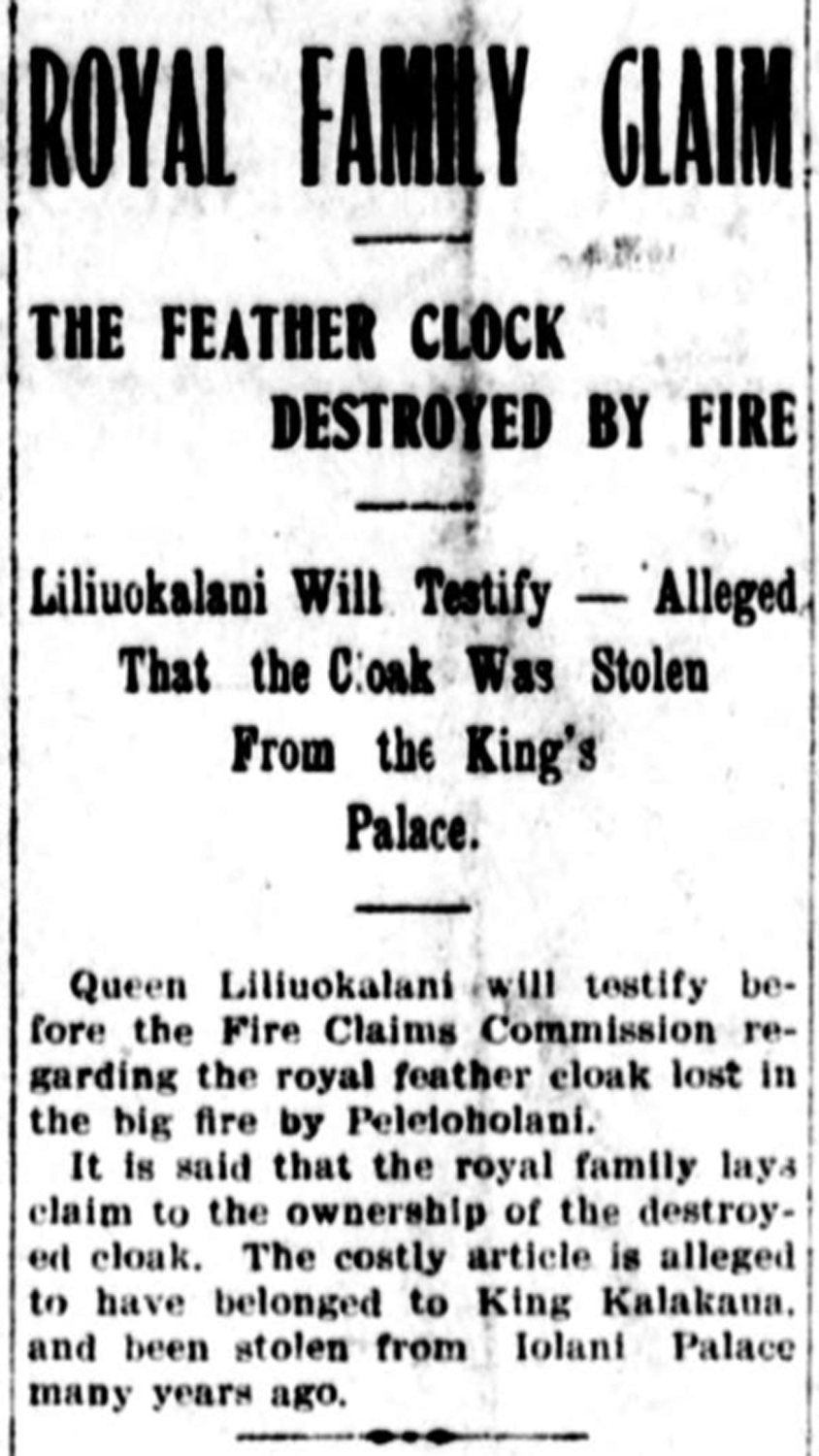
ROYAL FAMILY CLAIM

THE FEATHER CLOAK DESTROYED BY FIRE

Liliuokalani Will Testify—Alleged That the Cloak Was Stolen From the King’s Palace.

Queen Liliuokalani will testify before the Fire Claims Commission regarding the royal feather cloak lost in the big fire by Peleioholani.

It is said that the royal family lays claim to the ownership of the destroyed cloak. The costly article is alleged to have belonged to King Kalakaua, and been stolen from Iolani Palace many years ago.

[See: Ancient Relics Were Destroyed & Pau ka Ahuula i ke Ahi]

(Evening Bulletin, 11/2/1901, p. 1)

ROYAL FAMILY CLAIM

Evening Bulletin, Volume XI, Number 1984, Page 1. November 2, 1901.

Boat races celebrating the 49th birthday of King Kalakaua, 1885.

[Found under: “Ka La 16 o Novemaba.”]

THE RACES.

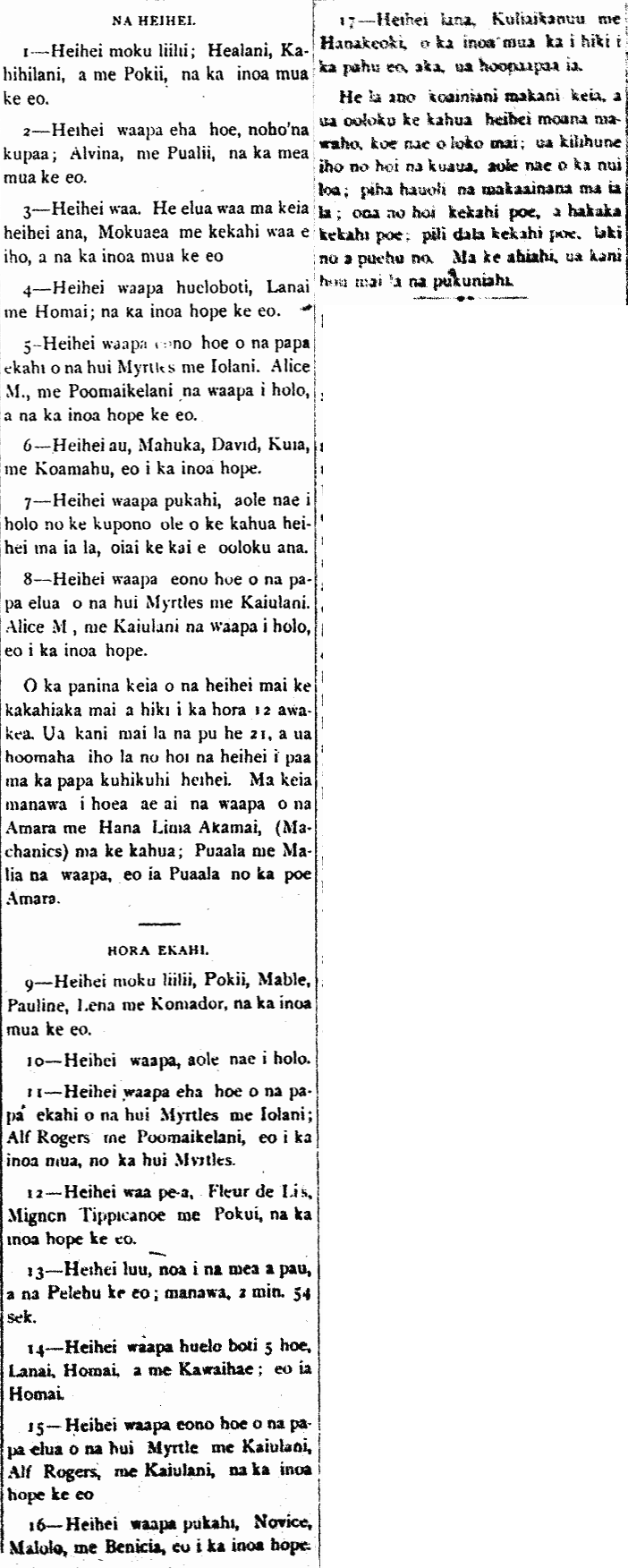
1—Yacht race [Heihei moku liilii]; Healani, Kahihilani, and Pokii, the one with the first name won.

2—Four-oared boat race, stationary seats [Heihei waapa eha hoe, noho’na kupaa]; Alvina, and Pualii, the first one won.

3—Canoe race. There were two canoes in this race, Mokauea and another, and the one with the first name won.

4—Whaleboat race [Heihei waapa hueloboti], Lanai and Homai; the one with the last name won.

5—Six-oared boat race of the senior crews of the Myrtle Boat Club and the Iolani Boat Club. Alice M. and Poomaikelani are the boats that raced, and the one with the last name won.

6—Swimming race, Mahuka, David, Kuia, and Koamahu, with the one with the last name winning.

7—Single scull race [Heihei waapa pukahi], but there was no race because of a lack of good conditions at the race grounds that day, being that the ocean was blustery [e ooloku ana].

8—Six-oared boat race of the junior crews of the Myrtle Boat Club and Kaiulani Boat Club. Alice M and Kaiulani were the boats that competed with the one with the last name winning.

This was the end of the races from the morning until 12 noon. 21 guns were sounded, and the scheduled races took an intermission. At this time, the boats of the Blacksmiths [Amara] and the Mechanics [Hana Lima Akamai] arrived at the grounds; Puaala and Malia were their boats with Puaala of the Blacksmiths winning.

ONE O’CLOCK.

9—Yacht race [Heihei moku liilii], Pokii, Mabel, Pauline, Lina and Commodore; with the one with the first name winning.

10—Racine canoe race [Heihei waapa], but they did not race.

11—Four-oared boats of the senior crews of Myrtle Boat Club and Iolani Boat Club; Alf Rogers and Poomaikelani, with the one with the first name winning.

12—Canoe sailing race [Heihei waa pe-a], Fleur de Lis, Mignon, Tippecanoe, and Pokui, with the one with the last name winning.

13—Diving Contest [Heihei luu], open to all, and Pelehu won with the time of 2 min. 54 seconds.

14—Whaleboat race with five oars; Lanai, Homai, and Kawaihae; Homai won.

15—Six-oared boats of the junior crews of the Myrtle Boat Club and Kaiulani Boat Club; Alf Rogers and Kaiulani, with the one with the last name winning.

16—Single sculls race [Heihei waapa pukahi], Novice, Malolo, and Benicia, with the one with the last name winning.

17—Launch race [Heihei lana], Kuliaikanuu and Hanakeoki, with the one with the first name taking the win, although it was contested.

It was a breezy day, and the race grounds outside were blustery, but not so inside; a sudden shower sprinkled down but not so much; the citizens were filled with joy that day; some were drunk, and some fought, while some gambled, some were lucky and some were routed. In the evening the cannons again sounded.

[I was reminded of this by today’s post by the Hawaiian Historical Society of a picture of the Poomaikelani (from the Hawaii State Archives)!]

(Kuokoa, 11/21/1885, p. 3)

NA HEIHEI.

Ka Nupepa Kuokoa, Buke XXIV, Helu 47, Aoao 3. Novemaba 21, 1885.

St. Andrew’s, the early days, 1909.

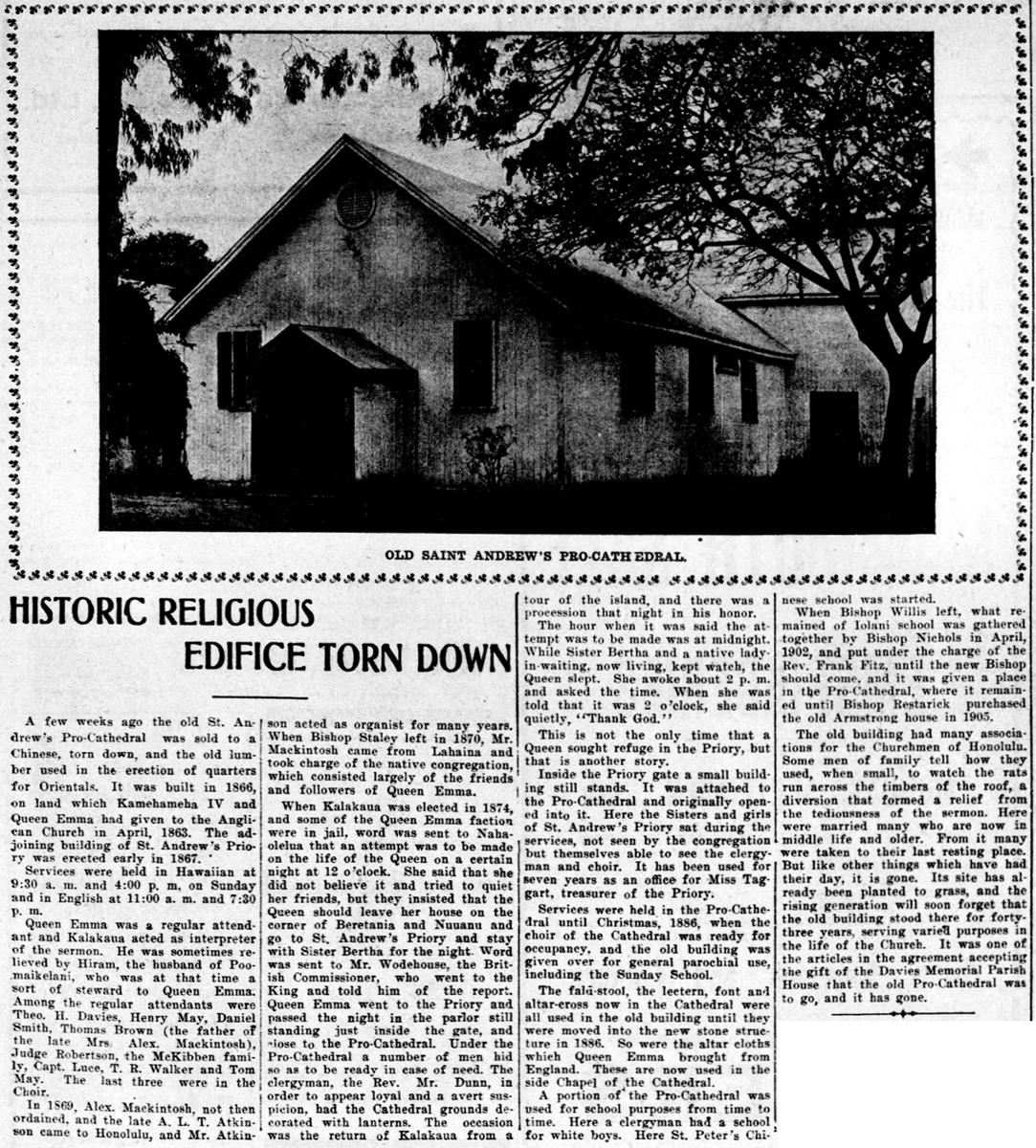
OLD SAINT ANDREW’S PRO-CATHEDRAL.

RELIGIOUS EDIFICE TORN DOWN

A few weeks ago the old St. Andrew’s Pro-Cathedral was sold to a Chinese, torn down, and the old lumber used in the erection of quarters for Orientals. It was built in 1866, on land which Kamehameha IV and Queen Emma had given to the Anglican Church in April 1863. The adjoining building of St. Andrew’s Priory was erected in 1867.

Services were held in Hawaiian at 9:30 a. m. and 4:00 p. m. on Sunday and in English at 11:00 a. m. and 7:30 p. m.

Queen Emma was a regular attendant and Kalakaua acted as interpreter of the sermon. He was sometimes relieved by Hiram, the husband of Poomaikelani, who was at that time a sort of steward to Queen Emma. Among the regular attendants were Theo. H. Davies, Henry May, Daniel Smith, Thomas Brown (the father of the late Mrs. Alex. McKintosh), Judge Robertson, the McKibben family, Capt. Luce, T. R. Walker and Tom May. The last three were in the Choir.

In 1869, Alex. Mackintosh, not then ordained, and the late A. L. T. Atkinson came to Honolulu, and Mr. Atkinson acted as organist for many years. When Bishop Staley left in 1870, Mr. Mackintosh came from Lahaina and took charge of the native congregation, which consisted largely of the friends and followers of Queen Emma.

When Kalakaua was elected in 1874, and some of the Queen Emma faction were in jail, word was sent to Nahaolelua that an attempt was to be made on the life of the Queen on a certain night at 12 o’clock. She said that she did not believe it and tried to quiet her friends, but they insisted that the Queen should leave her house on the corner of Beretania and Nuuanu and go to St. Andrew’s Priory and stay with Sister Bertha for the night. Word was sent to Mr. Wodehouse, the British Commissioner, who went to the King and told him of the report. Queen Emma went to the Priory and passed the night in the parlor still standing just inside the gate, and close to the Pro-Cathedral. Under the Pro-Cathedral a number of men hid so as to be ready in case of need. The clergyman, the Rev. Mr. Dunn, in order to appear loyal and a avert suspicion, had the Cathedral grounds decorated with lanterns. The occasion was the return of Kalakaua from a tour of the island, and there was a procession that night in his honor.

The hour when it was said the attempt was to be made was at midnight. While Sister Bertha and a native lady-in-waiting, now living, kept watch, the Queen slept. She awoke about 2 p. m. and asked the time. When she was told that it was 2 o’clock, she said quietly, “Thank God.”

This is not the only time that a Queen sought refuge in the Priory, but that is another story.

Inside the Priory gate a small building still stands. It was attached to the Pro-Cathedral and originally opened into it. Here the Sisters and girls of St. Andrew’s Priory sat during the services, not seen by the congregation but themselves able to see the clergyman and choir. It has been used for seven years as an office for Miss Taggart, treasurer of the Priory.

Services were held in the Pro-Cathedral until Christmas, 1886, when the choir of the Cathedral was ready for occupancy, and the old building was given over for general parochial use, including the Sunday School.

The fald-stool, the lectern, font and altar-cross now in the Cathedral were all used in the old building until they were moved into the new stone structure in 1886. So were the altar cloths which Queen Emma brought from England. These are now used in the side Chapel of the Cathedral.

A portion of the Pro-Cathedral was used for school purposes from time to time. Here a clergyman had a school for white boys. Here St. Peter’s Chinese school was started.

When Bishop Willis left, what remained of Iolani school was gathered together by Bishop Nichols in April, 1902, and put under the charge of the Rev. Frank Fitz, until the new Bishop should come, and it was given a place in the Pro-Cathedral, where it remained until Bishop Restarick purchased the old Armstrong house in 1905.

The old building had many associations for the Churchmen of Honolulu. Some men of family tell how they used, when small, to watch the rats run across the timbers of the roof, a diversion that formed a relief from the tediousness of the sermon. Here were married many who are now in middle life and older. From it many were taken to their last resting place. But like other things which have had their day, it is gone. Its site has already been planted to grass, and the rising generation will soon forget that the old building stood there for forty-three years, serving varied purposes in the life of the Church. It was one of the articles in the agreement accepting the gift of the Davies Memorial Parish House that the old Pro-Cathedral was to go, and it has gone.

(Pacific Commercial Advertiser, 9/18/1909, p. 3)

HISTORIC RELIGIOUS EDIFICE TORN DOWN

The Pacific Commercial Advertiser, Volume L, Number 8459, Page 3. September 18, 1909.

Mele inoa for Queen Kapiolani, 1881.

A Name Song.

For Queen Kapiolani Napelakapu; from Holoholoku comes this mele for the wife of Aikanaka, the King of Kauai; Hinaaikamala [Hinaaikamalama] was the wife of Aikanaka; which was recorded by S. Hinau. A small portion was copied here below.

Nani kuu hilahila e noho nei-e
Hele wale ka manene a ka lima-e
A ka laulau hoi mai-e
Hohoi maua me kuu nele-e
Me ka hilahila pau pu no-e
Ahi loloko wewela i ka makemake-e
I ka hu-honua a ka waimaka-e
O kuu maka kai ike i ka eha-e
Halanalana no e hanini-e
Kahanu kolopaa oia hanu-e
Ka lapalapa huila o ke kanaka-e
Ka hinu holo ia a ke aloha-e
Nana i kuikui nawali au-e
Nakunaku ka pua hau i ka wai e-e
Napanapa ka lau ke ike ku-e
He ukiuki keia i ka lono-e
Lono wau ua pa kanaka oe-e.

[This can also be seen in the mele “Nani Kuu Maka e Au Wale Nei-e,” found on pages 264–267, of Na Mele Aimoku, Na Mele Kupuna, a me Na Mele Ponoi o ka Moi Kalakaua I. It is credited to Niau. There is also an appended note that the top of this mele has been lost.

It is also unfortunate that this newspaper, Ka Elele Poakolu, is still not available online in any form.]

(Elele Poakolu, 5/11/1881, p. 2)

He Mele Inoa.

Ka Elele Poakolu, Buke II, Helu 10, Aoao 2. Mei 11, 1881.

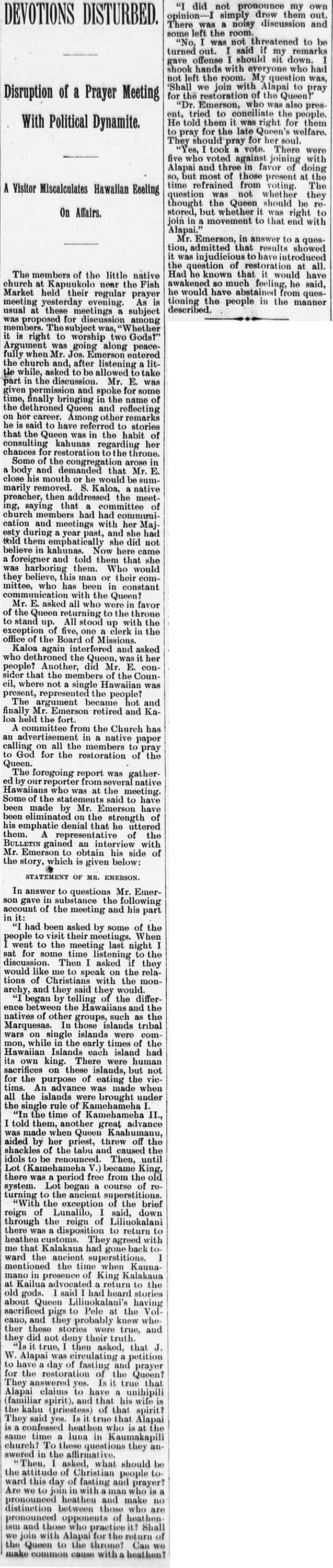
Joseph Emerson interrupts meeting at the Kapuukolo Church, 1893.

DEVOTIONS DISTURBED.

Disruption of a Prayer Meeting With Political Dynamite.

A Visitor Miscalculates Hawaiian Feeling On Affairs.

The members of the little native church at Kapuukolo near the Fish Market held their regular prayer meeting yesterday evening. As is usual at these meetings a subject was proposed for discussion among members. The subject was, “Whether it is right to worship two Gods?” Argument was going along peacefully when Mr. Jos. Emerson entered the church and, after listening a little while, asked to be allowed to take part in the discussion. Mr. E. was given permission and spoke for some time, finally bringing in the name of the dethroned Queen and reflecting on her career. Among other remarks he is said to have referred to stories that the Queen was in the habit of consulting kahunas regarding her chances for restoration to the throne.

 Some of the congregation arose in a body and demanded that Mr. E. close his mouth or he would be summarily removed. S. Kaloa, a native preacher, then addressed the meeting, saying that a committee of church members had had communication and meetings with her Majesty during a year past, and she had told them emphatically she did not believe in kahunas. Now here came a foreigner and told them that she was harboring them. Who would they believe, this man or their committee, who has been in constant communication with the Queen?

Mr. E. asked all who were in favor of the Queen returning to the throne to stand up. All stood up with the exception of five, one a clerk in the office of the Board of Missions.

Kaloa again interfered and asked who dethroned the Queen, was it her people? Another, did Mr. E. consider that the members of the Council, where not a single Hawaiian was present, represented the people?

The argument became hot and finally Mr. Emerson retired and Kaloa held the fort.

A committee from the Church has an advertisement in a native paper calling on all the members to pray to God for the restoration of the Queen.

The foregoing report was gathered by our reporter from several native Hawaiians who was at the meeting. Some of the statements said to have been made by Mr. Emerson have been eliminated on the strength of his emphatic denial that he uttered them. A representative of the Bulletin gained an interview with Mr. Emerson to obtain his side of the story, which is given below:

STATEMENT OF MR. EMERSON.

In answer to questions Mr. Emerson gave in substance the following account of the meeting and his part in it:

 “I had been asked by some of the people to visit their meetings. When I went to the meeting last night I sat for some time listening to the discussion. Then I asked if they would like me to speak on the relations of Christianity with the monarchy, and they said they would.

“I began by telling of the difference between the Hawaiians and the natives of other groups, such as the Marquesas. In those islands tribal wars on single islands were common, while in the early times of the Hawaiian Islands each island had its own king. There were human sacrifices on these islands, but not for the purpose of eating the victims. An advance was made when all the islands were brought under the single rule of Kamehameha I.

“In the time of Kamehameha II., I told them, another great advance was made when Queen Kaahumanu, aided by her priest, threw off the shackles of the tabu and caused the idols to be renounced. Then, until Lot (Kamehameha V.) became King, there was a period free from the old system. Lot began a course of returning to the ancient superstitions.

“With the exception of the brief reign of Lunalilo, I said, down through the reign of Liliuokalani there was a disposition to return to heathen customs. They agreed with me that Kalakaua had gone back toward the ancient superstitions. I mentioned the time when Kaunamano in the presence of King Kalakaua at Kailua advocated a return to the old gods. I said I had heard stories about Queen Liliuokalani’s having sacrificed pigs to Pele at the Volcano, and they probably knew whether these stories were true, and they did not deny their truth.

“Is it true, I then asked, that J. W. Alapai was circulating a petition to have a day of fasting and prayer for the restoration of the Queen? They answered yes. Is it true that Alapai claims to have a unihipili (familiar spirit), and that his wife is the kahu (priestess) of that spirit? They said yes. Is it tre that Alapai is a confessed heathen who is at the same time a luna in Kaumakapili church? To these questions they answered in the affirmative.

“Then, I asked, what should be the attitude of Christian people toward this day of fasting and prayer? Are we to join in with a man who is a pronounced heathen and make no distinction between those who are pronounced opponents of heathenism and those who practice it? Shall we join with Alapai for the return of the Queen to the throne? Can we make common cause with a heathen?

“I did not pronounce my own opinion—I simply drew them out. There was a noisy discussion and some left the room.

“No, I was not threatened to be turned out. I said if my remarks gave offense I should sit down. I shook hands with everyone who had not left the room. My question was, ‘Shall we join with Alapai to pray for the restoration of the Queen?’

“Dr. Emerson, who was also present, tried to conciliate the people. He told them it was right for them to pray for the late Queen’s welfare. They should pray for her soul.

“Yes, I took a vote. There were five who voted against joining with Alapai and three in favor of doing so, but most of those present at the time refrained from voting. The question was not whether they thought the Queen should be restored, but whether it was right to join in a movement to that end with Alapai.”

Mr. Emerson, in answer to a question, admitted that results showed it was injudicious to have introduced the question of restoration at all. Had he known that it would have awakened so much feeling, he said, he would have abstained from questioning the people in the manner described.

[This article was translated in Leo o ka Lahui, 2/9/1893, p. 2. It is interesting that there is a note appended to the end of the translated article that they did not have time to translate Emerson’s response.]

(Daily Bulletin, 2/7/1893, p. 3)

DEVOTIONS DISTURBED.

The Daily Bulletin, Volume V, Number 644, Page 3. February 7, 1893.

“King of the Cannibal Islands,” 1830 / 1872.

By 1830 at least, there was a mocking ballad called “King of the Cannibal Islands” that was popular in the United Kingdom (as seen in newspaper advertisements for various concerts). Click here for lyrics printed on a broadside in 1858. By many accounts this was written in response to Kamehameha II going to England in 1824.

As a result of another famous trip taken by a Hawaiian monarch in 1874, the lyrics are adapted in America (the original song popular there much earlier).

THE KING OF THE CANNIBAL ISLANDS.

[From the N. Y. Graphic.]

Tam? Tam! Kalakaua the great
Is booming through the Golden Gate;
The Polynesian potentate,
The King of the Cannibal Islands.

Chorus—Hunki-dori-doodle-dum,
Ministers all upon a bum;
Honolulu! How they come
With the King of the Cannibal Islands.

From sugar-coated Hawaii
He comes strange countries for to see;
And ‘Frisco greets him: “How are ye?
O King of the Cannibal Islands.
Hunki-dori, etc. Continue reading

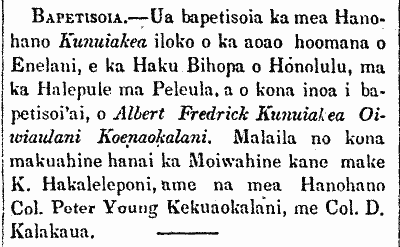
Albert Kunuiakea baptized, 1862.

[Found under: “NA MEA HOU O HAWAII NEI.”]

Baptized.—The Honorable Kunuiakea was baptized in the Anglican faith, by the Lord Bishop of Honolulu, at the Church at Peleula, and his name he was baptized with is Albert Fredrick Kunuiakea Oiwiaulani Koenaokalani. Present was his hanai mother, the dowager Queen K. Hakaleleponi, and the Honorable Col. Peter Young Kekuaokalani, and Col. D. Kalakaua.

(Kuokoa, 11/22/1862, p. 2)

Bapetisoia.

Ka Nupepa Kuokoa, Buke I, Helu 52, Aoao 2. Novemaba 22, 1862.