Mrs. Kiliwehi Hoapili Kaauwai passes on. 1873.

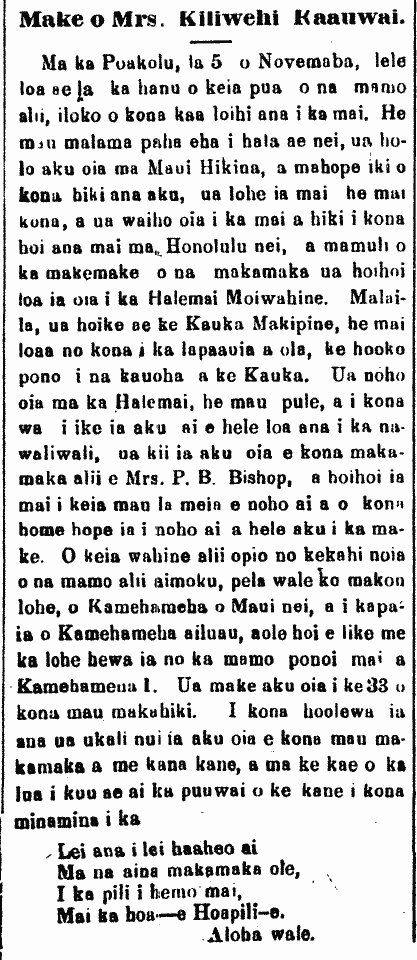
Mrs. Kiliwehi Kaauwai Dies.

On Wednesday, the 5th of November, the breath of this descendant of chiefs left her, after being sick for a long while. Perhaps some four months ago, she travelled to East Maui, and a short while after she reached there, it was heard that she was ill, and she remained in this state until returning to Honolulu, and at the request of her friends, she was taken to the Queen’s Hospital. There, Dr. McKibbin [Kauka Makibine], said that she had sickness that was curable if she followed closely the Doctor’s advice. She remained at the Hospital for a number of weeks, and when it was seen that she was becoming very weak, she was taken by her royal companion, Mrs. P. B. Bishop, to live with her these past days, and this was Kiliwehi’s last home where she dwelt until her death. This young chiefess is indeed one of the descendants of rulers, according to what we hear, of Kamehameha of Maui, who was called Kamehameha Ailuau; and not as was mistakenly heard, that she was a direct descendant of Kamehameha I. She died at the age of 33. At her funeral, she was escorted by her friends and her husband [Hoapili Kaauwai], and at the edge of her grave, her husband heart let out its regret with:

Adorned by a lei of pride
In friendless lands,
The link that has been severed,
From the companion—O Hoapili—e,
Much Aloha.

(Kuokoa, 11/8/1873, p. 2)

Make o Mrs. Kiliwehi Kaauwai.

Ka Nupepa Kuokoa, Buke XII, Helu 45, Aoao 2. Novemaba 8, 1873.

Mele for the birthplace of alii, Kukanikolo, 1925.

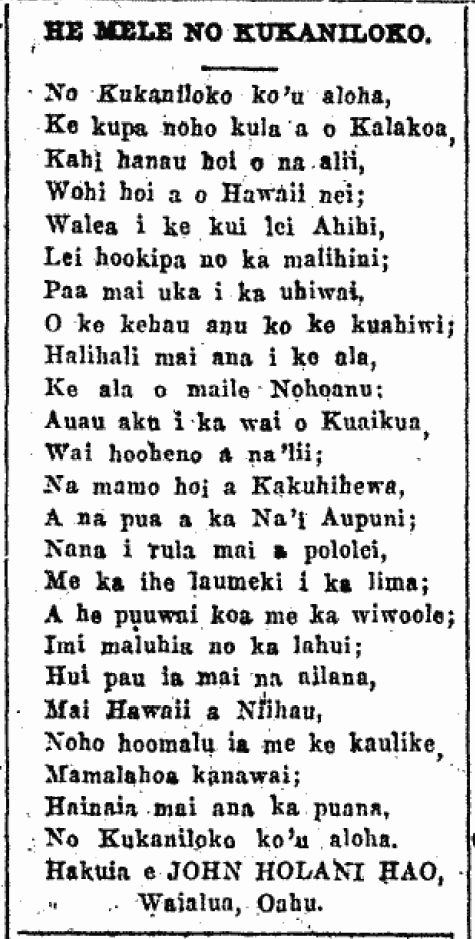
HE MELE NO KUKANILOKO.

No Kukaniloko ko’u aloha,
Ke kupa noho kula a o Kalakoa,
Kahi hanau hoi o na alii,
Wohi hoi a o Hawaii nei;
Walea i ke kui lei Ahihi,
Lei hookipa no ka malihini;
Paa mai uka i ka uhiwai,
O ke kehau anu ko ke kuahiwi;
Halihali mai ana i ke ala,
Ke ala o maile Nohoanu;
Auau aku i ka wai o Kuaikua,
Wai hooheno a na’lii;
Na mamo hoi a Kakuhihewa,
A na pua a ka Na’i Aupuni;
Nana i rula mai a pololei,
Me ka ihe laumeki i ka lima;
A he puuwai koa me ka wiwoole;
Imi maluhia no ka lahui;
Hui pau ia mai na ailana,
Mai Hawaii a Niihau,
Noho hoomalu ia me ke kaulike,
Mamalahoa kanawai;
Hainaia mai ana ka puana,
No Kukaniloko ko’u aloha.

Hakuia e JOHN HOLANI HAO,
Waialua, Oahu.

HE MELE NO KUKANILOKO.

For Kukaniloko is my aloha,
Native dwelling on the plains of Kalakoa,
Birthplace of the alii,
Wohi chiefs of Hawaii nei;
Taking pleasure in stringing lei of Ahihi,
A lei of welcome for the visitor;
The uplands are covered by fog,
The cold mist of the mountains;
Carrying along the scent,
The fragrance of maile in the cold;
Bathing in the waters of Kuaikua,
Cherished waters of the alii;
The descendants of Kakuhihewa,
And progeny of the Conqueror of the Nation;
Who ruled with righteousness,
With barbed spear in hand;
And a brave and fearless heart;
In pursuit of peace for the people;
Completely joining the islands,
From Hawaii to Niihau,
Living in peace with equality,
The law of Mamalahoa;
Let the refrain be told,
For Kukaniloko is my aloha.

Composed by JOHN HOLANI HAO,
Waialua, Oahu.

(Kuokoa, 5/28/1925, p. 7.)

HE MELE NO KUKANILOKO.

Ka Nupepa Kuokoa, Buke LXIV, Helu 22, Aoao 7. Mei 28, 1925.

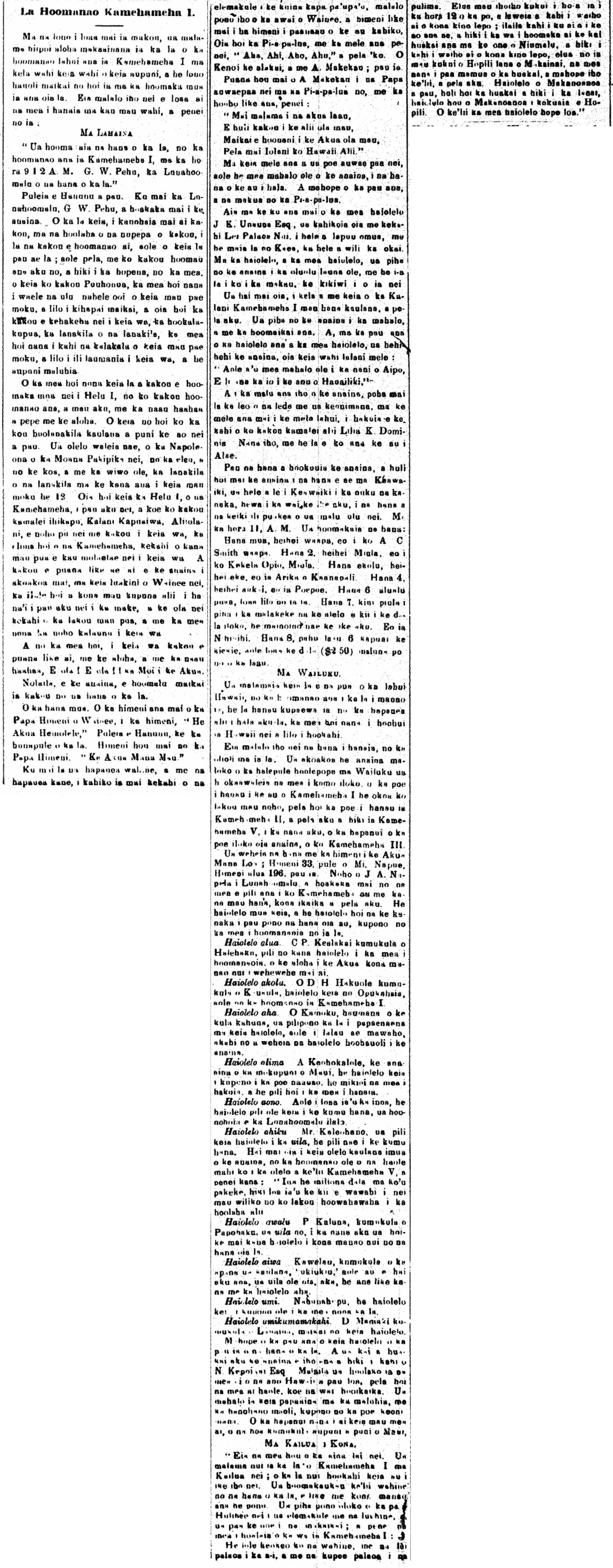
The first Kamehameha Day out in the country, continued, continued, 1872.

At Kailua, Kona.

“Here is what is new here in the land of calm. The day of Kamehameha I was celebrated grandly in Kailua; this is the biggest day I’ve witnessed. The chiefess [probably Keelikolani, governess of Hawaii Island], prepared for the activities of the day as she saw fit. The grounds of Hulihee was filled with old men and women, and the sands were packed with visitors; and this is what was reenacted from the times of Kamehameha I:

The women wore white, with lei of whale ivory [palaoa] around their necks, and bracelets of palaoa on their wrists. There were two torches lit at 12 midnight and taken to where his body lay; and there they stood until daylight, until the procession began over the sands of Niumalu until where his body was placed; there were two torches of Hopili and Makainai who carried them before the procession, and following was the chiefess, and so forth. Makanoanoa gave a speech and after it was over, the procession returned to the lanai, and Makanoanoa spoke again assisted by Hopili. The chiefess was the last to speak.”

[This is the last part of the article describing the celebration of the first Kamehameha Day in Lahaina, Wailuku, and Kailua in Kona.]

The first Kamehameha Day out in the country, continued, 1872.

At Wailuku.

The children of the Hawaiian nation celebrated this day to commemorate the day believed to be the incorrect [? kupaewa] day of birth of the old chief who passed on, the one who joined Hawaii nei together to become one.

Here below are the activities done in celebration on that day. A crowd gathered at the protestant church in Wailuku; people were separated into those who were born during the time of Kamehameha I, who had a separate seating section, and so too of the people of Kamehameha IIʻs time, and all the way until those of Kamehameha Vʻs time; when looking about, a majority of the audience was born in the time of Kamehameha III.

The program was opened with the singing of a hymn to Almighty God; Hymn 33 and Mr. Napue gave a prayer; there was a second Hymn 196, and that came to an close. J. A. Napela [J. H. Napela] served as the Chairman, and spoke about things of Kamehameha Iʻs time and his deeds, his strength, and so forth. This was the first speech, and it was given for the commemoration, appropriately done by one who is well-immersed in the ways of those times.

Speech number two. C. P. Kealakai, teacher of Halehaku; his speech was about the one being commemorated; his main topic which he expounded upon was aloha for God.

Speech number three. D. H. Hakuole, teacher of Kauaula; his speech was about Opukahaia, and not about the remembrance of Kamehameha I.

Speech number four. Kamoku, a student of the theological seminary; this speech was on the mark [pilipono ka la i papaenaena] and did not go astray; it was the first delightful speech for the audience.

Speech number five. A. Keohokalole, audience member from the island of Maui; this was a speech suited for the learned; the items were woven skillfully together, and was fitting to the program.

Speech number six. I donʻt have the name; it was a speech that was not pertinent to the topic; he was made to sit down by the Chairman.

Speech number seven. Mr. Kaleohano; the speech was about electricity, but it was related to the topic. He spoke about these famous words before the audience, because the haole sugar farmers don’t recall the words of the alii, Kamehameha V, who said: “If I had a million dollars in my pocket, I would be able to demolish these sugar mills for their contempt of the royal proclamation.

Speech number eight. P. Kaluna, teacher of Papohaku, it was electric; it was apparent that his speech showed his great thought for the celebration of the day.

Speech number nine. Kawelau, teacher of the district of that famous rain, the Ukiukiu [of Makawao]; I will not say that he wasn’t electric, but it was somewhat like speech number four.

Speech number ten. Nahunahupu; this was a speech not appropriate for the person who was being commemorated that day.

Speech number eleven. D. Mamaki, teacher of Lahaina; this was a fine speech.

After this speech was over, that concluded the activities of the day. Everyone proceeded down to the place of N. Kepoikai, Esq. There, they were supplied with every type of Hawaiian food, along with haole food, all except liquor. This feast was appreciated for its peaceful nature and great pride, well-suited for gentlemen. The majority of those who partook in the food were government school teachers of the from all around Maui.

[This is a continuation of “Day Commemorating Kamehameha I.” There is one more section describing the celebration held at Kailua, Kona, with quite a display of whale ivory! I will try to get that up sometime in the future.]

The first Kamehameha Day out in the country, 1872.

Day Commemorating Kamehameha I.

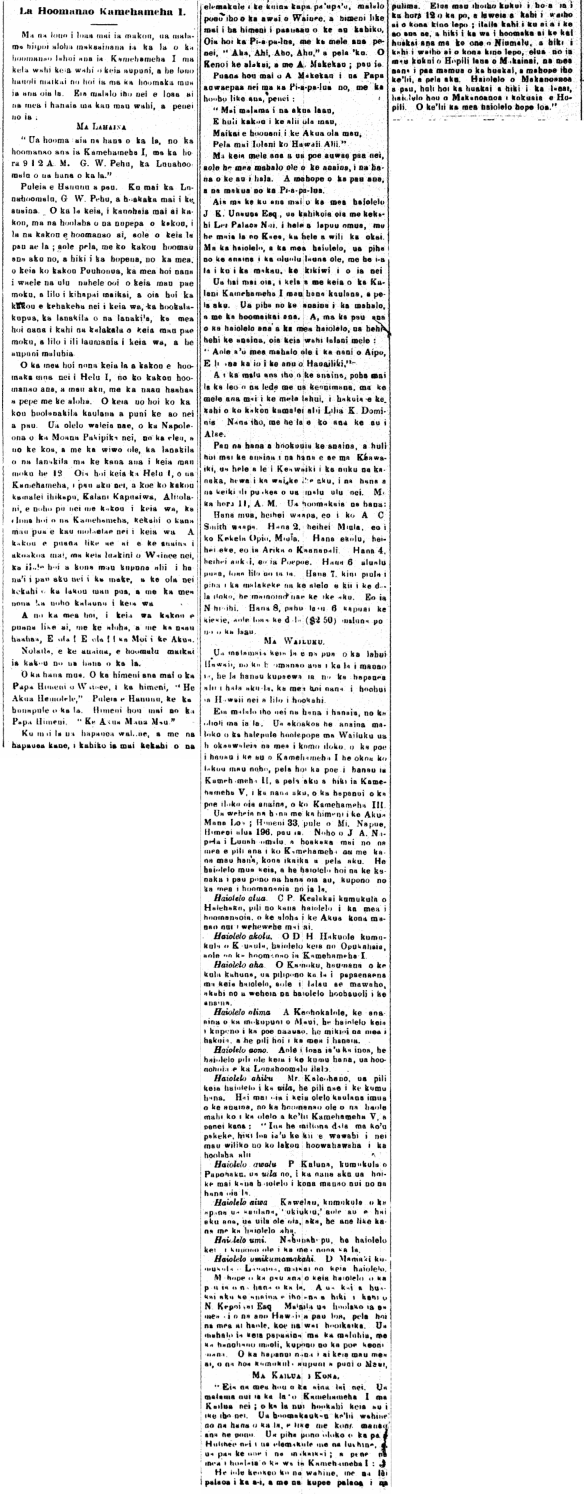
According to the news we received, the day the nation remembers Kamehameha I was preciously observed in different places of the nation, and this is good news for the very beginning of this day. Here below you will find what took place in various places, and here it is:

In Lahaina

“The activities of the day for the commemoration of Kamehameha I began at 9:12 A. M. with G. W. Pehu as the Chairman of the day’s events.”

A prayer was given by Hanunu. Chairman G. W. Pehu stood and explained to the crowd. This is the day that we were told in the announcements in our newspapers that this day is one that we are to commemorate, but not just on this day and that’s it; no, we are to continue this until the end, for he is the pillar of our world, the one who cleared away the thorny wilderness of this archipelago and made it into a fine garden, and it for him which we have pride: the wondrous one, the victor of victors, the one who shorn off the roughness  of these islands and smoothed it out making it a peaceful nation.

The one for whom we are starting off with this very first day, for whom we are celebrating for all times, with humble hearts, modesty, and aloha. He is our famed conqueror across the whole world. He is called the Napoleon of the Pacific Ocean, for his dexterity and his bravery and fearlessness; the victor of victors in battle for these 12 islands. He is the 1st of the Kamehamehas, who has gone, leaving our sacred offspring, King Kapuaiwa, Aliiolani, now living amongst us, the fifth of the Kamehamehas, one of his blossoms now appears clearly before us. And we proclaim together O Crowd gathered here at the church of Wainee, the House made by his royal ancestors who are passed on, while some of their descendants live on, along with the one who occupies the throne today.

For we now say in unison with aloha and humble hearts, May He Live! May the King Live in God!!

Therefore O People, let us keep the activities of the day well under control.

The first event. The singing of the Choir of Wainee, the hymn, “He Akua Hemolele.” There was a prayer by Hanunu, the pastor of the day. The Choir sang once more, “Ke Akua Mana Mau.”

The old ladies stood, along with the old men; some of the old men were right below the pulpit of Wainee, decked out in  layers of pa’upa’u kapa, and sang memorized songs of old. Like the Second Alphabet [Pi-a-pa-lua], sung like this: “Aha, Ahi, Aho, Ahu,” and so forth. Kenoi was the leader along with A. Makekau; this came to an end.

A. Makekau called out once more to this group of oldsters, with the Pi-a-pa-lua, exhorting in this manner:

“Don’t care after wooden idols,
Let us turn to the ever-living ruler,
It is good to glorify the ever-living God,
This, according to Iolani, the King of Hawaii.”

With this singing of the old ones, there was not a single one there who did not feel gratitude for the work done in times past. And after this was done, the makua then sang the Pi-a-pa-lua.

When the speaker, J. K. Unauna, stood, he was wearing a Large Whale Ivory Lei [Palaoa], which curved at the front like a banana of Kaea whose blossom containers [okai] are twisted. By the speech, of the speaker, the audience was immensely pleased, like a fish caught on the hook, weaving this way and that.

He spoke of the different famous feats of the Chief Kamehameha I. The audience was filled with thanks and appreciation. And, at the end of the speech of the speaker, the audience stomped their feet, like these lines of mele:

“I have nothing but praise for the beauty of Aipo,
Shuddering at the cold of Hauailiki”

[“Aole a’u mea mahalo ole i ka nani o Aipo,
E li ana ka io i ke anu o Hauailiki.”]

And when the audience calmed down, the voices of the men and women burst forth, singing the national anthem [mele lahui] composed by one of our chiefly children, Lilia K. Dominis. To witness this, it was as if the current was drawing to Alae [e ko ana ke au i Alae].

The program was over, and the audience was released, and the went to the other festivities at Keawaiki, which was teeming with people; there were so many people seen at the activities of the white ones of Lahaina nei. At the hour of 11 A. M., the games began:

First event, boat race, won by the boat of A. C. Smith. Event 2, Mule race, won by Castle Jr.’s mule. Event three, sack race, won by Arika of Kaanapali. Event 4, swimming race, won by Poepoe. Event 6, pig chase [alualu puaa], which was won by him. Event 7, tin can filled with molasses and you try to get the dollar inside using your tongue; it was miserable to watch. Won by [?Nahioihi]. Event 8, a wooden pole of 6 feet tall; the money ($2.50) atop the pole was not gotten.

[This article continues with scenes from Wailuku and Kailua, Kona. Look for the continuation at a later date. The image online is very hard to read. I can’t wait for the day when all the newspapers are rescanned clearly!]

(Au Okoa, 6/20/1872, p. 3)
La Hoomanao Kamehameha I.

Ke Au Okoa, Buke VIII, Helu 10, Aoao 3. Iune 20, 1872.

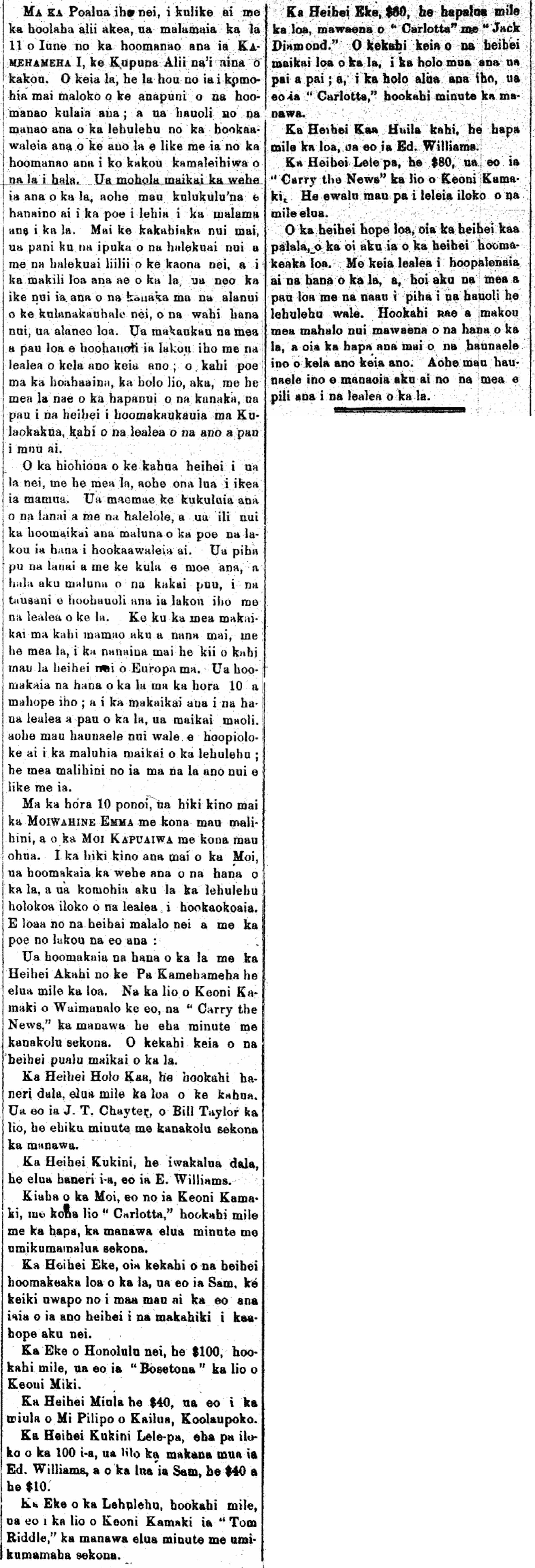
The First Kamehameha Day, 1872.

This past Tuesday, as per the Royal Proclamation, the 11th of June was observed as the day to commemorate Kamehameha I, our Royal Ancestor who conquered the land. This is a new day included in the realm of holidays; and the people were joyous at the designating of a day like this for the remembering of our precious beloved one of days gone by. The day opened beautifully, without any drops to bother the people who were well adept to celebrate the day. From early morning, the doors of the large and small shops of town were closed shut, and when the sun came out, nonexistent the sight of many people on the streets of this town, and the places of work were deserted. Everyone was ready to entertain themselves with pleasures of all sorts; some people with feasts or horse riding, but it seemed as if most of the people were at the races set up at Kulaokahua, where enjoyments of all sorts took place [? i muu ai].

The sight of the race track on that day, was as if like no other before. The lanai and tents were nicely built, and congratulations go to those responsible for that distinguished job. The lanai and grounds were filled all the way atop the hills with thousands enjoying themselves with the festivities of the day. Should a visitor stand far away and look forth, it was as if it was a scene from great racing days in Europe. The events of the day began at 10 o’clock or thereafter; and to take in all of the many fun activities of the day was great; there were no big uproars to disturb the peace; that is something unusual for big days like this.

At 10 o’clock sharp, Queen Emma made an appearance with her guests, and King Kapuaiwa with his suite. At the arrival of the King, the activities of the day were opened, and all the people joined in the festivities set aside. There are the races below as well as those who won.

The activities of the day began with the First Race for the Kamehameha Plate, which was two miles long. John A. Cummins [Keoni Kamaki] of Waimanalo won, with “Carry the News,” with a time of four minutes and thirty seconds. This was one of the fine open races [heihei pualu] of the day.

Trotting Race [Heihei Holo Kaa], for one hundred dollars, two mile long course. J. T. Chayter won with the horse Bill Taylor, with a time of seven minutes and thirty seconds.

Foot Race [Heihei Kukini], for twenty dollars, two hundred yards, won by E. Williams [Edward Williams].

King’s Cup, won by John A. Cummins [Keoni Kamaki], with his horse, “Carlotta,” one mile and  a half, with a time of two minutes and twelve seconds.

Sack Race [Heihei Eke], was one of the most humorous races of the day, won by Sam, the harbor boy who is used to winning that type of race in past years.

Honolulu Purse [Eke Honolulu nei], of $100, one mile, won by “Bosetona,” the horse of Keoni Miki [John Meek].

Mule Race [Heihei Miula], $40, won by the mule of Mr. Pilipo of Kailua, Koolaupoko.

Foot Hurdle Race [Heihei Kukini Lele-pa], four hurdles in a hundred yards; the first place went to Ed. Williams, and the second to Sam; $40 and $10.

Public Purse [Eke o ka Lehulehu], one mile, the horse of John A. Cummins [Keoni Kamaki], “Tom Riddle,” won, with a time of two minutes and fourteen seconds.

$60 Purse [Heihei Eke $60], half a mile long, between “Carlotta” and “Jack Diamond.” This was one of the best races of the day, in the first running, they were head to head; but on the second race, “Carlotta” won with a time of one minute.

Velocipede Race [Heihei Kaa Huila kahi], half a mile long, won by Edward Williams.

Hurdle Race [Heihei Lele pa], for $80, won by “Carry the News,” the horse of John A. Cummins [Keoni Kamaki]. Eight hurdles were jumped over in two miles.

The final race was the wheelbarrow race [heihei kaa palala], which was the most comical. With this race, the activities of the day came to a close, and everyone went home with hearts filled with much joy. There is one thing amongst all the activities which we appreciate greatly, that is the fraction of various sorts of commotions. There were no disturbances believed to have resulted from the gaiety of the day.

[This is quite a different type of celebration compared to today. Whatever you may have planned for today, let there be remembering of the one who unified the islands, Kamehameha Paiea.]

(Au Okoa, 6/13/1872, p. 2)

Ma ka Poalua iho nei...

Ke Au Okoa, Buke VIII, Helu 9, Aoao 2. Iune 13, 1872.

Announcing the first Kamehameha Day, 1872.

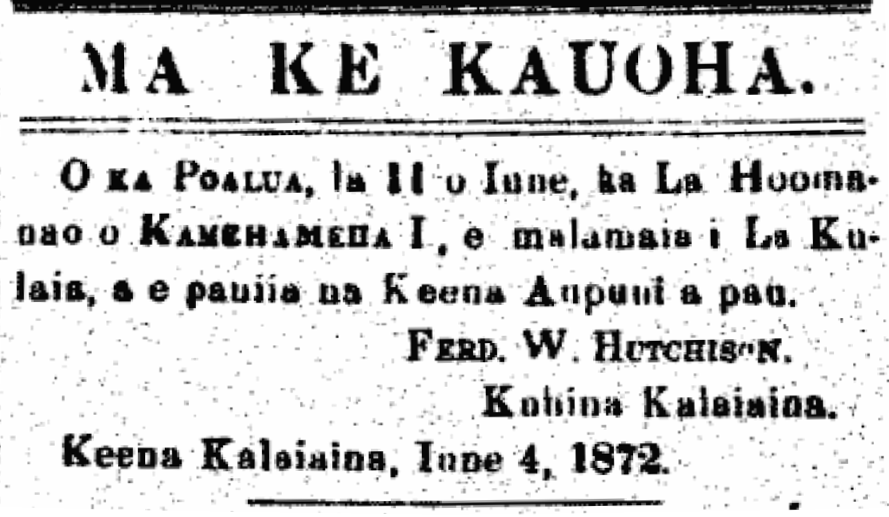
BY AUTHORITY.

Tuesday, the 11th of June, the Day of Commemoration of Kamehameha I, will be observed as a Holiday, and all Government Offices will be closed.

Ferd. W. Hutchison.

Minister of the Interior [Kuhina Kalaiaina].

Office of the Interior [Keena Kalaiaina], June 4, 1872.

(Au Okoa, 6/6/1872, p. 2)

MA KE KAUOHA.

Ke Au Okoa, Buke VIII, Helu 8, Aoao 2. Iune 6, 1872.

The Kings of Hawaii, 1876.

This is from an issue of “The Friend,” which includes a short biography in English of the ruling monarchs of Hawaii nei, written by S. C. Damon. As for this page of illustrations, they say:

The illustrations accompanying this number of the Friend we could wish were better executed. The plate was made in New York, from the best photographs we could procure in Honolulu. The original of Kamehameha 1st was executed in 1817 by a Russian artist, who accompanied Kotzebue in his voyage, and may be seen by referring to the third volume of his voyage. The original of Kamehameha 2d was executed in England in 1824, in the style of the dress of George 4th’s reign. We think those of Kamehameha 3d, 4th and 5th are very good, but not quite so good those of Lunalilo or His Majesty Kalakaua.

[For the biographies, find them here: The Friend, February 1, 1876.

Although it is clunky to maneuver, most of this series of news letters is available from the Mission Houses Museum here: The Friend.]

(Friend, 2/1/1876, pp. 9–13)

[Monarchs]

The Friend, New Series, Volume 25, Number 2, Page unnumbered. February 1, 1876.

Reenactment of Kamehameha’s landing on Oahu, 1913.

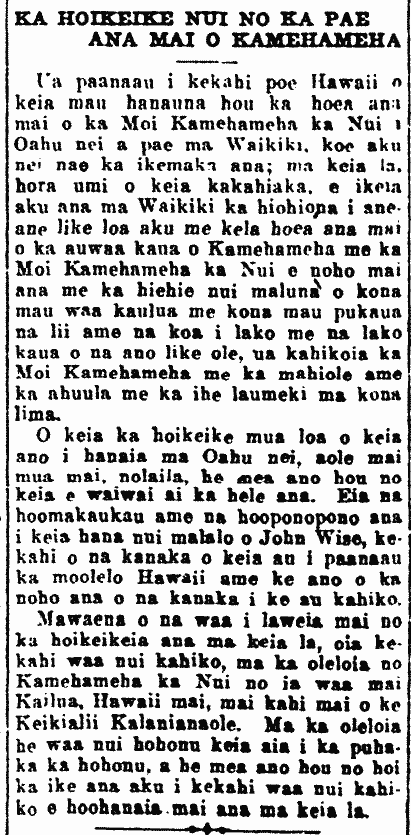
GREAT PERFORMANCE OF THE LANDING OF KAMEHAMEHA

Some people of Hawaii of these new generations have committed to memory the arrival of Kamehameha the Great to Oahu and his landing in Waikiki, without however having witnessed it; today, at ten in the morning, it will be seen in Waikiki a scene very similar to that arrival of the war canoes of Kamehameha with the greatly distinguished King Kamehameha the Great sitting aboard his double-hulled canoes [waa kaulua] along with his war leaders, the chiefs, and warriors supplied with war implements of all sorts; King Kamehameha is adorned with a feather helmet [mahiole] and feather cloak [ahuula] along with a barbed spear [ihe laumeki] in his hand.

This is the first show of this type done here on Oahu; there was not one from the beginning; therefore, it is something new worth going to.  The preparations for and supervising of this great work is under John Wise, one of the people of this time that has memorized the history of Hawaii and the way of life of the people of old.

From amongst the waa that are being brought to show this day, is one of the huge, old waa; it is said that it belonged to Kamehameha the Great and is being brought from Kailua, Hawaii, from the estate of Prince Kalanianaole. It is said that this a huge and deep canoe, and the depth reaches the waste, and it is something new to see a huge waa of the old times being used these days.

(Kuokoa, 2/21/1913, p. 5)

KA HOIKEIKE NUI NO KA PAE ANA MAI O KAMEHAMEHA

Ka Nupepa Kuokoa, Buke L, Helu 8, Aoao 5. Feberuari 21, 1913.

More mele from Mary Jane Montano, 1927.

SOME OLD MELE OF HAWAII NEI.

Mr. Solomon Hanohano, Editor of the Kuokoa Newspaper:—Please publish the following mele from times past, when the land was filled with alii.

This is a name song [mele inoa] for the royal one Ahumanu [Kaahumanu], which was inherited by Kaumakaokane II, the mother of Kuakini (John Adams Cummins) during the youth of Kaumaka, and that royal woman [Kaahumanu] then called Kaumakaokane, by the name Papaleaiaina.

This name is the name that Kalaniahumanu [Kaahumanu] called the Royal One, Paiea Kamehameha I, and it is answered to today by the granddaughter of the Hon. J. A. Cummins, that being Matilda Papaleaiaina Walker Constable.

It would be best that these jewels of Hawaii nei be shown, for some of us will live on as teachers for the impertinent questions, as like the one who questioned in the Advertiser newspaper, about my dear brother, the Hon. J. A. Cummins, the “backbone” [iwikuamoo] of the chiefly ones who have passed into the next realm.

Kaumakaokane he inoa,
Hanau a koa he kupuna,
Eia ua aliiwahine nei,
Ke holo mai nei o ka moku,
Me ka hae o kau weloweloula,
Ku’ilua ka pu,
He aloha ia,
Aole i ike ka haole,
Wahi a Kalanikauleleiaiwi,
Iwi ka maka,
Holoholo ka onohi,
Lele ka puuwai i ka makemake,
I ka wai olu o Lanipo-e,
Nau ke ku’i haukeke ka auwae,
I hemahema i ka wa kamalii,
O ko’u wa naaupo no ia,
E laua la e,
Papaleaiaina kuu aloha e—
O kau ka haili aloha i o’u nei,
O ka welelau o kuu lima ka i pa aku,
Pa i ka lihi o Kilauea.

And here is the genealogy of the lei to adorn the neck of Ahia (Mrs. Capt. George Beckley), that being John Adams Cummins.

Liloa is the father who dwelt with Akahiakuleana, born was Umi. Umi, dwelt with Piikea, born was Aihakoko, Kumulaenuiaumi. Kumulaenui, dwelt with Kumunuipawalau, born was Kekapuhelemai; Kekapuhelemai dwelt with Piilani, born was Lonoikauakini.

Lonokauakini, dwelt with Kapukaheiau, born was Lonoikahaupo; Lonoikahaupo, dwelt with Ninauaiwi, born was Kekapalakea. Kekapalakea dwelt with Kelahuna, born was Kowali; Kolwali dwelt with Kaumaokaokane, born was Keaweaua. Keaweaua dwelt with Kaahaiku, born was Keauiaole; Keauiaole dwelt with Liloa, born was Kaumakaokane, Kameeiamoku.

Kaumakaokane (f) dwelt with Thomas Cummins, born was John Adams Cummins.

Kelahuna (f) is a descendant of Kelahunapaikua (m) and Ahia (f) and Kelahunapaikua (m) is a child of Kakuhihewa and Kolimoalani, that being Koaekea (f), the grandchild of Akahinuikameenoa (f), the woman that I placed a kapu upon.

Kelahuna (f) is the younger sister of Kamehaiku, these being female alii of Kau, Hawaii, and Kamehaiku is the woman of Keeaumoku, the father of Kaahumanu who slept with Kalanianoano and begot Kanehoa, the grandfather of Kaleianoano, Hoapili, and so forth, as well as Jesse Hakainai [Makainai ?], and so forth.

Sincerely, this is I

Ako-kuia ka hale lehua o ka manu,
Kauwewe i ka liko o ka ohia,
He uanoe he uaawa no ka mauna,
Uli ka nahele o Ookuauli,
Uli ka nahu hoomau a ka makani,
A makani a lei a lea,
Lea i na kauna ami a ka ua,
Alohi Maukele anapa i ka la e,
Okioki a hoe,
O ke aho no ia a ka ua Polohinalo,
A pikipiki ka lei,
Me he nu’a kapa la,
Popo ka lei a waiho malie,
Nana aku o kuu apana hala iuka o Panaewa,
Mamina ino no kuu kula lehua,
A’u i kawili mua ai,
Ua maka-pa ua eena ka manu,
He ena kai olohia ia no ke kanaka e—

The is the origin of my name from the heavenly one, Kauikeaouli; Kekulani is the name appended to Keoni Ana Opio [John Young, Jr.] when Kauikeaouli died and returned.

E o mai oe i kou inoa e Kekulani,
O ka lani no ka i ku,
I ka papa holu i ka makani,
A o oe no ke o mai e,

MARYJANE AHIA AHUENA KEKULANI MONTANO.

(Kuokoa, 3/31/1927, p. 1)

KEKAHI MELE KAHIKO O HAWAII NEI.

Ka Nupepa Kuokoa, Buke LXVI, Helu 13, Aoao 1. Maraki 31, 1927.