Translations of Manini, Francisco de Paula Marin, 1838.

SOME OLD THINGS.

Here are some things translated from the writings of Francisco de Paula Marin [Manini], the Spanish haole who died the previous year. The writing was done in Spanish, and they were translated by Mr. Charles R. Smith [Mi. Kale R. Semita].

1814, Oct. 26, until Nov. 19, there was a kapu, and a feast for the Makahiki.

1819, Nov. 6, The word of the King, Liholiho, that the men and women would eat freely. The women ate pig, and other foods that were kapu to them previously; the heiau were burned down. It was the end of idolatry [hoomanakii].

1811, Oct. 9, Kaahumanu I was married to Kaumualii, the King of Kauai, at Honolulu.

1825, Sep. 27. There was a great noise heard in Honolulu, like the sound of canons; there were a lot of rocks which rained down upon the town.

Ke Kumu Hawaii newspaper asks the kamaaina, the ones who witnessed the falling of these rocks, and the sound of it [falling]. What was this like? Write to us how it sounded to you and how this amazing thing appeared to you.

Here is another thing that was clear through those writings of Manini. November is the month that there is much rain every year, and that is the month when there is much sickness. From the month of November to February there is much sickness; but some years, the sicknesses go on, along with fever, and also vomiting blood. Cold and heat, they are the same as many years before, as well as recent years. If it is a hot day, the mercury rises in the thermometer to 84° to 86° indoors; it does not go above 86°. There is much lightning and thunder some years, and in others there is none.

(Kumu Hawaii, 12/5/1838, p. 55)
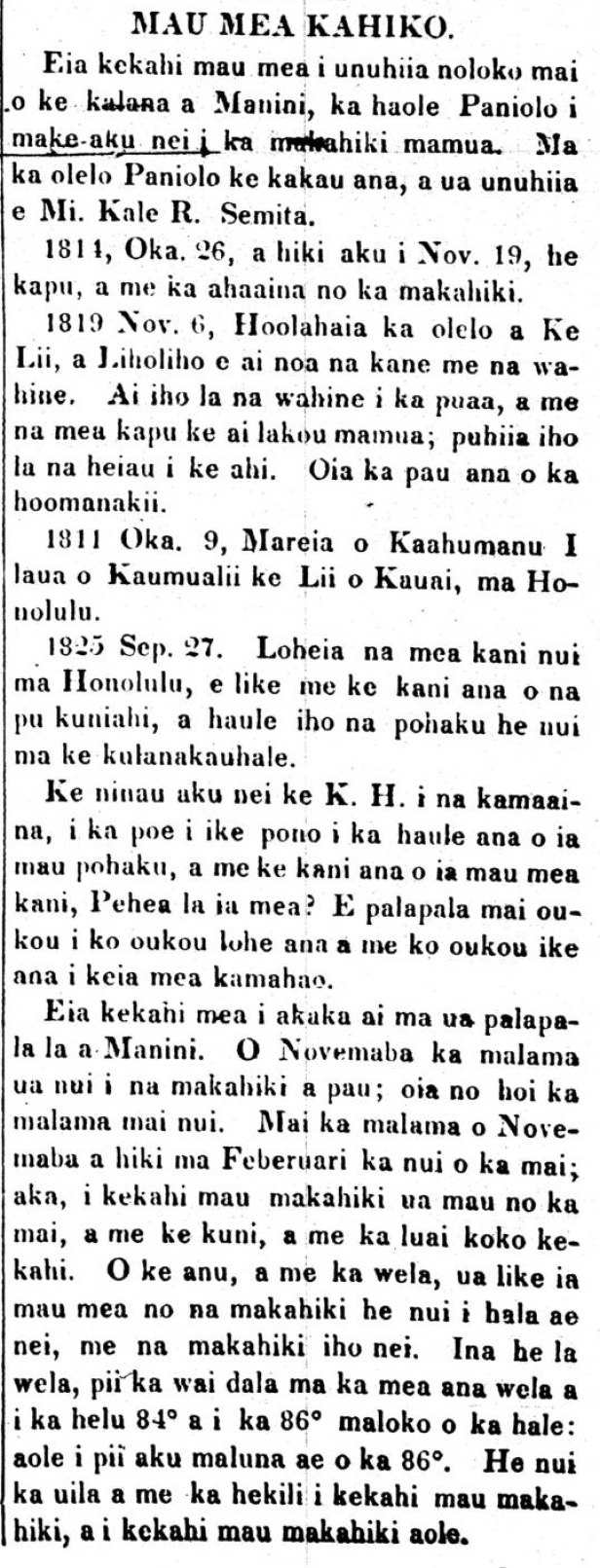
Ke Kumu Hawaii, Buke 4, Pepa 14, Aoao 55. Dekemaba 5, 1838

Letter pertaining to plight of William Kanui, 1863.

Pertaining to  William Tennoee [William Tenoee] Alias Kanui.

We heard from Rev. S. C. Damon, the Pastor at the Bethel Church [ka Halepule Betela] at Polelewa, Honolulu, that he received a letter from San Francisco, pertaining to the old Hawaiian that is living in that city, that being the one named above, and he is living there in severe poverty and in difficulty. Kanui has been living in foreign lands since a long time ago, perhaps more than fifty years. Continue reading

Mission Houses Museum, 1920.

NEW MUSEUM.

After not being paid attention to for many years, that old house of Levi Chamberlain [Levi Kamalena] in the old missionary lot at the corner of King and Kawaiahao, was spruced up and it is beautiful to see today as it looked when it was first built; it is supplied with office furnishings in preparation of bringing back some old relics of the missionary teachers there. Continue reading

Liholiho and Kamamalu, 1924.

[Found under: “LIFE OF KAMEHAMEHA II AND HIS QUEEN EVENTFUL”]

At the annual social meeting of the Daughters of Hawaii at Queen Emma home Wednesday afternoon, a story of the life and short reign of King Kamehameha II, usually known as Liholiho Iolani, the latter being his favorite name, and his queen, Kamamalu. The paper was read by Mrs. Flora Wood Jones, historian, who wove the historical facts into an interesting story. It is as follows: Continue reading

Stephen Reynolds was in Honolulu while Kamehameha II lived there, 1868.

[Found under: “KA MOOLELO O NA KAMEHAMEHA.”]

When King Liholiho resided in Honolulu, there was an increase of haole living in Honolulu at that time; some were of high standing, some were ship captains, some were traders, and some had shops. The haole living there at the time were: Jones Aluli, Mister Parker [Mikapako], Stephen Reynolds [Lanai], Continue reading

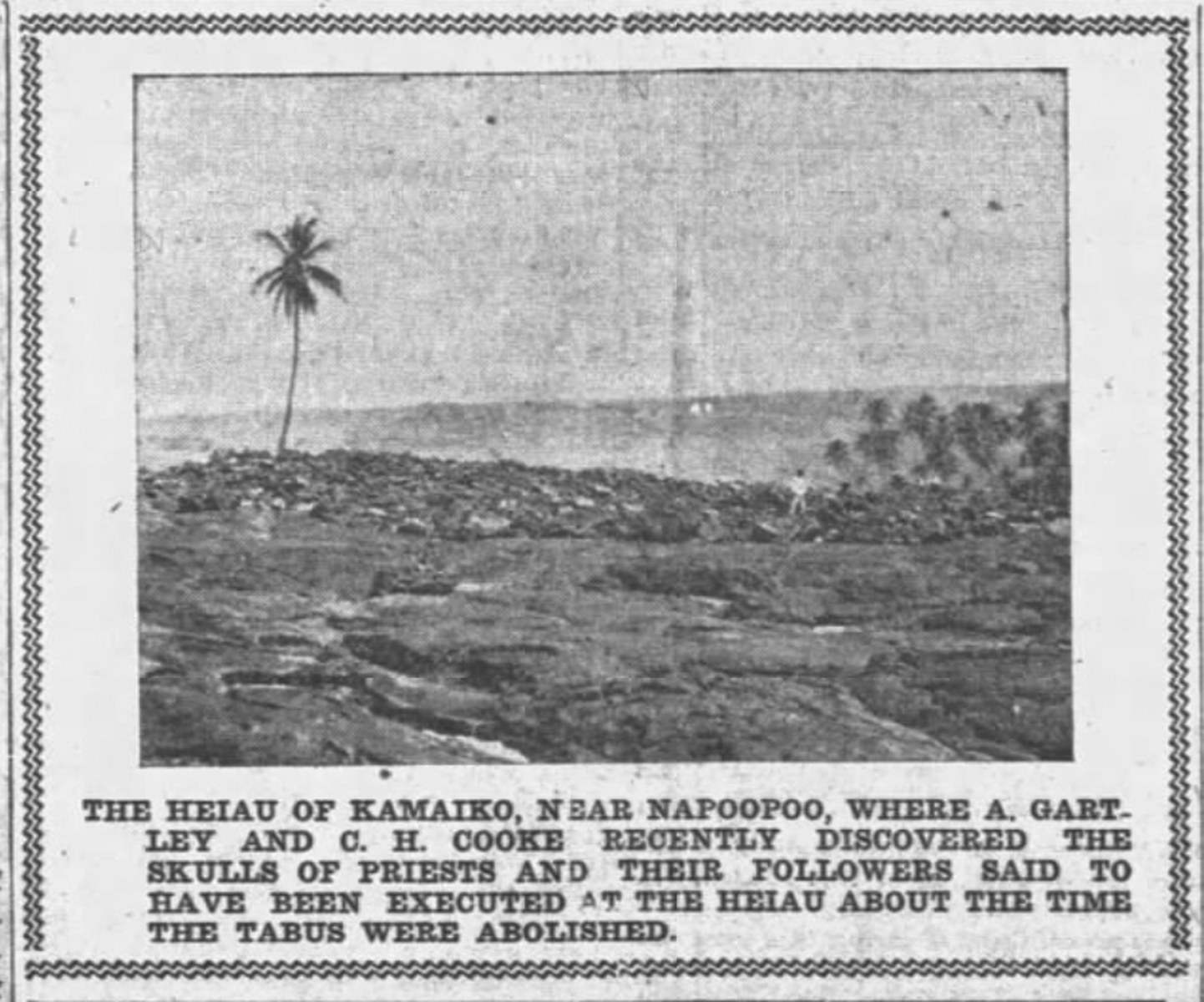
Picture of Kamaiko Heiau in 1908.

THE HEIAU OF KAMAIKO, NEAR NAPOOPOO, WHERE A. GARTLEY AND C. H. COOKE RECENTLY DISCOVERED THE SKULLS OF PRIEST AND THEIR FOLLOWERS SAID TO HAVE BEEN EXECUTED AT THE HEIAU ABOUT THE TIME THE TABUS WERE ABOLISHED.

(PCA, 3/25/1908, p. 1)

PCA_3_25_1908_1

The Pacific Commercial Advertiser, Volume XLVII, Number 7995, Page 1. March 25, 1908.

Kamaiko Heiau story in the PCA, 1908.

GRIM RELICS OF HUMAN SACRIFICE ARE DISCOVERED

A. Gartley and C. H. Cooke Find Many Skulls and Skeletons at the Kamaiko Heiau in Kona, All in Good Preservation.

A Gartley and C. H. Cooke made a most interesting discovery in connection with the Kamaiko heiau of the district of Keei, in South Kona, on their recent visit to the Big Island. Continue reading

Iwi in Kamaiko Heiau, 1908.

BONES FOUND IN HEIAU

At Keei, Kona, Found were Many Human Skulls and Bones.

Upon the return of Mr. A. Gartley and C. H. Cook [C. H. Cooke] from their excursion to South Kona, Hawaii, they said that when they went to look at Kamaiko Heiau at Keei, they found many human bones in the heiau.

It is conjectured that the reason there are many human skulls and their bones there is because their lives were sacrificed in this heiau when the kapu system [ka noho ame ka ai kapu ana] was abolished. Continue reading