Mele and King Lunalilo, 1883.

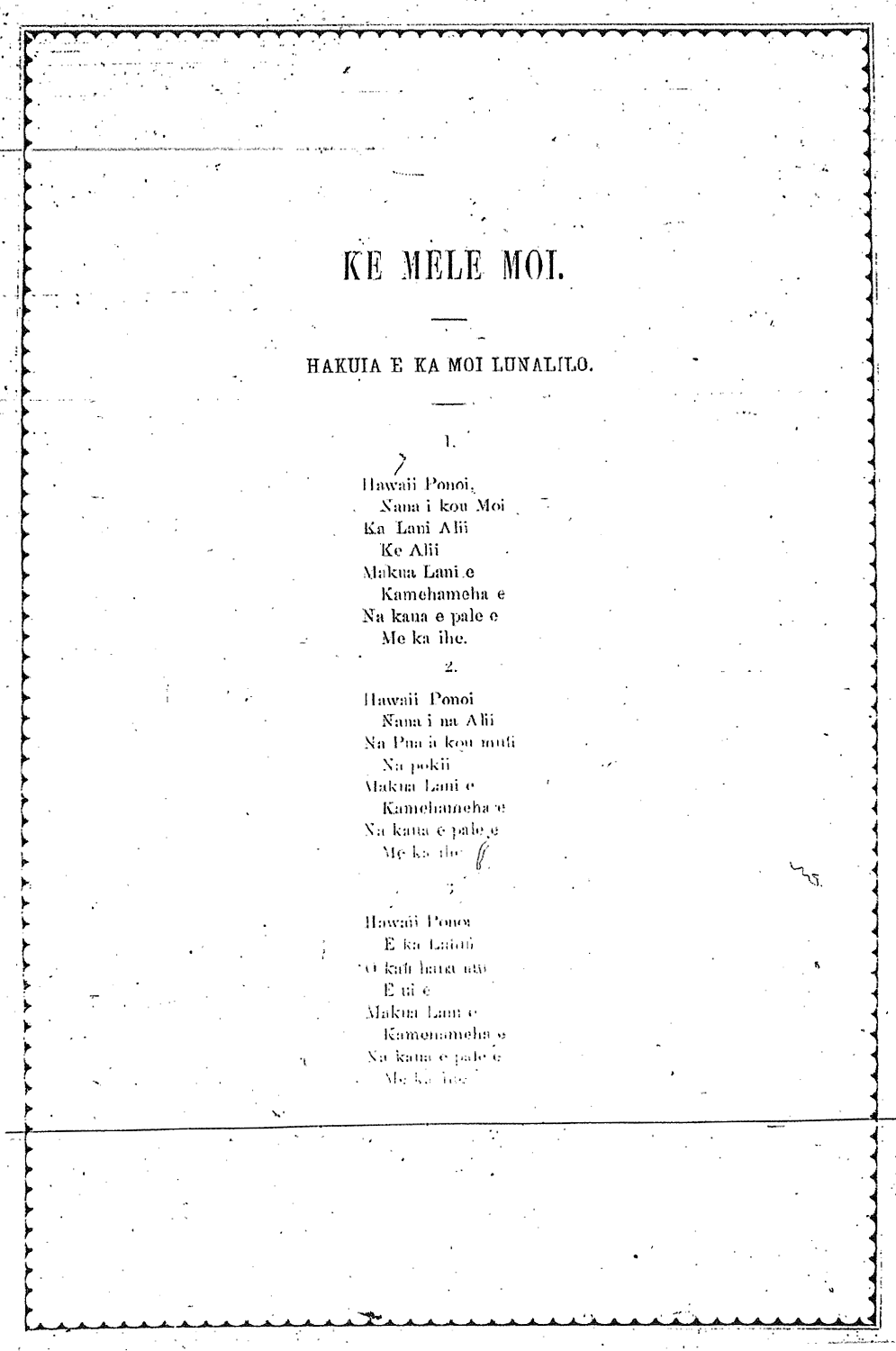
ROYAL MELE.

COMPOSED BY KING LUNALILO.

1

Hawaii Ponoi,
Nana i kou Moi
Ka Lani Alii
Ke Alii
Makua Lani e
Kamehameha e
Na kaua e pale e
Me ka ihe.

2.

Hawaii Ponoi
Nana i na Alii
Na Pua a kou muli
Na pokii
Makua Lani e
Kamehameha e
Na kaua e pale e
Me ka ihe.

3.

Hawaii Ponoi
E ka Lahui
O kau hana nui
E ui e
Makua Lani e
Kamehameha e
Na kaua e pale e
Me ka ihe.

[It is interesting to note that i could not find any article in any paper protesting the attribution of this song. In the same issue is the National Anthem by Princess Liliuokalani.]

(Koo o Hawaii, 8/15/1883, p. 2)

KE MELE MOI.

Ke Koo o Hawaii, Buke 1, Helu 1, Aoao 2. Augate 15, 1883.

Follow up to Hawaiian National Hymn, 1862.

[Found under: “NEWS OF HAWAII NEI.”]

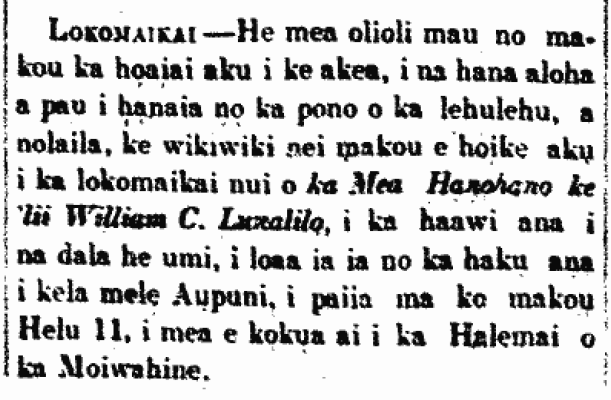
Good Will.—We are always delighted to release to the public all kind deeds done for the benefit of the people, and therefore, we are showing at once the great kindness of the Honorable, Chief William C. Lunalilo, in his donating the ten dollars he received for composing the National song that was published in our Issue 11, to aid the Queen’s Hospital.

(Kuokoa, 2/15/1862, p. 2)

Lokomaikai.

Ka Nupepa Kuokoa, Buke I, Helu 12, Aoao 2. Feberuari 15, 1862.

More on the Hawaiian National Hymn, 1874.

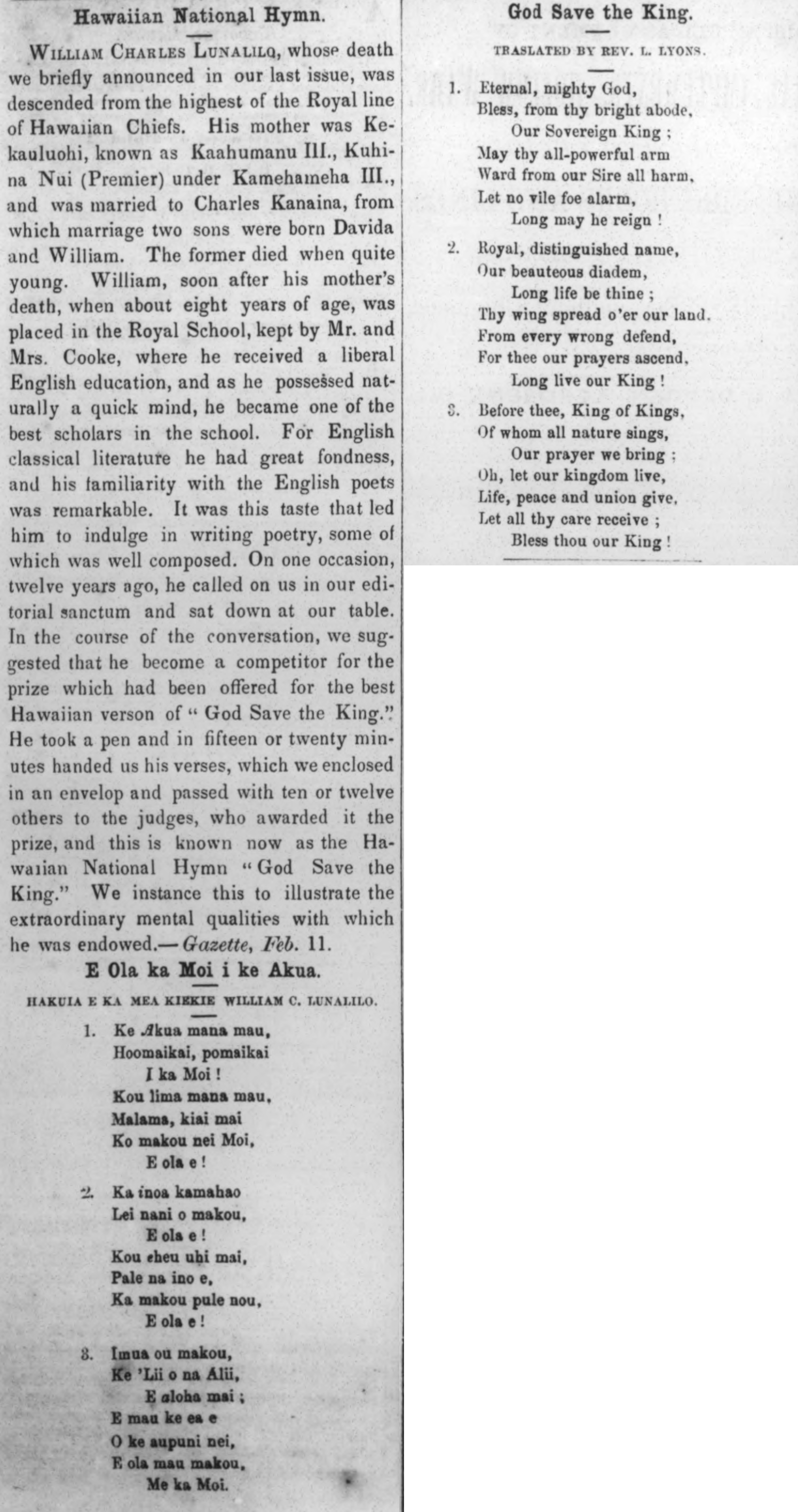
Hawaiian National Hymn.

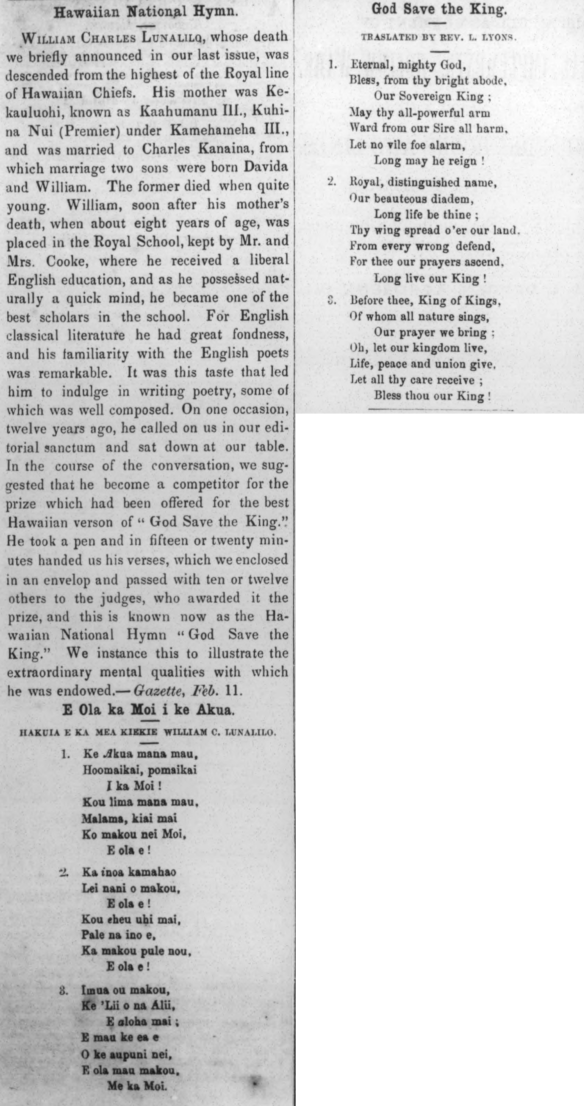
William Charles Lunalilo, whose death we briefly announced in our last issue, was descended from the highest of the Royal line of Hawaiian Chiefs. His mother was Kekauluohi, known as Kaahumanu III., Kuhina Nui (Premier) under Kamehameha III., and was married to Charles Kanaina, from which marriage two sons were born Davida and William. The former died when quite young. William, soon after his mother’s death, when about eight years of age, was placed in the Royal School, kept by Mr. and Mrs. Cooke, where he received a liberal English education, and as he possessed naturally, a quick mind, he became one of the best scholars in the school. For English classical literature he had great fondness, and his familiarity with the English poets was remarkable. It was this taste that led him to indulge in writing poetry, some of which was well composed. On one occasion, twelve years ago, he called on us in our editorial sanctum and sat down at our table. In the course of the conversation, we suggested that he become a competitor for the best prize which had been offered for the best Hawaiian version of “God Save the King.” He took a pen and in fifteen or twenty minutes handed us his verses, which we enclosed in an envelope and passed with ten or twelve others to the judges, who awarded it the prize, and this is known now as the Hawaiian National Hymn “God Save the King.” We instance this to illustrate the extraordinary mental qualities with which he was endowed.—Gazette, Feb. 11.

E Ola ka Moi i ke Akua.

HAKUIA E KA MEA KIEKIE WILLIAM C. LUNALILO.

1. Ke Akua mana mau,
Hoomaikai, pomaikai
I ka Moi!
Kou lima mana mau,
Malama, kiai mai
Ko makou nei Moi,
E ola e!

2. Ka inoa kamahao
Lei nani o makou,
E ola e!
Kou eheu uhi mai,
Pale na ino e,
Ka makou pule nou,
E ola e!

3. Imua ou makou,
Ke ‘Lii o na Alii,
E aloha mai;
E mau ke ea e
O ke aupuni nei,
E ola mau makou,
Me ka Moi.

God Save the King.

TRANSLATED BY REV. L. LYONS.

1. Eternal, mighty God,
Bless, from thy bright abode,
Our Sovereign King;
May thy all-powerful arm
Ward from our Sire all harm,
Let no vile foe alarm,
Long may he reign!

2. Royal, distinguished name,
Our beauteous diadem,
Long life be thine;
Thy wing spread o’er our land.
From every wrong defend,
For thee our prayers ascend,
Long live our King!

3. Before thee, King of Kings,
Of whom all nature sings,
Our prayer we bring;
Oh, let our kingdom live,
Life, peace and union give,
Let all thy care receive;
Bless thou our King!

(Friend, 3/2/1874, p. 24)
Hawaiian National Hymn.

The Friend, New Series, Volume 23, Number 3, Page 24. March 2, 1874.

Hawaiian National Hymn, 1862.

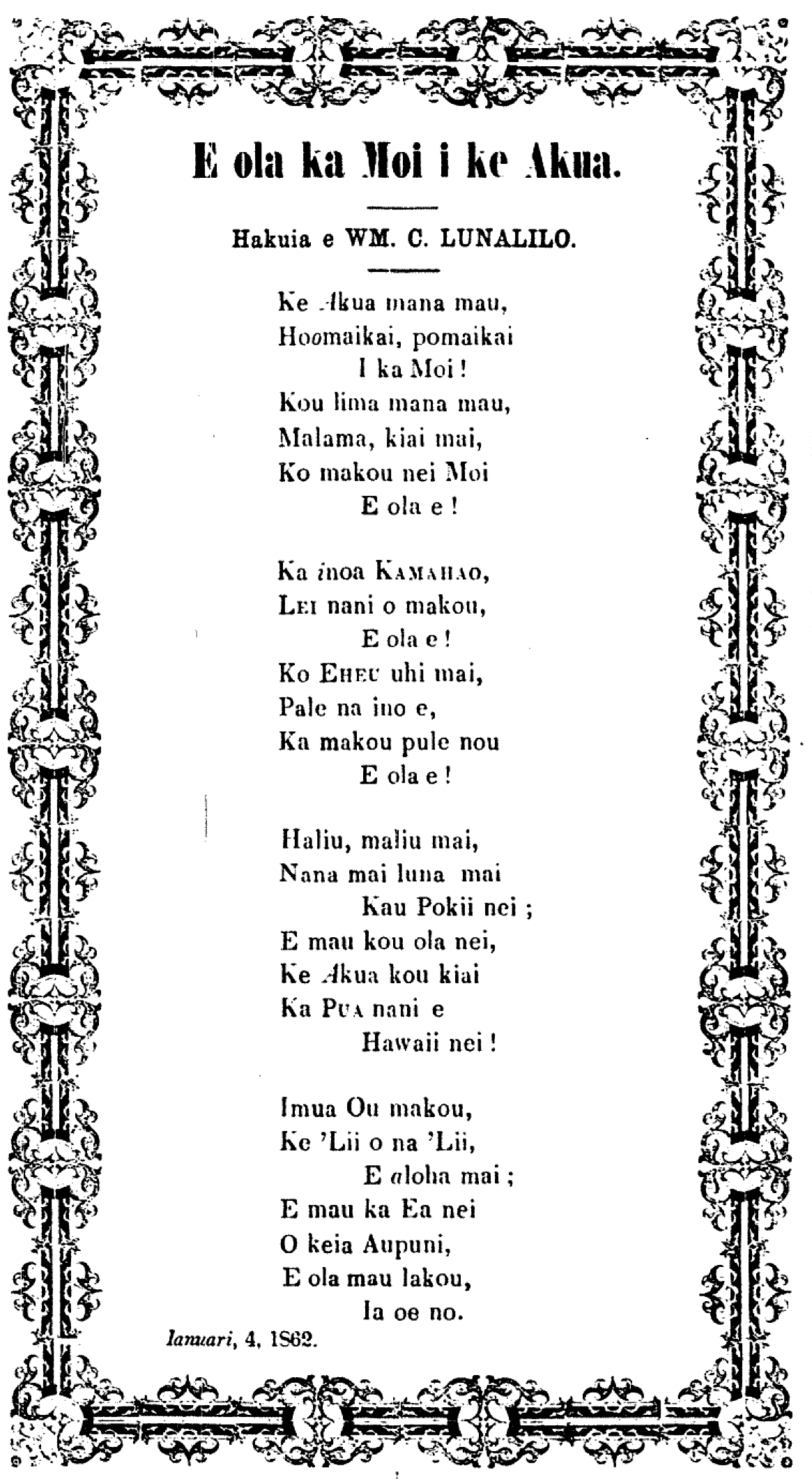
E ola ka Moi i ke Akua.

Composed by WILLIAM C. LUNALILO.

Ke Akua mana mau,
Hoomaikai, pomaikai
I ka Moi!
Kou lima mana mau,
Malama, kiai mai,
Ko makou nei Moi
E ola e!

Ka inoa Kamahao,
Lei nani o makou,
E ola e!
Ko Eheu uhi mai,
Pale na ino e,
Ka makou pule nou,
E ola e!

Haliu, maliu mai,
Nana mai luna mai
Kau Pokii nei;
E mau kou ola nei,
Ke Akua kou kiai
Ka Pua nani e
Hawaii nei!

Imua Ou makou,
Ke ‘Lii o na ‘Lii,
E aloha mai;
E mau ka Ea nei
O keia Aupuni,
E ola mau lakou,
Ia oe no.

January 4, 1862.

(Kuokoa, 2/8/1862, p. 1)

E ola ka Moi i ke Akua.

Ka Nupepa Kuokoa, Buke I, Helu 11, Aoao 1. Feberuari 8, 1862.

The Kings of Hawaii, 1876.

This is from an issue of “The Friend,” which includes a short biography in English of the ruling monarchs of Hawaii nei, written by S. C. Damon. As for this page of illustrations, they say:

The illustrations accompanying this number of the Friend we could wish were better executed. The plate was made in New York, from the best photographs we could procure in Honolulu. The original of Kamehameha 1st was executed in 1817 by a Russian artist, who accompanied Kotzebue in his voyage, and may be seen by referring to the third volume of his voyage. The original of Kamehameha 2d was executed in England in 1824, in the style of the dress of George 4th’s reign. We think those of Kamehameha 3d, 4th and 5th are very good, but not quite so good those of Lunalilo or His Majesty Kalakaua.

[For the biographies, find them here: The Friend, February 1, 1876.

Although it is clunky to maneuver, most of this series of news letters is available from the Mission Houses Museum here: The Friend.]

(Friend, 2/1/1876, pp. 9–13)

[Monarchs]

The Friend, New Series, Volume 25, Number 2, Page unnumbered. February 1, 1876.

A newspaper called, “Lunalilo” 1873.

[Found under: “DOMESTIC NEWS”]

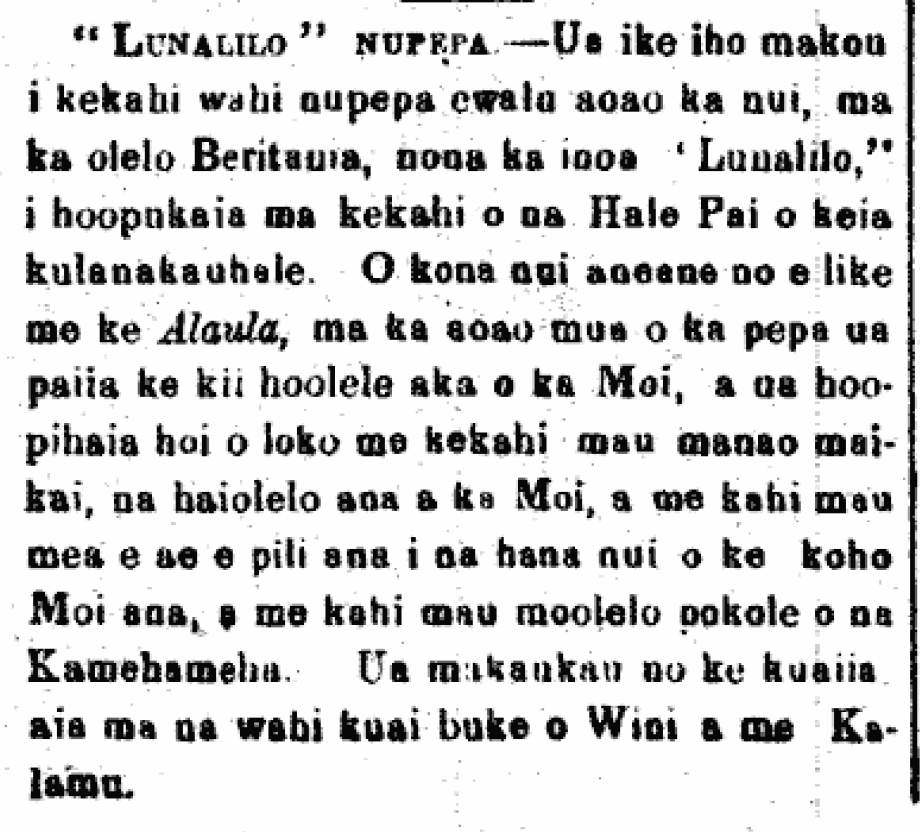
“Lunalilo” Newspaper.—We have seen a newspaper of eight sides, in the English language, with the name, “Lunalilo,” which was printed at one of the Printing Houses of this town. Its size is about the size of the Alaula, and on the first page of the paper is printed with a silhouette [kii hoolele aka] of the King, and the inside is filled with good ideas, the speeches of the King, and some other things pertaining to the election of the King, as well as some short stories about the various Kamehameha. It is ready for sale at the bookstores of Whitney [Wini] and Kalamu [Thrum].

[This is documented in the great four-volume Hawaiian bibliography by David Forbes, “Hawaiian National Bibliography, 1780-1900”]

(Au Okoa, 1/30/1873, p. 3)

"Lunalilo" nupepa.

Ke Au Okoa, Buke VIII, Helu 42, Aoao 3. Ianuari 30, 1873.

Lunalilo’s Crypt overgrown by weeds? 1894.

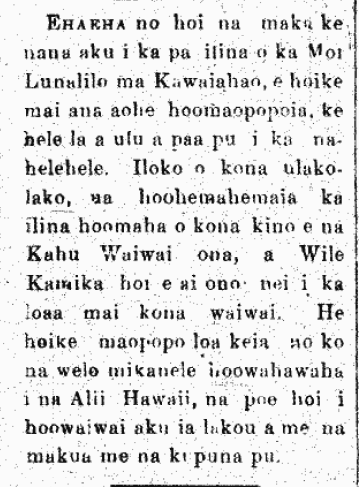
It is painful to see the cemetery of King Lunalilo at Kawaiahao, showing that it is not remembered, for it is overgrown by weeds. In its wealth, the crypt where his body is laid to rest was left to waste by his Trustees, along with Wile Kamika [William Owen Smith] who feasts off of his pay from the trust. This is proof of the missionary descendents’ [welo mikanele] contempt for the Alii of Hawaii, the people who made them wealthy and also their parents and grandparents.

(Makaainana, 3/19/1894, p. 4)

Ehaeha no hoi na maka...

Ka Makaainana, Buke I----Ano Hou, Helu 12, Aoao 4. Maraki 19, 1894.