More plays! 1925.

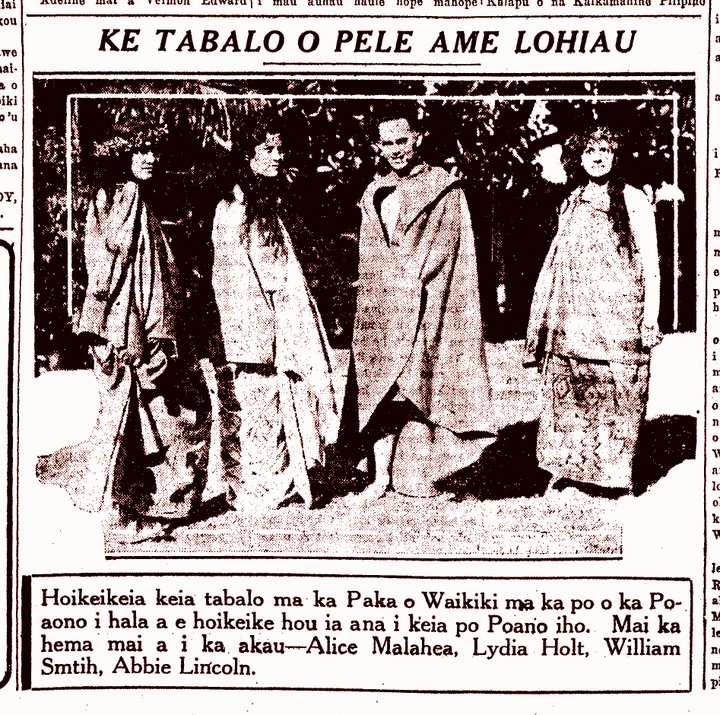
TABLEAU OF PELE AND LOHIAU

This play was shown at Waikiki Park on this past Saturday, and will be shown again on this Satrday night. From the left to the right—Alice Malahea, Lydia Holt, William Smith, Abbie Lincoln.

[This is another i wish i could have seen! This is a repost from the abandoned Hoolaupai Facebook page of times past. I like the format of http://nupepa-hawaii.com because it is very easily searched!]

(Kuokoa, 5/21/1925, p. 5)

KE TABALO O PELE AME LOHIAU

Ka Nupepa Kuokoa, Buke LXIV, Helu 21, Aoao 5. Mei 21, 1925.

This must have been some show, 1912.

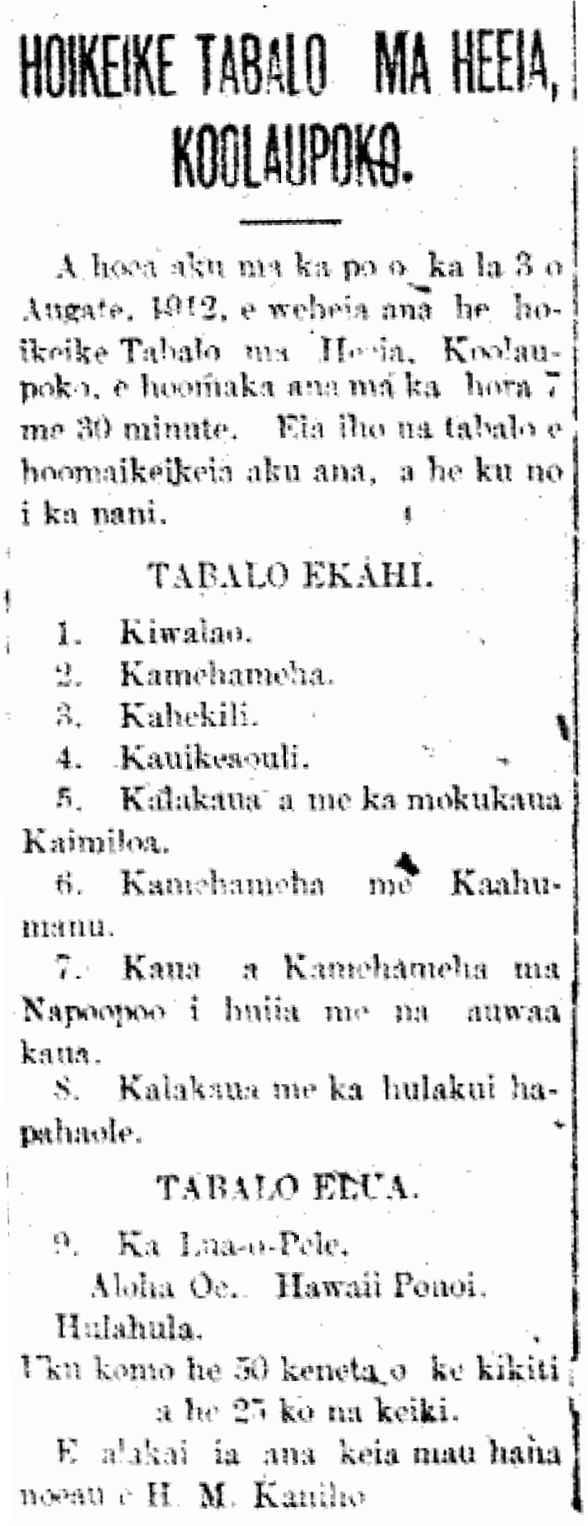
PAGEANT AT HEEIA, KOOLAUPOKO.

With the arrival of the night of the 3rd of August, 1912, a Pageant will be performed at Heeia, Koolaupoko, beginning at 7:30. Here are the scenes that will be shown, and it will be beautiful.

FIRST TABLEAU.

1. Kiwalao.

2. Kamehameha.

3. Kahekili.

4. Kauikeaouli.

5. Kalakaua and the warship Kaimiloa.

6. Kamehameha and Kaahumanu.

7. Battle of Kamehameha at Napoopoo along with the war fleet of canoes.

8. Kalakaua and the hapa haole hula ku’i.

SECOND TABLEAU.

9. The crater of Pele.

Aloha Oe. Hawaii Ponoi.

Western Dancing [Hulahula].

Entrance, 50 cents a ticket, and 25 for children.

This masterful undertaking will be lead by H. M. Kaniho.

(Aloha Aina, 7/27/1912, p. 4)

HOIKEIKE TABALO MA HEEIA, KOOLAUPOKO.

Ke Aloha Aina, Buke XVII, Helu 30, Aoao 4. Iulai 27, 1912.


Olympics, Duke Kahanamoku and the King of Sweden, 1912.

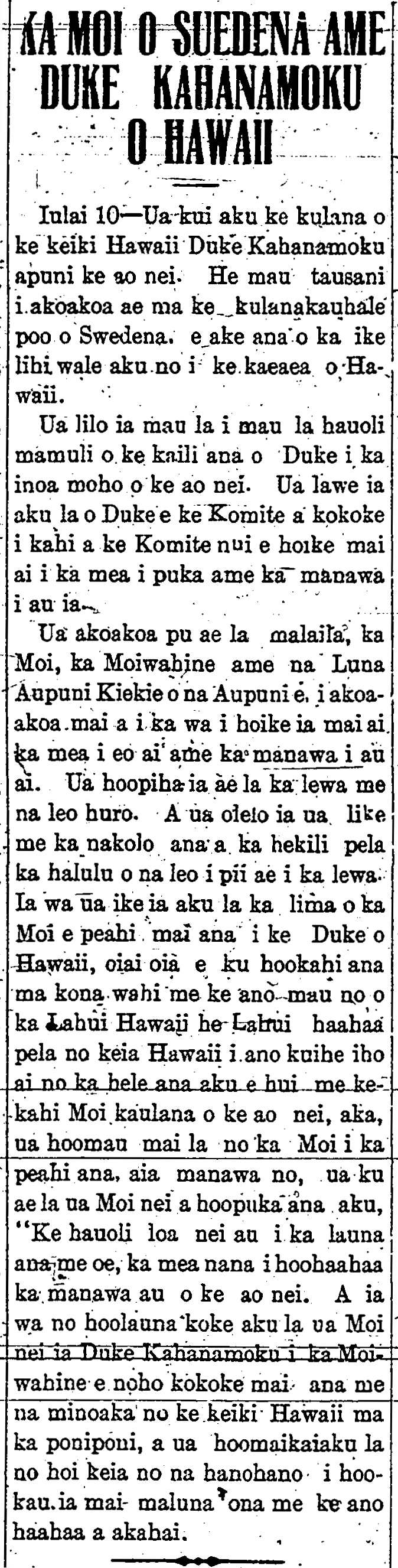
THE KING OF SWEDEN AND DUKE KAHANAMOKU OF HAWAII.

July 10—The news spread around the world of the standing of the Hawaiian boy, Duke Kahanamoku. There were thousands gathered in the capital of Sweden, wanting to catch a glimpse of the hero of Hawaii.

Those days became one of joyfulness because Duke captured the title, champion of the world. Duke was taken by the Committee in the vicinity of where the main Committee was announcing the finishers and their times in which they swam.

Gathered there as well was the King, Queen, and the Heads of State of other Nations, when the winner was announced along with his time. The skies were filled with cheers. And it is said that the voices ringing out in the skies were like the roar of thunder. At this time, the hand of the King was seen waving to the Duke of Hawaii, as he was standing all alone as is the general case with the Hawaiian People, a humble Lahui; and so of this Hawaiian, who hesitated to go and meet with a famed King of the world, but the King kept waving him forth, but at this time, the King stood and said, “I am happy to meet you, the one who dwarfed the swimming records of the world. And then right there after, the King introduced Duke Kahanamoku to the Queen who sat near by who had smiles for the dark-faced [maka poniponi] boy of Hawaii, and he thanked them for this honor granted him, humbly and unpretentiously.

(Hoku o Hawaii, 9/18/1912, p. 2)

KA MOI O SUEDENA AME DUKE KAHANAMOKU O HAWAII

Ka Hoku o Hawaii, Buke 7, Helu 7, Aoao 2. Iulai 18, 1912.

It is best to be truthful and just admit when you are wrong before you dig yourself into a bigger hole. 1912.

LOSE YOUR HEAD, DIE; LOSE YOUR FEET, LIVE.

The statements placed above are from a couple of men in the olden days of Hawaii nei, and this is the story:

There were two men, and one day, the two of them climbed up the mountain to cut house thatching [aho hale] which was a regular thing in those days of ours. They cut thatch until evening, and their work for the day was over, and they went to somewhere suitable and started a fire to warm themselves and prepared their meal for that night, and after they were done eating, they were about to sleep.  One of them lay down with his head to the fire and his feet away, while the other slept with his feet toward the fire and his head away; and when the one who had his feet toward the fire noticed his friend with his head toward the fire, he spoke the words placed above, saying:

E, what say you my friend, LOSE YOUR HEAD, DIE; LOSE YOUR FEET, LIVE, so why don’t you move your head away from the fire and move your feet close to it; and when the one whose head was close to the fire heard this, he replied:

LOSE YOUR FEET, DIE, for if you lose your feet to the fire, then where are your feet to go back home with to see the faces of your wife and children; therefore, because of the different choices made by the two men, they stuck to their decisions and both fell asleep; in the middle of the night, the first man smelled the smell of burning hair, and thus being startled, he saw his friend whose head was on fire; at this, he got up and made ready to head back to the home of their families and as the first man neared their houses, he turned back and saw his companion running behind him with his head on fire, the first man knew that this was a spook [uhane lapu] and not a live person, and as this first one entered the house the spook passed by the house, going around with his head still on fire; the first man told their story from beginning to end, while telling those in his household that his friend died because of his stubbornness, for he warned him to move his head away from the fire and yet he did not listen [much less heed]. So pigheaded.

This story is perhaps similar to people of these times; they stick their heads [hou poo] into stubborn ideas that are caused by false pride [uilani kuhihewa] and the results of this mistaken pride is what we have seen above.

(Hoku o Hawaii, 7/25/1912, p. 3)

PAU POO MAKE, PAU WAWAE OLA

Ka Hoku o Hawaii, Buke 7, Helu 8, Aoao 3. Iulai 25, 1912.

With the death of David Kaukaha Kanewanui, the rest of the fishing descriptions are now lost. 1902.

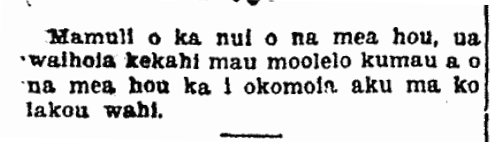
Because of the amount of new items, some regular columns were put aside and the new things were put in their place.

[With the new editor of the Kuokoa, the paper’s focus changed. This short paragraph is all there was that i could find to explain the abrupt ending to the column. David Kanewanui, i am sure, would have completed the priceless fishing descriptions and would have gone on to do so much more. Don’t play with guns…]

(Kuokoa, 7/11/1902, p. 6)

Mamuli o ka nui o na mea hou...

Ka Nupepa Kuokoa, Buke XL, Helu 28, Aoao 6. Iulai 11, 1902.

“All subjects were handled for what he believed to be the best interests of the Hawaiians…” 1902.

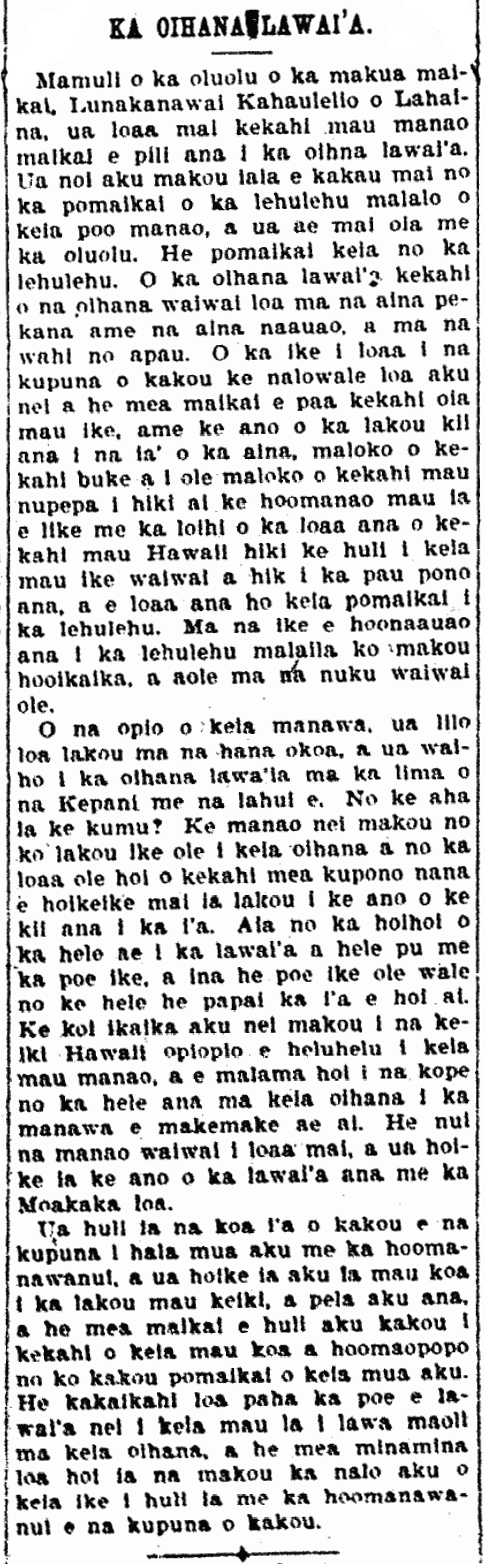
Ka ʻOihana Lawaiʻa: Hawaiian Fishing Traditions

Ka ʻOihana Lawaiʻa: Hawaiian Fishing Traditions

If you haven’t seen this book on fishing and so much more by Daniela Kahaulelio yet, it is one of the stories David Kanewanui, editor of the Kuokoa, knew was important for him to print for the youths of his time, and perhaps more importantly, for those of today and tomorrow. Kanewanui writes:

“…O ka ike i loaa i na kupuna o kakou ke nalowale loa aku nei a he mea maikai e paa kekahi oia mau ike, ame ke ano o ka lakou kii ana i na ia o ka aina, maloko o kekahi buke a i ole maloko o kekahi mau nupepa i hiki ai ke hoomanao mau ia e like me ka loihi o ka loaa ana o kekahi mau Hawaii hiki ke huli i keia mau ike waiwai a hik i ka pau pono ana, e loaa ana no keia pomaikai i ka lehulehu. Ma na ike e hoonaauao ana i ka lehulehu malaila ko makou hooikaika, a aole ma na nuku waiwai ole.”

“The knowledge possessed by our kupuna is disappearing, and it is good to record some of that knowledge, along with how they caught the fish of the land, within a book or within some newspapers, so that they can always be recalled as long as there are Hawaiians who can seek this treasured knowledge until it is exhausted, and its benefits will be for all. Through knowledge will the public be educated, and this is our focus, and not worthless complaining.”

(Kuokoa, 2/28/1902, p. 2)

KA OIHANA LAWAIA

Ka Nupepa Kuokoa, Buke XL, Helu 9, Aoao 2. Feberuari 28, 1902.

English version of David Kanewanui’s Death Announcement, 1902.

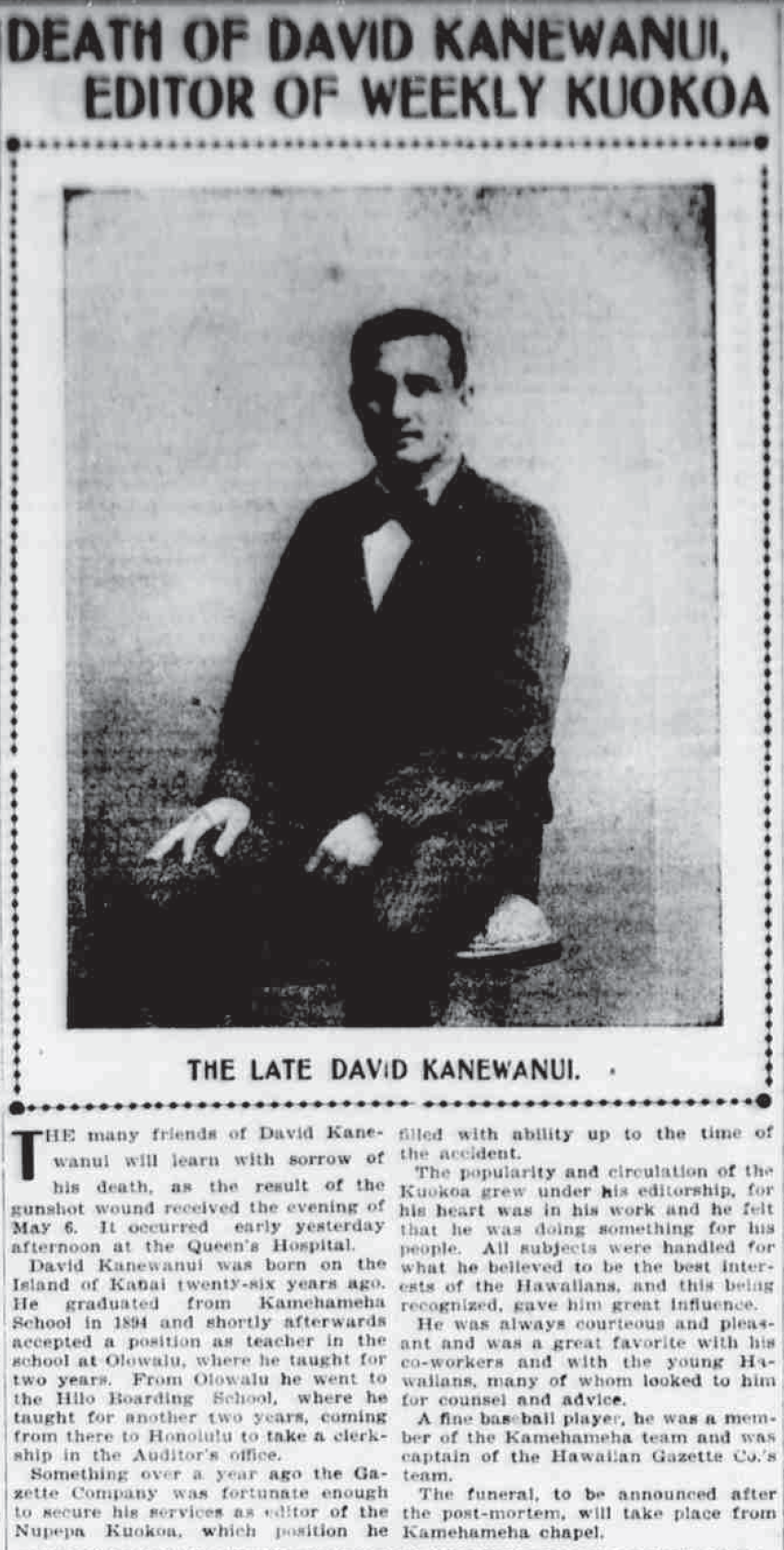
DEATH OF DAVID KANEWANUI, EDITOR OF WEEKLY KUOKOA

THE LATE DAVID KANEWANUI.

THE many friends of David Kanewanui will learn with sorrow of his death, as the result of the gunshot wound received the evening of May 6. It occured early yesterday afternoon at the Queen’s Hospital.

David Kanewanui was born on the Island of Kauai twenty-six years ago. He graduated from Kamehameha School in 1894 and shortly afterwards accepted a position as teacher in the school at Olowalu, where he taught for two years. From Olowalu he went to the Hilo Boarding School, where he taught for another two years, coming from there to Honolulu to take a clerkship in the Auditor’s office.

Something over a year ago the Gazette Company was fortunate enough to secure his services as editor of the Nupepa Kuokoa, which position he filled with ability up to the time of the accident.

The popularity and circulation of the Kuokoa grew under his editorship, for his heart was in his work and he felt that he was doing something for his people. All subjects were handled for what he believed to be the best interests of the Hawaiians, and this being recognized, gave him great influence.

He was always courteous and pleasant and was a great favorite with his co-workers and with the young Hawaiians, many of whom looked to him for counsel and advice.

A fine baseball player, he was a member of the Kamehameha team and was captain of the Hawaiian Gazette Co.’s team.

The funeral, to be announced after the post-mortem, will take place from Kamehameha chapel.

(Hawaiian Gazette, 5/23/1902, p. 5)

DEATH OF DAVID KANEWANUI, EDITOR OF WEEKLY KUOKOA

The Hawaiian Gazette, Volume XXXVII, Number 39, Page 5. May 23, 1902.

David Kanewanui did not return to the Kuokoa office ten days later. 1902.

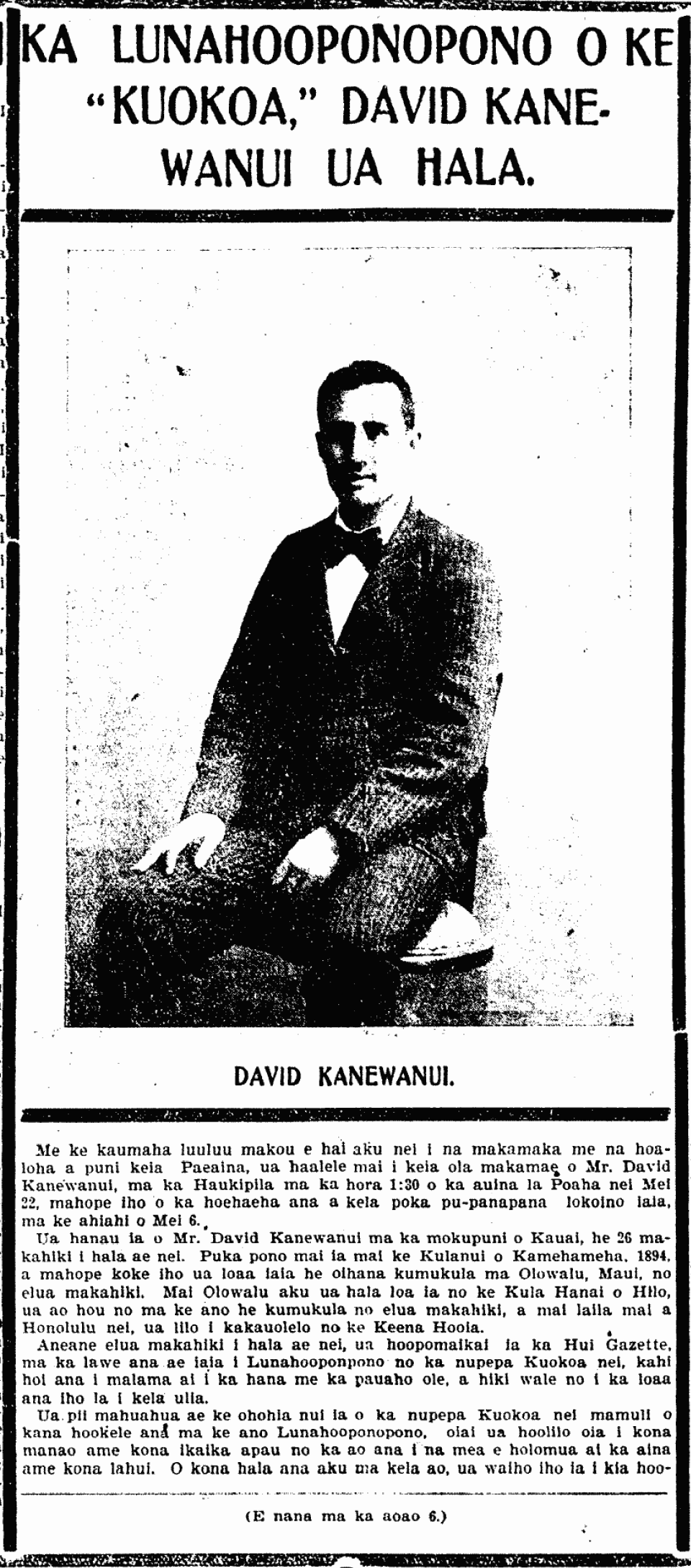
THE EDITOR OF THE “KUOKOA,” DAVID KANEWANUI HAS PASSED.

[For the translation of this article, see the following post, from the mirrored article appearing in The Hawaiian Gazette, 5/23/1902, p. 5. The last paragraph however does not appear in the English and reads:]

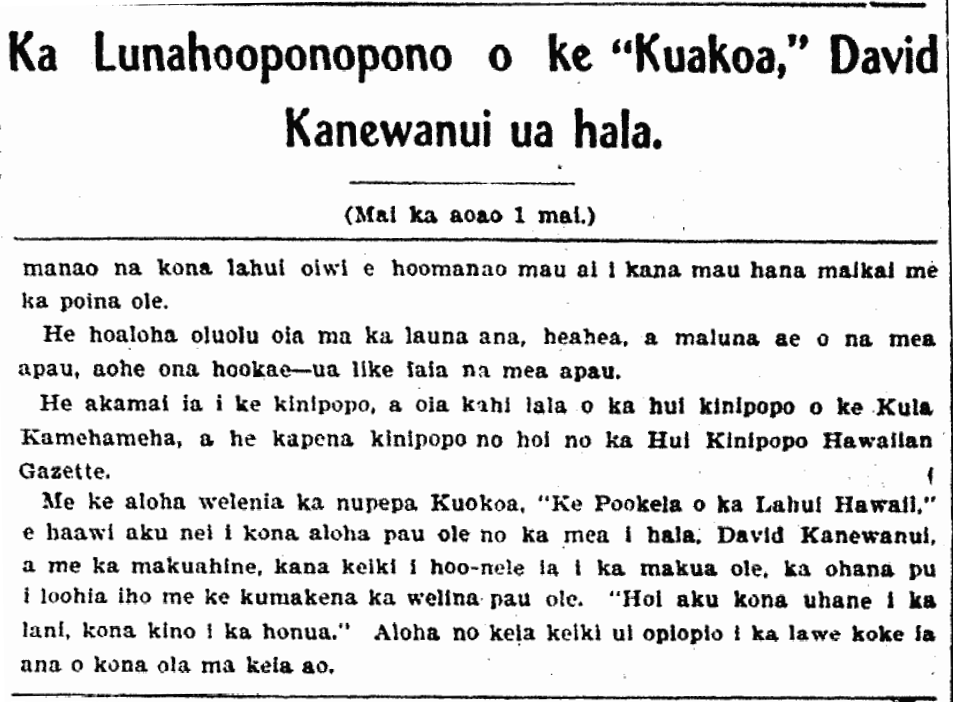
With feelings of anguish, the newspaper Kuokoa, “The Foremost of the Hawaiian People,” [“Ke Pookela o ka Lahui Hawaii”] offers its never-ending aloha to the one who passed, David Kanewanui; and to his mother, his children who are left without a parent, and to the family as well who are overcome with mourning, our never-ending love. “His soul returns to heaven, and his body to the earth.” Aloha to this youth whose life in this world was taken so early.

(Kuokoa, 5/23/1902, pp. 1 & 6)

KA LUNAHOOPONOPONO O KE "KUOKOA," DAVID KANEWANUI, UA HALA.

Ka Nupepa Kuokoa, Buke XL, Helu 21, Aoao 1. Mei 23, 1902.

Ka Lunahooponopono o ke "Kuakoa," David Kanewanui ua hala.

Ka Nupepa Kuokoa, Buke XL, Helu 21, Aoao 6. Mei 23, 1902.

Strange report, 1902.

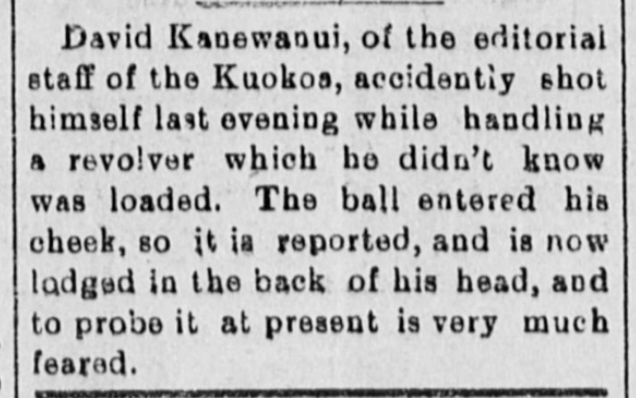
David Kanewanui, of the editorial staff of the Kuokoa, accidently shot himself last evening while handling a revolver which he didn’t know was loaded. The ball entered his cheek, so it is reported, and is now lodged in the back of his head, and to probe it at present is very much feared.

[It is best to check all sources and not to rely on just one article!]

(Independent, 5/7/1902, p. 3)

David Kanewanui...

The Independent, Volume XIV, Number 2201, Page 3. May 7, 1902.