Please don’t play with firearms. Who knows what far-reaching effects it may have! 1902.

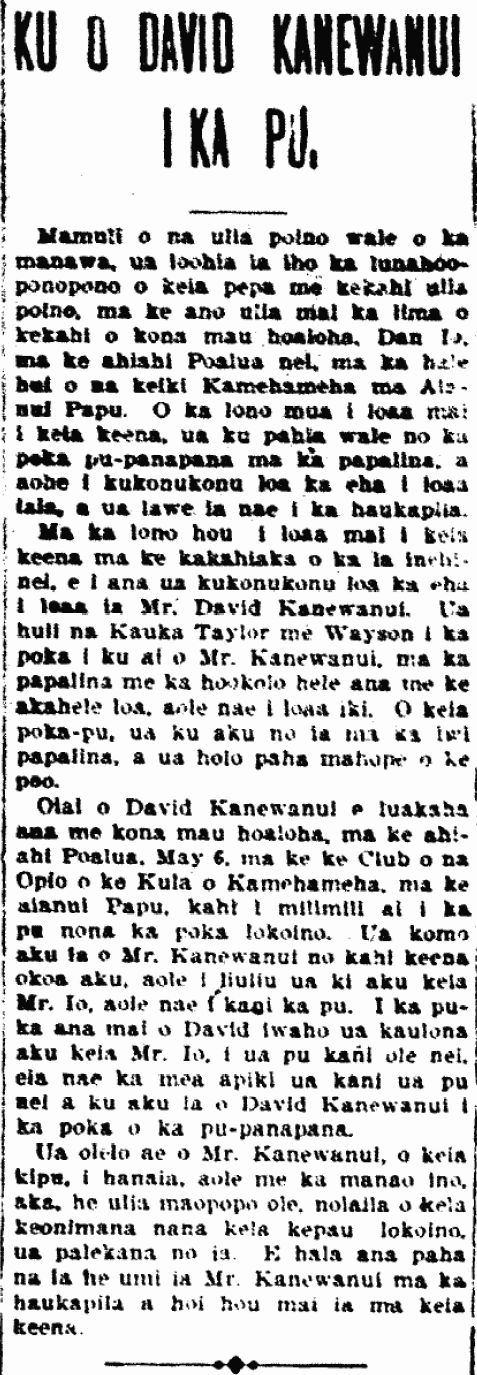
DAVID KANEWANUI SHOT BY A GUN.

Because of a tragic accident of circumstance, the editor of this paper has been struck by misfortune, at the hands of one of his friends, Dan Io, on the evening of this Tuesday, at the club house of the boys of Kamehameha on Fort Street. The first report received by this office, the pistol bullet just grazed his cheek, and the injuries sustained were not that severe, but he was nonetheless taken to the hospital.

According to the latest report received by this office yesterday morning, it stated that the injuries sustained by Mr. David Kanewanui were very severe. Doctors Taylor and Wayson searched for the bullet that hit Mr. Kanewanui in the cheek, while progressing carefully, however they did not find a trace. This bullet hit the cheek bone, and perhaps travelled behind the head.

While David Kanewanui was enjoying his time with his friends, on the evening of Tuesday, May 6th, at the Boys’ Club of Kamehameha School on Fort Street; the gun with the evil bullet was being played with. Mr. Kanewanui entered from another room, and soon thereafter, this Mr. Io shot, but the gun did not fire. After David stepped outside, this Mr. Io aimed that gun that did not fire, but the strange thing is that the gun did fire, and David Kanewanui was shot by a bullet from the pistol.

Mr. Kanewanui stated that this shooting was not malicious, but it was an unexpected accident; therefore, that gentleman to whom belonged this evil lead, was saved. Mr. Kanewanui will perhaps spend ten days in the hospital, whereupon he will return once again to this office.

(Kuokoa, 5/9/1902, p. 6)

KU O DAVID KANEWANUI I KA PU.

Ka Nupepa Kuokoa, Buke XL, Helu 19, Aoao 6. Mei 9, 1902.

Interesting advertisement done as a conversation. 1907

PAULO KALAUKA.

Where were you?

I was at Paulo Kalauka folk’s place!

What were you doing there?

I went to get me some money!

He has a lot of money!

How did you get your money?

I put down my land as mortgage!

You don’t say!

If that’s the case, I’m going to go get me some money.

Where is his Office?

It is on King Street, Number 74, in the Watty Building.

Go quick! Don’t dawdle!

(Kuokoa, 8/2/1907, p. 6)

PAULO KALAUKA

Ka Nupepa Kuokoa, Buke XLII, Helu 31, Aoao 6. Augate 2, 1907.

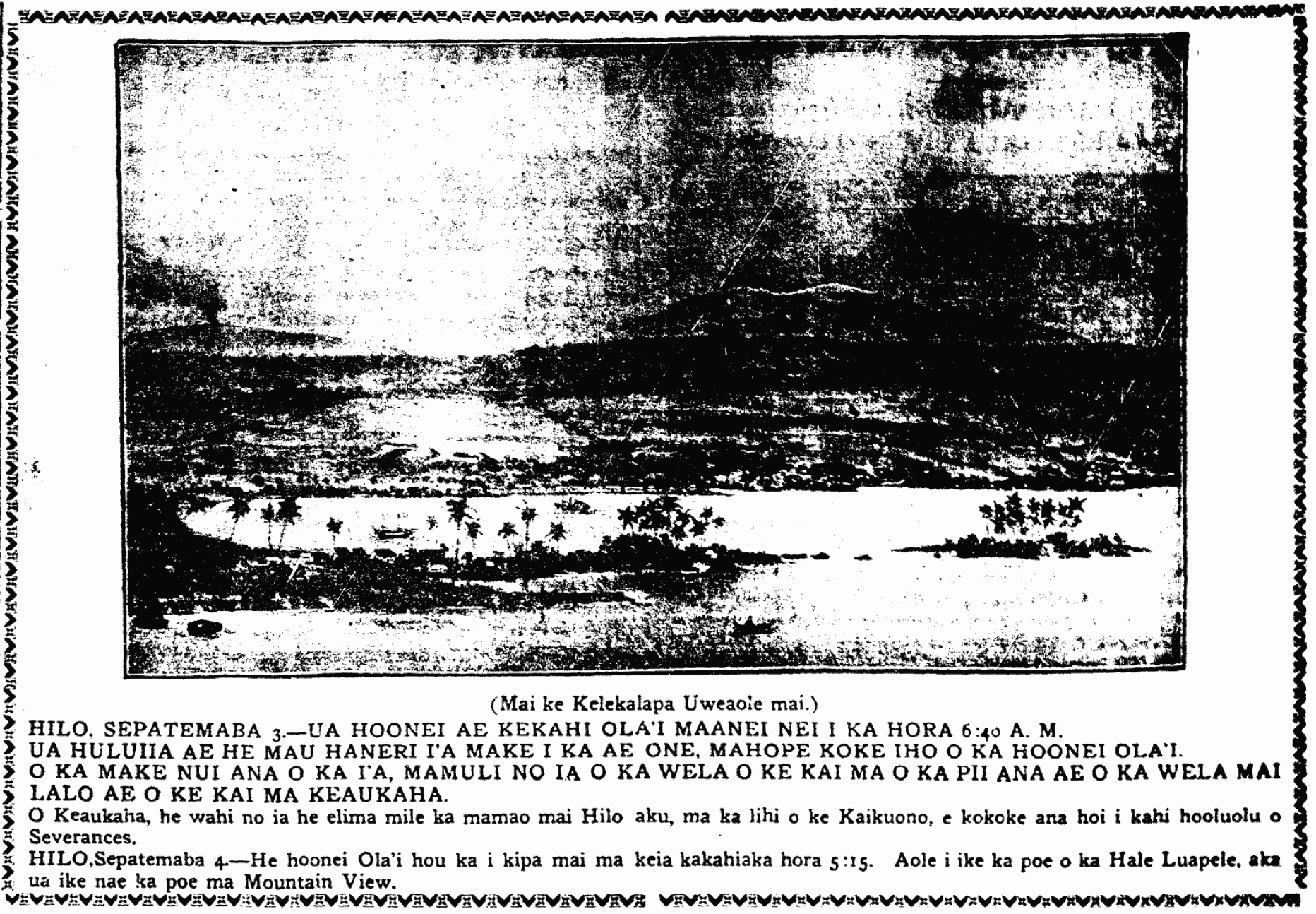
Earthquake, 1906.

(From the Wireless Telegraph.)

HILO, SEPTEMBER 3.—AN EARTHQUAKE SHOOK HERE AT 6:40 A. M.

SOME HUNDREDS OF DEAD FISH WERE GRABBED FROM THE SEASHORE, SOON AFTER THE QUAKE.

THE NUMEROUS DEAD FISH WAS BECAUSE OF THE HEAT OF THE SEA CAUSED BY HEAT RISING FROM BENEATH THE SEA AT KEAUKAHA.

Keaukaha is an area five miles away from Hilo, on the edge of the Bay, close by the recreation area of the Severances.

HILO, September 4.—We were visited by another Earthquake this morning at 5:15. The people at the Volcano House [Hale Luapele] did not feel it, but those at Mountain View did.

(Kuokoa, 9/7/1906, p. 8)

(Mai ke Kelekalapa Uweaole mai.)

Ka Nupepa Kuokoa, Buke XLV, Helu 36, Aoao 8. Sepatemaba 7, 1906.

Mele are everywhere in the newspapers. 1907.

KA HANU O EVALINA.

1. Homai, na’u e honi aku,
I ka lau aala vabine,
He moani lau liilii,
Ka hanu o Evalina.

He anoi au e honi,
I ka nae ala vabine,
He moani lau liilii,
Ka hanu o Evalina.

2. Hui mala’nu ke aloha,
Ke hiki mai nei welawela,
Ua luhi a maopaopa,
He pali kiekie kelakela.

3. He uwila hiki aumoe,
He pakuikui oloolo,
He kulana mapuna hoe,
Kunewa i ka nui o ka holo.

4. Ua holo ka’u kaona,
Ua ikeia e ka nui manu,
Hookahi no hailona,
Ka puia aala o ka hanu.

[This mele is not preceded by an introductory article, and is given without composer. “Ka Hanu o Evalina” is credited to Kalakaua and Liliuokalani, and this is one of the variants.]

(Kuokoa, 3/21/1907, p. 5)

KA HANU O EVALINA.

Ka Nupepa Kuokoa, Buke XLII, Helu 13, Aoao 5. Maraki 21, 1907.

“Beautifying” Waikiki: Have we changed that much in a hundred years? 1912.

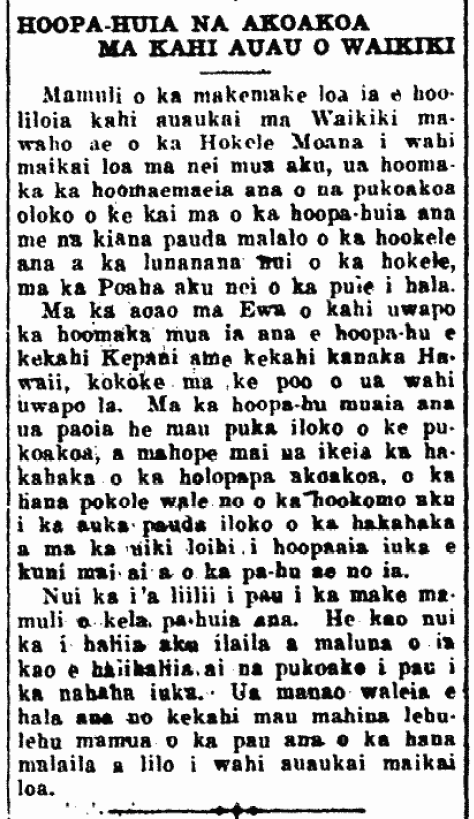
CORAL BLOWN UP AT A SWIMMING SPOT IN WAIKIKI.

Because of a great desire to make the swimming area in Waikiki outside of the Moana Hotel great in the future, they have begun to clear coral from the ocean by blowing it up using giant powder [kiana pauda] under the direction of the general manager of the hotel, on Thursday of last week.

The blasting has begun on the Ewa side of the wharf, by some Japanese and Hawaiians, near the head of that wharf. In the first blasting, holes were dug into the coral, and after, cracks were seen in the coral bed. It was quick work putting in some explosives in the cracks while lighting it using a long fuse held on shore  and then it exploded.

There were many small fishes killed because of the blast. There was a big scow taken there and the coral that was blown off was carried away upon it. It is imagined that it will be several months before the work there will be done and the area will then be a fine bathing spot.

(Kuokoa, 7/26/1912, p. 4)

HOOPA-HUIA NA AKOAKOA MA KAHI AUAU O WAIKIKI

Ka Nupepa Kuokoa, Buke XLVIII, Helu 30, Aoao 4. Iulai 26, 1912.

Vital Statistics. 1912.

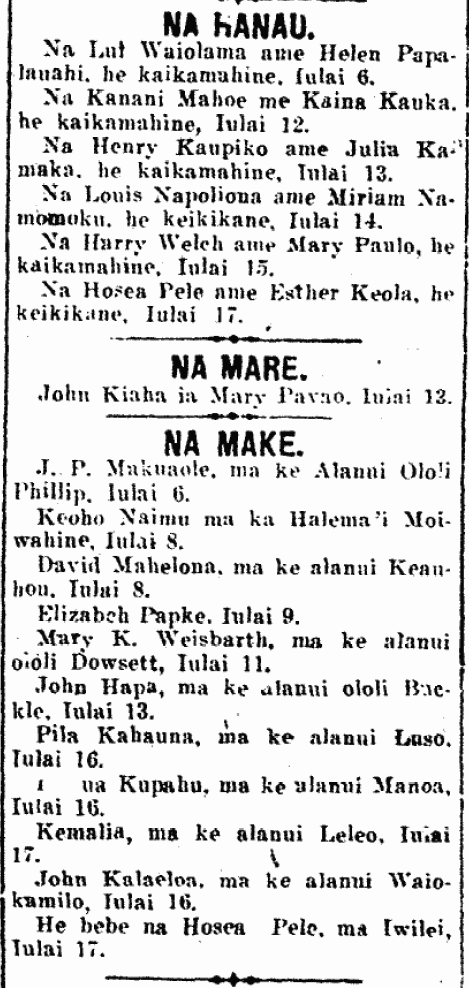
BIRTHS.

To Lui Waiolama and Helen Papalauahi, a son, July 6.
To Kanani Mahoe and Kaina Kauka, a daughter, July 12.
To Henry Kaupiko and Julia Kamaka, a daughter, July 13.
To Louis Napoliona and Miriam Namomoku, a son, July 14.
To Harry Welch and Mary Paulo, a daughter, July 15.
To Hose Pele and Esther Keola, a son, July 17.

MARRIAGES.

John Kiaha to Mary Pavao, July 13.

DEATHS.

J. P. Makuaole, on Phillip Lane, July 6.
Keoho Naimu, at Queen’s Hospital, July 8.
David Mahelona, on Keauhou Street, July 8.
Elizabeth Papke, July 9.
Mary K. Weisbarth, on Dowsett Lane, July 11.
John Hapa, on Buckle Lane, July 13.
Pila Kahauna, on Luso Street, July 16.
[Pililua] Kupahu, on Manoa Street, July 16.
Kemalia, on Leleo Street, July 17.
John Kalaeloa, on Waiokamilo [Waiakamilo] Street, July 16.
A baby of Hosea Pele, at Iwilei, July 17.

[I am iffy about those sites that show pictures of graves in general, but i have to say that one of those sites cleared up a name in this column! I looked up “Kupahu July 16 1912,” and up came a link to this site, and as a result, what would have been relegated to just a last name has been completed!]

(Kuokoa, 7/19/1912, p. 8)

NA HANAU. / NA MARE. / NA MAKE.

Ka Nupepa Kuokoa, Buke XLVIII, Helu 29, Aoao 8. Iulai 19, 1912.

More from the Pacific Northwest, but a little more “recent,” 1912.

A LETTER FROM AFAR

(Written by Sam K. Nainoa.)

The following letter is written by Sam K. Nainoa from Seattle, after the passing of several weeks since he left his homeland with his queen, on their travels, explaining some major things that they saw in their sightseeing of these foreign lands, and this will be something which the readers of the Kuokoa will rejoice in because of the progress witnessed by the two of them made by the Hawaiian youths living in that foreign land.

SEATTLE, May 16, 1912, Aloha oe:—Here we are, staying in this town; we’ve been here almost two weeks, meeting with the Hawaiian boys, and we are full of joy.

There is a great number of my classmates living here, all of them Hawaiians; they are playing music and singing, and they are making a lot doing this work; and some of them married haole women, and they are truly taken by this land, with no desire at all to return to the land of their birth.

Some of them have land and are well off; according to what they tell me, their thoughts of returning to Hawaii are no more; this is where they will live and they will leave their bones in this foreign land.

We went touring around another area farther across this expansive ocean for a few days and came right back, and am writing this letter to you. We went sightseeing at a wood mill, at a place called Port Blakeley, which is one of the largest mills in the world.

What I saw was truly amazing. There are many Hawaiian boys indeed living there, and to go from one area to the next, you travel by steamship. The Hawaiians take a fancy to living there, and for work, they do lumbering.

Hawaiians have no problem with jobs there; they have work at all times.

Some boys from Port Blakeley came to Seattle and got together with us and the band boys who live in Seattle; they insisted that we go with them to where they live, and there was not refusing the hospitality of the kamaaina, so we went aboard a steamship, spending a few days there and immediately returning back.

There were two Hawaiian women there with their husbands, and they have become mothers to the Hawaiian boys there; their living is easy, and they get along lovingly; I would not be mistaken to say there is a place for them in this land without their parents [he mua a he hope ka noho ana o ka aina makua ole ?]

There is bountiful food there, and when we arrived, two pigs were roasted as is the custom of Hawaiians, and all the luau foods were prepared like inamona, limu eleele, dried fish, alamihi crab, raw fish, and their poi was poi palaoa [flour poi].

Here they have dried opelu and dried nehu and many other things so that Hawaiians living here have nothing to complain about; they have everything, perhaps even more than Hawaii.

We enjoyed ourselves, and there was but one thing to do, that is to sing and to play music, and we were terribly happy. There is an over abundance of palai fern there, it is protects your feet [he pale wawae ia mea he palai ?] and it grows all the way until the ocean. When we went pole fishing, we caught poopaa and also large kuahonu crabs. There is a fish that looks like opelu here, and perhaps it is opelu; so too with the puhikii, which is good eating raw.

There are so many delicacies here: salmon worked in with tomatoes and onions; and according to what these Hawaiians say, there is no food that you can’t get here, you have so much to choose from to satisfy your wants.

These people were very kind to us, and we are greatly indebted to them for their hospitality, and these Hawaiians of ours are blessed in making this place somewhere that they look for their livelihood.

This is enough for now, and maybe there will be more free time here after to write more of our travels. All the Hawaiians here give their aloha to our lahui.

Your friend,

S. K. NAINOA.

(Kuokoa, 6/7/1912, p. 6)

HE LEKA MAI NA AINA MAMAO MAIA

Ka Nupepa Kuokoa, Buke XLVIII, Helu 23, Aoao 6. Iune 7, 1912.
Hawaiians in the Pacific Northwest, 1865.

Travels From Washington Territory to Oregon.

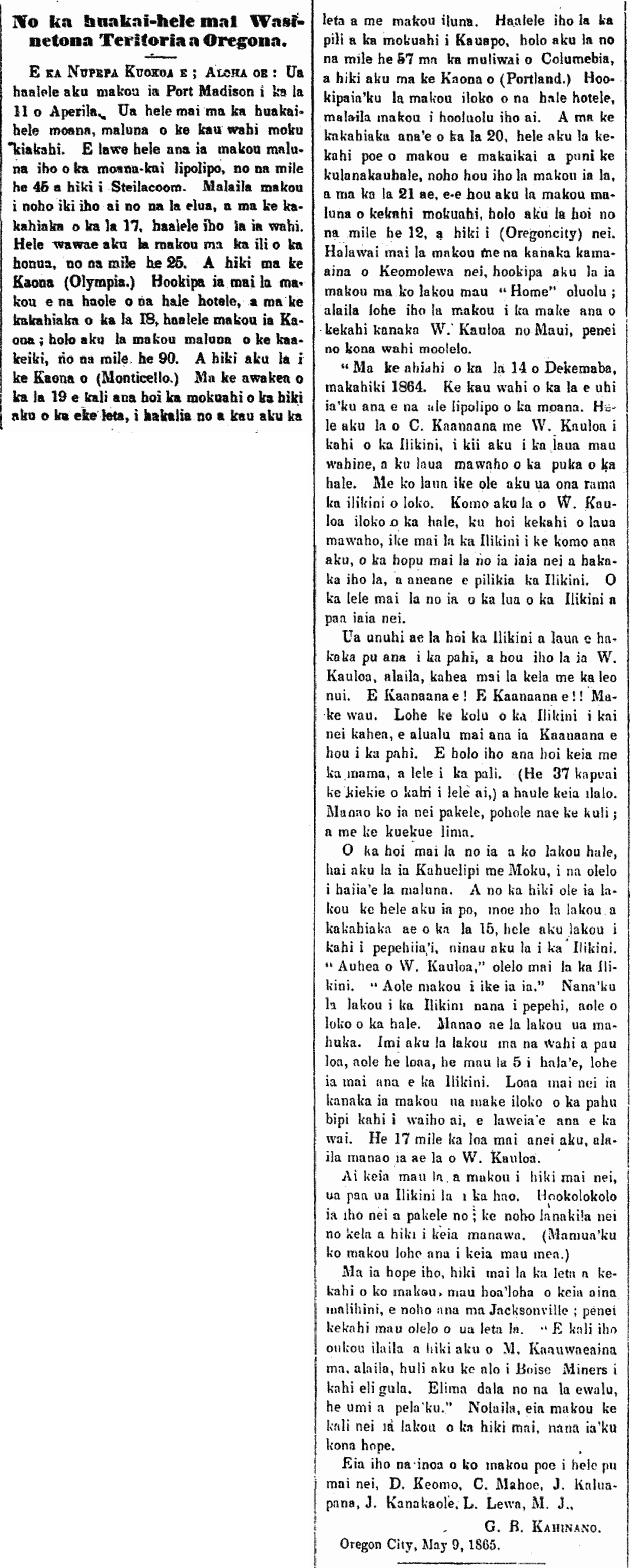
O Kuokoa Newspaper; Aloha to you: We left Port Madison on the 11th of April. We went by sea aboard a single-masted ship. It took us over the deep seas for 45 miles until Steilacoom. There we stayed for a short period of two days, and in the morning of the 17th, we left that place. We walked the surface of the earth for 25 miles. And we reached Town (Olympia). We were welcomed by the haole of the hotels, and on the morning of the 18th, we left Town; we went aboard carriage [kaa-keiki ?] for 90 miles. Then we reached the Town (of Monticello). Midday of the 19th, the steamship awaited the arrival of the letter bag, and right after the letters were loaded, we boarded. The ship left the harbor and went for 57 miles on the Columbia River and we reached the Town (of Portland). We were entertained in the hotels and that is where we rested. In the morning of the 20th, some of our party went to tour the town, and we stayed that day; on the 21st, we boarded another steamship, and went for 12 miles until arriving here (Oregon City).  We met with the Hawaiian kamaaina of Komolewa [Vancouver], and were welcomed into their pleasant homes [interesting that the quote “Home” in the original]; and we learned of the death of a Hawaiian, W. Kauloa of Maui, and this is his story:

“In the evening of the 14th of December, 1864. While some of the sun was covered over by the dark billows of the sea. C. Kaanaana went along with W. Kauloa to the place of the Indian [Ilikini] to fetch their wives, and they stood outside of the door of the house. With no idea that the Indians within were inebriated. W. Kauloa entered the house, and the other stood outside; the Indian saw him enter, at which point he grabbed him and started to fight, and the Indian was close to being in trouble. The second Indian jumped in and grabbed him.

The one Indian that was doing the  fighting pulled out a knife and stabbed W. Kauloa, at which point he called out in a loud voice, “Hey, Kaanaana! Hey Kaanaana!! I am dying. A third Indian heard him call out, and went after Kaanaana and stabbed him with a knife. He ran quickly and jumped off a cliff. (It was 37 feet high from where he jumped from,) and he fell to the ground. He believed that he was saved, although his knee was scraped, along with his elbow.

He returned to their house and told Kahuelipi and Moku of what was described above. And because they could not go that night, they slept until morning of the 15th, and went to the place of the killing and asked the Indian, “Where is W. Kauloa,” at which the Indian replied, “We don’t know him.” They looked for the Indian who did the killing, and he wasn’t in the house. They thought he escaped. They searched all over, and could not find him; 5 days later, they heard from the Indians. We found that man dead, left in a beef barrel, carried by the water. It was 17 miles away from here and thought to be W. Kauloa.

And during time when we arrived, that Indian was confined in shackles. He was just tried and was let go; he is living freely until now. (Before we heard this story.)

There after, there arrived a letter from one of our friends of this foreign lands, living in Jacksonville; here is some of what the letter said: “You all wait their until the arrival of M. Kaauwaeaina them, and then make for Boise Miners, where they are digging for gold. Five dollars per eight days or ten, and so forth.” Therefore, we are awaiting their arrival here and will see what happens later.

Here are the names of those who came with me: D. Keomo, C. Mahoe, J. Kaluapana, J. Kanakaole, L. Lewa, M. J.,

G. B. Kahinano.

Oregon City, May 9, 1865.

(Kuokoa, 6/15/1865, p. 4)

No ka huakai-hele mai Wasinetona Teritoria a Oregona.

Ka Nupepa Kuokoa, Buke IV, Helu 24, Aoao 4. Iune 15, 1865.

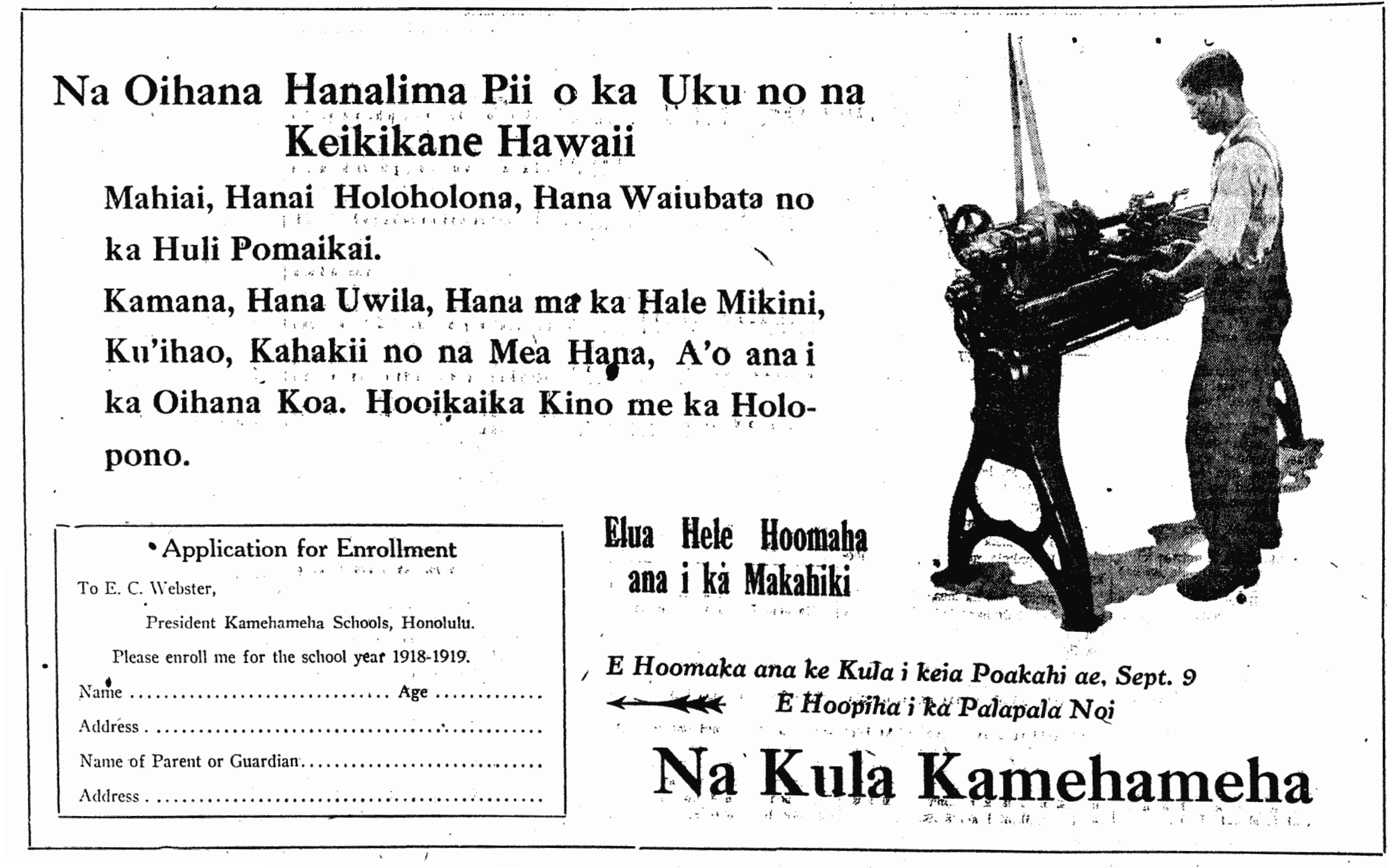
Application to Kamehameha Schools, 1918.

Profitable Trades for Hawaiian Boys

Farming, Stock Raising, Dairying for Profit,

Carpentry, Electricity, Machine Shop Practice,

Forging, Mechanical Drawing, Military, Athletic and Moral Training.

Two Field Trips Each Year.

School will begin this coming Monday, Sept. 9

Fill out the Application

Kamehameha Schools.

Application for Enrollment

To E. C. Webster,

President Kamehameha Schools, Honolulu.

Please enroll me for the school year 1918–1919.

Name … Age …

Address …

Name of Parent of Guardian …

Address …

(Kuokoa, 9/6/1918, p. 3)

Na Oihana Hanalima Pii o ka Uku no na Keikikane Hawaii

Ka Nupepa Kuokoa, Buke LVI, Helu 36, Aoao 3. Sepatemaba 6, 1918.

Kamehameha School for Girls new school year, 1898.

KAMEHAMEHA SCHOOL FOR GIRLS.

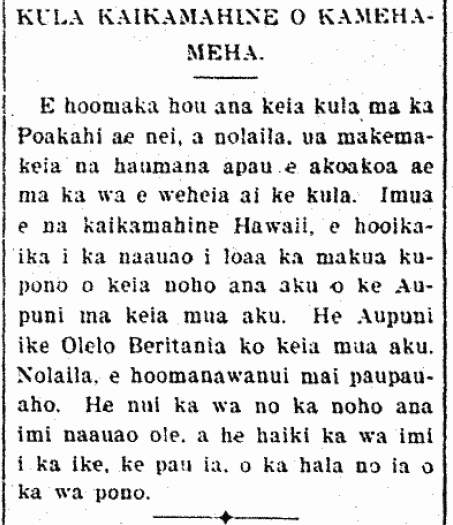
This school will be in session again starting next Monday, and so all students are requested to assemble when school opens. Imua, O Hawaiian girls, strive to be educated so that there will be good parents in the future of this Nation. Here forth this is a Nation of the English Language. Therefore, be patient and don’t give up. There is a lot of time not given to learning, and only a limited time allotted for learning; once this is over, it will be too late.

(Kuokoa, 9/2/1898, p. 3)

KULA KAIKAMAHINE O KAMEHAMEHA.

Ka Nupepa Kuokoa, Buke XXXVII, Helu 35, Aoao 3. Sepatemaba 2, 1898.