International Hawaii, 1844.

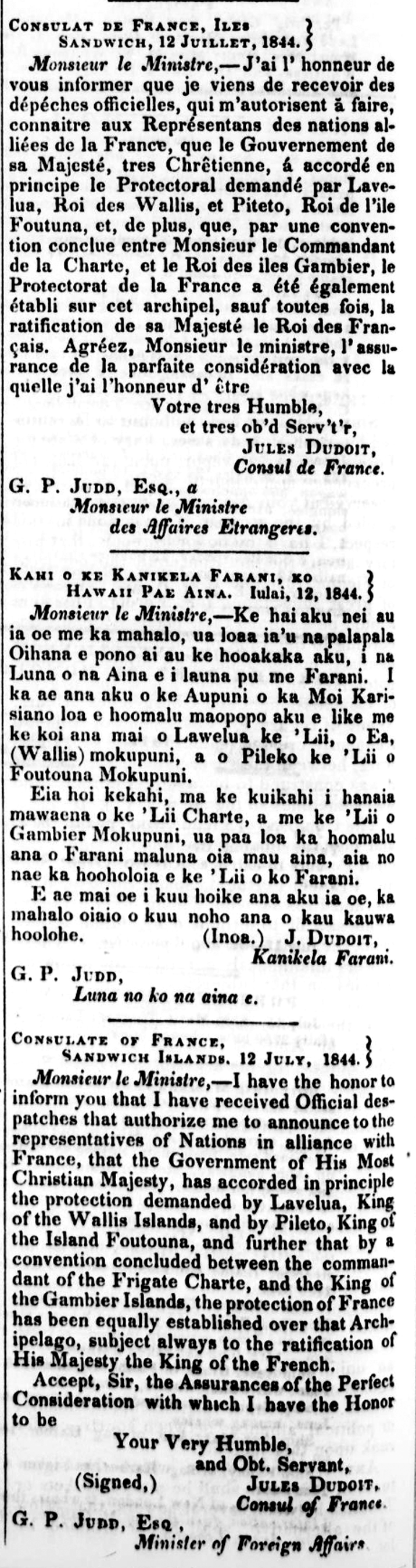
Consulat de France, Iles
Sandwich, 12 Juillet, 1844.

Monsieur le Ministre,—J’ai l’ honneur de vous informer que je viens de recevoir des dépéches officielles, qui m’autorisent ă faire, connaitre aux Représentans des nations alliées de la France, que le Gouvernement de sa Majesté, tres Chrêtienne, á accordé en principe le Protectoral demandé par Lavelua, Roi des Wallis, et Piteto, Roi de l’ile Foutuna, et, de plus, que, par une convention conclue entre Monsieur le Commandant de la Charte, et le Roi des iles Gambier, le Protectorat de la France a été également établi sur cet archipel, sauf toutes fois, la ratification de sa Majesté le Roi des Français. Agréez, Monsieur le ministre l’ assurance de la parfaite considération avec la quelle j’ai l’ honneur d’ être

Votre tres Humble,
et tres ob’d Serv’t’r,
Jules Dudoit,
Consul de France.

G. P. Judd, Esq., a
Monsieur le Minstre
des Affaires Etrangeres.

—————

Kahi o ke Kanikela Farani, Ko
Hawaii Pae Aina. Iulai, 12, 1844.

Monsieur le Ministre,—Ke hai aku nei au ia oe me ka mahalo, ua loaa ia’u na palapala Oihana e pono ai au ke hooakaka aku, i na Luna o na Aina e i launa pu me Farani. I ka ae ana aku o ke Aupuni o ka Moi Karisiano loa e hoomalu maopopo aku e like me ke koi ana mai o Lawelua ke ‘Lii, o Ea, (Wallis) mokupuni, a o Pileko ke ‘Lii o Foutouna Mokupuni.

Eia hoi kekahi, ma ke kuikahi i hanaia mawaena o ke ‘Lii Charte, a me ke ‘Lii o Gambier Mokupuni, ua paa loa ka hoomalu ana o Farani maluna o ia mau aina, aia no nae ka hooholoia e ke ‘Lii o ko Farani.

E ae mai oe i kuu hoike ana ia oe, ka mahalo oiaio o kuu noho ana o kau kauwa hoolohe.

(Inoa.)  J. Dudoit,
Kanikela Farani.

G. P. Judd,
Luna no ko na aina e.

—————

Consulate of France,
Sandwich Islands, 12 July, 1844.

Monsieur le Ministre,—I have the honor to inform you that i have received Official despatches that authorize me to announce to the representatives of Nations in alliance with France, that the Government of His Most Christian Majesty, has accorded in principle the protection demanded by Lavelua, King of the Wallis Islands, and by Pileto, King of the Island Foutouna, and further that by a convention concluded between the commandant of the Frigate Charte, and the King of the Gambier Islands, the protection of France has been equally established over that Archipelago, subject always to the ratification of His Majesty the King of the French.

Accept, Sir, the Assurances of the Perfect Consideration with which I have the Honor to be

Your Very Humble,
and Obt. Servant,
(Signed,) Jules Dudoit,
Consul of France.

G. P. Judd, Esq.
Minister of Foreign Affairs.

(Polynesian, 7/20/1844, p. 2)
Consulat de France, Iles

The Polynesian, New Series, Volume 1, Number 9, Page 2. July 20, 1844.
Handwritten newspaper, “Mamalahoa Kanawai,” 1873.

[Found under: “Nu Hou Kuloko.”]

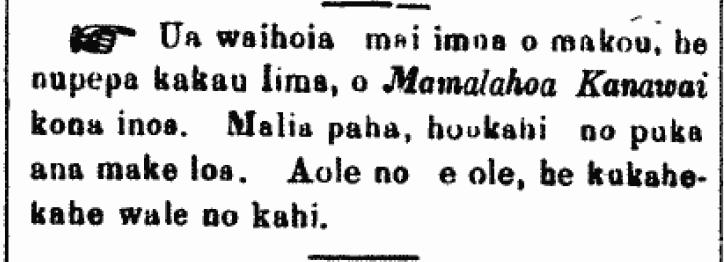
Put before us was a handwritten newspaper called “Mamalahoa Kanawai.” Perhaps it will only come out with one issue and it will perish. Or perhaps also it will flourish.

[Anyone know of this newspaper?]

(Kuokoa, 7/5/1873, p. 2)

Ua waihoia mai imua o makou...

Ka Nupepa Kuokoa, Buke XII, Helu 27, Aoao 2. Iulai 5, 1873.

More on mele, 1860.

Pertaining to Mele

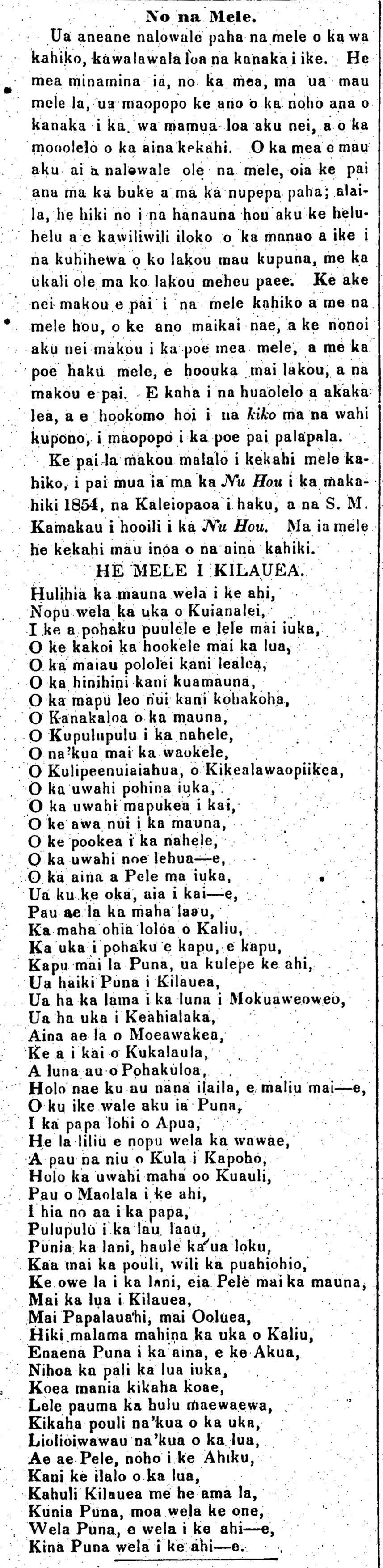
Perhaps the mele of old are almost all lost; those who know them are but few. This is something to be regretful of for in those mele, one can understand the way of life of the people of very long ago, and the stories of the land as well. The means for these mele to continue and not to be lost is by printing them in books and newspapers perhaps; in that way, the new generations can read them and contemplate over it and see the misconceptions of their kupuna and to not follow in their misguided ways. We wish to print the old mele and new mele, as long as they are good, and we ask of those who have mele and the composers of mele to send them to us and we will print them. Write the letters very clearly, and insert punctuation where they should be so that the printers understand.

We are printing below an old mele previously printed in Nu Hou in 1854, composed by Kaleiopaoa and submitted to the Nu Hou by S. M. Kamakau. In the mele there are foreign place names.

HE MELE I KILAUEA.

Hulihia ka mauna wela i ke ahi,
Nopu wela ka uka o Kuianalei,
I ke a pohaku puulele e lele mai iuka,
O ke kakoi ka hookele mai ka lua,
O ka maiau pololei kani lealea,
O ka hinihini kani kuamauna,
O ka mapu leo nui kani kohakoha,
O Kanakaloa o ka mauna,
O Kupulupulu i ka nahale,
O na’kua mai ka waokele,
O Kulipeenuiaiahua, o Kikealawaopiikea,
O ka uwahi pohina iuka,
O ka uwahi mapukea i kai,
O ke awa nui i ka mauna,
O ke pookea i ka nahele,
O ka uwahi noe lehua—e,
O ka aina a Pele ma iuka,
Ua ku ke oka, aia i kai—e,
Pau ae la ka maha laau,
Ka maha ohia loloa o Kaliu,
Ka uka i pohaku e kapu, e kapu,
Kapu mai la Puna, ua kulepe ke ahi,
Ua haiki Puna i Kilauea,
Ua ha ka lama i ka luna i Mokuaweoweo,
Ua ha uka i Keahialaka,
Aina ae la o Moeawakea,
Ke a i kai o Kukalaula,
A luna au o Pohakuloa,
Holo nae ku au nana ilaila, e maliu mai—e,
O ku ike wale aku ia Puna,
I ka papa lohi o Apua,
He la liliu e nopu wela ka wawae,
A pau na niu o Kula i Kapoho,
Holo ka uwahi maha oo Kuauli,
Pau o Maolala i ke ahi,
I hia no aa i ka papa,
Pulupulu i ka lau laau,
Punia ka lani, haule ka ua loku,
Kaa mai ka pouli, wili ka puahiohio,
Ke owe la i ka lani, eia Pele mai ka mauna,
Mai ka lua i Kilauea,
Mai Papalauahi, mai Ooluea,
Hiki malama mahina ka uka o Kaliu,
Enaena Puna i ka aina, e ke Akua,
Nihoa ka pali ka lua iuka,
Koea mania kikaha koae,
Lele pauma ka hulu maewaewa,
Kikaha pouli na’kua o ka uka,
Liolioiwawau na’kua o ka lua,
Ae ae Pele, noho i ke Ahiku,
Kani ke ilalo o ka lua,
Kahuli Kilauea me he ama la,
Kunia puna, moa wela ke one,
Wela Puna, e wela i ke ahi—e,
Kina Puna wela i ke ahi—e.

(Hae Hawaii, 3/21/1860, p. 204)

No na Mele.

Ka Hae Hawaii, Buke 4, Ano Hou.—Helu 51, Aoao 204. Maraki 21, 1860.

The importance of mele, 1860.

Pertaining to Mele!

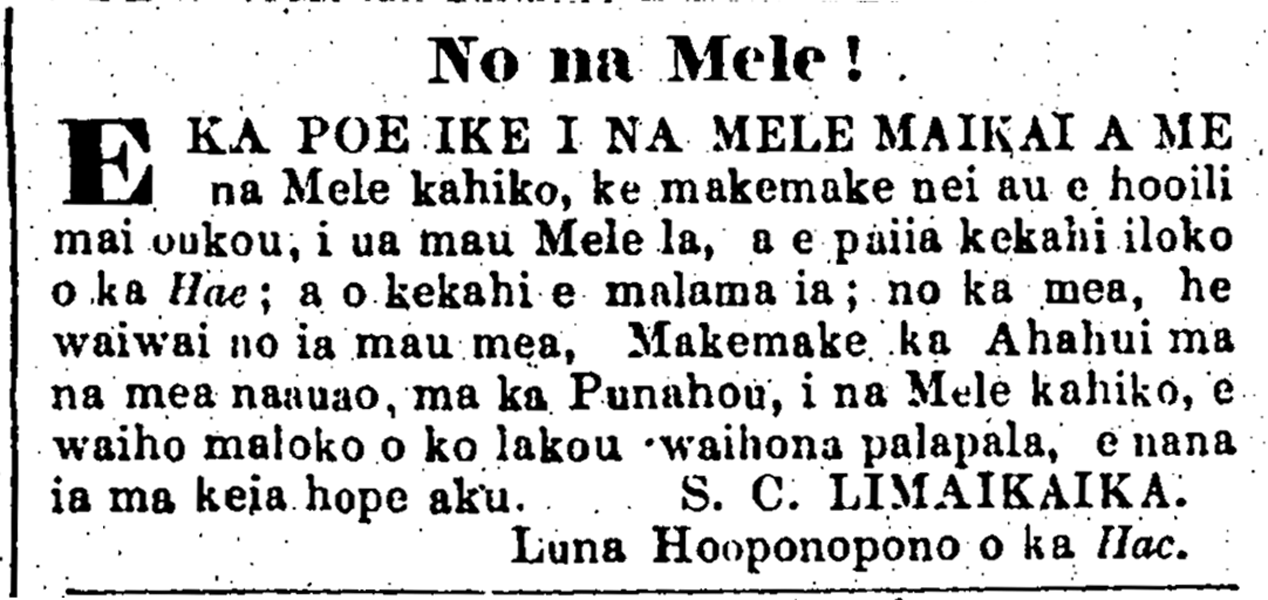
O PEOPLE THAT KNOW FINE MELE AND the old Mele, I want you all to send those Mele in, and some will be published in the Hae [Ka Hae Hawaii]; and some will be kept; for those things are valuable. The Philomathian Society [?? Ahahui ma na mea naauao]  at Punahou is wanting old Mele to put into their archives to be looked at at a later date. S. C. Armstrong [S. C. Limaikaika].

Editor of the Hae.

(Hae Hawaii, 3/21/1860, p. 203)

No na Mele

Ka Hae Hawaii, Buke 4, Ano Hou.—Helu 51, Aoao 203. Maraki 21, 1860.

Crown Room of Iolani Palace, 1936.

THE CROWN ROOM OF IOLANI PALACE TO BE REDONE

ACTING GOVERNOR HITE REVEALED HIS THOUGHTS

This past Thursday, June 25, acting Governor [kokua Kiaaina] Charles M. Hite revealed his thoughts to redo the crown room of Iolani Palace in the upcoming days to bring back once again the commemoration of the alii of Hawaii who passed on; the pulo’ulo’u, the paintings hanging upon the walls, the throne, and also the other chairs which decorated the crown room. Continue reading

Hanaiakamalama rules, 1916.

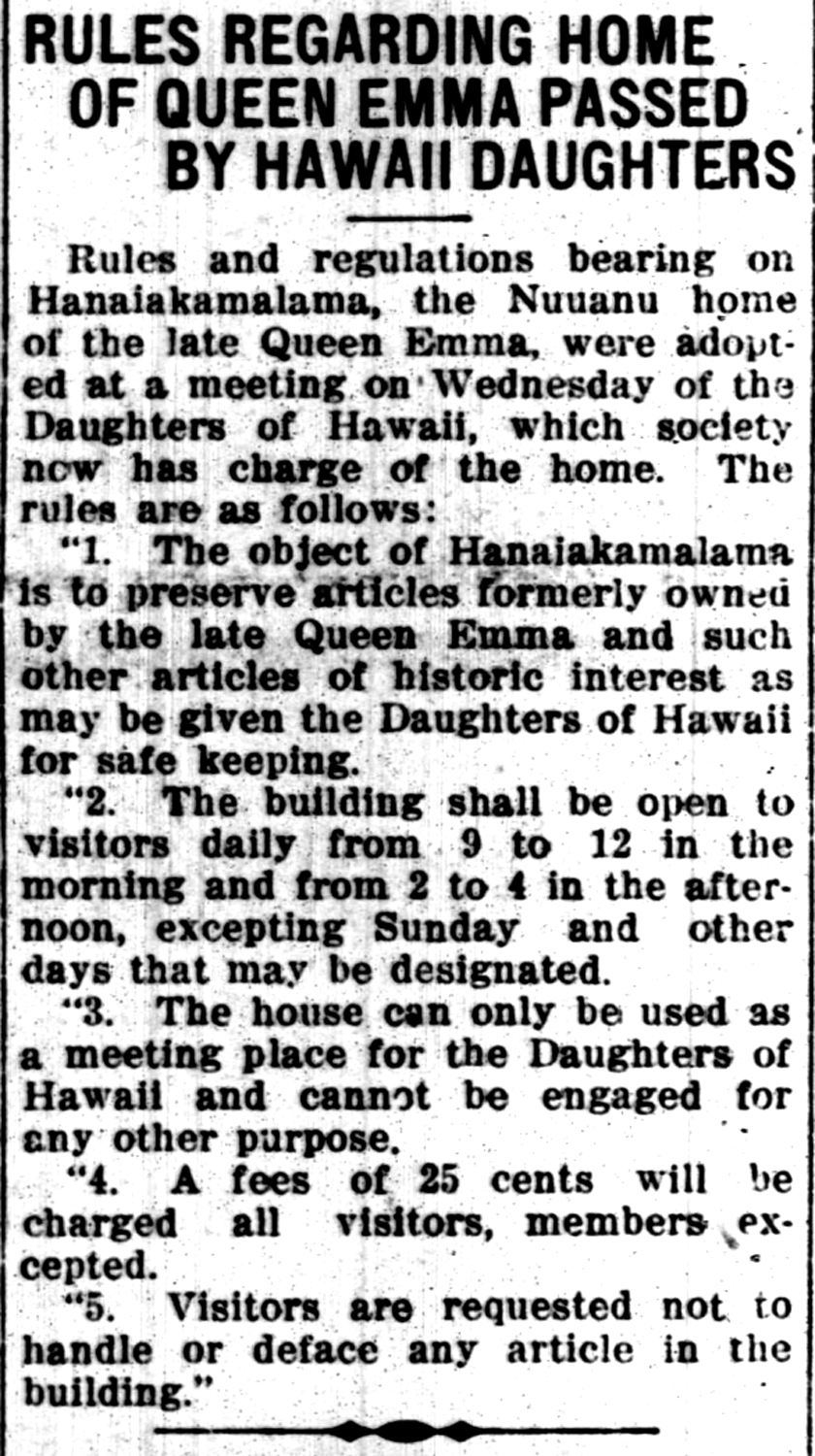
RULES REGARDING HOME OF QUEEN EMMA PASSED BY HAWAII DAUGHTERS

Rules and regulations bearing on Hanaiakamalama, the Nuuanu home of the late Queen Emma, were adopted at a meeting on Wednesday of the Daughters of Hawaii, which society now has charge of the home. The rules are as follows:

“1. The object of Hanaiakamalama is to preserve articles formerly owned by the late Queen Emma and such other articles of historic interest as may be give the Daughters of Hawaii for safe keeping.

“2. The building shall be open to visitors daily from 9 to 12 in the morning and from 2 to 4 in the afternoon, excepting Sunday and other days that may be designated.

“3. The house can only be used as a meeting place for the Daughters of Hawaii and cannot be engaged for any other purpose.

“4. A fee of 25 cents will be charged all visitors, members excepted.

“5. Visitors are requested not to handle or deface any article in the building.”

(Star-Bulletin, 10/19/1916, p. 3)

RULES REGARDING HOME OF QUEEN EMMA PASSED BY HAWAII DAUGHTERS

Honolulu Star-Bulletin, Volume XXIV, Number 7651, Page 3. October 19, 1916.

Samuel K. Kekoowai on the Daughters of Hawaii and Hanaiakamalama, 1923.

HANAIAKAMALAMA

This is a building near the end of the route of the electric car, and it stands on a hill.

As a result of the graciousness of one of the members of the Daughters of Hawaii [Ahahui o na Kaikamahine o Hawaii], this writer [Samuel K. Kekoowai] was introduced to Mrs. J. Swanzy, the leader of this association, and by her kindness I was welcomed to see the walls of that house which is filled with beautiful decorations of the monarchy, and their images hanging from the walls, set up almost like the museum of Kamehameha [Bernice Pauahi Bishop Museum].

This group, the Daughters of Hawaii, upholds the name of Queen Emma Kaleleonalani, and her birthday is cherished by them, and the writer observed the commemoration held by the association which holds dear the name placed upon them, the Daughters of Hawaii.

In the story told to me within the house, Kaleleonalani was raised by her hanai guardian [kahu hanai], Dr. Rooke [Kauka Luka], until she married Liholiho Kamehameha 4, however, there is another version that I have been told by another.

On that 20th day of this June, I saw the back room totally filled with those who came, from the members to visitors, and most were whites and there were a few Hawaiians [??? a o-a na Hawaii].

The story of the circuit of Queen Emma Kaleleonalani around Oahu nei was told, beginning at Waimanalo at the place of John Cummins [Keoni Kamaki], and to Kaneohe at the place of Wainui Pii, and then on to Waikane at the place of Kameaaloha; at Kahana there was a Chinese named Apakana, on to Punaluu there was Naili, to Laie at the place of Kupau, to Kahuku at the place of Kaluhi, to Waialua at the place of Kaiaikawaha. Continue reading