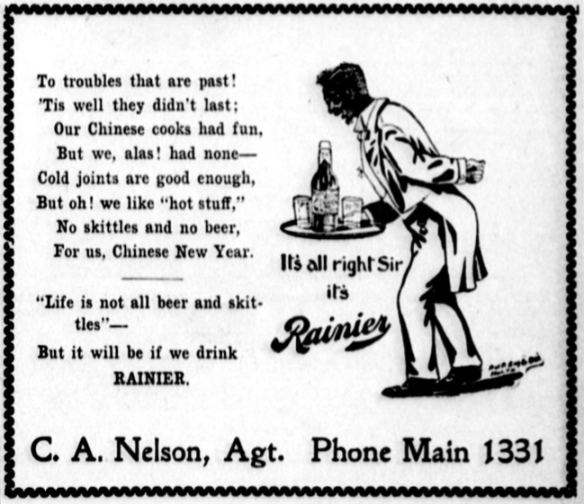
Chinese New Year beer ad, 1907.

To troubles that are past!
‘Tis well they didn’t last;
Our Chinese cooks had fun,
But we, alas! had none—
Cold joints are good enough,
But oh! we like “hot stuff,”
No skittles and no beer,
For us, Chinese New Year.

“Life is not all beer and skittles”—
But it will be if we drink

RAINIER.

It’s all right Sir
it’s
Rainier

C. A. Nelson, Agt.  Phone Main 1331

(Evening Bulletin, 2/18/1907, p. 5)

EveningBulletin_2_18_1907_5.png

Evening Bulletin, Volume IX, Number 3619, Page 5. February 18, 1907.

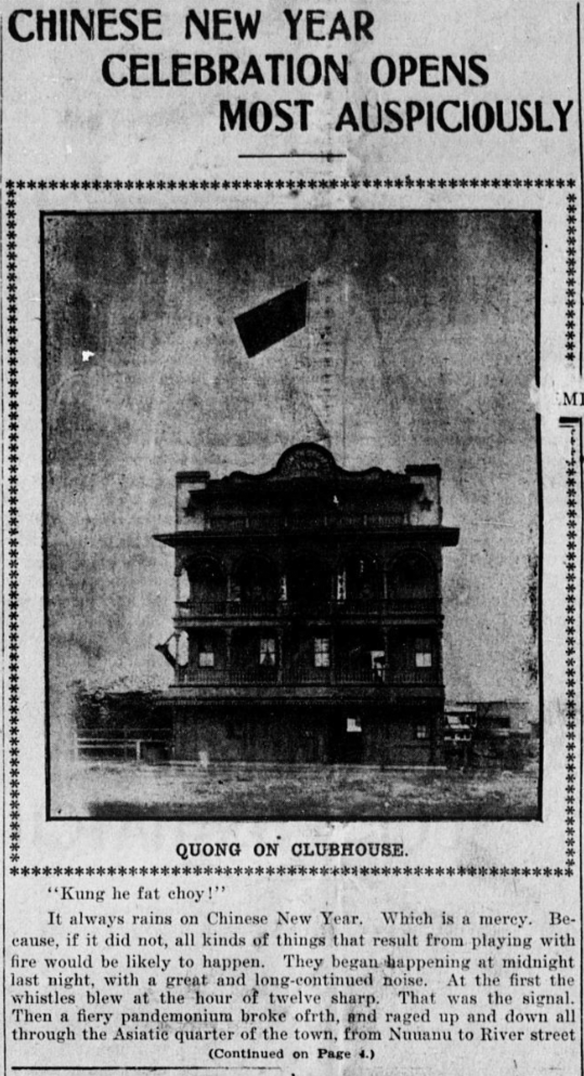
Chinese New Year, 1905.

CHINESE NEW YEAR CELEBRATION OPENS MOST AUSPICIOUSLY

QUONG ON CLUBHOUSE.

“Kung he fat choy!”

It always rains on Chinese New Year. Which is a mercy. Because, if it did not, all kinds of things that result from playing with fire would be likely to happen. They began happening at midnight last night, with a great and long-continued noise. At the first the whistles blew at the hour of twelve sharp. That was the signal. Then a fiery pandemonium broke forth, and raged up and down all through the Asiatic quarter of the town, from Nuuanu to  River street…

(Hawaiian Gazette, 2/3/1905, p. 1)

HawaiianGazette_2_3_1905_1.png

Hawaiian Gazette, Volume XL, Number 10, Page 1. February 3, 1905.

…and beyond, and on all the cross streets where the sons of the Central Flowery Kingdom, who make their homes in Honolulu, have their abiding place. Continue reading

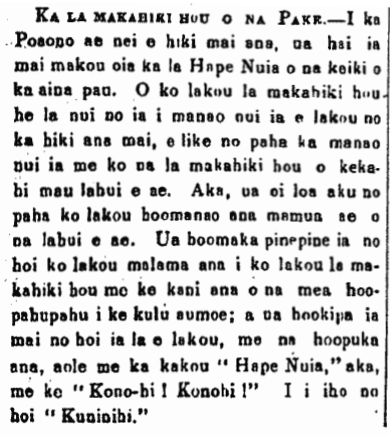
Konohi! 1868.

New Year’s Day of the Chinese.—This coming Saturday [1/25/1868], we were told, is the Happy New Year Day of the people of China [ka aina pua]. Their new year day is a day that is considered a very important day to arrive, perhaps just as how the new year day of other people are thought greatly of. But their celebration is probably much bigger than that of the other ethnicities. Their celebration of their new year often begins by setting off fire crackers at midnight, and you are welcomed by them with them saying not our “Hape Nuia,” but with “Kono-hi! Konohi!” And then you say “Kuninihi.” [?? I iho no hoi “Kuninihi.”]

(Au Okoa, 1/23/1868, p. 2)

AuOkoa_1_23_1868_2

Ke Au Okoa, Buke III, Helu 40, Aoao 2. Ianuari 23, 1868.

List of name variants, 2016.

Kililika? C. Lui?

I have been trying to get various major organizations to host a page that would list different names of historical people (both famous and not so famous), along with any other information that’s available on them, like birth and death dates, pictures, &c.

Just looking at the last posted article, if you were searching for Havekost or Lewers, there is no way you would have found this information about them. This is not only true for haole names, but there are often different names Hawaiians were known as as well. Hopefully this listing will be helpful not only for the researcher of history, but for anyone looking up information about their family and community.

I plan on updating this list every so often with what I find. I don’t have the time nor the means to include information that other people may have collected. It will always be available on the right margin of this page under “LISTS”.

If you think this is a good idea, perhaps encourage an organization that you think has kuleana in collecting and sharing this kind of information to host a list!

PapaInoa

It was a lot more windy back a 150 years ago! 1866.

Wind and Rain on Maui.

The wind and rain has returned during these past two weeks, from the 7th to the 20th, coming the strongest from the south side of Maui; collapsed were many homes, places of work, churches, schools, and bell towers. The name of this wind that acts without aloha is a Kona, but it is not something we should be astonished by, for God can do as he likes. Praised always be his name for his works.

At Nawaieha.

The number of buildings toppled by this wind was thirty or more. Some wooden buildings with new beams were turned over, but most important was the Church here in Wailuku; its windows were smashed, and the side makai on the top was torn off and the shingles were scattered by the force of the Kona wind. That is the biggest problem encountered by us here in Nawaieha. But we are hopeful that it will be rebuilt more beautiful than before, for all the members of this covenant gathered together to collect a sum of money sufficient to rebuild the church with great elegance, topping the beauty of the previous building. The wealthy haole are also joining in to help, that being Christopher H. Lewers [C. Lui] of Waihee and all of the wealthy people, and also J. D. Havekost [Kililika], who is a white kamaaina from Wailuku nei, as well as the youth of the shady valleys of Wailuku. A number of committees to ask for donations were set. I see these wealthy people with their aloha and their regret for the house of Jehovah. It is good; it is right that you build the house where the souls who are skeptical, godless, and so forth are widely taught. Continue reading

Old time high school football, 1919.

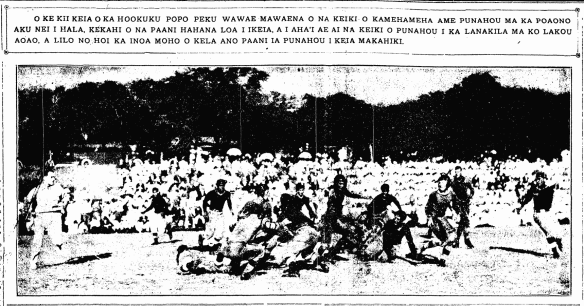
THIS IS A PICTURE OF THE FOOTBALL MATCH BETWEEN THE BOYS OF KAMEHAMEHA AND PUNAHOU THIS PAST SATURDAY, ONE OF THE MOST FIERCEST OF GAMES SEEN, AND THE BOYS OF PUNAHOU RAN AWAY WITH THE VICTORY ON THEIR SIDE, AND THE NAME OF CHAMPION IN THAT SPORT WENT TO PUNAHOU THIS YEAR.

(Kuokoa, 11/21/1919, p. 1)

Kuokoa_11_21_1919_1

Ka Nupepa Kuokoa, Buke LVII, Helu 47, Aoao 1. Novemaba 21, 1919.

Clarification from the Commissioners to Quiet Land Titles, 1846.

TO ALL CLAIMANTS OF LAND IN THE HAWAIIAN ISLANDS.

The undersigned have been appointed by His Majesty the king, a board of commissioners to investigate and confirm or reject all claims to land arising previously to the 10th day of December, 1845. Patents in fee simple [alodio], or leases for terms of years, will be issued to those entitled to the same, upon the report which we are authorized to make, by the testimony to be presented to us.

The board holds it stated meetings weekly at Hale Kauila in Honolulu, to hear the parties or their counsel, in defense of their claims; and is prepared, every day, to receive in writing, the claims and evidences of title which parties may have to offer, at Hale Kauila, in Honolulu, between the hours of nine in the morning and three in the afternoon. Continue reading

Land Commissioners, 1846.

PAY HEED!

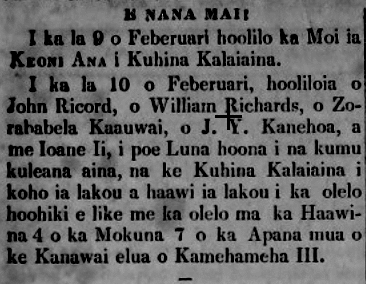
On the 9th of February, the King appointed Keoni Ana as Minister of the Interior [Kuhina Kalaiaina].

On the 10th of February, John Ricord, William Richards, Zorababela Kaauwai, J. Y. Kanehoa, and Ioane Ii were appointed Commissioners to settle land claims [Luna hoona i na kumu kuleana aina]; the Minister of Interior selected them and gave them an oath as per what is prescribed in Article 4 of Chapter 7 of Part One of the Second Act of Kamehameha III.

[O ka hoohiki, oia no:

Ke hoohiki nei kela mea keia mea o makou, e imi pono me ka paewaewa old i na kumu kuleana aina a na kanaka i hoopii mai nei no ke Aupuni o ko Hawaii pae aina, a e hooholo makou i ka olelo pono no ua kuleana la, ke kumu kuleana, ka loihi o ke kuleana, a me ka nui o ka aina, e like hoi me ka olelo iloko o ka Haawina eha o ka Mokuna ehiku o ka Apana m ua o ke Kanawai i kapaia, ‘He Kanawai hoonohonoho i na hana i haawiia i na Kuhina o ko Hawaii Pae Aina,’ i hooholoia ma Honolulu i keia la _____ o _____, 18_____.

Imua o’u _____ _____, ke Kuhina Kalaiaina.

The oath reads:

We and each of us do solemnly swear that we will carefully and impartially investigate all claims to land submitted to us by private parties against the government of the Hawaiian Islands; and that we will equitably adjudge upon the title, tenure, duration and quantity thereof, according to the terms of article fourth of the seventh chapter of the first part of an act entitled “An act to organize the executive departments of the Hawaiian Islands,” passed at Honolulu, _____ day of _____, 18____.

Subscribed and sworn to, this _____ day of _____, 18_____.

Before me, _____ _____,

Minister of the Interior.]

(Elele Hawaii, 3/3/1846, p. 184)

EleleHawaii_3_3_1846_184.png

Ka Elele Hawaii, Buke I, Pepa 24, Aoao 184. Maraki 3, 1846.

Princess Liliuokalani to make circuit of the Islands, 1881.

[Found under: “NOTES.”]

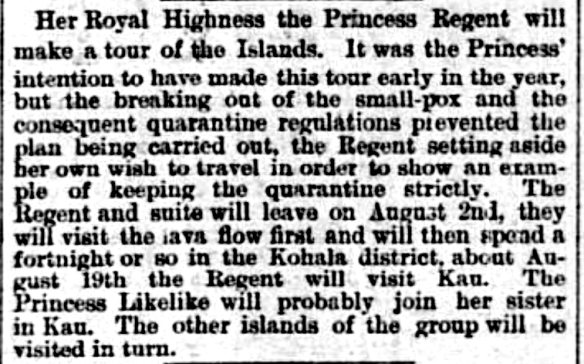
Her Royal Highness the Princess Regent will make a tour of the Islands. It was the Princess’ intention to have made this tour early in this year, but the breaking out of the small-pox and the consequent quarantine regulations prevented the plan being carried out, the Regent setting aside her own wish to travel in order to show an example of keeping the quarantine strictly. The Regent and suite will leave on August 2nd, they will visit the lava flow first and will then spend a fortnight or so in the Kohala district, about August 19th the Regent will visit Kau. The Princess Likelike will probably join her sister in Kau. The other islands of the group will be visited in turn.

(Hawaiian Gazette, 7/27/1881, p. 2)

HawaiianGazette_7_27_1881_2.png

The Hawaiian Gazette, Volume XVII, Number 30, Page 2. July 27, 1881.

Unheeded words of Talmage to the United States of America, 1894.

REV. DR. TALMAGE.

His Article Which Greatly Hurt the Missionaries Amongst Us.

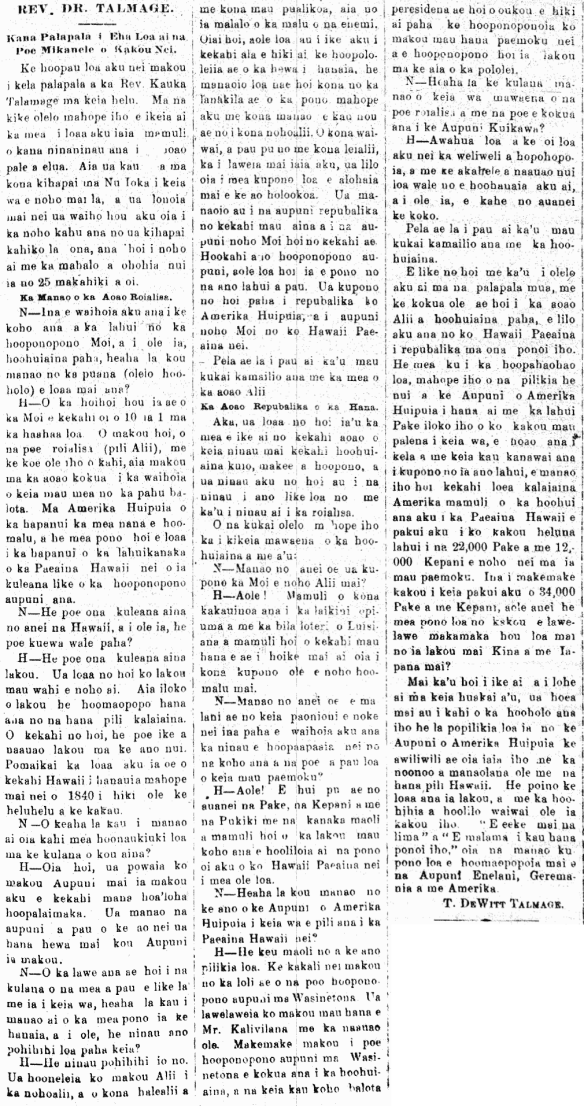
The article below written by the Rev. Doctor Talmage of New York and published in a newspaper there was translated and published in the newspaper “Aloha Aina;” however,  because of the difference between our understanding of the translation and theirs, we took it and translated it once more and am putting it before our readers. Here is our translation of the said article:

Honolulu, June 18, 1894.

The chamberlain came to invite the two of us to go to the residence of the former Monarch, and had suggested 11 o’clock that morning as the best hour for our visit…

[This is what sent me looking for the article I posted earlier today. Unfortunately, the previous translation is not found online. It must have been printed in the paper, “Nupepa Aloha Aina” which ran from 1/6/1894 to 1/5/1895. The entire run is in the holdings of the Mission Children’s Society Library. This is a paper that is well worth digitizing and OCRing. I am excited to see what the translation differences could be!]

Makaainana_11_12_1894_1.png

Ka Makaainana, Buke II—Ano Hou, Helu 20, Aoao 1. Novemaba 12, 1894.

Makaainana_11_26_1894_1.png

Ka Makaainana, Buke II—Ano Hou, Helu 22, Aoao 1. Novemaba 26, 1894.