OUR BELOVED GRANDMOTHER HAS PASSED.
Lilia Kaleikau was born in Lahaina, Maui, from the loins of Pohunui (f) and Nakea, in the year 1826, on the 28th day of April. Continue reading

Lilia Kaleikau was born in Lahaina, Maui, from the loins of Pohunui (f) and Nakea, in the year 1826, on the 28th day of April. Continue reading
O Mr. Editor of the Kuokoa Newpaper, Solomon Hanohano, Aloha oe:—Please may we ask for your patience in giving us an open space of the Prize of the People to welcome the title place above, so that the multitudes of family of the beloved one who passed on may see. Here is her story:
Abigail [Apikaila] Kailipanio Kuaana Pahia was born at Kalauao, Ewa, Oahu, in 1847, from the loins of Kuaana (m) and Rebecca [Rebeka] Kauhane, therefore she was 70 years old and some months extra. She was married for 38 years with the senior Frank Pahia, and then she lay to rest. Continue reading
MRS. FRANK PAHIA
Kailipanio, the wife of Frank Pahia and the mother of Mrs. William Henry died at the family residence, Heeia, Continue reading
The obituary of Frank Pahia made me remember a post I saw from Kanaeokana a few days ago. Lately we have been seeing so much corruption and abuse of government positions. Where are the Frank Pahias of today?
Another tool in our aloha ‘āina arsenal
An interesting political movement is underway, and many of us haven’t noticed it even though it is happening right here, close to home. Kānaka Hawaiʻi are turning out in greater and greater numbers to run for their neighborhood boards.
On Oʻahu, neighborhood boards have become one of the latest frontiers of mālama ʻāina. It’s easy to feel like your lone voice can’t change how things are going, but neighborhood boards give you a say in dealing with localized issues taking place right where you live. Your area’s legislators often attend in person, giving you more direct access to them. Even the Governor, Mayor, and the state’s federal delegation in Washington D.C. send representatives to local board meetings.
FRANK PAHIA.
At 4 o’clock on Thursday afternoon past, the messenger of death visited the home of Frank Pahia, an important Hawaiian, who carried out the work of the people for half a century, and [the messenger of death] took his life breath and left his cold body, the dust returning to dust at the cemetery of the Hawaiian church in Kaneohe, after he was sick for a short time.
He was born in Kukuipahu, Kohala, Hawaii, on the 1st of January, 1847, and at his rest, he was 76 years old and a few days over. He became a widower six years ago, and he left behind three children, Mrs. William Henry, the widow of the first Sheriff of the Territory; William Henry; Henry Pahia, a surveyor; and John I. Pahia, a watchman for the lighthouse.
Frank Pahia was highly educated at the schools of Kohala, here in Honolulu, and finally at the college of Lahainaluna, the school famous in that time as the Light not extinguished by the Kauaula wind.
Frank Pahia held many government jobs outside of his regular vocation of surveyor; he was the deputy sheriff of Hawaii at Hilo, and when he returned to Oahu nei, the was deputy sheriff for 16 years for here in the district of Koolaupoko. He was one of the members of the legislature in the time of the Monarchy for two seasons.
Heeia is where he lived the last days of his life. In 1916, his partner left him and he lived alone until his death.
While he held all sorts of positions, he carried out his duties with impartially and righteously; there was seen at all any blemishes in his work in all the positions he held.
He was kind and had an open heart, and he was a redeemer for the people of this land, and a parental figure for the district in which he lived.
(Kuokoa, 1/11/1923, p. 3)
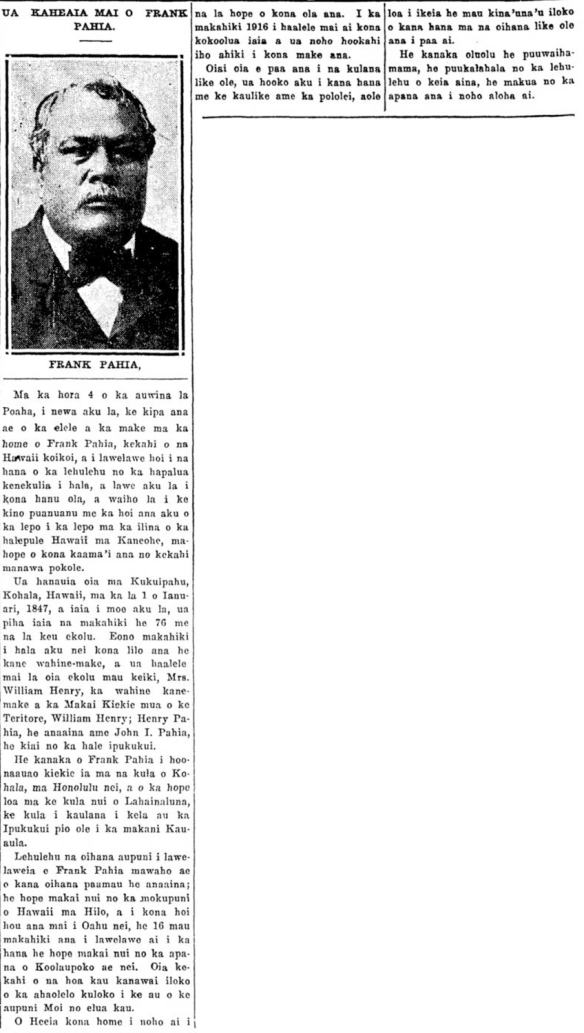
Ka Nupepa Kuokoa, Buke XLII, Helu 2, Aoao 3. Ianuari 11, 1923.
O Lahui Hawaii: Aloha oe:—
In the morning of Friday, the 7th of July, a girl of 3 or 4 years old was burned up by fire. The reason she was burned up was because she took a match far from the house, like about 7 fathoms [7 anana], and then she immediately struck the match and her clothes was lit by the fire, and she soon felt the heat and ran to the house with the fire burning all over her body, it was then that her grandfather saw this, so he ran and tore off the burning clothes, and when he saw what the fire did to her body, it was very dreadful, and from that time to 4 p. m., she died. Continue reading
KNOW ALL MEN, I am the one whose name is below; I forbid all people who own animals from setting them loose on my land situated at Pawaakai at the corner of King and Waikiki Streets; Continue reading
Man snagged by a hook.—This past Saturday, some people from Waikiki went malolo fishing [pahoe malolo], and as usual, one dove in to see how the fish were going in, and that is what Mauhelemoku did, Continue reading
Some people went fishing, all sorts of fishing where you would catch fish, until the fishing of the women who drape the malo of their men over their necks. The famous fishing of Kohala is malolo fishing [kapaepae malolo]. The type of fishing of that land of the apaapaa winds is one where the women drape the malo of their men over their necks and slap their chests in grief [paiauma] as they walk the sea capes. Continue reading
Does anyone know how the fishing for flying fish called kapaepae malolo worked? It seems that Kohala was especially famous for this type of fishing!
 nupepa