Three Lena Machado mele! 1939.

Lena Machado mele! Check out “None Nei”!

nupepa's avatarnupepa

Hawaiian Songs of This Age

Composed by Lena Machado

NONE NEI

Heaha neia hana a’e none nei
None ana paha i ke kumu o ka hana,
O kau hana maa mau ia,
Hoouluhua mau nohoi oe ia’u.
Heaha kou makemake e hana aku au,
Eia nohoi oe i ku’u poli e pili ala,
Pehea la au e hana aku ai,
Hoouluhua mau nohoi oe ia’u.
Oihoiha e none like aku kaua,
None ana i ka pili makemake
O kou makemake ua hooko ia
O ko’u nei la, aole loa
Haina kapuana ua mele ia
Heaha neia hana a’e none nei.

HOOHENOHENO

Hooheno hoohenoheno nohoi oe,
E ne-none nei i ku’u poli,
E hoolale, e hoolalelale mai ana,
E kiliopu hou kaua ia kawa
O kou makemake a’o ko’u noia
E miliopu-lima hou kaua ilaila
O oe a o wau wale no kei ike
I ka hana noeau a ke kupuna

View original post 87 more words
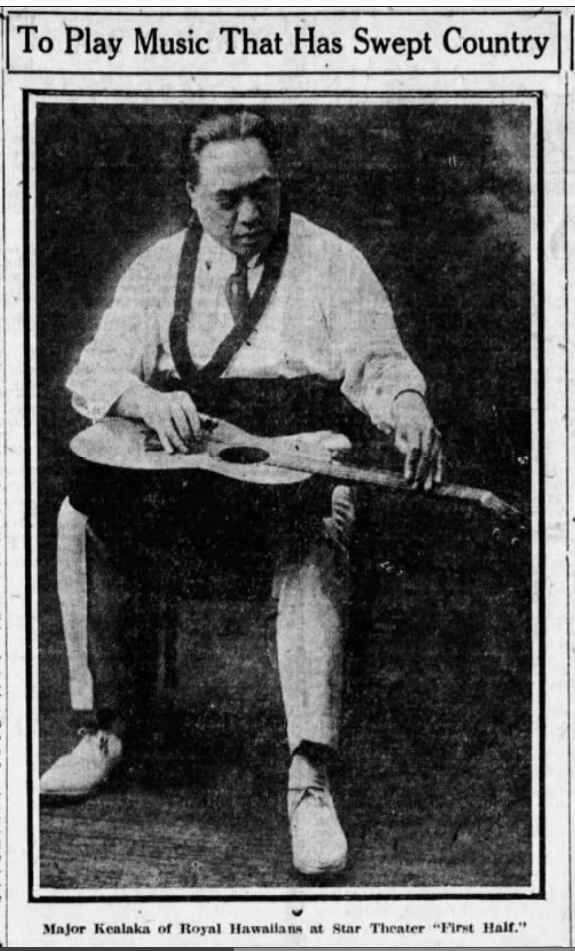
Music That Has Swept Country, 1916.

To Play Music That Has Swept Country

Major Kealaka [Major Kealakai] of Royal Hawaiians at Star Theater “First Half.”

(Munice Sunday Star, 9/17/1916, Second Section, p. 3)

MuniceSundayStar_9_17_1916_15

The Munice Sunday Star, Volume 39, p. 142, Second Section, Page 3. September 17, 1916.

Kawaihau Glee Club, 1905.

HUI HIMENI KAWAIHAU.

The Kawaihau Glee Club will give a free concert at the Emma Square musical assembly this Tuesday, April 3. There will be performed enthusiastically, songs recently composed by Mekia Kealakai, Jim  Shaw and Solomon Hiram, some of the experts of that famous glee club from the time of the Monarchy. They will be fully attired in their uniform that they wore when they travelled the length and breadth of America. For the benefit of the lovers of songs of the Aloha Aina newspaper, we are printing those heart-grabbing songs that will be played that night. Continue reading

Letter from Joseph Kekipi, 1916.

A Musical Band of Hawaiian Youths in America

Standing from the left: David Kaahili, Prince Jack Heleluhe, John Nakeleawe; Sitting below: Miss Amy Awai, Joseph K. Kekipi.

The photograph above, is of some Hawaiian youths that are travelling around America while working, singing and playing music. Their names are above, and they faces are familiar to Honolulu’s people. Continue reading

Leprosy patients released, 1920.

SOME PATIENTS TO BE RELEASED

Honolulu, July 9, The Board of Health announced the release of 30 leprosy patients from Kalihi, those who were recently treated by the new medicinal oil researched by Professor Dean of the University of Hawaii, and these released patients will return to their homes, and right after being examined by the Board of Medical Examiners [Papa Komisina o na Kauka]. Also announced by the Board of Health that perhaps no more patients will be sent to Kalaupapa in the future if they go to Kalihi at the right time and are treated by this new method. Continue reading

Ke Ola o Hawaii to begin, 1916.

BI-LINGUAL PAPER SOON TO BE LAUNCHED

HILO, February 19.—Ke Ola o Hawaii, or The Life of Hawaii, is the name of a new  weekly newspaper here for which articles of incorporation have been asked. The paper, which is to make its appearance next month, will be unique in that it will be published in both English and Hawaiian and also that it is to be strictly non-partisan. At least this is the assertion of the promoters and officers, who are of practically all political faiths. Continue reading

Newspaper history, continued, 1913.

Journalism at the Crossroads

(Continued From Page One.)

community being much interested in the doings and sayings of such public men as Roosevelt, Wilson, Taft, Bryan and other prominent figures.

Familiar Faces.

The pictures of these men, and others, appear in the Japanese dailies almost as frequently as they do in the American dailies. What congress is doing is also of absorbing interest. The probability of a reduction in the sugar tariff is viewed this way and that by the Japanese editors. No item of world’s news is neglected and everything that especially affects Hawaii is “played up” in true journalistic fashion. Continue reading