(2) Sharing the survey with as many people as you can.

FOR THE HAWAIIAN PEOPLE
O Kuokoa Newspaper; Aloha oe:
Some thoughts welled up within me pertaining to something printed by you on a page on the past 1st of March, Helu 14; about some matters dealing with increasing the people of our islands, if it is something appropriate to do. Continue reading
On the deck of the German ship, “Pricilla” brought a group of Portuguese numbering 120 Continue reading
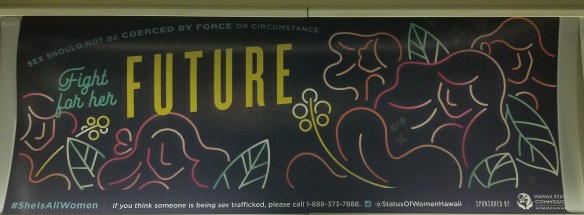
I saw this on the bus. It doesn’t relate to newspapers, but I am putting it out here anyway, because it is important.
The Lepers.—The active measures of the Board of Health to make another thorough examination of the Islands, for the purpose of staying the spread of leprosy, has attracted public attention to what is being done, in this matter of the public health. As the settlement at Molokai becomes thoroughly organized, and its comfortable provision for the lepers becomes better known, there is less dread and less unwillingness on the part of the suspected, to report themselves for examination. With a perseverance in the course adopted, the lepers throughout the Islands will soon be all gathered in and disposed of in the quarters assigned for their future residence. Continue reading
Leprosy patients.—One day last week all the way to Tuesday of this week, there were [?? many] leprosy patients taken to Molokai from the hospital of Kalihi. There were an unprecedented number of patients who were [????], but because they could not stay mixed up with those a little better off, therefore they were set apart, to the island, the great Molokai of Hina, without thought [???] if they are saved, in that there are no doctors stationed at the home to which they were sent.
[This volume of the Kuokoa was obviously bound into a book, and unfortunately this article fell next to the tight binding, and so it is difficult to make out the words on the right edge. It is time that the newspapers were unbound and rescanned as clearly as possible.]
(Kuokoa, 9/26/1868, p. 2)
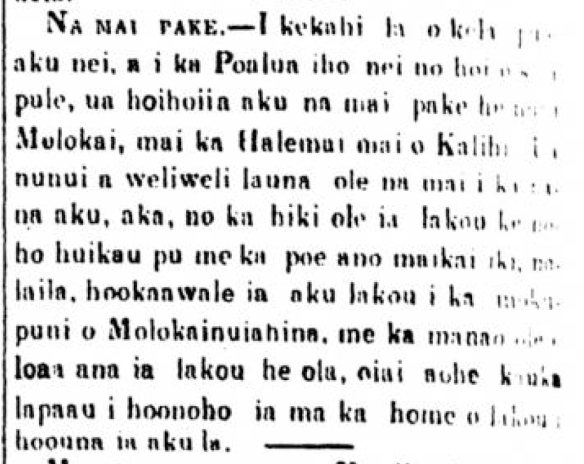
Ka Nupepa Kuokoa, Buke VII, Helu 39, Aoao 2. Sepatemaba 26, 1868.
Money is fine, but the love of money is the root of (evil) wrong. Continue reading
Whatsoever a man [or woman] soweth, that shall he [or she] also reap.
(Hoku o Hawaii, 7/4/1918, p. 3)
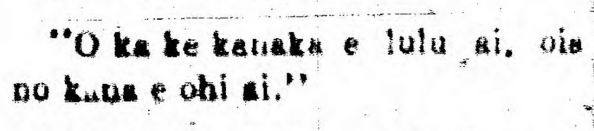
Ka Hoku o Hawaii, Buke 12, Helu 5, Aoao 3. Iulai 4, 1918.
I STATE that when A. Paki died, someone wrote down his genealogy, and gave it to me to publish in the Elele, and because of its great length, it was not published at the time. Continue reading
News was received from Paris, and written by him to his elder brother in Honolulu, about the French Nation giving the “Cross of War” to Francis Ii Brown, one of the children of Mrs. Irene Kahalelaukoa Holloway, and the reason he received this “Cross of War” was because of an act of bravery done; this Hawaiian Boy did not inform his elder brother in Honolulu in his letter the reason that he received this “Cross of War,” but it is clear that this “Cross,” was received because of an act of bravery he carried out. Continue reading
 nupepa