Unknown's avatar

About nupepa

Just another place that posts random articles from the Hawaiian Newspapers! It would be awesome if this should become a space where open discussions happen on all topics written about in those papers!! And please note that these are definitely not polished translations, but are just drafts!!! [This blog is not affiliated with any organization and receives no funding. Statements made here should in now way be seen as a reflection on other organizations or people. All errors in interpretation are my own.]

David Alapai and his mele inoa for Pele, 1919.

INTERESTING MATTERS PERTAINING TO THE LAVA SEASIDE OF ALIKA

When lava gushed forth upon the land of Alika, nearby the “building filled with tons of awa.” Sleeping there in that place was a man intoxicated on awa, and it was with great effort that this man drunken on awa escaped with his life. Just as that man got away did the “lava” engulf that building with its tons of awa. Right makai side of that awa storehouse the man had tied up his donkey and it is was seen that the lava had flowed off course and left behind this donkey belonging to that awa storehouse watchman. Several days later when that man was talking about his near escape from the lava, he told this funny story. “Pele does not have interest in Donkey meat, but she likes drinking awa. She waited a bit for me to get away from that building and then she drank all of our awa up, and to show her appreciation for this awa drinking party, she left behind my Donkey.” Continue reading

Volcanic activity, 1919.

Kilauea Displays Renewed Activity

According to a radiogram received by L. W. de Vis-Norton Wednesday night, a wonderful spectacle is developing at Halemaumau. The lava has risen to within 200 feet of the rim of the pit, and hundreds of fountains are in violent action. Continue reading

Eruption 150 years ago, 1868.

THE ERUPTION!

Up to Wednesday, 29th ult., there has been no further accounts of volcanic action on Hawaii. The earthquakes have ceased in violence and frequency, although the whole islands is still moved by slight vibrations. There was a smart shock felt in Kohala on Thursday, also the same day, a slight vibration here in Honolulu.

There are reports that the lava has again broken out in Kapapala, but we do not credit it.

We are happy to give our readers a clear and intelligent account of the late volcanic action on Hawaii, from the pen of the Hon. William Hillebrand, M. D., who has just returned from a close examination of the disturbed districts.

The account of the lava fissure at Kahuku, is entirely new to the public. H. I. M.’s Commissioner and Consul, M. Beranger, who made the tour with Dr. Hillebrand, has made a number of sketches of the most interesting volcanic appearances. Continue reading

This letter to the editor of the Nuhou is interesting in so many ways. 1873.

NOT GOOD.

When I saw the newspaper Nuhou Hawaii; I was greatly gladdened to see it. When I took a close look, I was very happy. I talked with my wife, “Hey, this paper, Nuhou Hawaii, it is very good for us to subscribe to this paper.” Please don’t be upset at my bad writing. Gibson, I have much appreciation for you; at your great strength in saying that they should not give Puuloa [Pearl Harbor]. I talk in Chinese; all of Honolulu is appreciative of you. Continue reading

Forty years ago, Brothers Cazimero May Day Concert at the Shell! 1978.

[Found under: “Show Biz: Wayne Harada”]

Hana hou

For You a Lei Day Program. The Brothers Cazimero, who just appeared in Ken Rosene’s Hawaii Contemporary Music Festival, will do an “encore” of sorts come May Day. Yep, on Lei Day—May 1—Robert and Roland Cazimero will headline a May Day concert at the Waikiki Shell. Continue reading

May Day is Lei Day in Hilo, 1941.

Day to Don Lei

Tomorrow is a great day here in Hilo; it is the day to wear lei, and everyone will be seen walking on the streets with lei.

Because tomorrow has become the day to wear lei, the Civic Club of Hilo took steps to hold a grand exhibit, and it will be shown to the public.

This event is held every year by this association, and this they expanded it by planing to have a grand entertainment at Kalakaua Square. At the same time, the queen who recently was victorious at the Holoku Ball this past month will preside while those that did not win the contest will be her attendants.

Joining in on the exhibition will also be queens chosen from the various schools of Hilo nei.

There will also be music by the Civic Club Choir, the Hawaiian Women’s Club of Hilo, and the County Band and the Hilo High School Band. Continue reading

Lei Day 50 years ago, 1968.

It all started in 1928

Wear your aloha shirts, muumuus, leis tomorrow

As has been the custom since Grace Tower Warren and Don Blanding began the observance of Lei Day in 1928, aloha shirts, muumuus and leis will be the garb of the day tomorrow.

Throughout the Islands each year on May Day, schools and other institutions present their May programs and lei contests.

The Oahu Lei Contest, sponsored by the Department of Parks and Recreation, will be judged tomorrow and the leis will be on display at the Waikiki Shell from 1 to 9 p.m.

Prizes totaling $650 will be awarded to  lei makers in different categories.

Darlene Bakke, this year’s lei queen, will reign over the festivities including music, hula dancing and pageantry, to be held at the Shell.

A demonstration of kahili making—kahilis were the standard of royalty in Old Hawaii—will be given from 9 to 11 a.m. on the Shell lawn. Continue reading

On string figures, 1909.

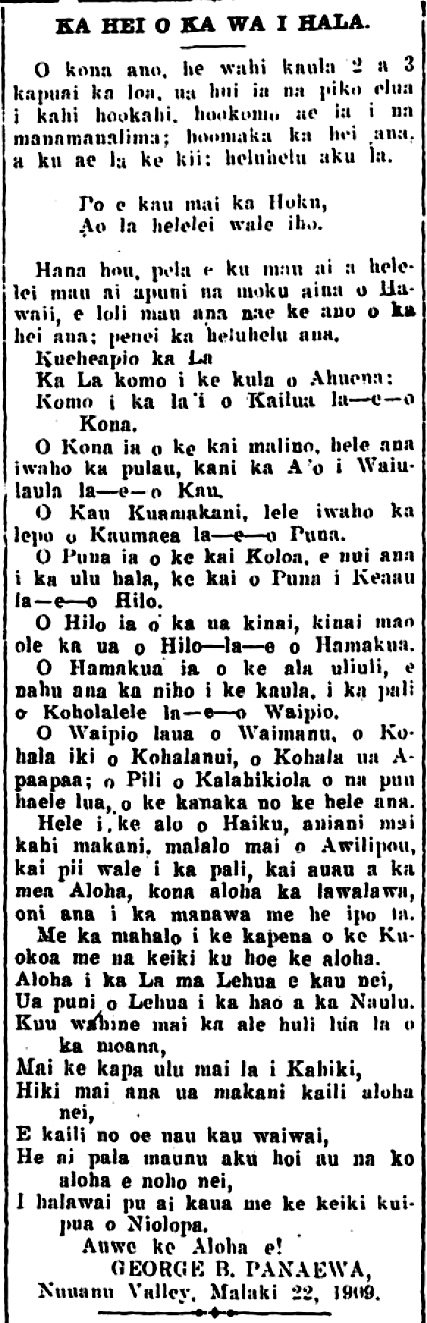
HEI OF TIMES PAST.

It’s description; a string 2 to 3 feet in length, with ends knotted together at one point; fingers are inserted and the fingers move and the figure is made; recited:

Po e kau mai ka Hoku,
Ao la helelei wale iho.

[O Night, the stars hang down,
At daylight, they all fall down.]

Done again, and that is how they forever more hang and fall across the districts of Hawaii; the kinds of hei are constantly changing; this is how it is recited.

Kueheapio ka La
Ka La komo i ke kula o Ahuena;
Komo i ka la’i o Kailua la—e—o Kona.
O Kona ia o ke kai malino, hele ana iwaho ka pulau, kani ka A’o i Waiulaula la—e—o Kau.
O Kau Kuamakani, lele iwaho ka lepo o Kaumaea la—e—o Puna.
O Puna ia o ke kai Koloa, e nui ana i ka ulu hala, ke kai o Puna i Keaau la—e—o Hilo.
O Hilo ia o ka ua kinai, kinai mao ole ka ua o Hilo—la—e o Hamakua.
O Hamakua ia o ke ala ulili, e nahu ana ka niho i ke kaula, i ka pali o Koholalele la—e—o Waipio.
O Waipio laua o Waimanu, o Kohala iki o Kohala nui, o Kohala ua Apaapaa; o Pili o Kalahikiola o na puu haele lua, o ke kanaka no ke hele ana.
Hele i ke alo o Haiku, aniani mai kahi makani, malalo mai o Awilipou, kai pii wale i ka pali, kai auau a ka mea Aloha, kona aloha ka lawalawa, oni ana i ka manawa me he ipo la.

With appreciation for the captain of the Kuokoa and aloha to the quartermaster boys.

Aloha i ka La ma Lehua e kau nei,
Ua puni o Lehua i ka hao a ka Naulu,
Kuu wahine mai ka ale huli lua la o ka moana,
Mai ke kapa ulu mai la i Kahiki,
Hiki mai ana ua makani kaili aloha nei,
E kaili no oe nau kau waiwai,
He ai pala maunu aku hoi au na ko aloha e noho nei,
I halawai pu ai kaua me ke keiki kuipua o Niolopa.

Auwe ke Aloha e!

GEORGE B. PANAEWA,

Nuuanu Valley, March 22, 1909.

[Did you check out today’s “Welo Hou” post from Bishop Museum? It talks about the mele above that accompanies the making of a traditional string figure illustrating the districts of Hawaii Island! Click here to go to the post.]

(Kuokoa, 3/26/1909, p. 6)
Kuokoa_3_26_1909_6

Ka Nupepa Kuokoa, Buke XLVI, Helu 13, Aoao 6. Maraki 26, 1909.