Unknown's avatar

About nupepa

Just another place that posts random articles from the Hawaiian Newspapers! It would be awesome if this should become a space where open discussions happen on all topics written about in those papers!! And please note that these are definitely not polished translations, but are just drafts!!! [This blog is not affiliated with any organization and receives no funding. Statements made here should in now way be seen as a reflection on other organizations or people. All errors in interpretation are my own.]

John L. Stevens represents Hawaii in America, 1893.

STEVENS AND HAWAII.

The Ex-Minister Points Out the Advantage of Annexation.

AMERICAN INTEREST LEAD

An Address Before San Francisco Chamber of Commerce, Which Passes Resolution Favoring Annexation.

San Francisco, June 1.—Hon. John L. Stevens, ex-United States minister at Hawaii, addressed the Chamber of Commerce of this city to-day on the subject of “Hawaiian Affairs and Their Relation to the Interest of the United States.” A large number of businessmen were present and gave the speaker an appreciative reception. At the close of the address a resolution was adopted favoring the speedy annexation of the islands. Mr. Stevens, in relating his first impressions upon the islands, said he had not been long in Honolulu before he perceived how thoroughly an American city it was and how predominating were all American interests on the islands. Continuing he said:

He had found an intelligent body of citizens of American and European origin supporting a semi-barbaric monarchy, dead in everything but its vices; coarsely luxuriant in its tastes and wishes and spreading social and political demoralization througout the island.

The speaker then related several incidents in the career of the deposed queen, and charges her not only with personal immorality, but also with having by unconstitutional and arbitrary methods, secured the adoption of certain measures, such as the opium and lottery bills, and recited her attempt to promulgate a new constitution, which finally aroused the respectable element of the community to action. Mr. Stevens then reviewed in detail the circumstances of the revolution and overthrow of the queen last January, and the subsequent establishment of the provisional government. He spoke of the danger of riot and incendiarism at the time of the revolution, the fact that there was no adequate police power in Honolulu, and that an appeal was accordingly made for the landing of men from the United States ship Boston. In this connection, Mr. Stevens said in part:

Under the diplomatic and naval rules, the United States minister and naval commander would have shamefully ignored their duty had they not landed men from the Boston for the security of American life and property and the maintenance of public order, even had the committee of public safety not requested the United States to do so. The Boston’s men stepped not an inch from the line of duty; they never lifted a finger in aid of the fallen monarchy on the rising of the provisional government and all assertions to the contrary, by whomsoever uttered, are audacious falsehoods.
Continue reading

Be vigilant. Just because someone claims to represent you, does that necessarily mean it is so? 1893 / timeless.

HOW IS IT POSSIBLE?

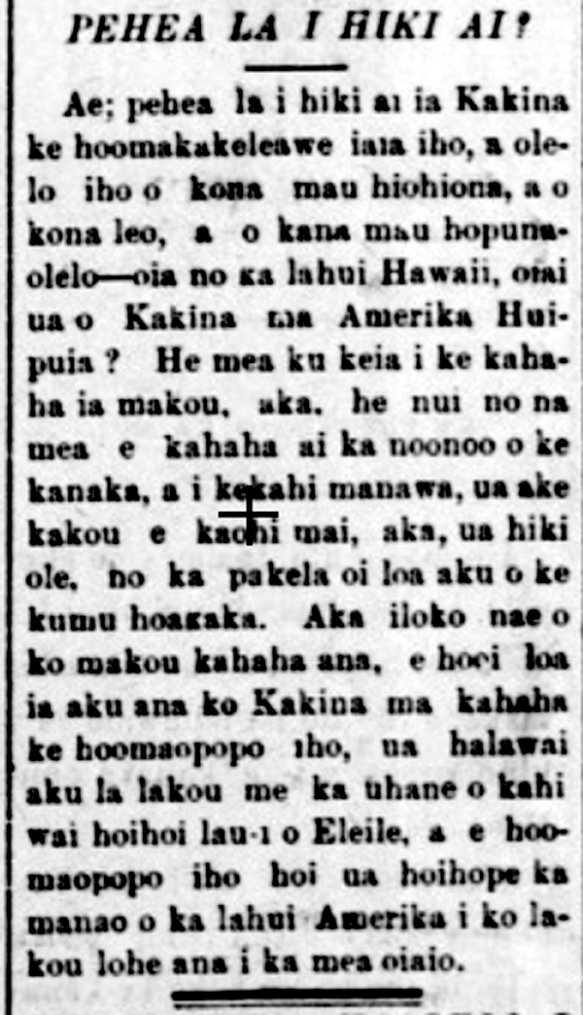
Yes, how can Stevens [John L. Stevens] make himself so brazen and say that his appearance, his voice, and his words—that they represent the Hawaiian people, all the while that that Stevens is in the United States? This is something that is appalling to us, but there are many things that will shock someone, and at times we just want to suppress that feeling, but we cannot, because of how blatant the examples. However, while we may be in shock, the shock of Thurston and his group will greatly surpass this, when they realize that they  met up with the spirit of the waters of Eleile that turn back ti leaves,* and they will realize that the sentiment of the Americans will turn back as well when they hear the truth.

[Many times people don’t pay attention to what is happening outside their own community because they have a job to do, or they have children to care for, or this, or that. Let us be vigilant during these upcoming years. The future generations deserve our attention.]

* See Mary Kawena Pukui’s ʻŌlelo Noʻeau: Hawaiian Proverbs & Poetical Saying, #1649 about the current in the pool of Eleile which turns back stalks of ti leaves thrown into it by visitors.

(Hawaii Holomua, 2/15/1893, p. 2)

HawaiiHolomua_2_15_1893_2.png

Hawaii Holomua, Buke III, Helu 160, Aoao 2. Feberuari 15, 1893.

Na olelo ponoi o Kalani Kalakaua ma kona la hanau, 1874.

“Aloha oukou:

Ua lawe mai au i keia la, oia hoi kuu la hanau, i la hoomaikai i ka Mea Mana, no na pomaikai o ko kakou ola kino a kokoke i ka puni o keia makahiki. A ano ka mea hoi, ke kokoke mai nei ka manawa o Ko’u holo ana aku i na aina e, e imi i ka pomaikai o na hana nui a ko kakou aupuni; ua puili ae au i keia wa, e hai aku i Ko’u aloha ia oukou e na makaainana.

Ke hele nei au e hooko aku i ka mea a ke kau Ahaolelo i hooholo iho nei.

He mea mau iloko o na moolelo kahiko o na aupuni a me ko keia wa no hoi, ke kaahele ana o na Aimoku iloko o kekahi mau aupuni e aku, e imi ana no i pomaikai lahui iho. Continue reading

King Kalakaua’s 50th birthday celebration, with detailed tour of Iolani Palace, 1886.

THE KING’S BIRTHDAY.

The Palace Decorated for the Festivities.

Changes in the Pictures and Decorations Which Bring Out the Ancient History of the People.

In view of the festivities which commence this morning in honor of the fiftieth anniversary of the natal day of His Majesty the King, Iolani Palace has undergone extensive preparations, the arrangements for the reception and entertainment of the guests being very complete. The balconies are bedecked in bunting embodying in bold and striking designs the colors of the Royal Standard. The principal entrance hall has been richly caparisoned at the hands of the upholsterer. Its walls have been newly hung with the valuable oil paintings, representing in life size the line of Hawaiian Sovereigns, with their consorts, from the time of Kamehameha I, downwards. The first position on the right is occupied by the portrait of the Conqueror, whose reign marked so momentous and epoch in the history of the Kingdom, and whose genius has so largely influenced its destiny. Side by side with this is the portrait of Kekauluohi, mother of King Lunalilo. Next are those of Kmehameha II and Queen Kaumaulii [Kamamalu ?]; Kamehameha III and Queen Kalama. On the left are arranged the portraits of Kamehameha IV and Queen Emma; Kamehameha V and King Lunalilo. The niches in the intervening spaces are each filled with some choice fern or other horticultural specimen. The general effect is extremely pleasing to the eye.

The throne room, in which the receptions will take place, has been newly furnished with a rich crimson carpet. On either side of the dais are suspended the Royal Orders of Kamehameha, Kalakaua, Kapiolani and the Crown of Hawaii, whilst the walls on every side are adorned with the numerous foreign decorations with which His Majesty has from time to time been invested. Each one is enclosed in a gilt oval frame, surmounted with the Royal Arms of the particular nation or empire to which the Order belongs. Leaving the throne room and crossing the central hall, one passes into the Blue room . The first object that meets the eye is a striking portrait of His Majesty in the uniform of the King’s Guard, with decorations. Facing this, to the right of the doorway, is one of Her Majesty the Queen, whilst on the left is a full length life size representation of Louis XIV of France, a work of rare value. The two former are from the brush of Charles Hasselmann. Among the many ornaments and curios is a set of vases in Benares brass ware, from India. To the rear of this apartment is the spacious dining hall, in which are displayed the massive silver table ware, each article bearing the Royal Arms in colored enamel. The furniture is early English in style, whilst some choice works of art adorns the walls. The latter include a portrait of Kamehameha IV, taken during the monarch’s boyhood, a companion pair of Napoleon I and IV, taken during that monarch’s boyhood, a companion pair of Napoleon I and Blucher; Admiral Thomas, who restored the country; the Czar Alexander II of Russia, and a graphic delineation of the crater of Kilauea by night, painted by Furneaux.

Ascending the grand staircase the upper hall is next entered, wherein the King’s Privy Council of State is usually held. The central figure is a bust in bronze of His Majesty the King; oil paintings and tasteful cabinets, containing articles of vertu,are disposed on either side, while the hall, which runs the entire width of the building, commands a magnificent vista of Pauoa Valley, the mountains, tier behind tier, with the different hues forming an effective background. The front window overlooks the Aliiolani Hale, and affords a distant view of the sea.

The private apartments of His Majesty lead off from the upper hall, and are located on the left, or Ewa, side of the Palace. In the front is the music room, in which the heavy style of furniture is discarded for a lighter and more appropriate one, the appointments being in excellent taste. In the room are a set of half a dozed water color drawings of special historic interest. They are illustrative of island scenes at a period prior to the advent of civilization, among which are representations of the large double canoes carrying the ancient idols; the heiaus or temples, both open and closed; grass houses, etc. These pictures are enlargements by R. C. Barnfield, after the originals taken on the spot by Captain Kotzbue, the Russian author of “Voyages in the Pacific.”

At the further end, facing the entrance, is a speaking likeness of Her Majesty the Queen, life size, in oil, by Furneaux. The room also contains a very fine painting of the crater of Kilauea, by Tavernier; a Belgian Princess, a daughter of the present King, together with cabinet photographs of Sir John and Lady Franklin. Less obtrusive, but of considerable interest, is a study in music, framed in a peculiarly chaste and unique manner.

Continue reading

The haughty ass, 1865.

The Ass.

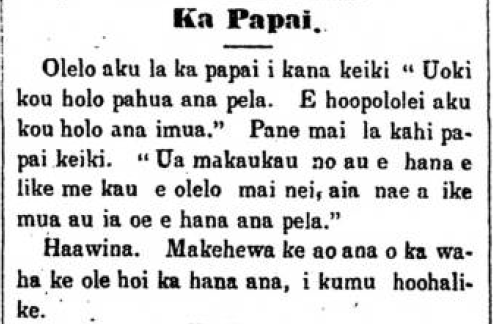
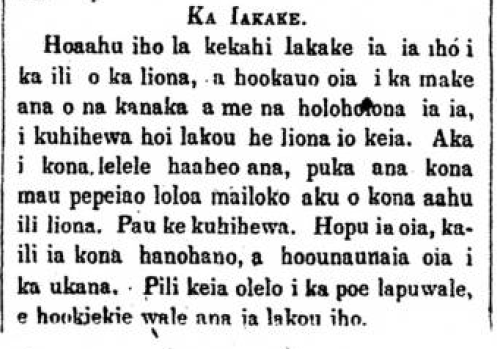
An ass clothed himself in the skin of a lion, and acted as if he’d bring death to man and beast so that they would mistake him for a real lion. But when he lept proudly, his long ears stuck out from his lion skin cloak. The illusion was no more. He was captured, his glory was taken away, and he was made to transport goods. This story pertains to those scoundrels who lord over others.

[This story appeared right below yesterday’s crab story. And once again, the theme is unfortunately timeless.]

(Kuokoa, 3/23/1865, p. 4)

Kuokoa_3_23_1865_4.png

Ka Nupepa Kuokoa, Buke IV, Helu 12, Aoao 4. Maraki 23, 1865.

Lead by example, 1865 / timeless.

The Crab.

A crab said to its child, “Quit that walking sideways. Walk straight ahead.” The child crab responded. “I am ready to do as you say, but only when I see you do so first.”

Lesson. It is useless to say things with your mouth without doing so as an example.

[What kind of nation is it where the heads speaks words of disrespect? What kind of an example does that serve for the young and those that seemingly know no better?

Many of Aesop’s fables like this one were translated in the Hawaiian-language newspapers.]

(Kuokoa, 3/23/1865, p. 4)

kuokoa_3_23_1865_4

Ka Nupepa Kuokoa, Buke IV, Helu 12, Aoao 4. Maraki 23, 1865.

Veterans Day in Hilo Town, 1940.

THE DAY THE WAR CAME TO AN END WILL BE COMMEMORATED

Monday, November 11, is the day that commemorates the end of the War. It will be remembered here in Hilo with a great parade, beginning at 9 a.m.

There will be two bands, the Hawaii County Band [Bana Kalana o Hawaii] and the navy band will join in the parade. So too will the American Legion [Legiona Amelika], the Women’s Legion [Legiona o na Wahine], the Boy and Girl Scouts [Puali Kiai o na Keikikane ame Kaikamahine], and some other organizations. Continue reading

Veterans Day, the early years, 1938.

nupepa's avatarnupepa

THE ENDING OF THE WAR
NOVEMBER 11

November 11, 1938. The battles of Marne, Ypres, Loos, Arras, Somme, Chateau Thierry, Verdun, Argonne, Belleau Wood—these famous blood-shedding battles, their stories and the men who fought in them, both living and dead, remain as memorials for the conscience. The great number of soldiers constantly sent away here and there for their home, to fight and for peace. We honor those men who fought for a purpose, and at the same time, put to use those frightful years as a means to attain the peace of which we are blessed.

Drive-In Market                                  E. Yanagihara Store

V. A. Carvalho                                      Quong Sing Market

Beamer’s Hardware Store              B. F. Shoen, Ltd.

S. Ikeda Soyo Factory                       Hawaii Motor Supply

J. S. Rickard                                           The Men’s Shop

Union Meat Co.                                  G. Miyamoto Cash & Carry

Diamond Bar                                        Kilauea Radio Shop

Simeon Armor The Sign Artist       Akadama

De Silva Vogue…

View original post 38 more words

Some advice from the past to composers of today, 1893.

ALL MELE HAVE KAONA.

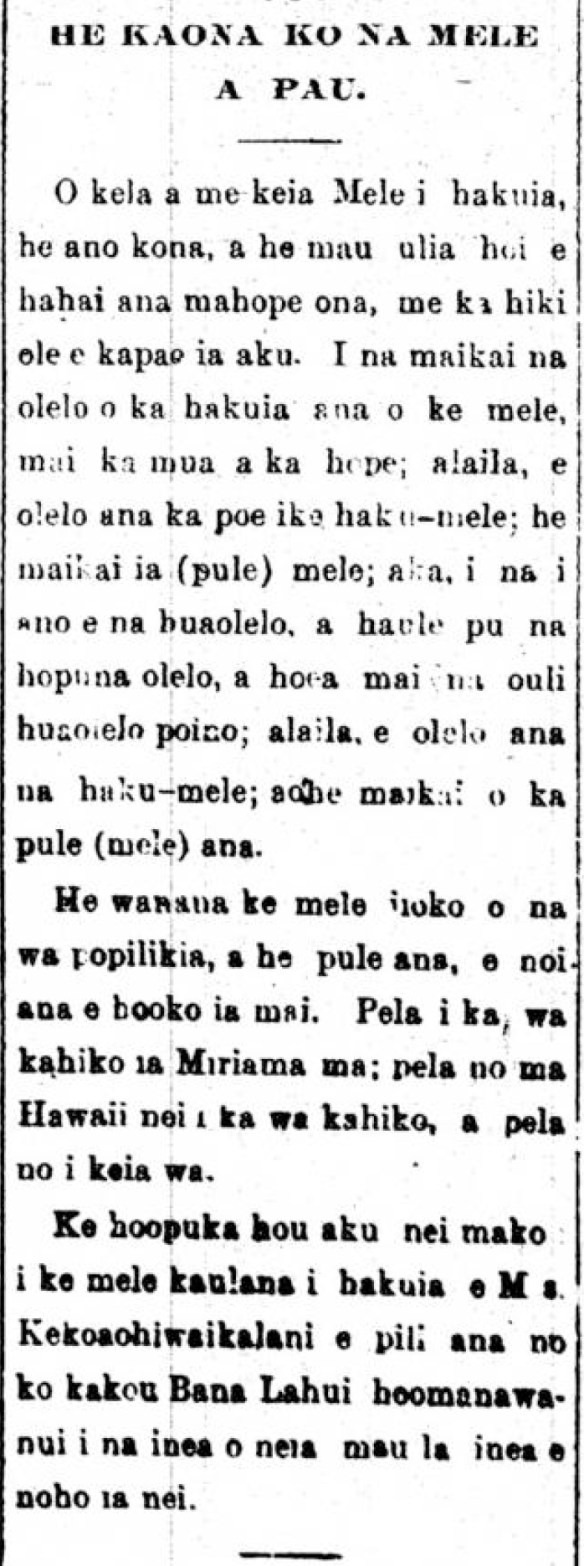
Each Mele that is composed has its own nature, and there are results that follow that cannot be avoided. Should the words of the composition be good from beginning to end, then those who understand mele composition [haku mele] will say that the mele (prayer) is a good one; however, should the words be off, and syllables are dropped, and words of unfortunate nature result, those knowledgeable in haku mele will say that the pule (mele) is not good.

A mele is a prophesy in times of trouble, and it is a prayer that asks to be fulfilled. So it was in the ancient times of Miriam folks; and so it was in ancient times in Hawaii nei, and so it is today.

We publish once again the famous mele composed by Mrs. Kekoaohiwaikalani pertaining to our Hawaiian Band [Bana Lahui] who are enduring the hardships of these trying times we are living in.

[Doesn’t this sound like a call from the past to those of today?]

(Leo o ka Lahui, 9/8/1893, p. 2)

LOKL_9_8_1893_2.png

Ka Leo o ka Lahui, Buke II, Helu 765, Aoao 2. Sepatemaba 8, 1893.

Mele from the pen of patriot, Eleanor Kekoaohiwaikalani Prendergast, 1893.

KE ALOHA AINA.

1st. Kahiko ka ohu i Nuuanu
I ka hoku a ka lau Kawelu
Ua lupea ia e ka moani
Hoope aala oia uka.

Hui: He halia he aloha keia
No kuu aina hanau
A’u e hiipoi mau nei
No ka Lanakila o Hawaii.

2nd. Ua nani ka pua o ka Ilima
I pilia mai me ka Maile
I wehi hoohie no ke kino
Kahiko mau no Hawaii.

3rd. Kamahao ka ike’na i ka nani
I ka wai Lehua a na manu
Manu inu wai pua Ohelo
Iiwipolena o ke Kuahiwi.

Miss Kekoaohiwaikalani.

Puahaulani Hale
Honolulu, Mar. 25, 1893.

(Leo o ka Lahui, 4/25/1893, p. 1)

LOKL_4_25_1893_1.png

Ka Leo o ka Lahui, Buke II, Helu 691, Aoao 1. Aperila 25, 1893.