Unknown's avatar

About nupepa

Just another place that posts random articles from the Hawaiian Newspapers! It would be awesome if this should become a space where open discussions happen on all topics written about in those papers!! And please note that these are definitely not polished translations, but are just drafts!!! [This blog is not affiliated with any organization and receives no funding. Statements made here should in now way be seen as a reflection on other organizations or people. All errors in interpretation are my own.]

J. J. Williams Photographer advertisement, 1902.

J. J. WILLIAMS

PHOTOGRAPHER

CRAYONS
WATER COLORS
LANTERN SHOWS

ONLY COMPLETE
COLLECTION OF
ANCIENT
& MODERN
HAWAIIAN VIEWS.

Fort Street

Photography shoots are very reasonable at Wiliama’s place; you will receive beautiful prints from 4.00 for a dozen.

[Speaking of photography, the microfilming of these newspapers were done many years ago, and the resulting images taken from those microfilms are many times not legible. I barely could make out the tiny print. There needs to be funding to reshoot the Hawaiian-Language Papers, so that the words from the past can be seen clearly today!!]

(Aloha Aina, 1/11/1902, p. 3)

J. J. WILLIAMS PHOTOGRAPHER

Ke Aloha Aina, Buke VIII, Helu 2, Aoao 3. Ianuari 11, 1902.

“He has gone forever, but memories of him shall not be forgotten.” 1932.

A CHILD AND A NATIVE OF HAWAII

Last week, the last rites were carried out on the body of Joseph Kahahawai, the one who was shot by some soldiers after they kidnapped Kahahawai from the courthouse.

Kahahawai went to show himself before the officials, or those of the court, and when he exited from that office, he was pointed out by a women sitting upon her car to some other haole people.

When one of the two of them saw that Kahahawai was coming out, one of the haole went and said to Kahahawai to go with him, and showed Kahahawai a written document, and that was when Kahahawai agreed to go with him to the side of the car, but not the car belonging to the woman who pointed Kahahawai out; he went and death was sentenced upon him without him knowing the consequences of him agreeing to accompany these haole.

On Sunday was the funeral rites, and his body was laid to rest at Puea Cemetery on School Street.

As was reported in the papers, the funeral was large as the buddies and friends of the boy went along with his body to the graveyard.

The first services over his body was held at the Catholic church, and thereafter he was taken to the graveyard, and there, Rev. Robert Ahuna of the Christian Science Church held the last rites over the cold body of the child of whom the parents said their child was not at fault.

The Rev. Ahuna spoke before the congregation gathered together [?], “This kind of thing has not been seen here in Hawaii, but now this cruel deed is taking place because the law was taken into the hands of some people.”

There were thousands of people who came to Puea Cemetery.

Because there were so many people, they tried to move apart the people standing, as the hearse could not enter.

After the services by Rev. Ahuna, that famous hymn was sung, the hymn sung always at graveyards when someone is buried. That hymn is “Ka Lani Kuu Home [Heaven is My Home],” and after it was over, that beloved song of Hawaii nei, and a Nationalistic song for Hawaii’s locals [Hawaii Ponoi] was sung, and then dirt was covered over the child of Hawaiian parents who are loved.

He has gone forever, but memories of him shall not be forgotten.

(Hoku o Hawaii, 1/19/1932, p. 3)

HE PUA A HE EWE NO HAWAII

Ka Hoku o Hawaii, Buke, XXV, Helu 33, Aoao 3. Ianuari 19, 1932.

More from Kalaupapa, 1912.

GOOD CARE IS GIVEN.

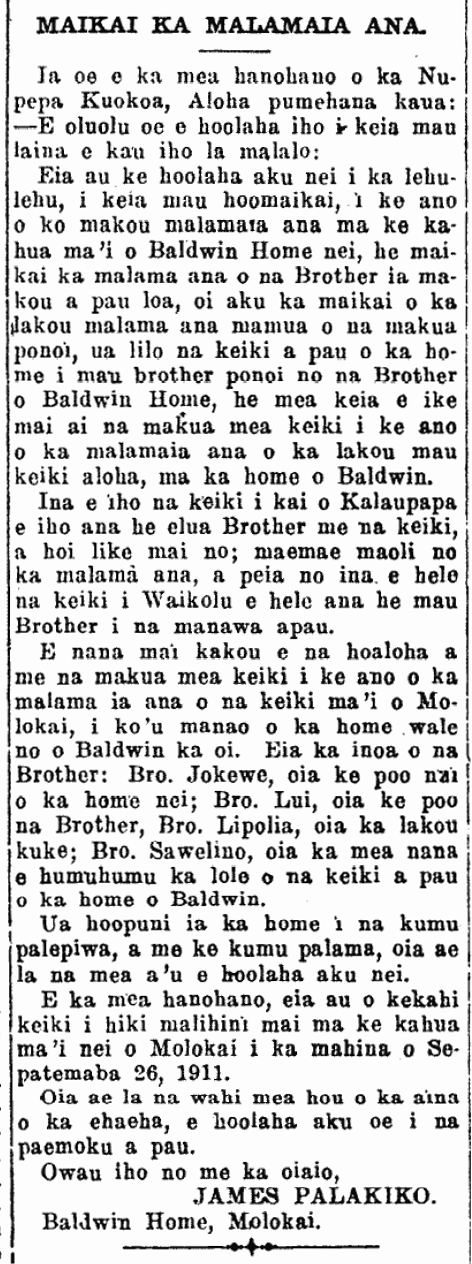
To you, the distinguished one, O Nupepa Kuokoa, warm Aloha between us:—Please print these lines below:

Here I am spreading amongst the public, appreciation for the way we are being cared for at Baldwin Home here at the leprosy colony; the Brothers take good care of all of us and their care is better than true parents, all of the boys of the home have become true brothers to the Brothers of Baldwin Home; and this [letter] is to let the parents know of how their beloved children are being cared for at Baldwin Home.

If the children go down to the ocean of Kalaupapa, two Brothers will go down with them and come back with them; they take care of the children very morally; also, if the children go to Waikolu, some of the Brothers will accompany them all the time.

Let us look, O Friends and Parents, at the manner in which the sick children of Molokai are taken care of; in my opinion, Baldwin Home is the best. These are the names of the Brothers: Bro. Jokewe [Joseph Dutton] is the head of this Home, Bro. Lui [?] is the head of the Brothers, Bro. Lipolina [?] is their cook, Bro. Sawelino [?] is the one who sews the clothes of all of the children of Baldwin Home.

The Home is surrounded by eucalyptus trees and plum trees; those things above are what I have to inform you of.

O Distinguished One, I am one of the children who came to this foreign land, her to the leprosy colony of Molokai in the month of September 26, 1911.

That is the news from the land of suffering; please spread it to the entire archipelago.

Sincerely yours,
James Palakiko.
Baldwin Home, Molokai.

(Kuokoa, 1/12/1912, p. 6)

MAIKAI KA MALAMAIA ANA.

Ka Nupepa Kuokoa, Buke XLVIII, Helu 2, Aoao 6. Ianuari 12, 1912.

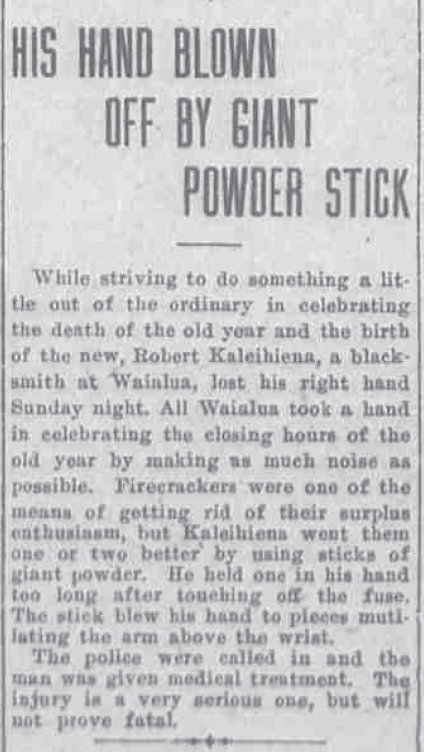
Fireworks accident #4, 1912.

[Here is the coverage of one of the English papers taken from Chronicling America. Notice how the name given is “Kaleihiena”. This is not to say that the Hawaiian-Language Newspapers did not have typos. Some papers were more prone to typos than others…]

(Hawaiian Gazette, 1/5/1912, p. 7)

HIS HAND BLOWN OFF BY GIANT POWDER STICK

The Hawaiian Gazette, Vol. LV, No. 2, P. 7. January 5, 1912.

More on different papers, 1912.

Yesterday, we saw three different articles from three different papers reporting on the same incident. Just as we need to look in all of the available Hawaiian-Language Newspapers to see how an event was covered, we should not neglect the other language papers as well….

Here for instance is an article talking about the same event from one of the English papers.

Fireworks accident #3, 1912.

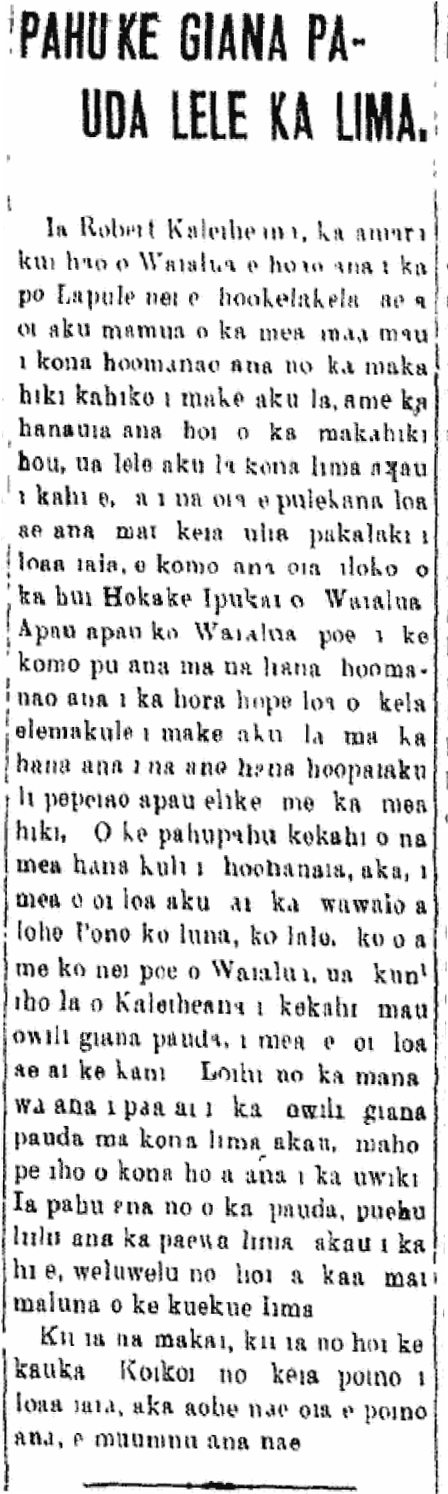
DYNAMITE WENT OFF AND HAND FLEW.

When Robert Kaleiheana, the blacksmith of Waialua, was attempting this past Sunday to go over the top when he was commemorating the death of the old year and the birth of the new, his right hand flew off, and should he be saved from this unfortunate accident which befell upon him, he will join the Hokake Ipukai club of Waialua [?]. When all of Waialua’s people were in on the celebration of the last hour of that old man that died [the year 1911] by making all the deafening noises that they could. Firecrackers were one of the noise makers that were set off, but to top this noise so that all those above, and below, here, and there of Waialua could hear, Kaleiheana set ablaze some stick of dynamite to make a bigger bang. He held the dynamite for a long time in his right hand, after he set the fuse on fire. When the powder exploded, his right hand was scattered about, it was all shredded until the wrist.

The police were fetched, and the doctor was brought as well. This injury he received was severe, but he will not be in danger, and yet he will be maimed.

(Kuokoa Home Rula, 1/5/1912, p. 1)

PAHU KE GIANA PAUDA LELE KA LIMA.

Kuokoa Home Rula, Buke X, Helu 1, Aoao 1. Ianuari 5, 1912.

Fireworks accident #2, 1912.

HAND BLOWN UP BY DYNAMITE

To celebrate the passing of the old year and so too the arrival of the new year, Robert Kaleiheana of Waialua got into an accident when his hand was blown up by dynamite this past Sunday; however his injuries were not terribly severe.

According to the news of that explosion, there were many Waialua people entertaining themselves by setting off fireworks, but what Kaleiheana was setting off was dynamite, and because he held on to the stick of powder in his hand for too long, that was why he got in trouble when the fuse caught on fire until the explosion.

His hand is what was hurt, and the police were informed, and the injured was treated immediately; and from what they say, his injuries were not very severe.

(Kuokoa, 1/5/1912, p. 1)

PA-HULA KA LIMA E KE KiANA PAUDA

Ka Nupepa Kuokoa, Buke XLVIII, Helu 1, Aoao 1. Ianuari 5, 1912.

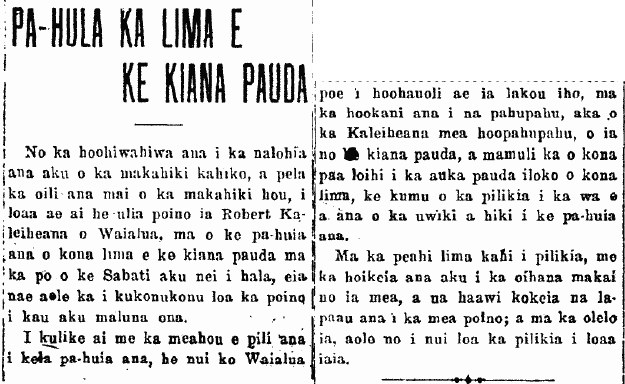
Fireworks accident #1, 1912.

[Found under: “ACCIDENTS OF THE NEW YEAR.”]

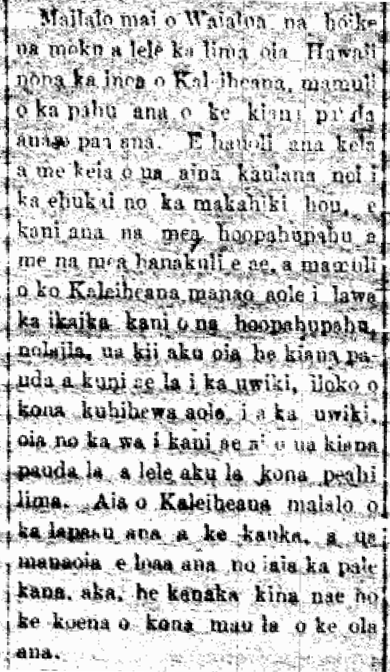
From down in Waialua it was heard that the hand of that Hawaiian named Kaleiheana was severed and flew because of the explosion of the gun powder which he held. Everyone of that land famed for the sea spray was celebrating the new year, and were setting off firecrackers and other noise makers, and because Kaleiheana thought that the firecrackers weren’t powerful enough, he took some dynamite and lit the fuse; while he mistakenly believed that the fuse wasn’t burning, that was when that dynamite exploded and his hand flew. Kaleiheana is under doctor’s care, and it is believed that he will be saved, but he will be disfigured for the rest of his life.

(Aloha Aina, 1/6/1912, p. 2)

Mailalo mai o Waialua...

Ke Aloha Aina, Buke XVI, Helu 1, Aoao 2. Ianuari 6, 1912.

Different papers, different views, 1912.

It is not unusual for different newspapers to cover the same story differently. Most papers were slanted in some way or another. If heads or editors of a paper changed, the coverage could change as well.

The following three articles deal with the same event, but are considerably different in content. This isn’t even a politically charged article, it’s about a fireworks accident…

It is important to consider what paper an article comes from and the circumstances of its publication.