Unknown's avatar

About nupepa

Just another place that posts random articles from the Hawaiian Newspapers! It would be awesome if this should become a space where open discussions happen on all topics written about in those papers!! And please note that these are definitely not polished translations, but are just drafts!!! [This blog is not affiliated with any organization and receives no funding. Statements made here should in now way be seen as a reflection on other organizations or people. All errors in interpretation are my own.]

All sorts of rumors spread on the streets, 1893.

RUMORS.

There are all sorts of stories spreading about on the sidewalks. Some of the news is shocking, some are exaggerations, and some are just baseless stories. Here is what is known—the Reformists’ idea to incite dissension is hard-pressed.

(Hawaii Holomua, 1/16/1893, p. 2)

NA LONO LAUAHEA.

Hawaii Holomua, Buke III, Helu 140, Aoao 2. 1/16/1893.

Loyalty, 1893.

STEADFAST.

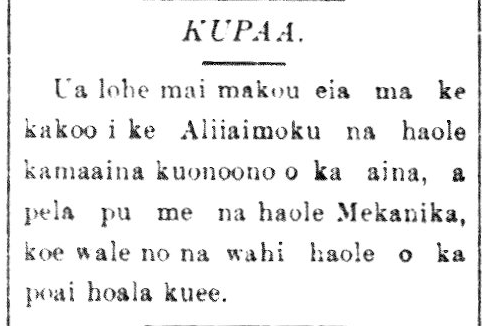
We hear that the local wealthy haole kamaaina support the Ruler, and so too the haole Mechanics; all that is left are those haole who are of the circle inciting dissension.

(Hawaii Holomua, 1/16/1893, p. 2)

KUPAA.

Hawaii Holomua, Buke III, Helu 140, Aoao 2. Ianuari 16, 1893.

Proclamation by the Cabinet of Ministers of Queen Liliuokalani, 1893.

BY AUTHORITY.

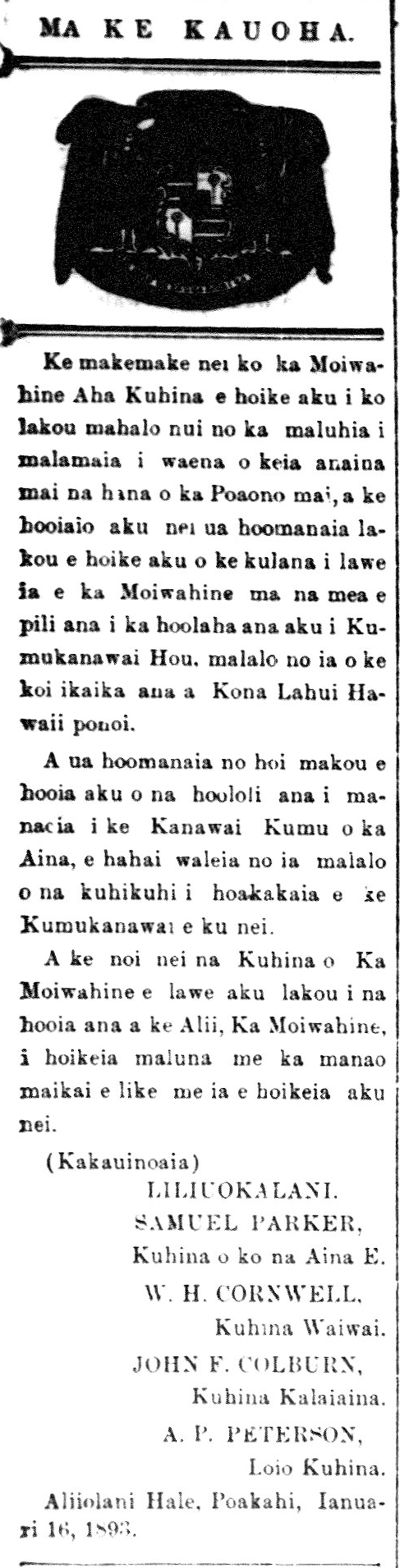
Her Majesty’s Ministers desire to express their appreciation for the quiet and order which has prevailed in this community since the events of Saturday, and are authorized to say that the position taken by Her Majesty in regard to the promulgation of a new Constitution, was under stress of Her native subjects.

Authority is given for the assurance that any changes desired in the fundamental law of the land will be sought only by methods provided in the Constitution itself.

Her Majesty’s Ministers request all citizens to accept the assurances of Her Majesty in the same spirit in which it is given.

(Signed)

LILIUOKALANI,

SAMUEL PARKER,
Minister of Foreign Affairs.

W. H. CORNWELL,
Minister of Finance.

JOHN F. COLBURN,
Minister of the Interior.

A. P. PETERSON,
Attorney-General.

Iolani Palace [Aliiolani Hale], January 16th, 1893.

[English taken from Chronicling America, The Hawaiian Gazette, 1/17/1893, p. 4]

(Hawaii Holomua, 1/16/1893, p. 2)

MA KE KAUOHA.

Hawaii Holomua, Buke III, Helu 140, Aoao 2. Ianuari 16, 1893.

Optimism a hundred and nineteen years ago… 1893.

COMPARISONS.

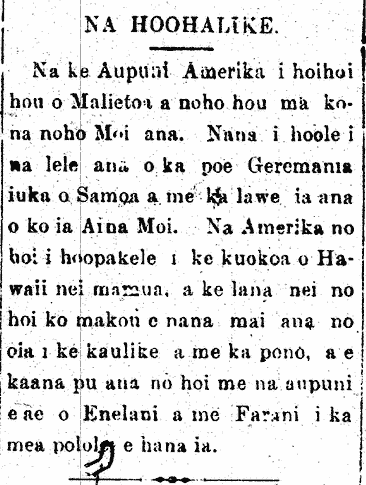
It was the Nation of America which restored Malietoa to once again rule as King. America held back the advances of Germany on Samoa and the taking of the Kingdom. It was America who saved the independence of Hawaii earlier, and we are optimistic that America will look at what is fair and just, and it will work along with the other nations of England and France to the right thing.

(Leo o ka Lahui, 1/18/1893, p. 2)

NA HOOHALIKE

Ka Leo o ka Lahui, Buke II, Helu 625, Aoao 2. Ianuari 19, 1893.

Woah. This is some story! Hawaiian living abroad comes home to visit… after 38 years. 1915.

THAT HAWAIIAN RETURNS TO SEE HIS HOMELAND ONCE MORE.

JOHN BELL WILSON

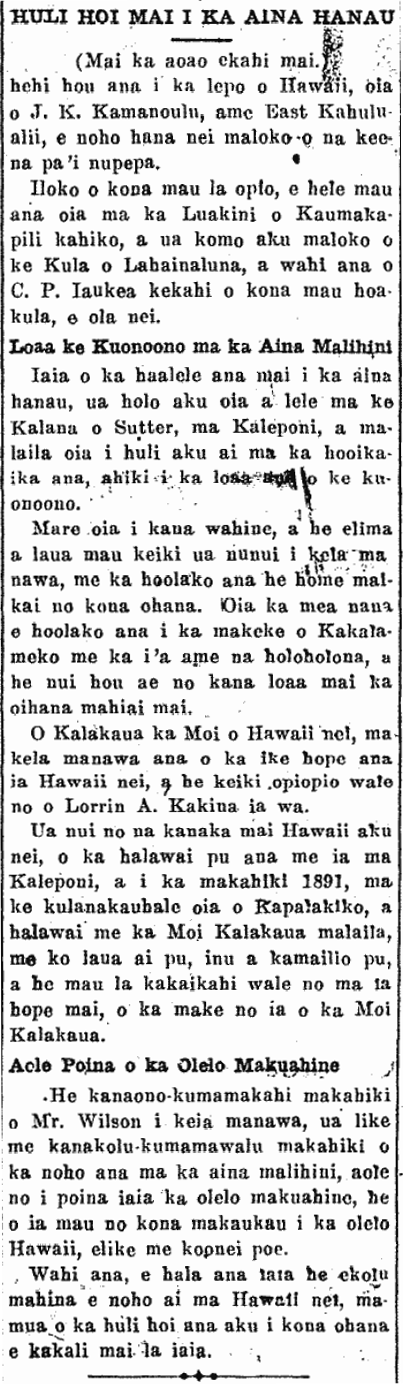
After leaving Honolulu thirty-eight years ago, that Hawaiian, John Bell Wilson is his name, returned to see once again his family and homeland while he was still in good health, on the steamship Matsonia this past Wednesday, filled with shock at how the places he was familiar with in his childhood had changed.

John Bell Wilson left Honolulu nei when he was a youngster of twenty-three years in age on a sailboat, because there were few steamships in his day, but it was upon a beautiful steamship that he returned to see the land of his birth and his friends, as he was shocked at the change of Honolulu from an almost nothing town which he left to a beautiful town which one admires.

His eyes met up with new sights of Honolulu and ethnicities which were unfamiliar to him; and as he travelled here and there, there were no friends who he knew in his youth, except for but a few who were still living which he met up with, those friends who he went around with in those days gone by.

Heard of the Death of His Mother

When John Bell Wilson returned to see his homeland, he had one big thing on his mind, that was meeting affectionately with his mother, who he thought was still living, but she was not, and this left him heartbroken.

Mr. Wilson was depressed at the death of his mother, being that from the time he left this land until his return, he did not write his mother; and when he asked his friends when he landed ashore about his mother, this was when he was told she had passed long ago to the other side, three years ago.

He went immediately to find the grave where his mother was laid to rest, and he planned to build a memorial to her, as a show of remembrance from a thoughtless child for his beloved mother.

Not Recognizing Honolulu

According to the words of Mr. Wilson after he saw the scenery unfamiliar to him, he could not recall the old Honolulu, because the town had changed so much from when he left, however he did have recollections of the major streets of town.

When he travelled about looking here and there, those scenes were not familiar to him, except for just a few people who went around with him and played with him in the days of his childhood. The small children he left behind were now very elderly and some of them had white hair.

Some of the familiar people who he saw on the first day he

(See page four.)

(Kuokoa, 2/5/1915, p. 1)

HULI HOI MAI IA KANAKA HAWAII E IKE HOU I KA AINA HANAU

Ka Nupepa Kuokoa, Buke LIII, Helu 6, Aoao 1. Feberuari 5, 1915.

RETURNED TO THE HOMELAND

(From page one.)

stepped once again on the soil of Hawaii, were J. K. Kamanoulu and East Kahulualii who work at the newspaper printing office.

In the days of his childhood, he went often to the old Kaumakapili Church, and he was enrolled at Lahainaluna School, and according to him, C. P. Iaukea is one of his friends who is still living.

Became Wealthy in a Foreign Land

When he left the land of his birth, he got off at Sutter County, California, and there he sought very hard until he became well off.

He married his wife, and they currently have five grown children, and he provided a good home for his family. He is the one who supplies the market of Sacramento with fish and meat, and he also makes profits from the farming industry.

Kalakaua was the King of Hawaii nei at the time he last saw Hawaii, and Lorrin A. Thurston was but a child.

There are many people from Hawaii who have met up with him in California, and in the year 1891, in the town of San Francisco, he met with King Kalakaua there, and they dined together, drank and talked, and just a few days after that was when King Kalakaua died.

Did Not Forget His Mother Tongue

Mr. Wilson is now sixty-one years old, so he was living thirty-eight years abroad, and he has not forgotten his native language, he is still fluent in Hawaiian, just as the people here are.

According to him, he will spend three months staying in Hawaii before returning to his family who await him.

(Kuokoa 2/5/1915, p. 4)

HULI HOI MAI I KA AINA HANAU

Ka Nupepa Kuokoa, Buke LIII, Helu 6, Aoao 4. Feberuari 5, 1915.

Cold weather on Maui, 1866.

Hail in Keanae.

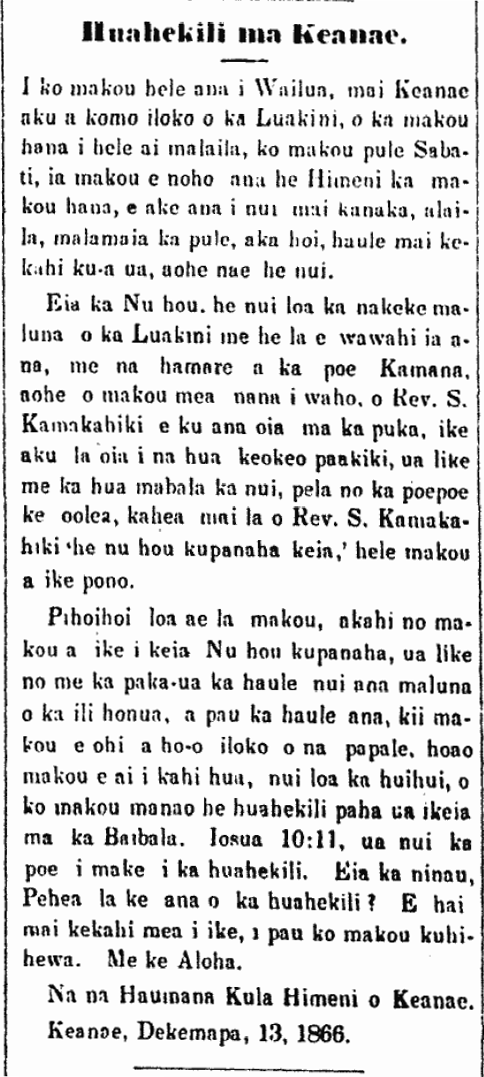
When we went to Wailua, from Keanae, and entered the church, the reason we went there was for Sunday services; while we were there, we were singing hymns hoping that a big crowd would come, at which point the prayers would be held, however, there was a shower, but not so big.

Here is the News: there was a big rumbling atop the Church as if it was being demolished with Carpenter’s hammers; none of us looked outside but Rev. S. Kamakahiki was standing by the window and saw hard white balls like the size of marbles, similar also in its spherical shape and hardness. Rev. S. Kamakahiki called out, “This is something new,” and we went to see for ourselves.

We were all agitated as this was our first time witnessing this new amazing thing; it was like rain, the way so much of them fell to the ground. After they fell, we went to pick some up and place them in our hats, and we tried to eat some of the balls. It was really cold, and we thought these were perhaps hailstones as seen in the Bible. Joshua 10:11, many people perished from the hailstones. Here is the question: How do you know a hailstone? Someone tell us, so are confusion is cleared. With Aloha.

The students of the Hymn School of Keanae.
Keanae, December 13, 1866.

(Kuokoa, 2/2/1867, p. 4)

Huahekili ma Keanae

Ka Nupepa Kuokoa, Buke VI, Helu 5, Aoao 4. Feberuari 2, 1867.

Six blind men and an elephant, 1867.

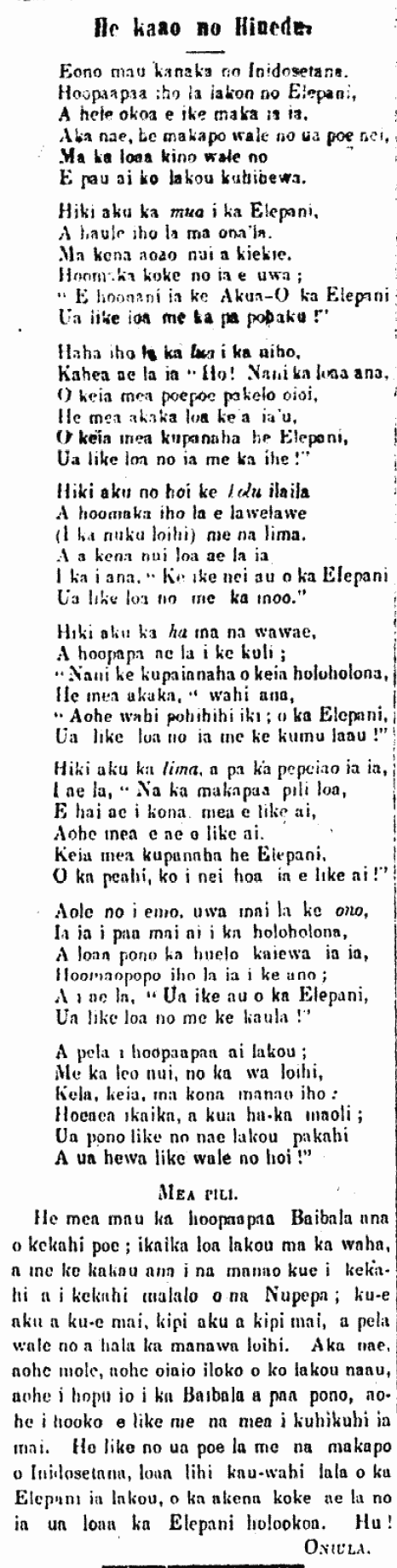
A TALE FROM HINDU.

[The story of the blind men who feel different parts of an elephant and give their varied impressions of what an elephant is, comes from India. But it was adapted into the poem “The Blind Men and the Elephant” by American, John Godfrey Saxe. This poem is then interpreted into Hawaiian in 1867 by Oniula, who submits many translations of foreign tales. The Saxe version can be found readily online…]

. . .

How it is related.

Some people constantly argue over the Bible; they are very outspoken, and write forcefully in the Newspapers, contradicting this person or that; arguing back and forth, conspiring back and forth, over long periods of time. However, there is no basis, no truth in their hearts; they don’t grasp the Bible firmly; they don’t do as they say. Those people are like the blind men of Indostan; they know just a small appendage of the Elephant, and then they boast that they know the whole Elephant. Hu!

Oniula.

(Kuokoa, 2/2/1867, p. 4)

He kaao no Hinedu.

Ka Nupepa Kuokoa, Buke VI, Helu 5, Aoao 4. Feberuari 2, 1867.

Poi and Kalo and a self sufficient Hawaii, 1915.

THE TIME WILL COME WHEN POI WILL BE SCARCE.

It would appear that the days are numbered, and 5 pounds of poi will go for a quarter, that is five cents per pound. This rise in price of poi is due to the lack of kalo, and perhaps because Hawaiians just don’t care to plant kalo in their fields.

These days in Honolulu, there are but few places that plant kalo. Places that loi kalo were seen are now dried out because the lands were accrued by other groups of people, and they dried the fields out; whereas it would be more beneficial if those back turners continued the planting of kalo. It has been almost two years since this spokesperson [the newspaper Ke Aloha Aina] first advised those with lands to farm them, for the time will come when there will be food shortages, at that time, America will declare war against Germany, which will intensify the problem, and that time we spoke of has come indeed. As proof of what we say, look to the issues of A. D. 1915–16, and you will find our words of advice, strongly encouraging Hawaiians to plant kalo and other crops, because the time will come when there will be hardships, and it will come, without fail.

Something terribly astonishing to us is that it as if kalo is being made into poi outside of Hawaii, for the cost is rising like goods imported here.

Why is this so? Because there is so little kalo being farmed, and there are a lot of people eating poi. These days, there are other ethnicities eating poi because their staples are expensive, and therefore, many people are eating poi and not much kalo is being planted.

We give our appreciation to the poi association of the stevedores which took some kalo lands and leased them out long term to plant kalo to supply their outlets at the markets and feed the poi-eating public.

Probably the public doesn’t realize that these days there is a poi shortage; maybe they continue to assume that poi is as usual. No! There is less poi now; six and a half pounds for a quarter, and some weeks it is just six pounds and sometimes five pounds for a quarter, which is five cents per pound.

So all you people with some kalo land, you should plant a lot of kalo and pull up well-developed corms when the time is right. Neglect during the day will leave you without. Work while the sun is up.

(Aloha Aina, 9/7/1917, p. 4)

E HIKI AKU ANA I KA MANAWA E LIILII LOA AKU AI O KA POI

Ke Aloha Aina, Buke XXII, Helu 36, Aoao 4. Sepatemaba 7, 1917.

McInerny Shoe Store ad, 1896.

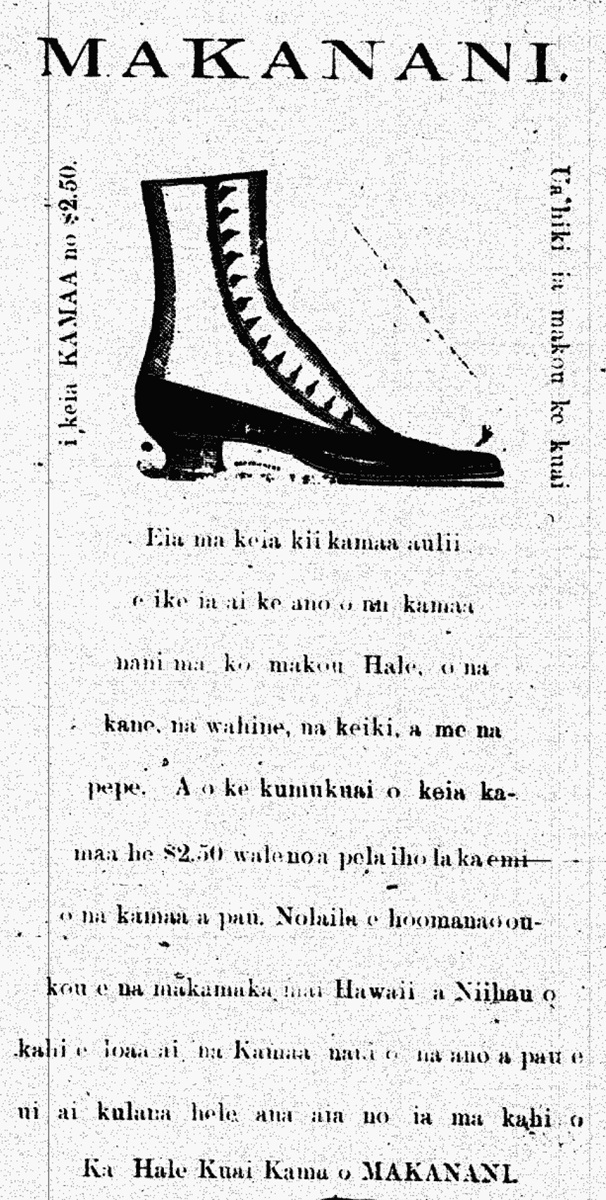
McINERNY.

We can sell these SHOES for $2.50.

Here in this picture of an exquisite shoe, you will see the kind of beautiful shoes at our Store; for men, women, children, and babies. And the price of these shoes is but $2.50, and so too is the low cost of all of the shoes. So remember friends, from Hawaii to Niihau, the place to get your beautiful shoes of all sorts, to make your walking look sharp, is at the MAKANANI Shoe Store.

[This issue is labeled “Helu 8”, but it should be “Helu 9”, and it gets corrected on 1/17/1896.]

(Oiaio, 1/14/1896, p. 2)

MAKANANI

Ka Oiaio, Buke I, Helu 8, Aoao 2. Ianuari 14, 1896.

Eat local advertisement? 1932.

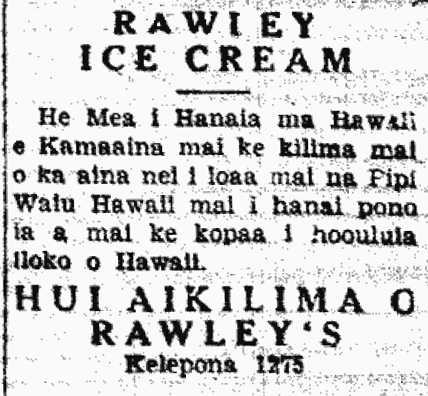
RAWLEY

ICE CREAM

Made in Hawaii by Kamaaina, from cream which is produced locally from Hawaii dairy cows which are well fed, and from sugar grown in Hawaii.

RAWLEY’S ICE CREAM COMPANY

Telephone 1275

(Alakai o Hawaii, 1/14/1932, p. 3)

RAWLEY ICE CREAM

Ke Alakai o Hawaii, Buke 3, Helu 37, Aoao, 3. Ianuali 14, 1932.