Unknown's avatar

About nupepa

Just another place that posts random articles from the Hawaiian Newspapers! It would be awesome if this should become a space where open discussions happen on all topics written about in those papers!! And please note that these are definitely not polished translations, but are just drafts!!! [This blog is not affiliated with any organization and receives no funding. Statements made here should in now way be seen as a reflection on other organizations or people. All errors in interpretation are my own.]

K. Uyeda’s hat store ad, the establishment that was damaged by fireworks, 1912.

THE GRAND HAT STORE OF
K. UYEDA

NUMBER 1028 NUUANU AVENUE, HONOLULU. TELEPHONE 2129.
POST BOX NUMBER 847.
HERE WE ARE SELLING BEAUTIFUL HATS OF ALL SORTS
We are holding a big sale of Hats for Men, Women and Children.
Orders are completed quickly and deftly.

(Aloha Aina, 1/27/1912, p. 4)

KA HALEKUAI PAPALE NUI O K. UYEDA

Ke Aloha Aina, Buke XVI, Helu 4, Aoao 4. Ianuari 27, 1912.

Sheet music of famous songs being sung by Ernest Kaai, 1912.

SOME FAMOUS HAWAIIAN SONGS.

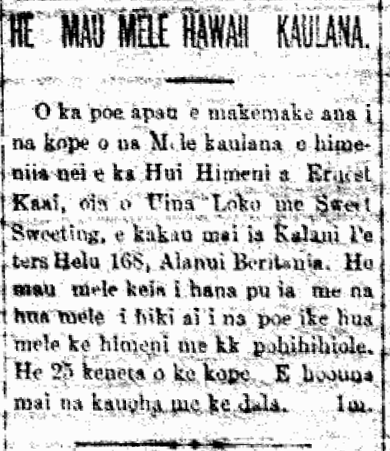
Everyone wanting copies of the famous songs being sung by the group of Ernest Kaai, they being “Uina Loko” and “Sweet Sweeting,” write to Kalani Peters, Number 168, Beritania Street. These are mele set with musical notes so that those who read music can sing them without confusion. They are 25 cents per copy. Send in your orders and money.

[I have not found a copy of this compilation as of yet… But i bet someone has a copy in their grandma’s piano bench, the kind with the lift-up music storage compartment!]

(Aloha Aina, 2/24/1912, p. 4)

HE MAU MELE HAWAII KAULANA.

Ke Aloha Aina, Buke XVI, Helu 8, Aoao 4. Feberuari 24, 1912.

Chinese New Year. Sunday, February 18, 1912.

NEW YEAR¹ OF THE KEIKI OF THE LAND OF FLOWERS²

The people of China were finely adorned as they celebrated their New Year; the Chinese were seen from Friday, going to the shops of their own countrymen to purchase new year’s items, from the day until evening, and purchasing all sorts of flowers, like crown flower, koniako [?]³, chrysanthemum, and some other blossoms to decorated their tables.

When the hands of the clock reached the point where the year staggered away and the New Year was born, the popping sounds of the firecrackers reverberated along with their huge pu ie [some kind of shooting firework?]⁴ on Nuuanu Avenue between the streets of King and Hotel. Amidst that popping along with the deafening huge pu ie that were lined up straight in a row; as the Chinese of the shops in the area were lighting those huge pu ie, one of the pu ie went off and flew straight through the entrance of the hat shop of Uyeda on the Ewa side, and broke the glass without this misfortune being noticed while the activities were going on, and it was with the coming of day that this damage was discovered by someone, and seen also was the ie of that pu ie lying on the floor. The one good thing was that the ie that went inside was not on fire, if not there would have been a “side dish” to the new year of the Chinese, a house fire.

¹”Konohi” is the Hawaiian word for Chinese New Year, coming from “kong-hee” [恭喜]…
²Aina Pua [Land of Flowers] is a poetic name for China.
³I don’t know what kind of flower a “koniako” is.
⁴I have yet to find out exactly what type of firework a “pu ie” is.

(Kuokoa Home Rula, 1/23/1912, p. 1)

KE KONOHI O NA KEIKI O KA AINA PUA

Kuokoa Home Rula, Buke X, Helu 8, Aoao 1. Feberuari 23, 1912.

Added suffering in Kalaupapa, 1912.

[Found under: “Local News”]

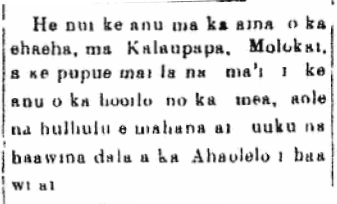
The land of suffering is terribly cold, at Kalaupapa, Molokai, and the patients are crouching up in the cold of the winter because they don’t have blankets to warm themselves being that little money was granted by the Legislature.

(Kuokoa Home Rula, 1/19/1912, p. 2)

He nui ke anu ma ka aina o ka ehaeha...

Kuokoa Home Rula, Buke X, Helu 3, Aoao 2. Ianuari 19, 1912.

Another flag story, 1893.

THE AMERICAN FLAG.

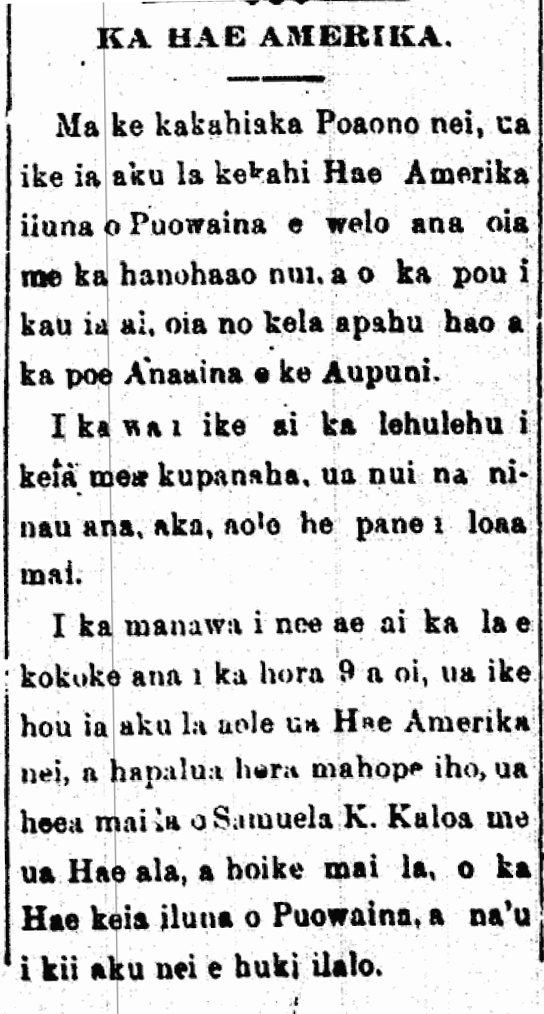
On this Saturday morning, an American Flag was seen above Puowaina fluttering proudly, and the pole upon which it was placed was that piece of metal of the Government Surveyors.

When people saw this astonishing thing, there were many questions, but no answers.

When the day progressed to 9 o’clock or more, it was seen now that the American Flag wasn’t there, and half an hour later, Samuela K. Kaloa arrived with that flag and said that this was the Flag that was up at Puowaina, and it was I who went and took it down.

(Leo o ka Lahui, 4/18/1893, p. 3)

KA HAE AMERIKA.

Ka Leo o ka Lahui, Buke II, Helu 686, Aoao 3. Aperila 18, 1893.

Beautiful flag story, 1893.

HAWAIIAN FLAG.

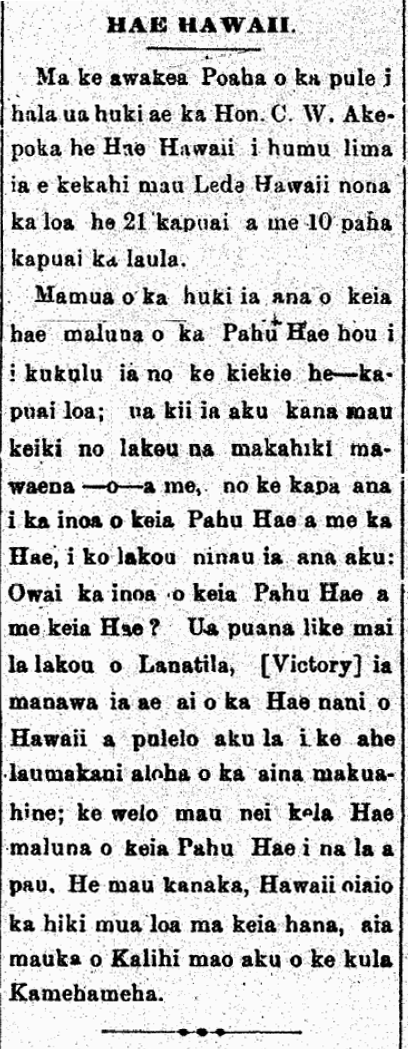
On Thursday afternoon of this last week, Hon. C. W. Ashford raised a Hawaiian Flag hand sewn by some Hawaiian Ladies, whose length was 21 feet and width was perhaps 10 feet.

Before the raising of this flag upon a new Flag Pole built ___ feet tall, his children were called, whose ages are between ___ and ___, to name this Flag Pole and the Flag; when they were asked: What is the name of this Flag Pole and this Flag? They answered together, “Lanatila [Victory];” it was then that the beautiful Flag of Hawaii rose and fluttered in the beloved soft gentle breeze of the motherland; that Flag waves continuously upon this Flag Pole everyday. These are true Hawaiians who have done this first, it is in the uplands of Kalihi past Kamehameha School.

(Leo o ka Lahui, 5/1/1893, p. 3)

HAE HAWAII.

Ka Leo o ka Lahui, Buke II, Helu 695, Aoao 3. Mei 1, 1893.

This would be a powerful picture to see, 1893.

The picture was taken of the Committee who delivered the Memoriala of the Hawaiian Nation and placed it before the Honorable James H. Blount (Balana) on the 1st of April, 1883 totaling 19 members. Should there be anyone who wants a copy of this, go to the Office of Ka Leo o ka Lahui and ask John Kapamawaho Prendergast for the cost to purchase an image and he will tell you.

[Anybody know if there is a copy of this somewhere?]

(Leo o ka Lahui, 4/25/1893, p. 3)

Ua pau i ke Pai ia...

Ka Leo o ka Lahui, Buke II, Helu 691, Aoao 3. Aperila 25, 1893.

Patriotic mele of a different sort, 1893.

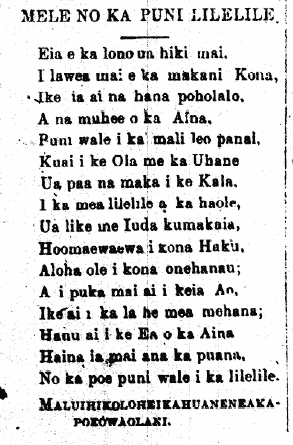
MELE NO KA PUNI LILELILE

Eia e ka lono ua hiki mai,

I lawea mai e ka makani Kona,

Ike ia ai na hana poholalo,

A na muhee o ka Aina,

Puni wale i ka mali leo panai,

Kuai i ke Ola me ka Uhane,

Ua paa na maka i ke Kala,

I ka mea lilelile a ka haole,

Ua like me Iuda kumakaia,

Hoomaewaewa i kona Haku,

Aloha ole i kona onehanau;

A i puka mai ai i keia Ao,

Ike ai i ka la he mea mehana;

Hanu ai i ke Ea o ka Aina,

Haina ia mai ana ka puana,

No ka poe puni wale i ka lilelile.

Maluihikoloheikahuaneneakapoeowaolani.

[There are not only patriotic compositions that laud and encourage, but there are also those like this one here which ridicule and disparage. This one goes something like:]

A SONG FOR THOSE WHO COVET SHINY THINGS.

The news has arrived,

Carried by the Kona breeze,

Witnessed are the deeds of deceit,

By the squids¹ of the Land,

Fawning after the sweet talk of reciprocity,

Selling away Life and Soul,

Eyes set on Riches,

That shiny thing of the haole,

Just like Judas the traitor,

Scorning his Lord,

With no aloha for his homeland;

If he’d come forth into the Light,

He’d see that the sun is a thing of warmth,

He’d breathe in the Ea² of the Land.

Let the story be told,

Of those who covet shiny things.

Maluihikoloheikahuaneneakapoeowaolani.

¹A squid can swim as easily backward as forward, so you never know if it is coming or going, and is thus used to describe a two-faced person.

²Ea can be seen as a play on the idea of Air as well as Sovereignty.

(Leo o ka Lahui, 2/21/1893, p. 3)

MELE NO KA PUNI LILELILE.

Ka Leo o ka Lahui, Buke II, Helu 646, Aoao 3. Feberuari 21, 1893.

Patriotic mele, 1893.

[Here is a patriotic mele famous to this day, it is also known as Mele Ai Pohaku, but familiar to most as Kaulana na Pua. This composition is published many times and in more than one Hawaiian-Language Newspaper. It is a song which both lauds and encourages.]

AN ADORNMENT FOR THE PATRIOTS.

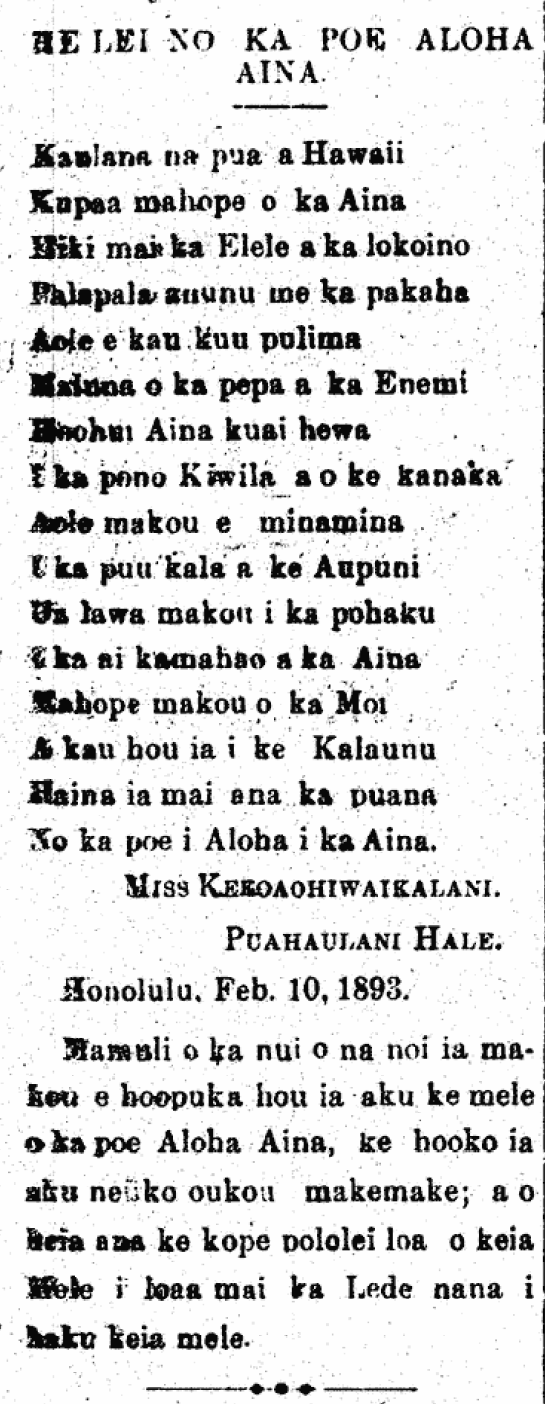
Famous are the blossoms of Hawaii

Who stand steadfast behind the Land

When the evil Messenger arrives

With his documents of greed and plunder

I won’t affix my signature

To the papers of the Enemy

That Annex and sell wrongfully

The Civil rights of the people

We will not feel longing

For the sums of money of the Government

We are satisfied with the stones

The amazing food of the land

We stand behind the Sovereign

She will be placed back upon the Throne

Let the refrain be told

Of the people who Love the Land.

Miss Kekoaohiwaikalani.
Puahaulani Hale.
Honolulu, Feb. 10, 1893.

Because of the many requests for us to reprint the song of the Patriots, we are fulfilling your desire; and this is a correct copy of this song which we received from the Lady who composed this song.

(Leo o ka Lahui, 5/11/1893, p. 3)

HE LEI NO KA POE ALOHA AINA.

Ka Leo o ka Lahui, Buke II, Helu 703, Aoao 3. Mei 11, 1893.

Mahalo to Kamaoli Kuwada for kindly allowing us to repost this! 1905/2012.

KA NA’I AUPUNI.

[Today is not only a day to mourn the events of 1893, but also to celebrate the courage, tenacity, and deep aloha of the lāhui Hawai’i for persisting and growing these past 119 years.

As the editors of the newspaper Ka Nai Aupuni said in an editorial published alongside Ka Moolelo o Kamehameha I:]

. . .

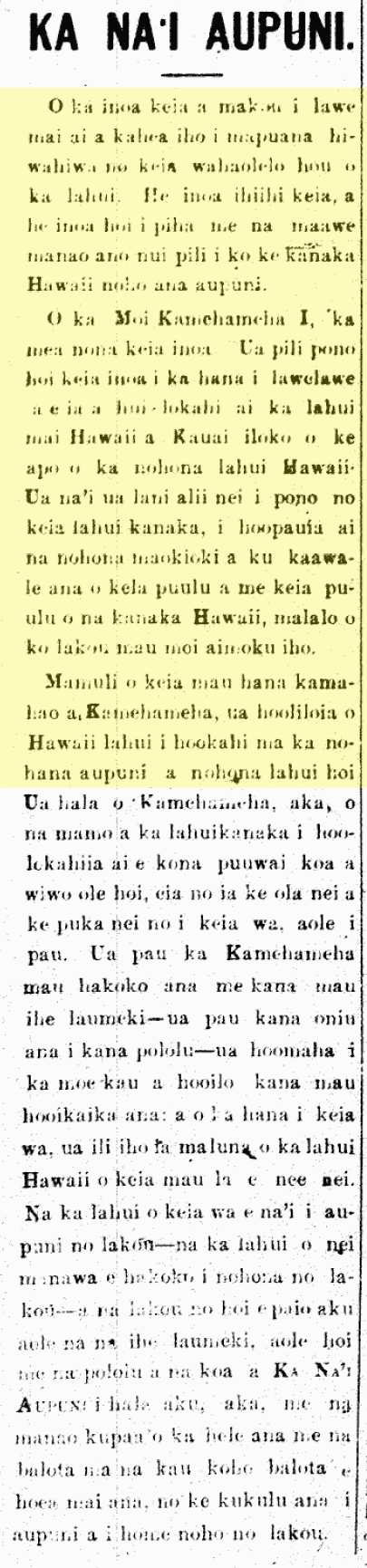
Kamehameha has passed on, but as for the descendants of the race of people united by his brave and fearless heart, they still live on and emerge in this time; they are not gone. Kamehameha’s fighting with his ihe, his barbed spears, is finished; the whirling of his pololū, his long spears, is ended; his struggles have retired to the sleep of ages; and the work of this time has been inherited by the Hawaiian nation of this progressive era. It is the people of this era who shall conquer a nation for themselves; it is the people of this era who will wrestle for a lifestyle of their own; it is they who will fight, not with barbed ihe, not with the long spears of the warriors of the Conqueror who has passed on, but with the firm conviction to go with ballots to the coming elections in order to build a government and a home for themselves.

(Na’i Aupuni, 11/27/1905, p. 2)

KA NA'I AUPUNI

Ka Na'i Aupuni, Buke I, Helu 1, Aoao 2. Novemaba 27, 1905.