Kamehameha School for Girls opens, 1894.

Day of Remembrance of Pauahi.

This coming Monday, November 19, will be the celebration of the birthday of the open-hearted royal lady who has passed, but who has left her great estate for the building of schools for the instruction in elementary education and spreading out to other branches of knowledge, in trade and in other industries, and not for just one sex [kama¹] but for the two sexes.

The boys school house has been completed and some years have been spent in instruction; some of the early students of this school have furthered their desire of knowledge and have moved on to other schools, while others have graduated and are gainfully employed, while the rest remain here increasing their knowledge. The results are evident.

The big thing perhaps on this coming birthday of the one who built the Kamehameha Schools, is the opening of the doors of the beautiful and brand new Kamehameha girls’ school, which stands proudly, along with the commemoration of the day that she was given birth to and became the mother of education.

¹Although I have not found “kama” in dictionaries defined as “sex,” as in male or female, I have found a number of uses in the newspapers and other documents.

(Kuokoa, 11/17/1894, p. 3)
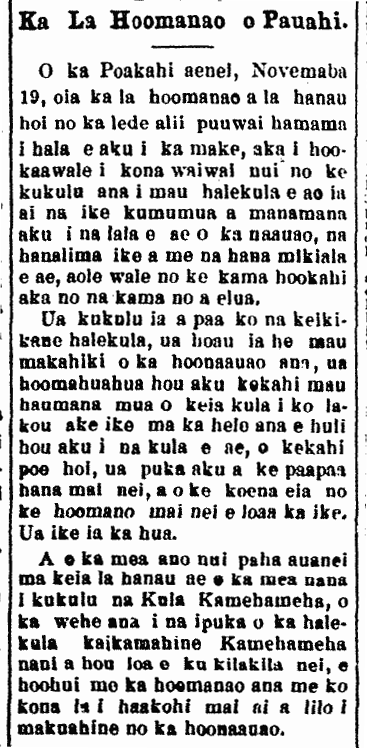
Ka La Hoomanao o Pauahi.

Ka Nupepa Kuokoa, Buke XXXIII, Helu 46, Aoao 3. Novemaba 17, 1894.
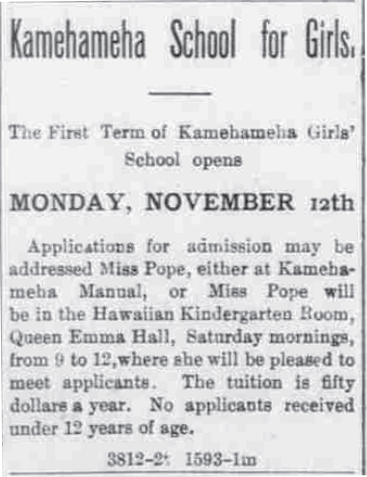
Kamehameha School for Girls advertisement, 1894.

Kamehameha School for Girls.

The First Term of Kamehameha Girls’ School opens

MONDAY, NOVEMBER 12th

Applications for admission may be addressed Miss Pope, either at Kamehameha Manual, or Miss Pope will be in the Hawaiian Kindergarten Room, Queen Emma Hall, Saturday mornings, from 9 to 12, where she will be pleased to meet applicants. The tuition is fifty dollars a year. No applicants received under 12 years of age.

[How things have changed!]

(Hawaiian Gazette, 10/23/1894, p. 6)

Kamehameha School for Girls.

The Hawaiian Gazette, Volume XXIX, Number 84, Page 6. October 23, 1894.

Oneha family history, 1876.

[Found under: “News”]

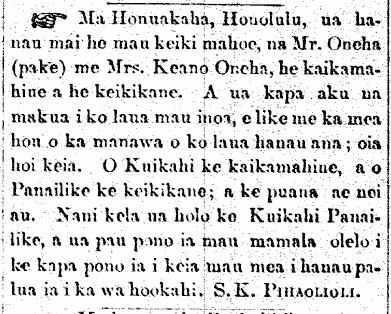
At Honuakaha, Honolulu, twins were born to Mr. Oneha (Chinese) and Mrs. Keano Oneha, one girl and one boy. The parents named them after the current news at the time of their birth; that being this: Kuikahi [Treaty] is the girl, and Panailike [Reciprocity] is the boy, and I announce it. How great that the Reciprocity Treaty has passed, and that this phrase is complete when speaking the names of these children born together at the same time. S. K. Pihaolioli.

[Children were often named after current events to commemorate the occasion.

There was a great debate over the merits of the Reciprocity Treaty with America, with many articulate compositions for and against it in the Hawaiian-Language Newspapers. More on that at a later date.]

(Lahui Hawaii, 10/19/1876, p. 3)

Ma Honuakaha, Honolulu...

Ka Lahui Hawaii, Buke II, Helu 43, Aoao 3. Okatoba 19, 1876.

More Decorating the Kamehameha Statue, 1912.

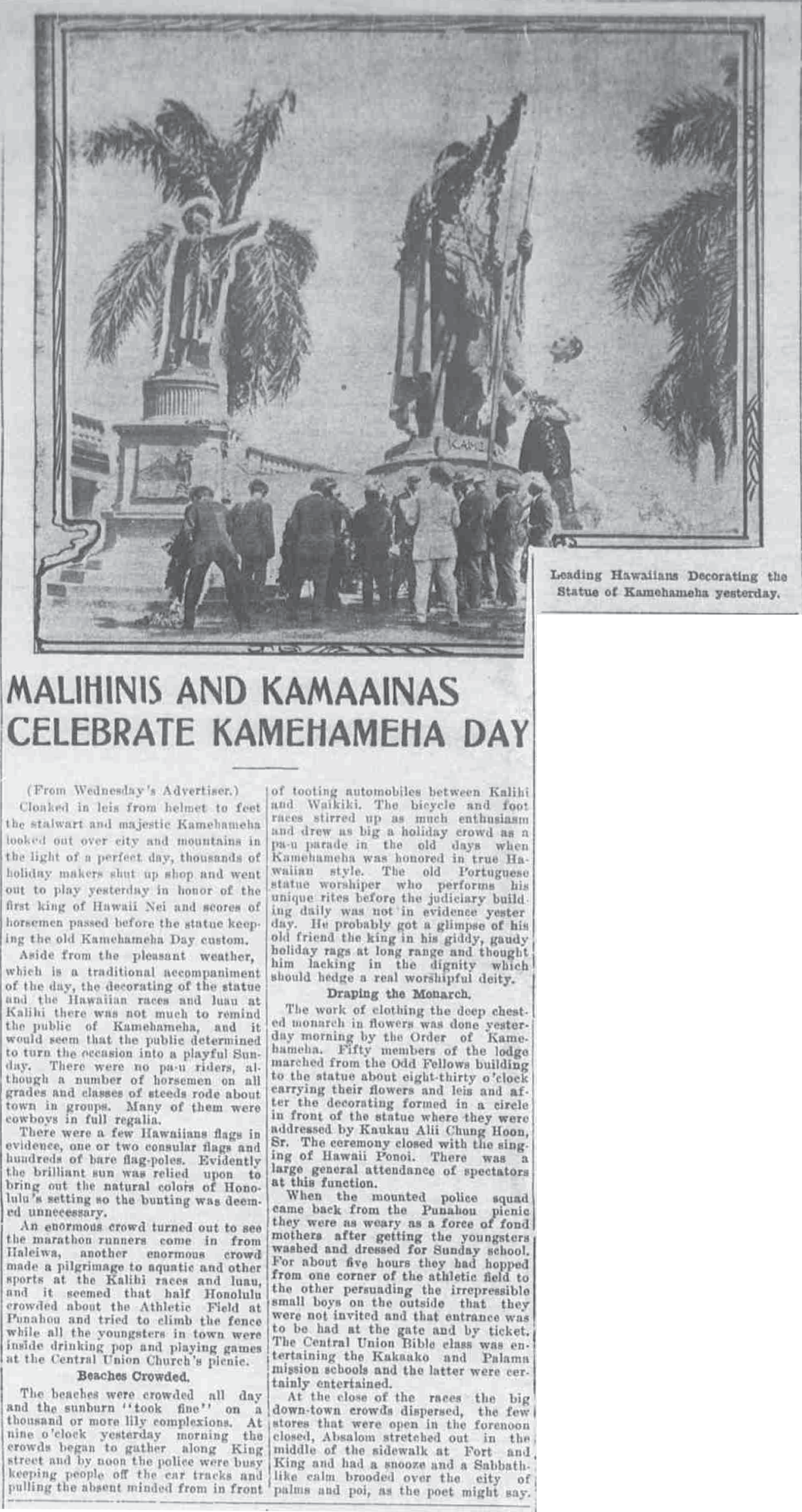
MALIHINIS AND KAMAAINAS CELEBRATE KAMEHAMEHA DAY

Leading Hawaiians Decorating the Statue of Kamehameha yesterday.

(From Wednesday’s Advertiser.)

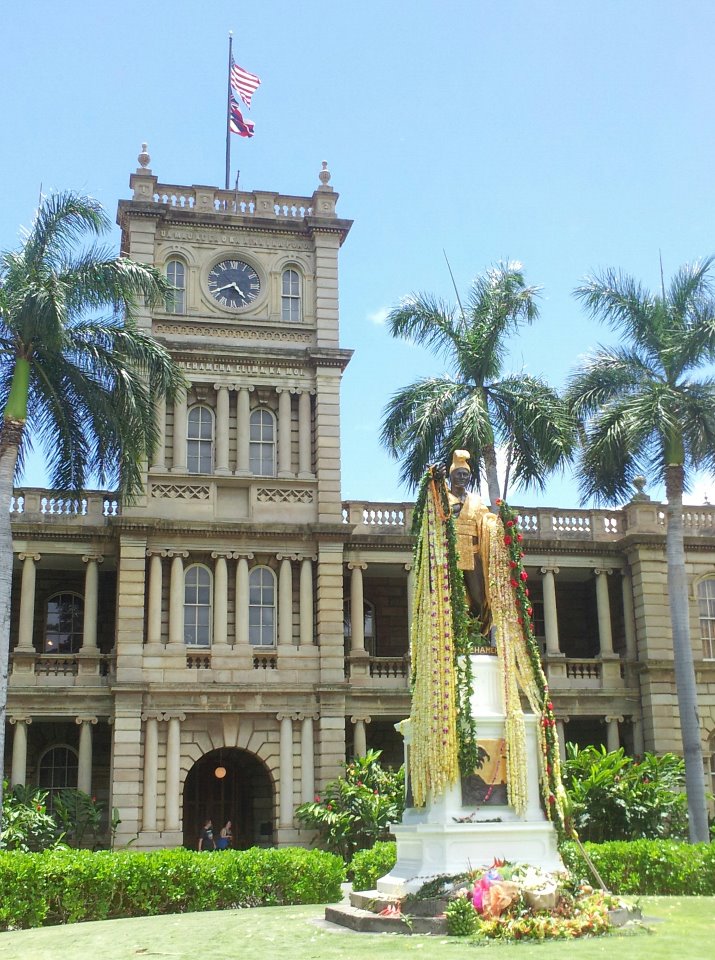
Cloaked in leis from helmet to feet the stalwart and majestic Kamehameha looked out over city and mountains in the light of a perfect day, thousands of holiday makers shut up shop and went out to play yesterday in honor of the first king of Hawaii Nei and scores of horsemen passed before the statue keeping the old Kamehameha Day custom.

Aside from the pleasant weather, which is a traditional accompaniment of the day, the decorating of the statue and the Hawaiian races and luau at Kalihi there was not much to remind the public of Kamehameha, and it would seem that the public determined to turn the occasion into a playful Sunday. There were no pa-u riders, although a number of horsemen on all grades and classes of steeds rode about town in groups. Many of them were cowboys in full regalia.

There were a few Hawaiian flags in evidence, one or two consular flags and hundreds of bare flag-poles. Evidently the brilliant sun was relied upon to bring out the natural colors of Honolulu’s setting so the bunting was deemed unnecessary.

An enormous crowd turned out to see the marathon runners come in from Haleiwa, another enormous crowd made a pilgrimage to aquatic and other sports at the Kalihi races and luau, and it seemed that half of Honolulu crowded about the Athletic Field at Punahou and tried to climb the fence while all the youngsters in town were inside drinking pop and playing games at the Central Union Church’s picnic.

Beaches Crowded.

The beaches were crowded all day and the sunburn “took fine” on a thousand or more lily complexions. At nine o’clock yesterday morning the crowds began to gather along King street and by noon the police were busy keeping people off the car tracks and pulling the absent minded from in front of tooting automobiles between Kalihi and Waikiki. The bicycle and foot races stirred up as much enthusiasm and drew as big a holiday crowd as a pa-u parade in the old days when Kamehameha was honored in true Hawaiian style. The old Portuguese statue worshiper who performs his unique rites before the judiciary building daily was not in evidence yesterday. He probably got a glimpse of his old friend the king in his giddy, gaudy holiday rags at long range and thought him lacking in the dignity which should hedge a real worshipful deity.

Draping the Monarch.

The work of clothing the deep chested monarch in flowers was done yesterday morning by the Order of Kamehameha. Fifty members of the lodge marched from the Odd Fellows building to the statue about eight-thirty o’clock carrying their flowers and leis and after the decorating formed in a circle in front of the statue where they were addressed by Kaukau Alii Chung Hoon, Sr. The ceremony closed with the singing of Hawaii Ponoi. There was a large general attendance of spectators at this function.

When the mounted police squad came back from the Punahou picnic they were as weary as a force of fond mothers after getting the youngsters washed and dressed for Sunday school. For about five hours they had hopped from one corner of the athletic field to the other persuading the irrepressible small boys on the outside that they were not invited and that entrance was to be had at the gate and by ticket. The Central Union Bible class was entertaining the Kakaako and Palama mission schools and the latter were certainly entertained.

At the close of the races the big down-town crowds dispersed, the few stores that were open in the forenoon closed, Absalom stretched out in the middle of the sidewalk at Fort and King and had a snooze and a Sabbath-like calm brooded over the city of palms and poi, as the poet might say.

[Found on Chronicling America!]

(Hawaiian Gazette, 6/14/1912, p. 2)

MALIHINIS AND KAMAAINAS CELEBRATE KAMEHAMEHA DAY

The Hawaiian Gazette, Volume LV, Number 39, Page 2. June 14, 1912.

Decorating the Kamehameha Statue, 1912.

[Found under: “Local News”]

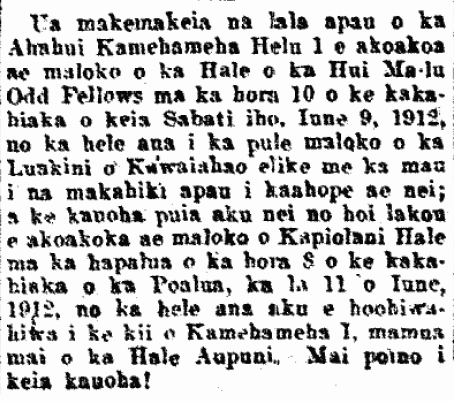
All members of the Ahahui Kamehameha Division 1 are requested to assemble in the Building of the Secret Society, Odd Fellows, at 10 in the morning of this coming Sunday, June 9, 1912, to go on to pray in Kawaiahao Church, as is done in all past years; and they are also ordered to assemble within Kapiolani Hale at half past 8 on the morning of Tuesday, the 11th of June, 1912, to go and decorate the statue of Kamehameha I in front of the Government Building. Do not forget this order!

(Kuokoa, 6/7/1912, p. 8)

Ua makemakeia na lala apau...

Ka Nupepa Kuokoa, Buke XLVIII, Helu 23, Aoao 8. Iune 7, 1912.

Keaunui family history, 1874.

[Found under: “Local News”]

On the 22nd of April, the King spoke at Lanakila Church in Hauula, and at the end of his royal speech, Keaunui brought his youngest daughter before the King; the King kissed the small girl, and the King asked, “Is this your daughter?” Keaunui said, “Yes, she is mine, her mother is over there, she is pregnant again.” The King responded, “When she gives birth, name the baby Kahooululahui,”¹ and the word of the King was agreed to. On the night of the 24th, when the King was in Ewa, at 2 o’clock at night, Mrs. Hellen K. Keaunui gave birth to a son, with J. L. Keaunui, and he was immediately named David Kahooululahui. He was the 13th of their children, they are just a small bit of the growing of the lahui; how blessed would be the nation if all the women from Hawaii to Kauai were like her.

¹”Hooulu Lahui” was Kalakaua’s famed motto, encouraging the increasing of the nation/race.

(Kuokoa, 5/9/1874, p. 2)

Ma ka la 22 o Apr...

Ka Nupepa Kuokoa, Buke XIII, Helu 19, Aoao 2. Mei 9, 1874.

And yet more on Aberahama Kaikioewa Palekaluhi, 1912.

THE ALII HAS GONE, A. K. PELEKALUHI KAIKIOEWA KAMEHAMEHANUI

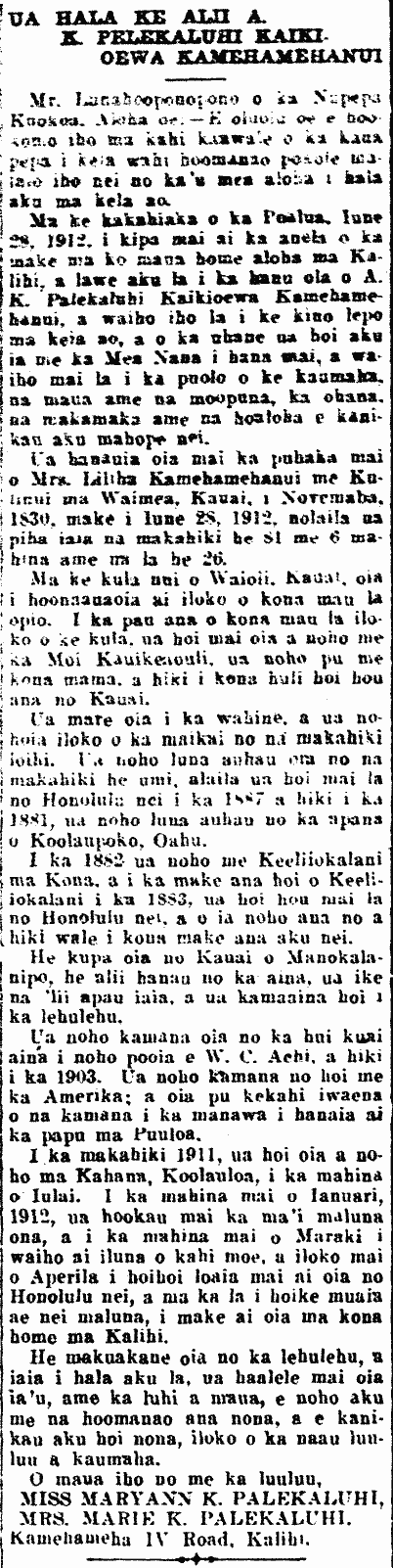
Mr. Editor of the Newspaper Kuokoa. Aloha to you:—Please be so kind as to insert in some open space in our paper, this short remembrance below for my beloved who passed over to that world.

On the morning of Tuesday, June 28 [?], 1912, the angel of death visited our beloved home in Kalihi, and took the living breath of A. K. Palekaluhi Kaikioewa Kamehamehanui, and left his earthly body here in this world, and his soul returned to the One who created it, leaving the bundle of sadness behind for us and the grandchildren, the family, the intimates, and friends to grieve over.

He was born from the loins of Mrs. Liliha Kamehamehanui and Kulinui at Waimea, Kauai, on the 1st of November, 1830, and died on June 28, 1912; therefore, he was 81 years and 6 months, and 26 days old.

He was educated at the college of Waioli, Kauai, in his youth. After his days at that school were over, he returned to live with the King Kauikeaouli; he lived with his mother until he went back to Kauai.

He married his wife, and they lived well for a great many years. He was employed as a tax assessor for ten years and then returned to Honolulu in 1887 [?] until 1881, and was the tax assessor for the district of Koolaupoko, Oahu.

In 1882, he resided with Keelikolani in Kona, and at her death in 1883, he came back to Honolulu and remained there until his recent death.

He was a native of Kauai of Manokalanipo, and a hereditary chief which all the alii knew of and also the general public was familiar with him.

He worked as a carpenter for the real estate company headed by W. C. Achi until 1903. He worked as a carpenter for America, and he was one of the carpenters when the fort at Puuloa was being built.

In 1911, he went back to live at Kahana, Koolauloa, in the month of July. From January 1912, he became ill and in March he was bedridden, and then in April he was brought back to Honolulu, and on the day shown above he died at his home in Kalihi.

He was a father for the multitudes, and with his passing, he leaves me and our child with memories of him, and grieving for him, with a sad and heavy heart.

We with grief,

MISS MARYANN K. PALEKALUHI,

MRS. MARIE K. PALEKALUHI.

Kamehameha IV Road, Kalihi.

(Kuokoa, 7/12/1912, p. 6)

UA HALA KE ALII A. K. PELEKALUHI KAIKIOEWA KAMEHAMEHANUI

Ka Nupepa Kuokoa, Buke XLVIII, Helu 28, Aoao 6. Iulai 12, 1912.

Aberahama Kaikioewa Palekaluhi and the malo of Kaumualii,

See this story about A. K. Palekaluhi’s description of a malo of Kaumualii’s, the king of Kauai, found in Additional Notes on Hawaiian Feather Work: a second supplement by William T. Brigham, in Memoirs of the Bernice Pauahi Bishop Museum of Polynesian Ethnology and Natural History, Vol VII.—No. 1, 1918. pp. 30–39.

I am not sure if this is what is described here at the Bishop Museum.

Even more on Aberahama Kaikioewa Palekaluhi (if it could be read), 1912.

THAT HIGH CHIEF OF THE LAND HAS GONE.

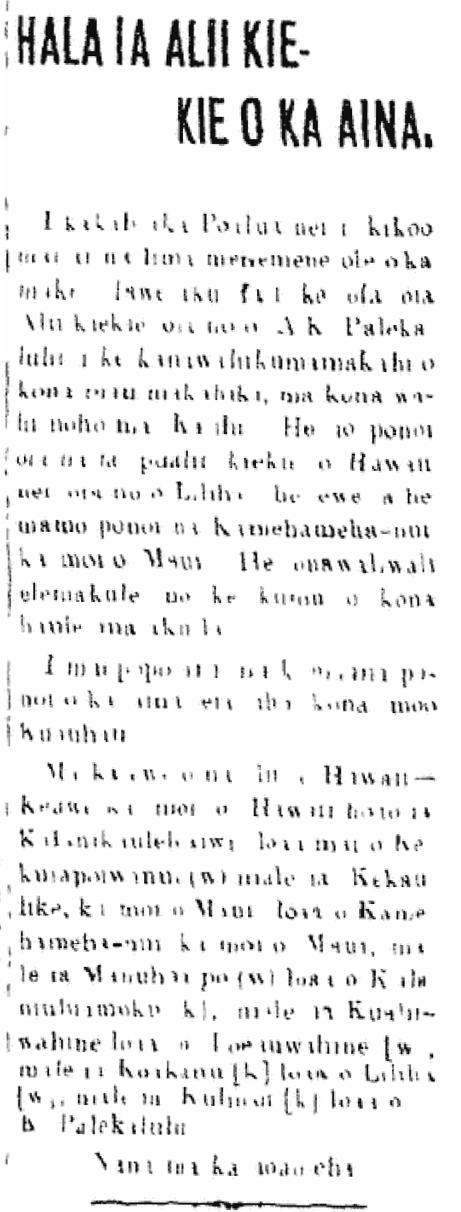
On Tuesday morning the merciless hand of death stretched out and took the life of that high chief, A. K. Palekaluhi at eighty-one years of life, at his residence in Kalihi. He is a true high chiefly descendant of Hawaii, of Liliha, who is of the lineage and a descendant of Kamehameha Nui, the king of Maui. His died because of the infirmities of old age.

To understand @@@@@, here is his genealogy.

In the lineage of the alii of Hawaii—Keawe, the king of Hawaii wed with Kalanikauleleiaiwi and born was Kekuiapoiwanui (f) who married [male] Kekaulike (m), the king of Maui, and born was Kamehameha Nui, the king of Maui, who married Manuhaaipo (f) and born was Kalaniuluamoku (m), who married Kualiiwahine and born was Loeauwahine (f), who married Koakanu (m) and born was Liliha (w) who married Kulinui (m) and born was A. K. Palekaluhi.

See page four.

[If you look below, most of this first column is hard to decipher, and much of the volunteer input would have likely been @@@@@ @@@@@. Hopefully people will think seriously about how much priceless information will be lost if the original newspapers are not clearly photographed before typescripts are done.]

(Kuokoa Home Rula, 5/31/1912, p. 1)

HALA IA ALII KIEKIE O KA AINA.

Kuokoa Home Rula, Buke X, Helu 22, Aoao 1. Mei 31, 1912.

THAT HIGH CHIEF OF THE LAND HAS GONE

From Page One.

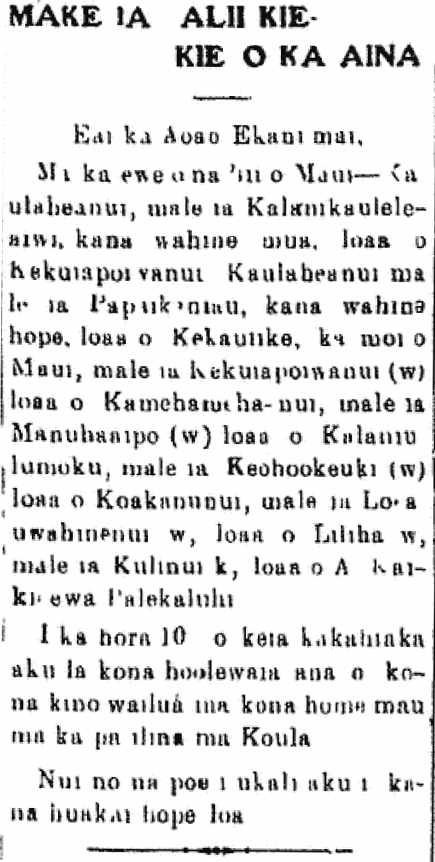
In the lineage of the alii of Maui—Kaulaheanui married Kalanikauleleaiwi, his first wife, and born was Kekuiapoiwanui. Kaulaheanui married Papaikaniau, his following wife, and born was Kekaulike, the king of Maui, who married Kekuiapoiwanui (f), and born was Kamehameha Nui, who married Manuhaaipo (f) and born was Kalaniulumoku who married Keohookeuki (f), born was Koakanunui who married Loeauwahinenui (f), and born was Liliha (f), who married Kulinui (m), and born was A. Kaikioewa Palekaluhi.

At 10 o’clock this morning, was the funeral over his remains at his eternal home at the cemetery at Koula.

There were many people who joined his last procession.

[It is interesting to see how different newspapers have different information in their coverage of the same event!]

(Kuokoa Home Rula, 5/31/1912, p. 4)

MAKE IA ALII KIEKIE O KA AINA

Kuokoa Home Rula, Buke X, Helu 22, Aoao 4. Mei 31, 1912.