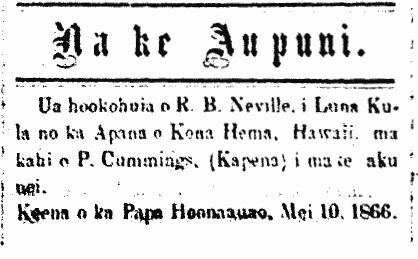
The beginnings of Kamehameha Schools, 1884.

Kamehameha School.

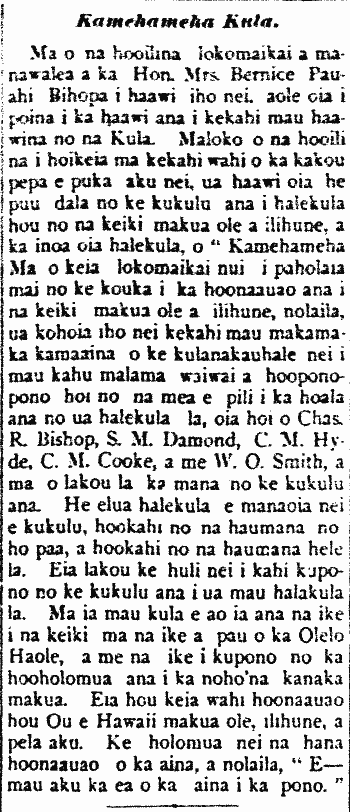
By way of the kind and generous endowment given by the Hon. Mrs. Bernice Pauahi Bishop, she did not forget to make contributions for Schools. Amongst the heirs shown in one of our papers published earlier, she gave a sum of money to build a new schoolhouse for children with no parents or who are indigent, and the name of the school is to be Kamehameha. By this great kindness extended to help in the education of orphan and indigent children, several familiar friends of this town were recently selected as trustees and administrators pertaining to the establishing of said school, that being Charles R. Bishop, S. M. Damon, C. M. Hyde, C. M. Cooke, and W. O. Smith; and with them lies the power to build. Two schools houses are being considered to be built: one for the boarders, and one for the day school students. They are now searching for a suitable place to build the buildings. In those schools, knowledge will be taught to the children in all facets of the English language, as well as learning that will be helpful for advancement in their adult life. Here is your new place of learning, O Hawaiians who are without parents, who are indigent, and so forth. Education in this land is progressing, and therefore, “Let the life of the land live on in righteousness.”

(Kuokoa, 11/8/1884, p. 2)

Kuokoa_11_8_1884_2.png

Ka Nupepa Kuokoa, Buke XXIII, Helu 45, Aoao 2. Novemaba 8, 1884.


Chorus at Kamehameha, 1889.

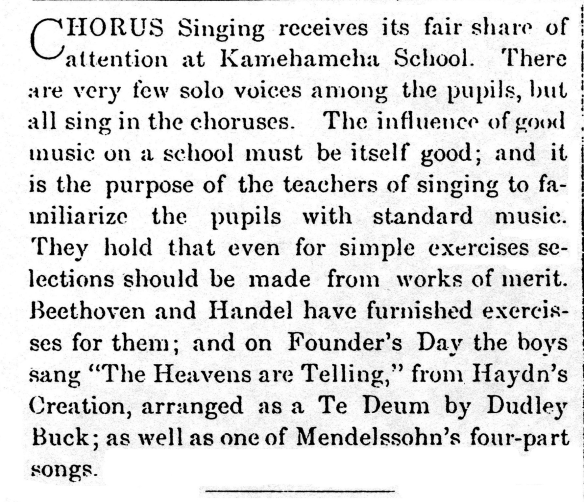
Chorus Singing receives its fair share of attention at Kamehameha School. There are very few solo voices among the pupils, but all sing in the choruses. The influence of good music on a school must be itself good; and it is the purpose of the teachers of singing to familiarize the pupils with standard music. They hold that even for simple exercises selections should be made from works of merit. Beethoven and Handel have furnished exercises for them; and on Founder’s Day the boys sand “The Heavens are Telling,” from Hayden’s Creation, arranged as a Te Deum by Dudley Buck; as well as one of Mendelssohn’s four-part songs.

(Handicraft, 1/1883, p. 3)

Handicraft_1_1889_3.png

Handicraft, Volume 1, Number 1, Page 3. January 1889.

American sailors are taught Hawaiian history, 1925.

PLAYS ABOUT KING KAUIKEAOULI.

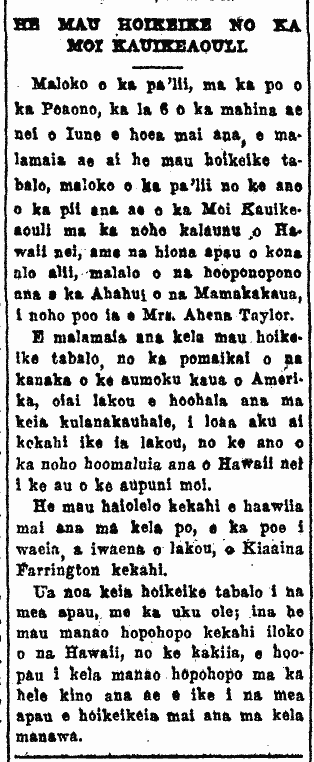
In the grounds of the palace on the night of Saturday, the 6th of this coming June, there will be pageants put on in the palace grounds pertaining to the rise of King Kauikeaouli  to the throne of Hawaii nei along with the appearance of his entire royal court; this will be arranged by the Mamakakaua Society headed by Mrs. Ahuena Taylor.

The pageant will be held for the benefit of the men of the fleet of American warships while they are spending time in this town, so that they obtain some knowledge of the nature of the governing of Hawaii nei i the time of the kingdom.

There will also be speeches presented that night by selected people, and amongst them is Governor Farrington.

This performance will be open to all, without charge; and if there are concerns amongst the Hawaiians that they will be charged, put an end to your worries by going down and witness everything that will be shown at that time.

(Kuokoa, 5/28/1925, p. 2)

Kuokoa_5_28_1925_2

Ka Nupepa Kuokoa, Buke LXIV, Helu 22, Aoao 2. Mei 28, 1925.

Kamehameha School’s “Handicraft,” 1889.

HANDICRAFT.

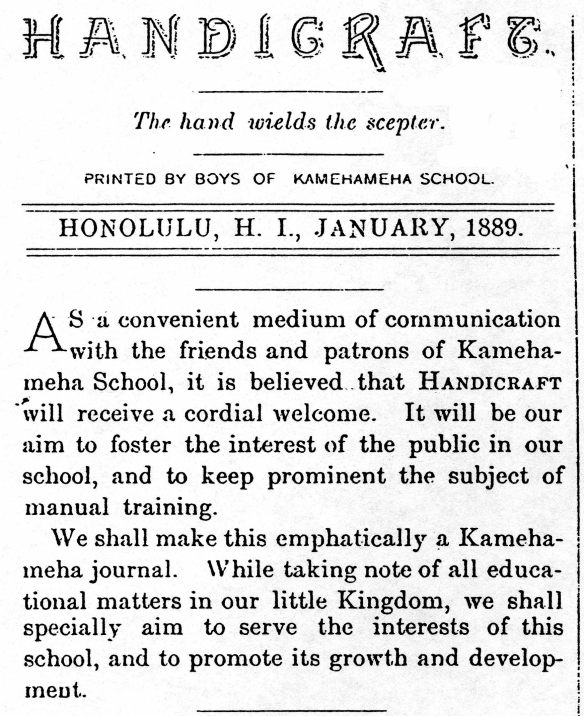
The hand wields the scepter.

PRINTED BY BOYS OF KAMEHAMEHA SCHOOL.

HONOLULU, H. I., JANUARY , 1889.

As a convenient medium of communication with the friends and patrons of Kamehameha School, it is believed that Handicraft will receive a cordial welcome. It will be our aim to foster the interest of the public in our school, and to keep prominent the subject of manual training.

We shall make this emphatically a Kamehameha journal. While taking note of all educational matters in our little Kingdom, we shall specially aim to serve the interests of this school, and to promote its growth and development.

[The priceless issues of the Handicraft are just one of the many cool items from Kamehameha Schools’ history found on their Archives page.]

(Handicraft, 1/1889, p. 2)

Handicraft_1_1889_2.png

Handicraft, Volume I, Number 1, Page 2. January 1889.

Kalihi fire, 1889.

The glowing fire on the Kalihi mountains Thursday night Feb. 21, was caused by workmen burning off the grass on the site of the new reservoir in the upper Nuuanu Valley. The fire could easily have been controlled in the first instance. As it was, it was allowed to run up a narrow ridge, and thence to spread along the flanks of the mountain until it became an extensive conflagration, destroying many vigorous young koa trees and persistently working itself down into the valley. On Friday morning, two teachers and about twenty of the largest boys in the Kamehameha School went up to the fire and after a vigorous battling with the dense smoke succeeded in hemming in the fire, and finally subdued it. The utmost care in such a dry season should be used in preventing the setting, much more the spreading, of fire in the grass and bushes above Honolulu. A few such fires would make it unnecessary to build extra reservoirs.

(Handicraft, 2/1889, p. 3)

Handicraft_2_1889_3.png

Handicraft, Volume I, Number 2, Page 3. February 1889.

Sarai Hiwauli, 1856.

BIOGRAPHY OF S. HIWAULI II.

Sarai Hiwauli was born in Kahaluu, Koolaupoko, after the great plague here on Oahu during the time of Kamehameha I, and she was taken to Hilo, Hawaii to be raised, along with her parents and her kupuna; from Hopuola and Kalimahauna came Hiwauli, from Kahili and Napolo came Hopuola, from Kahiko and Kuanuuanu came Kahili, from Keaweikekino and Iliholo came Kahiko, from Hoou and Kamaiki came Keaweikekino, from Mahiopupelea and Kapaiki came Hoau, from Kanaloauoo and Kapulaiolaa came Kapaihi, from Kahoanokapuokuihewa and Kapahimaiakea came Kapuleiolaa, from Loheakauakeiki and Kalaniheliikauhilonohonua came Kahoanokapuokuihewa, from Kauhealuikawaokalani and LonowahineikahaleIkiopapa came Kalaniheliikauhilonohonua, from Kaholipioku and Moihala came LonowahineikahaleIkiopapa, from Lonoapii and Piilaniwahine came Moihala, and so on. Continue reading

Sweet article on the 80th birthday of Pilipo Haae, 1940.

80 Years Old

(PILIPO HAAE)

The picture placed above is of one of the kamaaina of Kona of the horizon clouds in the calm, and the land famed for the Tail of the Manini [ke Pewa a o ka Manini],¹ that being Phillip Haae who just made 80 years old on the 23rd of June, A. D. 1940.

Pilipo Haae was born in Kealia Kai, South Kona, Hawaii, on the 23rd of June, A. D. 1860.

When he was six years old, he went to the school at Hookena, and Mr. D. H. Nahinu was his first teacher, and after him was Mr. J. E. Namaka. He went to school under this teacher for some years, and his last teacher in Kona was Mr. John Keawehawaii. They were taught in the Hawaiian language, being that during those days, O Hawaii’s Own, it was that the Hawaiian language which fully enveloped you.

While John Keawehawaii served as the teacher, Haae’s classmates and he as well were graduated. This was after the conclusion of the School Testing [Hoike Kula] of all of the Government Schools of South Kona which took place at the church of Honaunau.

In the month of August, the children of the Hookena school were considered for matriculation into Lahainaluna. The children were told, they being Geresoma Waiau, John Nahinu, and Phillip Haae. When he found out that he was one of the children to enter Lahainaluna School, his parents prepared what was necessary for him to go to school. When this was ready, and when the day came for his boat to leave, he got on. The Kilauea was the ship during those days.

When it reached Maui, and the ship stopped there, he got off on land. When the ship got to the dock, the upperclassmen from Lahainaluna were waiting, being sent to retrieve the new children.

In those days, there were no cars like today, but there were carts pulled by oxen. Their bundles and the fish boxes [? pahu I’a] were placed upon the cart, and we children who were headed to the school went up by foot. The children returning to the school came from Kau, Kona, and Kohala Loko and Kohala Waho. The children were all Hawaiian.

He entered into Lahainaluna School in 1877 in the month of September, and graduated in the month of June in 1883.

There were seven of them in the Senior Class [Papa Ekahi] the year that he graduated, and one of his classmates is still living here in Keaukaha, Hilo, Hawaii, and the two of them regularly get together at Keaukaha when Pilipo Haae comes to Hilo.

He entered into Lahainaluna School, and the Head Instructor [Kumupoo] was Mr. H. R. Hitchcock [H. R. Hikikoki], and T. B. Hascall was the first assistant, and Rev. J. B. Hanaike was the second assistant.

The children were taught in the Hawaiian language by the Hawaiian teacher, Rev. Hanaike, and sometimes they were instructed by the head teacher. Afterwards new assistant teachers came.

English was taught to the students during his later days at Lahainaluna School, but it was difficult for the lips to speak, and the haole understood what was being said when spoken all garbled [paka-ke].

After he graduated, he returned to his land in the month of August, after travelling about with his classmates of “Maui, The Greatest” [Maui No E Ka Oi].

In the month of August, Phillip was assigned by Mr. H. N. Greenwell, the School Agent of North and South Kona, to work as teacher at Ala-e School.

He carried out his assignment. He went to Ala’e School in September, 1883. The road to there was long; 5 miles, the roads of Pinaonao were bad; this along with the very meager pay from his school, just a $1 a day, therefore, he decided to leave the teaching job and to take on the occupation of his ancestors, that being “Farming” and “Fishing,” and so he left his teaching position in the month of May, 1886.

In the month of May, 1884, he was joined in holy matrimony with one of the birds from the uplands, of the lehua drooping with nectar of the birds of Mauliola, Honokaa, South Kona, Hawaii, and in the month of June, 1922, she left on the road of no return.²

The Work He Undertook

He did all sorts of jobs. His last position he held was the Head of the Prison of Hookena, South Kona, Hawaii County, which he held for 15 years.

In his marriage to his wife, they lived together for 38 years, and it was the death of his wife which separated the two of them. Betwixt them, their family garden bore fruit with boys and girls, and from them they have many grandchildren almost reaching seventy.

This perhaps is the true motto of King Kalakaua—”Increase the lahui.”

On this past 23rd of June, his 80th birthday was celebrated. He remains active as ever, and he is very good at numbers [makaukau loa ma na huahelu], and is pleasant to talk to, and is full of funny things to say.

He is one of our readers of the Hoku o Hawaii, and is an expert at seeking veiled information [as in riddles], and he is known by the pen names, “Kahi Koa Polani” and “Pohakuopele.”

We pray as well that he is given more birthdays to come.

¹A reference to the bay, Kapewaokamanini in Kona.

²Kahulaleaokeakealani, daughter of S. M. Paauhau was born on June 14, 1867 and died June 7, 1922.

[Just plain wow.]

(Hoku o Hawaii, 9/25/1940, p. 2)
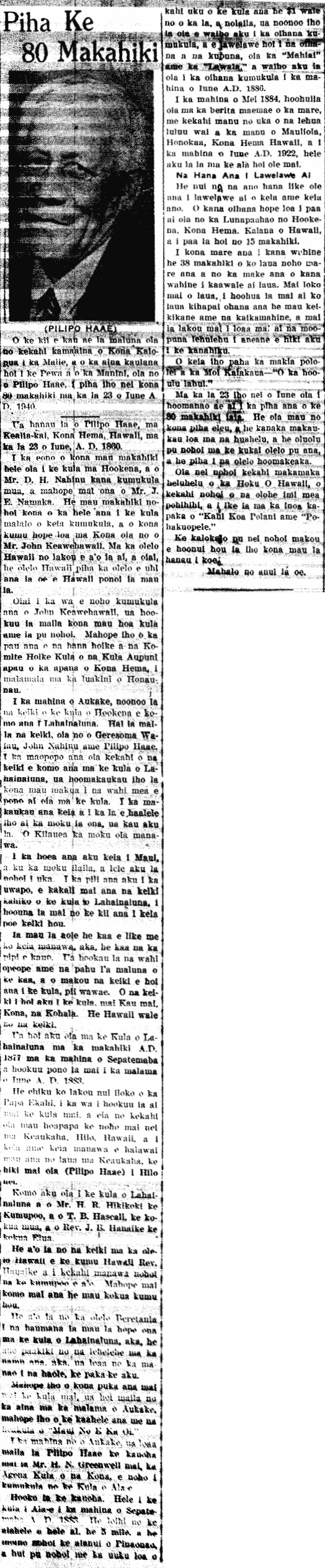
Piha Ke 80 Makahiki

Ka Hoku o Hawaii, Volume XXXV, Number 22, Aoao 2. Sepatemaba 25, 1940.