Napua Stevens back home, 1938.

CAME BACK HOME

The picture above is a picture of that kamaaina girl of Hilo nei, Miss Harriet Napua Stevens, formerly of Hilo and who is now staying in Honolulu and heard nightly at the Young Hotel [Hokele Iana] singing with the Band of Giggi Royce [Gigi Royce] of Honolulu. Continue reading

Hilo Hawaiian Civic Club’s Annual Holoku Ball, 1941.

HOLOKU
BALL

Sponsored by

Hawaiian Civic Club

Scholarship Fund

featuring

CLARA INTER

(HILO HATTIE)

Hilo Hotel —Hilo Armory

April 5, 1941

(Hoku o Hawaii, 4/2/1941, p. 4)

HOLOKU BALL

Ka Hoku o Hawaii, Volume XXXV, Number 49, Aoao 4. Aperila 2, 1941.

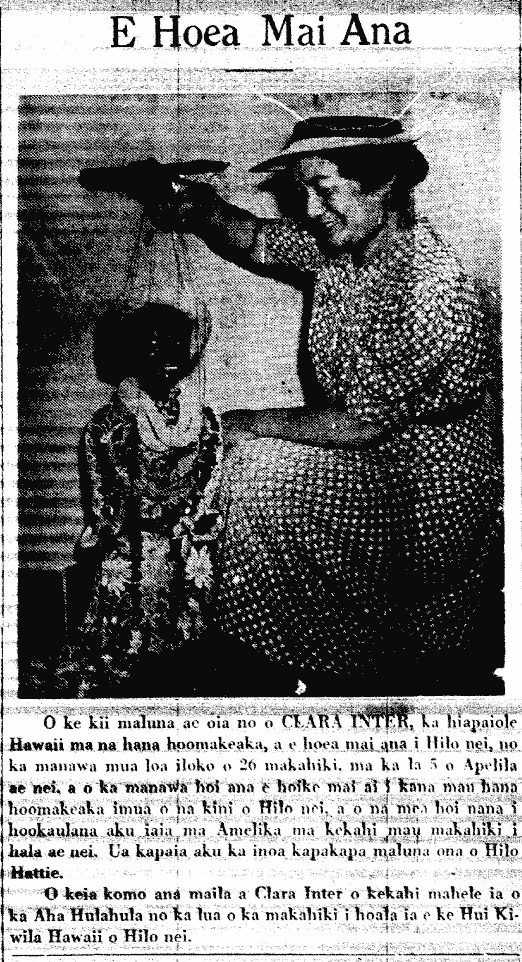
Hilo Hattie on her way to Hilo, 1941.

On Her Way

The picture above is of CLARA INTER, the Hawaiian champion of comedy, and she is coming to Hilo nei, for the first time in 26 years, on the 5th of this coming April; and this is when she will be showing her humor before the people of Hilo, and what she was made famous for in America some years ago. She is nicknamed Hilo Hattie.

Clara Inter is part of a Dance [Holoku Ball] put on for the second year by the Hawaiian Civic Club of Hilo [Hui Kiwila Hawaii o Hilo].

(Hoku o Hawaii, 3/26/1941, p. 1)

E Hoea Mai Ana

Ka Hoku o Hawaii, Volume XXXV, Number 48, Aoao 1. Maraki 26, 1941.

Shirley Temple in Hawaii, 1935.

SHIRLEY TEMPLE IS IN HONOLULU

On the morning of this past Monday, July 29, aboard the steamship Mariposa arrived Shirley Temple and her parents, Mr. and Mrs. George Temple. There were nearly 10,000 citizens of Honolulu who arrived early makai of the pier to see for themselves this famous girl in the movies [? oleana kiionioni]; and she is only 6 years old. She came to Honolulu nei to vacation for 18 days. They are staying at the Royal Hawaiian Hotel.

(Hoku o Hawaii, 8/6/1935, p. 2)

AIA I HONOLULU O SHIRLEY TEMPLE

Ka Hoku o Hawaii, Buke XXVII, Helu 7, Aoao 2. Augate 6, 1935.

Princess Kaiulani celebrates the new year in Waimea, 1899.

New Year’s Celebration in Waimea.

The people of Waimea held a Happy New Year party at 3 p. m. on this past Tuesday [1/3/1899], at the Courthouse here in Waimea. The table was given honor by the young Princess, Her Highness Kawekiulani Ahilapalapa Kaiulani and her entourage: the honorable ladies and gentlemen of Mana; the ladies of the mountainous land of the Kipuupuu Rain [Waimea]; and the lasso-flicking youth, Paul Jarrett. They ate until full, and drank until satiated of the delicacies of the table—Hape Nu Ia!

On the following night at 7 o’clock, European entertainment was held in the courtroom decorated with palai fronds of the forests, under the direction of an honorable gentleman giving welcome to the esteemed guest, the Wohi Princess, on that night of festivities, along with the other dignified ones accompanying her. In this European entertainment, the honor of the American Nation was paid first to Waimea, by the visit of the Young Alii Kawekiulani, Kawananakoa, Kuhio Kalanianaole, and his wife, along with the attending ladies of the alii for three nights; and it is said of the final night that it was Number 1 and better than Honolulu. According to the witnesses, “Waimea is the best.”

Maunakea.

Waimea, Hawaii, Jan. 5, 1899.

(Makaainana, 1/9/1899, p. 1)

Hoomanao Nu Ia ma Waimea.

Ka Makaainana, Buke XI—-Ano Hou, Helu 2, Aoao 1. Ianuari 9, 1899.

Christmas at Iolani Palace, 1920.

THE PALACE IS AGLOW WITH ELECTRIC LIGHTS.

The trees were bright with electric lights and the minds of the children were amazed, filled with wonder; the singing of Christmas joy and the skits were beautiful as the Christmas tree of the City of Honolulu was lit on the grounds of the capital this past Sunday; and there were thousands of people gathered while the event was held, while they sang along to Christmas carols being sung by choral groups.

The boys of the Kamehameha Schools led the singing along with the girls of the St. Andrews Priory School. Some of the songs sung that night were “Holy Light,” “O, The Little Town of Bethlehem,” a many other beautiful songs were sung. The crowd joined in the singing of the songs they knew, and when they did not know the words, they were silent.

The activities that night were wonderful because of the peace and because the queen of the night shone down her light, being this was a bright moonlit night, with a clear sky an no clouds.

There were skits performed as well, and in these performances to be seen, the crowd could watch the birth of the Lord, the angels blowing their trumpets, the following of the shepherds and the three magi to where the child lay, and their giving of gifts when they saw the child in the manger.

The audience was very appreciative of those who put on the joyous festivities that night, from the singing and so forth to the decorating of the trees with lights.

The words of the songs sung were projected onto a section of cloth so that everyone who could see could read it while the songs were being sung. The singing and the skits that were prepared for that night were wonderful.

(Kuokoa, 12/31/1920, p. 2)

KAULUWELA KA HALEALII I NA KUKUI UWILA.

Ka Nupepa Kuokoa, Buke LVIII, Helu 53, Aoao 2. Dekemaba 31, 1920.

Sun Sun Lau and E. K. Fernandez, 1939.

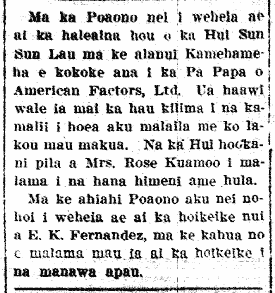
This past Saturday, the new restaurant of the Sun Sun Lau Group was opened on Kamehameha Avenue near the Lumber Yard of American Factors, Ltd. Ice cream was given to children who came with their parents. The band of Mrs. Rose Kuamoo took care of the music and hula performances.

On the previous Saturday evening, the great show of E. K. Fernandez was opened on the grounds where the show is always held.

[For you Hilo people, a little nostalgia…]

(Hoku o Hawaii, 7/5/1939, p. 4)

Ma ka Poaono nei i weheia ae ai...

Ka Hoku o Hawaii, Volume XXXIV, Number 10, Aoao 4. Iulai 5, 1939.

More on the California Midwinter International Exposition from Bila Kanealii, 1894.

The Midwinter Exposition.

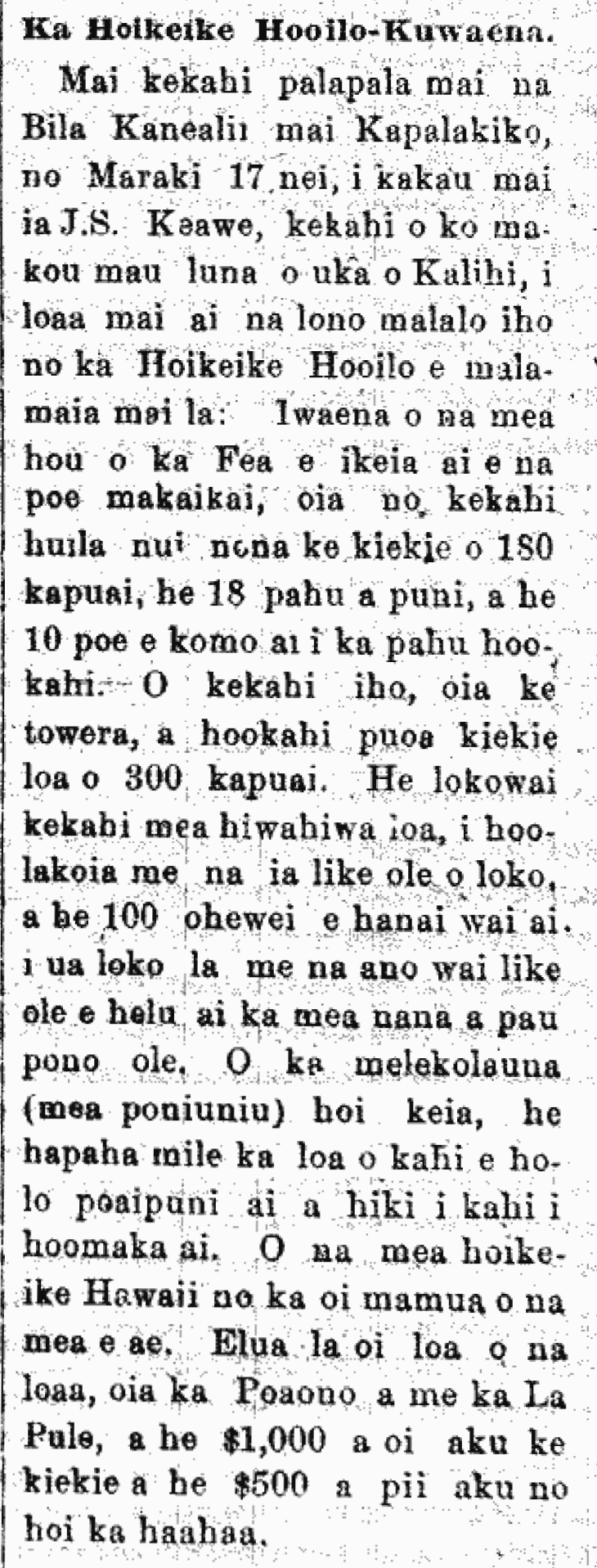
J. S. Keawe, one of our officers in the uplands of Kalihi writes that he received the news below about the Winter Exposition being held, from a letter of March 17th by Bill Kanealii from San Francisco: From amongst the new things at the Fair to be seen by the visitors, there is a huge wheel that is 180 feet tall with 18 boxes all around, with each box holding 10 people. Another is the tower with a very tall steeple 300 feet high. The lake is another thing of high esteem; it is stocked with all sorts of fish, with 100 pipes feeding water into the lake with all kinds of water, so many that the visitor would not be able to count them all. The merry-go-round [melekolauna] (a thing that spins), is a quarter mile long travelling around until reaching the place where it starts from. The Hawaii display is the best of all. There are two days that the proceeds are the highest, that being Saturdays and Sundays, where $1,000 or more is the most and $500 or more is the least.

(Makaainana, 4/2/1894, p. 3)

Ka Hoikeike Hooilo-Kuwaena.

Ka Makaainana, Buke I—-Ano Hou, Helu 14, Aoao 3. Aperila 2, 1894.

Hula and King Kalakaua’s 50th Jubilee, 1886.

THE LUAU FEAST AT THE PALACE GROUNDS.

Nov. 23, 1886.

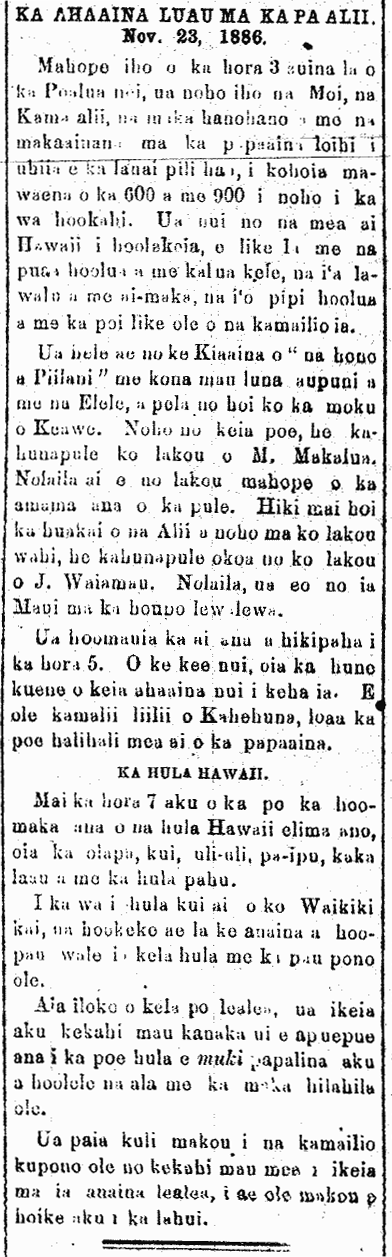
After 3 o’clock in the afternoon of this Tuesday, the King, the Princes and Princesses, the dignitaries, and the makaainana sat at a long table housed by a pavilion with corrugated iron roofing [lanai pili hao], which could sit an estimated 600 to 900 people at a time. There was much Hawaiian foods supplied, like laulau [puaa hoolua] and roasted pork [puaa kalua kele]; fish wrapped in ti leaves and baked [lawalu] and raw [ai-maka]; baked beef [i’o pipi hoolua] and all types of poi spoken of.

The Governor of the “bays of Piilani”¹ as well as his government officials and Delegates, along with those of the island of Keawe.² These people sat along with their pastor, M. Makalua. They began eating after the prayer was over. The entourage of the King and Queen arrived and sat in their area, and they had their own pastor, J. Waiamau. Therefore, Maui was victorious over their hunger [?? Nolaila, ua eo no ia Maui ma ka houpo lewalewa].

The eating continued perhaps until 5 o’clock. A big problem was the dearth of waiters for the grand feast that was boasted about. Thanks to the small children of Kahehuna [School], there were those to serve the food for the feast.

HAWAIIAN HULA.

From 7 o’clock in the night, Hawaiian hula of five types commenced, that being olapa, kui, uli-uli, pa-ipu, kaka laau, and hula pahu.

When those of Waikiki kai danced their hula kui, the audience complained, and that hula was put to an end without ending properly.

During that joyful night, some youths were seen attempting to get the dancers to kiss their cheeks, and to [?? hoolele na ala] without any sign of shame.

We were deafened by all the improper talk of some of the things seen in that partying crowd that we will not agree to tell the nation.

¹The governor of Maui was John Owen Dominis.

²The governor of Hawaii was Virginia Kapooloku Poomaikelani

(Ko Hawaii Pae Aina, 11/27/1886, p. 4)
KA AHAAINA LUAU MA KA PA ALII.

Ko Hawaii Pae Aina, Buke IX, Helu 48, Aoao 4. Novemaba 27, 1886.

Early movies of Hawaii, 1913.

THE PARADE ON WASHINGTON’S [BIRTH]DAY WILL BE FILMED

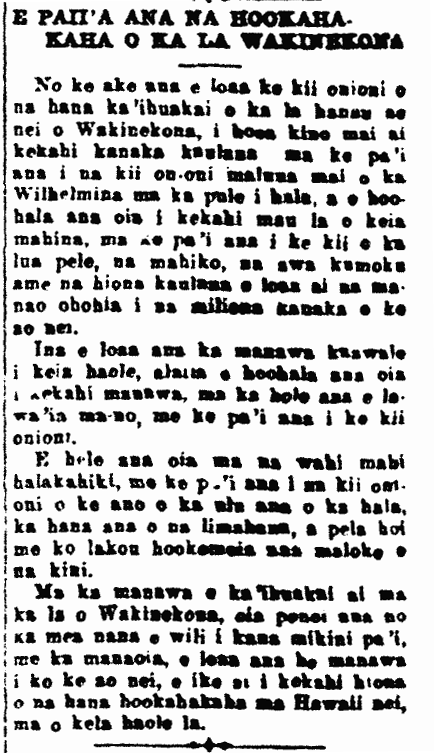
Because there is a desire to have a movie of the parade on this upcoming birthday of Washington, a man famous for filming movies arrived aboard the Wilhelmina last week, and he is spending some days of this month filming the volcano, the sugar plantation, the harbors, and famous sights to delight the millions of people of the world.

If this haole has spare time, he will spend some time going shark fishing, and filming it.

He will go to the pineapple plantations, and film the growth of the pineapple, the activities of the laborers, as well as the canning.

During the parade on Washington’s birthday, he will be the one rolling his film; and it is believed that there will come a time when the world will see scenes of the parade in Hawaii because of this haole.

[Anyone know who this is, and where these reels might be today?]

(Kuokoa, 1/31/1913, p. 7)

E PAII'A ANA NA HOOKAHAKAHA O KA LA WAKINEKONA

Ka Nupepa Kuokoa, Buke XLIX, Helu 5, Aoao 7. Ianuari 31, 1913.