The latest from Kalawao, 1909.

News From the Land of the Suffering.

To the Editor of the Aloha Aina Newspaper, Aloha:

Please allow my small parcel a space in your newspaper which is greatly enjoyed, and that is what is down below; let the paper take it proudly around so that our multitudes of friends may see.

Movies come regularly every Wednesday, and are shown on the evenings of Wednesday, Thursday, and Friday; and every Saturday in Honolulu. There has been a building erected for the patients to watch the movies. The patients are thrilled. They donated money to buy a first-class phonograph [pahu olelo]. They are very happy with singing, the sweet sound of the strings and the blare of the brass instruments.

There was an announcement made to the ones without the sickness or those partially afflicted that wanted to be examined by the Doctors who are coming into the settlement.

Some went to sign up, and some just looked on because they did not want to go back to where they came from, being there might be difficulties waiting ahead for them. And because of the small number of those going to sign up, the Superintendent of the settlement ordered someone to go to the houses to sign people up; the total of those people number 58, but I don’t have their names; the only names I have are those who went to sign up, and they number 55, along with their doctor.

THE PEOPLE WHOSE DOCTOR IS DR. WAYSON

[Names difficult to make out.]

THE PEOPLE WHOSE DOCTOR IS DR. GOODHUE.

The Men

[Names difficult to make out.]

The Women

[Names difficult to make out.]

The total number told to the writer is 108. This includes the people chosen by the Legislature [?]

With much aloha for my Lahui.

Sincerely,

S. K. MAIALOHA.

Kalawao, Molokai, Aug. 2, 1909

[Here is just another example of why the original newspapers need to be reshot clearly before the acid in the paper consumes all of the words, leaving us with crumbs…]

(Aloha Aina, 9/4/1909, p. 3)

Na Mea Hou o ke Kahua Ma'i.

Ke Aloha Aina, Buke XIV, Helu 36, Aoao 3. Sepatemaba 4, 1909.
More on E. K. Rose, Prince Lei Lani, 1924.

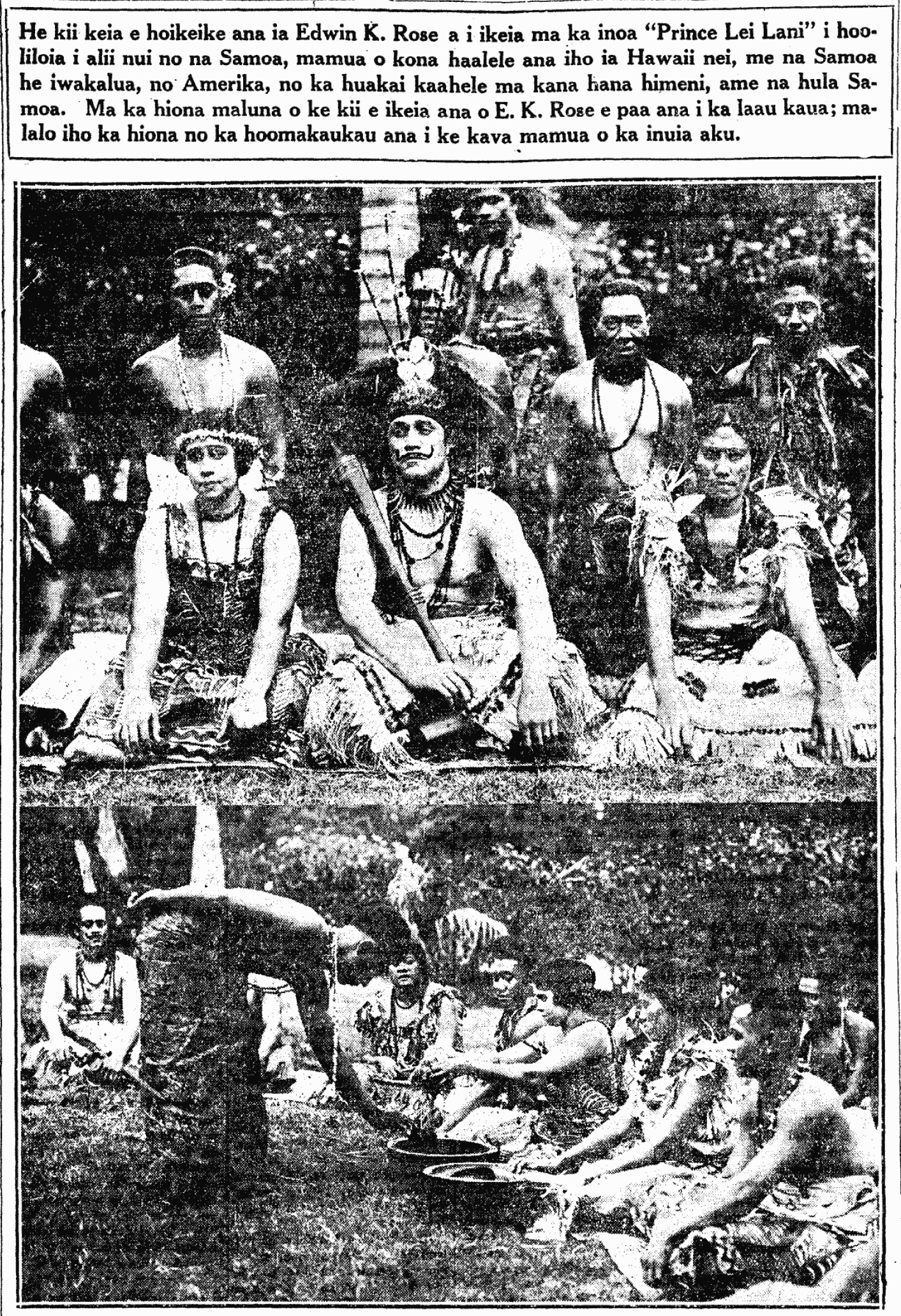
This is a picture showing Edwin K. Rose known by the name “Prince Lei Lani,” who was made a high chief of the Samoans, before he left Hawaii nei with twenty Samoans for America on a singing and Samoan dancing tour. In the scene on the top picture seen is E. K. Rose holding a war club; and below is a scene showing the preparation of kava before it being drunk.

(Kuokoa, 7/24/1924, p. 2)

He kii keia e hoikeike ana ia Edwin K. Rose...

Ka Nupepa Kuokoa, Buke LXIII, Helu 30, Aoao 2. Iulai 24, 1924.

Patients of the leprosy settlement present gift to the Waipa Trio, 1922.

Presented by the Patients of Molokai

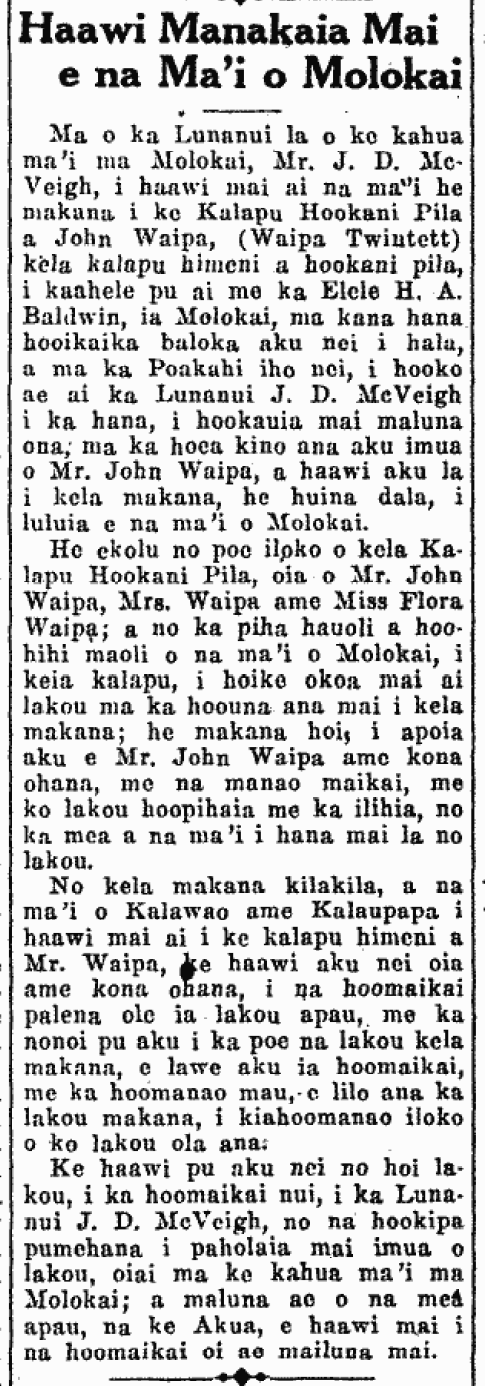
By way of the director of the leprosy settlement on Molokai, Mr. J. D. McVeigh, the patients gave a gift to the Band of John Waipa (The Waipa Twintett) [Waipa Trio]; that singing and musical group that travelled with Representative H. A. Baldwin, to Molokai, in his effort to increase voting; and on this past Monday, Director J. D. McVeigh carried out the duty given to him, by him appearing before Mr. John Waipa and presenting him with this gift, a sum of money donated by the patients of Molokai.

There are three people in that band: Mr. John Waipa, Mrs. Waipa, and Miss Flora Waipa; and because of the great joy and admiration that the patients had in the band, they showed this through the sending of this present; the gift was grasped by Mr. John Waipa and his family with pleasure, and they were filled with awe at this act done for them by the patients.

For this esteemed gift given by the patients of Kalawao and Kalaupapa to the singing group of Mr. Waipa, he and his family extend the endless appreciation to all of them, along with their request to all those who gave the gift, to accept their thanks and to always remember that their gift will be something for them to remember throughout their lives.

They also give their great appreciation to Director J. D. McVeigh for the warm hospitality extended to them while they were at the settlement on Molokai; and above all else, it is God who gives his highest blessings from above.

(Kuokoa, 4/28/1922, p. 1)

Haawi Makanaia Mai e na Ma'i o Molokai

Ka Nupepa Kuokoa, Buke LXI, Helu 17, Aoao 1. Aperila 28, 1922.

Another Hawaii Theater Ad, 1920.

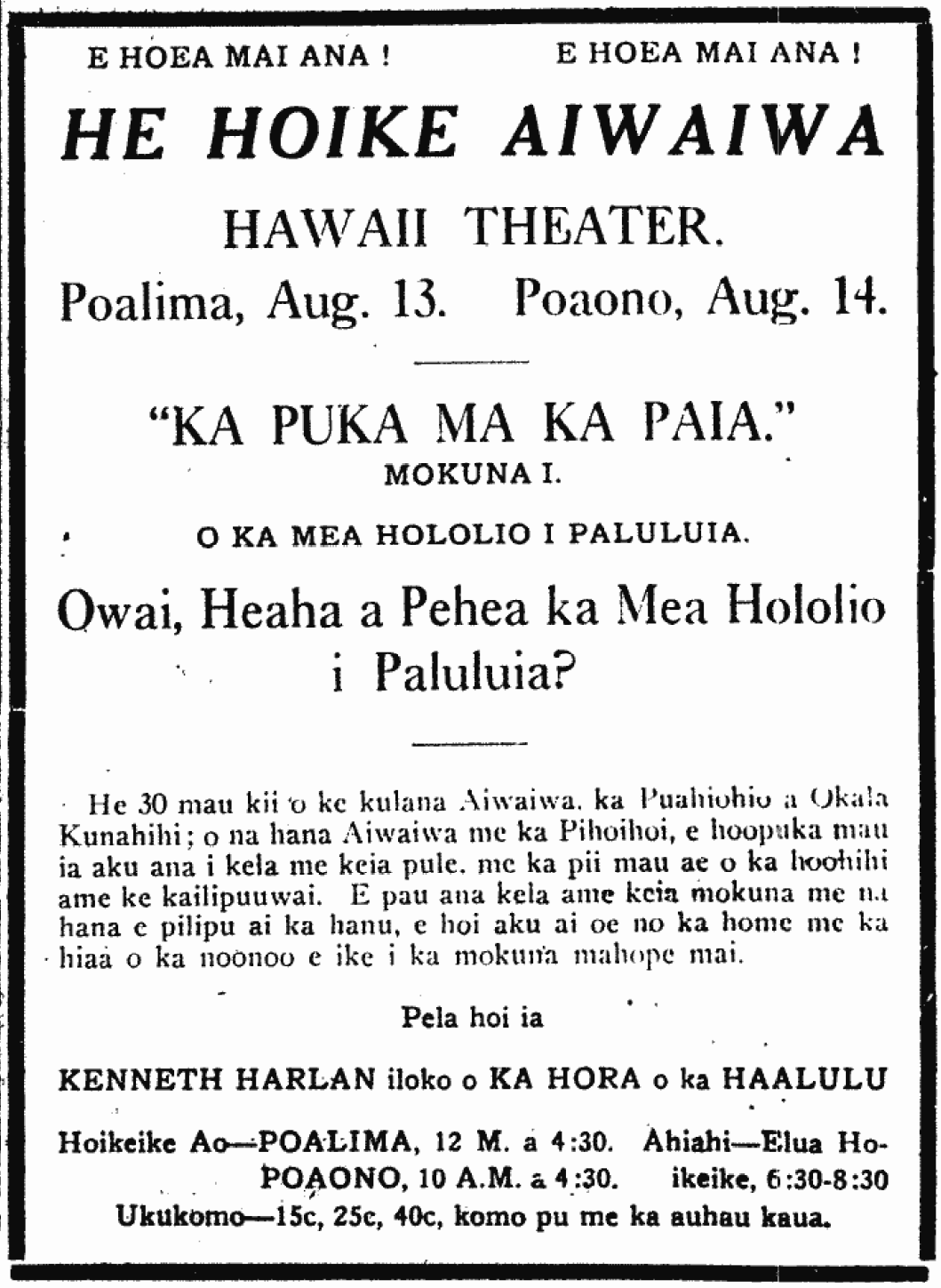
COMING! COMING!

AN AMAZING PERFORMANCE

HAWAII THEATER.

Friday, Aug. 13  Saturday, Aug. 14.

“THE HOLE IN THE WALL.”

EPISODE I.

THE MASKED RIDER.

Who, What and How is the Horseman Masked?

There are 30 films that are Amazing, with Fast Action [Puahiohio?] and Chicken skin; the amazing and astonishing acts will be shown weekly, ever increasing in fascination and emotion. Each episode will end with something that will leave you having a hard time breathing, and you will return home unable to sleep thinking about seeing the coming episode.

So too of

KENNETH HARLAN in THE TREMBLING HOUR

Matinees—FRIDAY, 12 M. and 4:30. Evening—Two Showings, 6:30-8:30.

SATURDAY, 10 A. M. and 4:30.

Entrance—15c, 25c, 40c, including war tax [auhau kaua].

[The things you can find on the internet these days! See here for more information on this movie, and a clip!!]

(Kuokoa, 8/13/1920, p. 3)

E HOEA MAI ANA! E HOEA MAI ANA!

Ka Nupepa Kuokoa, Buke XVIII, Helu 33, Aoao 3. Augate 13, 1920.

Kamehameha Serenaders, 1922.

GRATITUDE FROM THE KAMEHAMEHA SERENADERS.

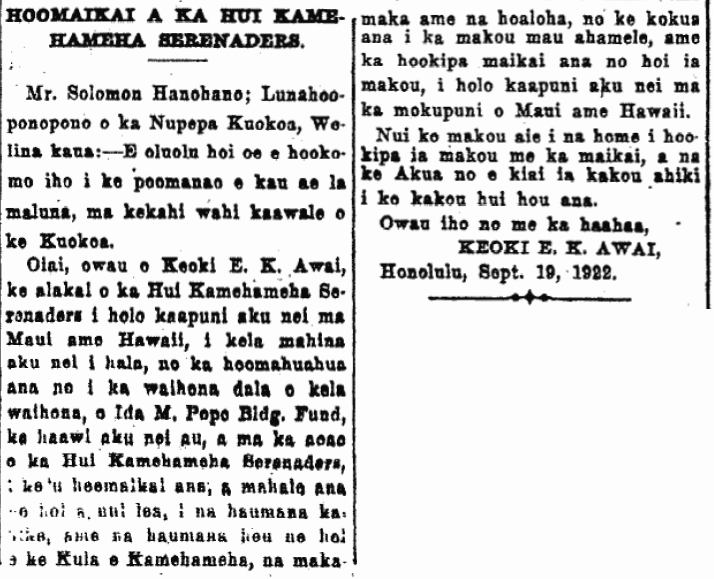
Mr. Solomon Hanohano; Editor of the Kuokoa Newspaper, Greetings:—Please insert this topic above in an open space in the Kuokoa.

Being that I am Keoki E. K. Awai, the leader of the Kamehameha Serenaders which travelled around Maui and Hawaii last month to increase the funds for the Ida M. Pope Bldg. Fund; I give my great appreciation and thanks to the past students and the new students as well of Kamehameha School, and intimates and friends, for their assisting our concerts and for the good care given us while we went around Maui and Hawaii.

We are greatly indebted to the homes which offered us their fine hospitality, and may God watch over us until we meet once again.

Sincerely,

GEORGE E. K. AWAI,

Honolulu, Sept. 19, 1922.

(Kuokoa, 9/21/1922, p. 8)

HOOMAIKAI A KA HUI KAMEHAMEHA SERENADERS.

Ka Nupepa Kuokoa, Buke LXI, Helu 38, Aoao 8. Sepatemaba 21, 1922.

Diamond Kekona passes away in Germany, 1922.

That Hawaiian Boy Dies in Germany

Diamond Kekona Grew Weary of This Life After One Week of Being Ill.

HIS WIFE WAS AT HIS DEATH BED

It was His Wife Who Announced the Sad News to Honolulu nei on Monday

On Monday, this town received the sad news about the death of Diamond Kekona, the son of D. K. Kekona of this town, in Berlin, Germany, on the 13th of last month, February.

It was Mrs. Diamond Kekona, the wife of Kekona, who sent the sad news of the death of her husband to Mekia Kealakai, the leader of the Royal Hawaiian Band [Bana Hawaii], because he was a friend of the young Kekona and his wife when they were all living in London.

A letter was also received by Mr. D. K. Kekona, the father of the young man, confirming the news about the passing of his son.

Diamond Kekona was born on the 6th of October, 1890, so at his death, he was thirty-three years old and some.

Diamond left Honolulu in 1905 for New York, with a group of singers and musicians. He spent many years in America in this occupation.

During the great war of the world, Diamond Kekona was in England, and he enlisted in the service under Britain, going off to war in France and Belgium. He married a British woman and had two children, however the two of them died.

At the end of the war, Mr. and Mrs. Kekona lived in Belgium, and just last year they went to Berlin, Germany, where they met up with Joe Puni, William Kanui, and Joseph Nihali [?]; but according to the letter of Mrs. Kekona, he did not get along with Joe Puni, and they did not talk.

Mr. Kekona was not sick for long before he died, it was just a week; and in the letter his wife wrote to Mr. D. K. Kekona, she told him of her intent to return the body of her husband to London to bury, in her homeland, close to her home.

With the passing of this Hawaiian youth in foreign lands, he left behind, grieving for him: his young British wife; his grandmother, Mrs. Makalohi, who is 91; his father, Mr. D. K. Kekona, working in the sheriff department and a pastor of the Christian Science Church [Hoomana Naauao]; two younger brothers named Hugo and August Kekona; and their sister, Mrs. Lonohira [Mrs. George Lonohiwa]; and a big family.

(Kuokoa, 3/22/1922, p. 1)

Make Ia Keiki Hawaii Maloko o Kelemania

Ka Nupepa Kuokoa, Buke LXI, Helu 12, Aoao 1. Maraki 22, 1922.

Hawaiian Opera, 1925.

Glee Club of Charles E. King

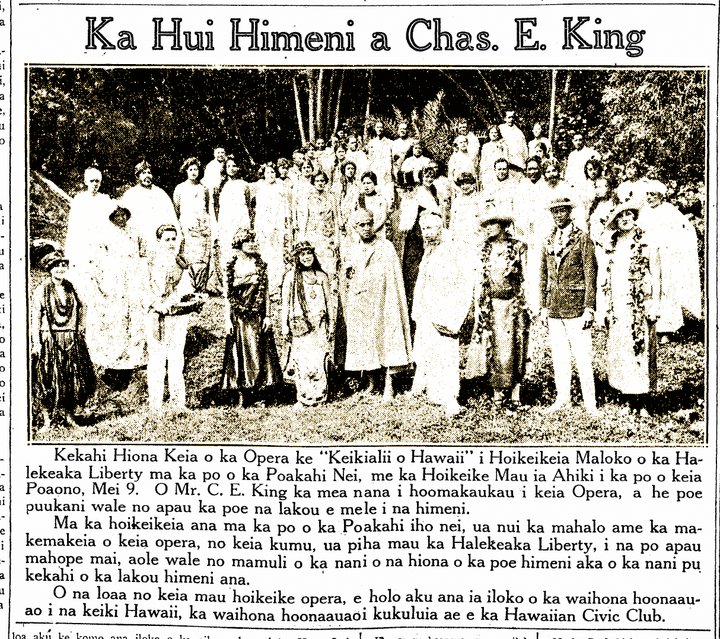
This is a scene from the Opera “Prince of Hawaii” presented at the Liberty Theater on the night of Monday last, continuing its performance until the night of Saturday, May 9. Mr. C. E. King put together this Opera, and there are only talented singers who perform the songs.

There was much lauding of the performance of Monday night, and for that reason, Liberty Theater has been full every night since–not just for the beautiful appearance of the singers, but also because of the beauty of their singing.

The proceeds of this opera will go to funding the education of Hawaiian children; for a scholarship set up by the Hawaiian Civic Club.

[I’m not much into opera, but I still would like to have witnessed this first hand!]

(Kuokoa 5/7/1925, p.1)

Ka Hui Himeni a Chas. E. King

Ka Nupepa Kuokoa, Buke LXIV, Helu 19, Aoao 1. Mei 7, 1925.

More plays! 1925.

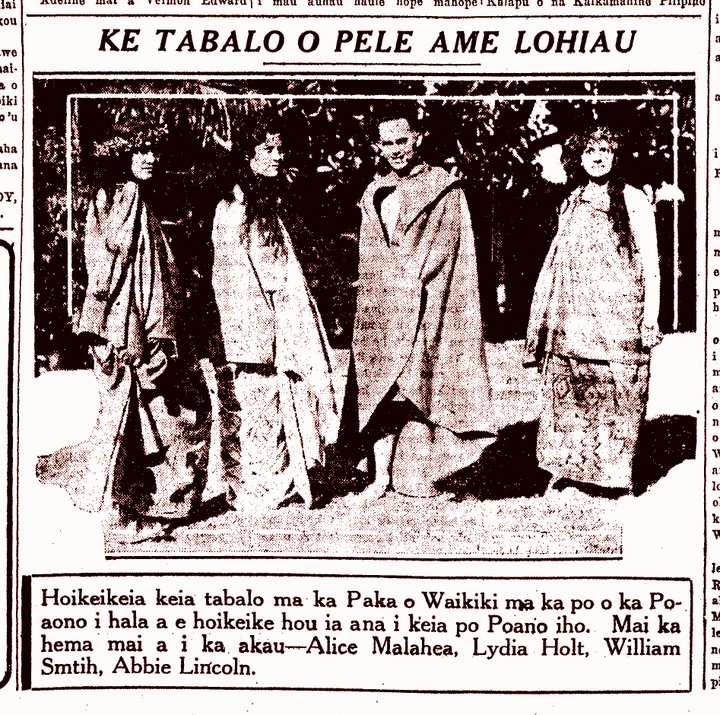
TABLEAU OF PELE AND LOHIAU

This play was shown at Waikiki Park on this past Saturday, and will be shown again on this Satrday night. From the left to the right—Alice Malahea, Lydia Holt, William Smith, Abbie Lincoln.

[This is another i wish i could have seen! This is a repost from the abandoned Hoolaupai Facebook page of times past. I like the format of http://nupepa-hawaii.com because it is very easily searched!]

(Kuokoa, 5/21/1925, p. 5)

KE TABALO O PELE AME LOHIAU

Ka Nupepa Kuokoa, Buke LXIV, Helu 21, Aoao 5. Mei 21, 1925.

This must have been some show, 1912.

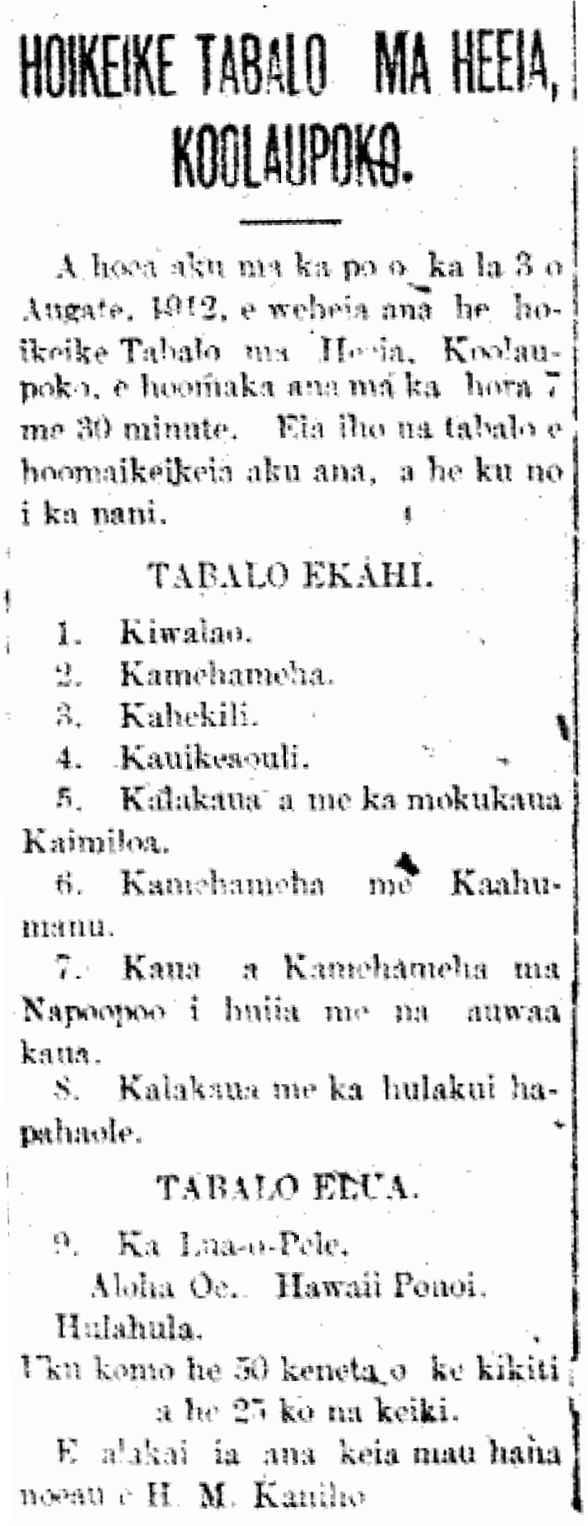
PAGEANT AT HEEIA, KOOLAUPOKO.

With the arrival of the night of the 3rd of August, 1912, a Pageant will be performed at Heeia, Koolaupoko, beginning at 7:30. Here are the scenes that will be shown, and it will be beautiful.

FIRST TABLEAU.

1. Kiwalao.

2. Kamehameha.

3. Kahekili.

4. Kauikeaouli.

5. Kalakaua and the warship Kaimiloa.

6. Kamehameha and Kaahumanu.

7. Battle of Kamehameha at Napoopoo along with the war fleet of canoes.

8. Kalakaua and the hapa haole hula ku’i.

SECOND TABLEAU.

9. The crater of Pele.

Aloha Oe. Hawaii Ponoi.

Western Dancing [Hulahula].

Entrance, 50 cents a ticket, and 25 for children.

This masterful undertaking will be lead by H. M. Kaniho.

(Aloha Aina, 7/27/1912, p. 4)

HOIKEIKE TABALO MA HEEIA, KOOLAUPOKO.

Ke Aloha Aina, Buke XVII, Helu 30, Aoao 4. Iulai 27, 1912.


Tarzan ad, 1919.

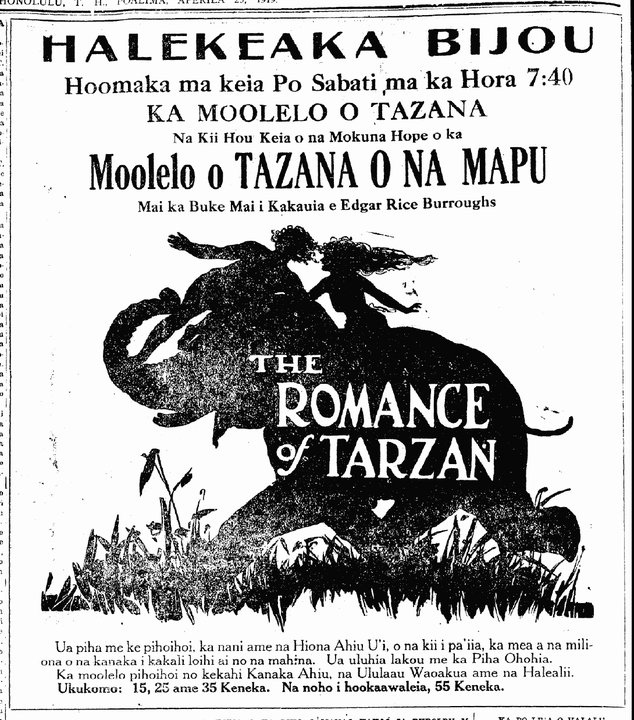
BIJOU THEATRE

Starting this Sunday Night at 7:40

THE STORY OF TARZAN

These are Pictures From the Last Chapters of the

Story of TARZAN OF THE APES

From the Book by Edgar Rice Burroughs

THE ROMANCE OF TARZAN

Filled with excitement, magnificence, and Wild Beauty; the images taken are what millions of people have been awaiting for months. They are overcome with total fascination.

The thrilling story of a Primitive Man, Jungle Wilds, and Palaces.

Entrance fee: 15, 25, and 35 Cents. Reserved seating: 55 Cents.

[Chronicling America does not have any Honolulu papers up yet for this year, so here is a similar ad printed in The Garden Island, 5/27/1919, p. 3.]

(Kuokoa 4/25/1919, p. 2)

HALEKEAKA BIJOU

Ka Nupepa Kuokoa, Buke LVII, Helu 17, Aoao 2. Aperila 25, 1919.