Bumper crop of mangos, 1868.

[Found under: “NU HOU KULOKO: Oahu.”]

Mango Fruit.—The past days, and these days as well, a lot [makena wale] of this delicious fruit is seen often at the markets and on the street sides of this town, but other fruits are very rare. We have seen thirty or more or less being sold for an eighth of a dollar [hapawalu], but it was not so recently when there wasn’t any; at that time at the Chinese stores it was six or ten for an eighth of a dollar. Those who crave mango are saved these days, and the adults and children peel them as they walk about the streets; and much is the diarrhea.

(Kuokoa, 8/8/1868, p. 2)

Kuokoa_8_8_1868_2.png

Ka Nupepa Kuokoa, Buke VII, Helu 32, Aoao 2. Augate 8, 1868.
J. E. Chamberlain, collector for the Hawaiian National Museum, 1876.

Curios for the Government Museum.

The Morning Star brought up for the Hawaiian Government the following curios, corals, &c. Two sets Gilbert Island armor complete with helmets; also shark teeth sword and spear, mats and native dresses; eel basket; common fish basket; umbrella coral, three feet six inches in diameter, perfect, from Apian by Mr. Randolph.

From Marshall Island: Spears, Male fringe petticoats and woman’s mat dress; carved figure-head; model of canoe fully rigged; paddles; red coral; black coral; platter coral, bone adzes from Strong’s Island. Continue reading

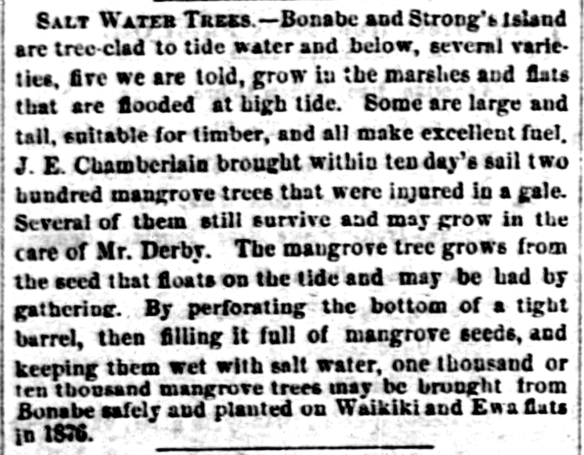
Unfortunately, some of Chamberlain’s mangrove seems to have survived, 1876.

Salt Water Trees.—Bonabe and Strong’s Island are tree-clad to tide water and below, several varieties, five we are told, grow in the marshes and flats that are flooded at high tide. Some are large and tall, suitable for timber, and all make excellent fuel. J. E. Chamberlain brought within ten day’s sail two hundred mangrove trees that were injured in a gale. Several of them still survive and may grow in the care of Mr. Derby. The mangrove tree grows from the seed that floats on the tide and may be had by gathering. By perforating the bottom of a tight barrel, then filling it full of mangrove seeds, and keeping them wet with salt water, one thousand or then thousand mangrove trees may be brought from Bonabe safely and planted on Waikiki and Ewa flats in 1876.

(Hawaiian Gazette, 3/22/1876, p. 2)

HawaiianGazette_3_22_1876_2.png

The Hawaiian Gazette, Volume XII, Number 12, Page 2. March 22, 1876.

Mangrove for Hawaii? 1876.

[Found under: “Ka Moolelo o ka Huakai aku nei a Hoku Ao i Maikonisia.”]

Ualana.

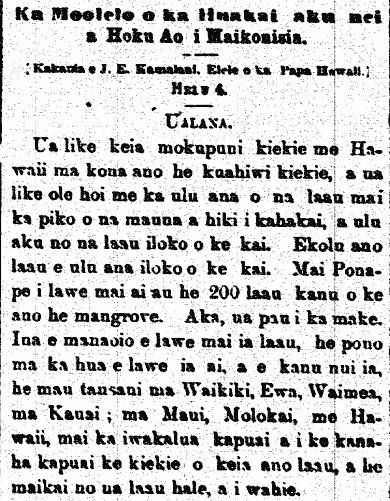
This high island is similar to Hawaii being that it is a high mountain, but it is different in that there are trees that grow from the mountain peaks all the way to the ocean, and there are trees that grow in the ocean. There are three kinds of trees growing in the ocean. I brought from Ponape 200 mangrove plants. But they all died. If we really want to bring in that plant, it should be brought in by seed, and planted extensively; thousands in Waikiki, Ewa, Waimea on Kauai, on Maui, Molokai, and Hawaii; this tree reaches from twenty to forty feet high, and is good as lumber for house building and for firewood.

[This appears in a description of travels of the Morning Star to Micronesia, written by Jeremiah E. Chamberlain, the representative of the Board of Hawaiian Missions.]

(Lahui Hawaii, 4/6/1876, p. 2)

LahuiHawaii_4_6_1876_2.png

Ka Lahui Hawaii, Buke II, Helu 15, Aoao 2. Aperila 6, 1876.

Bags to ship sugar to be woven of lauhala or akaakai? 1873.

Wanted.

Here is something that is much sought after by the producers of sugar. Bags that are woven with strips [ko-ana] of bulrush [akaakai] or lauahala perhaps, to put brown sugar [ko-paa eleele] in and ship to Australia or America. The previous week, a schooner brought 15,000 bags of this type from New Zealand, and the haole traders greatly appreciated them. The length of the bags are 33 inches, and 17 inches wide. If bags like these are woven here at a reasonable price, and a thousand are made, they will be sold out in a year. Continue reading

Escaped coconut crab, 1877.

[Found under: “NA ANOAI.”]

Last we we were shown by Kalua, a coconut-eating crab, which he found in the yard of the Senior Alii C. Kanaina, in a deep hole dug into the earth. Its whole appearance is strange indeed. Its legs are huge, and its pincers are scary to look at, and its whole body is remarkable. Where did it come from? Continue reading

More on the malihini, Joseph Rock, 1916.

COLLEGE BOTANIST RETURNS TOMORROW

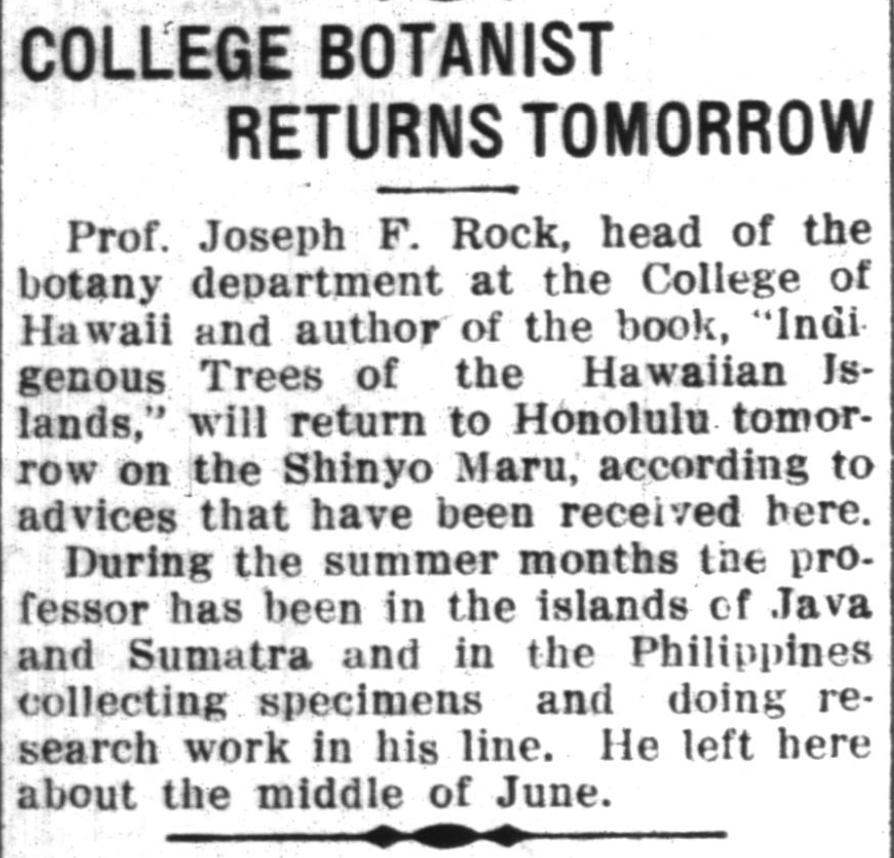
Prof. Joseph F. Rock, head of the botany department at the College of Hawaii and author of the book, “Indigenous Trees of the Hawaiian Islands,” will return to Honolulu tomorrow on the Shinyo Maru, according to advices that have been received here.

During the summer months the professor has been in the islands of Java and Sumatra and in the Philippines collecting specimens and doing research work in his line. He left here about the middle of June.

(Honolulu Star Bulletin, 9/4/1916, p. 3)

COLLEGE BOTANIST RETURNS TOMORROW

The Honolulu Star-Bulletin, Volume XXIV, Number 7612, Page 3. September 4, 1916.

Pineapple at the expo in Seattle, 1909.

HAWAIIAN PINEAPPLE IS HIGHLY DESIRED AT THE EXPOSITION.

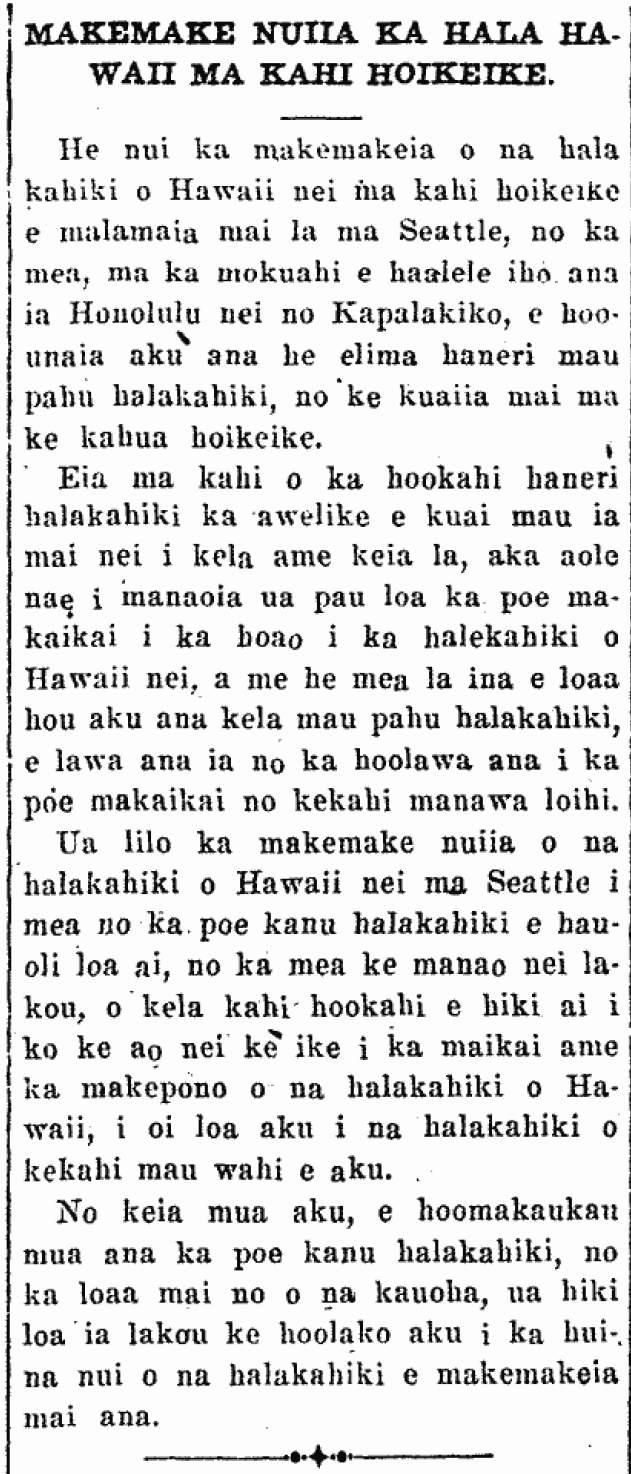
There is much desire for hala kahiki from Hawaii at the exposition being held in Seattle, because on the ship that just left Honolulu for San Francisco, five-hundred boxes of pineapple is being sent to be sold at the show grounds.

One hundred pineapples are being sold on the average each day, but it is believed that not everyone visiting has tasted the pineapple from Hawaii; and if they receive those added boxes of pineapple, it will supply the visitors for a good amount of time.

This great taking to of the pineapples from Hawaii at Seattle has become something for the pineapple planters to rejoice about, because they feel that that is the one place where people from all over the world can see the quality and the affordability of the pineapples of Hawaii which is foremost above the pineapples of other places.

From now on, the pineapple planters will prepare for orders, and they are able to supply large amounts of pineapples that will be desired.

(Kuokoa, 6/25/1909, p. 5)

MAKEMAKE NUIIA KA HALA HAWAII MA KAHI HOIKEIKE.

Ka Nupepa Kuokoa, Buke XLVI, Helu 26, Aoao 5. Iune 25, 1909.

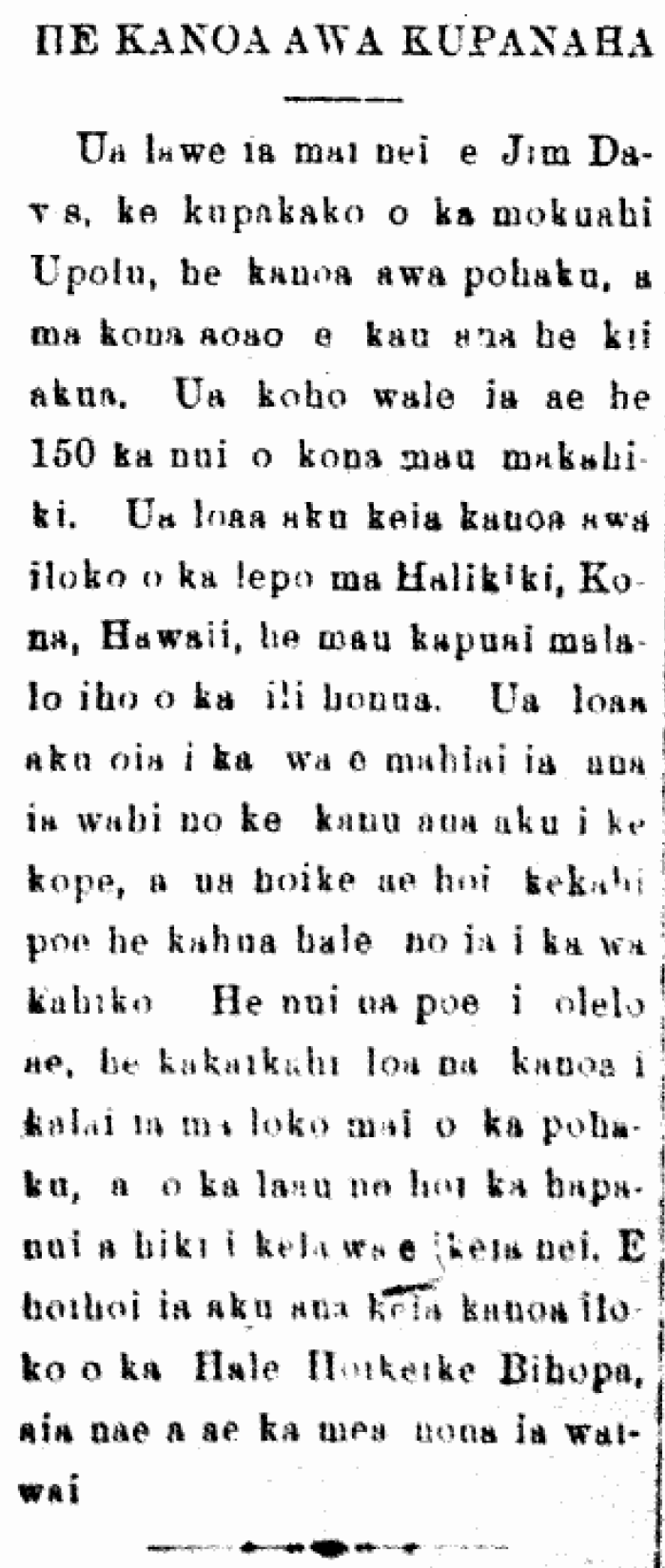
Another stone kanoa, 1900.

AN AMAZING AWA BOWL.

Brought over by Jim Davis, the supercargo [kupakako] of the steamer Upolu, was a stone awa bowl that has a god image [kii akua] on its side. It is estimated to be 150 years old. This kanoa was found in the earth of Halikiki, Kona, Hawaii, a few feet underground. It was found when the land was being worked to plant coffee, and some people said there was a house foundation there in the olden days. There are many who say that a kanoa carved out of stone is very rare, and that most seen to this day are made from wood. This kanoa will be taken to the Bishop Museum after the one who it belongs to gives his consent.

[There was also this story on a stone kanoa at the Museum. And this did not i hear make its way to the Bishop Museum…]

(Aloha Aina, 6/9/1900, p. 6)

HE KANOA AWA KUPANAHA

Ke Aloha Aina, Buke VI, Helu 23, Aoao 6. Iune 9, 1900.